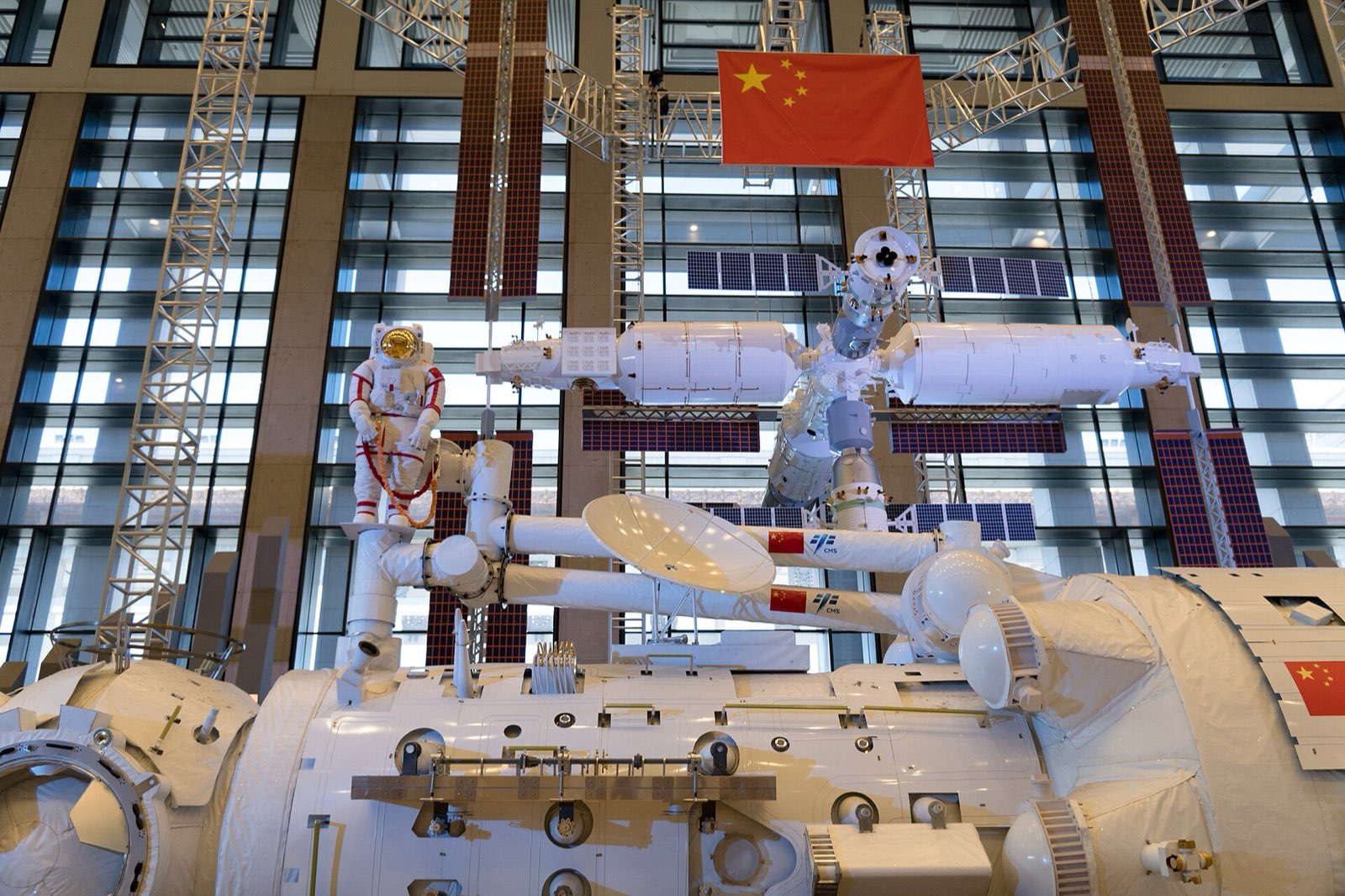
Full-scale Tianhe core module mockup with Chinese flag and robotic arm and spacesuit display, at the National Museum ofMuseum mockup
China Manned Space Agency

Tianhe core module (Tiangong)

Tianhe is the first module of China's Tiangong space station, launched on 29 April 2021.

Space stations
Product IDcmse-tianhe-core-module
Length
16.6 m
Maximum diameter
4.2 m
Launch
29 April 2021, 03:23 UTC, Long March 5B from Wenchang
Crew size
3 in normal operation, up to 6 during crew rotation
Habitable volume
50 m3

In short

Tianhe sits at the centre of the three-module, T-shaped Tiangong station, a programme run by the China Manned Space Agency. It is used as living quarters, a control centre and a docking hub for the crewed Shenzhou ships and the Tianzhou cargo ships. It also supplies power, life support and propulsion to the other modules.

The frame is 5A06 aluminium alloy, and two flexible solar wings of gallium arsenide cells provide power. Four electric Hall thrusters running on xenon gas supplement the chemical thrusters. Inside, the life-support system distils urine into water and reacts carbon dioxide with hydrogen to make methane and water.

Application

The first module of China's Tiangong station, used as living quarters, control centre and docking hub for crewed Shenzhou and Tianzhou cargo ships. It supplies power, life support and propulsion to the other modules.

How it is built

Frame and cabins

The module's space frame is 5A06 aluminium alloy. The node cabin is the docking hub, and the life control cabin has a small segment where the crew sleep and a large one for science equipment. At the rear, the resource cabin holds the main engines, propellant tanks and power system.

  • Module frame
  • Node cabin (docking hub)
  • Small column segment of the life control cabin
  • Large column segment of the life control cabin
  • Resource cabin (unpressurised service compartment)

Solar wings and power

Two flexible solar wings, each measuring 67 square metres, use triple-junction gallium arsenide cells. Sun sensors between the panels let the angle adjust automatically. A standard 100 V bus carries the power to the modules, and the batteries are lithium-ion.

  • Flexible solar wings (x2) with triple-junction gallium arsenide cells
  • Sun sensors between the solar panels
  • 100 V power bus and grid-connected distribution
  • Lithium-ion batteries

Electric thrusters

Four Hall thrusters, each producing 80 millinewtons, run on xenon gas from two storage modules that robotic arms can replace in orbit. They supplement the chemical propulsion system. A refuelling system takes on propellant carried by Tianzhou cargo ships.

  • Hall thruster propellant
  • Hall-effect electric thrusters (x4)
  • Xenon gas-storage modules (x2)
  • Chemical propulsion system
  • Propellant refuelling system

Robot arm and pointing

A robotic arm 10.2 m long, with seven joints, is mounted outside the life control cabin and can carry up to 25 tonnes. Six control moment gyroscopes mainly control the module's orientation, with thrusters assisting. The station can also call on the thrusters of a docked cargo ship.

  • Core Module Manipulator (large robotic arm, 7 degrees of freedom)
  • Arm end effectors and end cameras (x2 sets)
  • Foot restraint platform for the arm
  • Control moment gyroscope set (6 CMGs on Tianhe)

Life support

Urine is distilled into water that meets drinking-water requirements and also feeds the oxygen generator. Carbon dioxide from the crew is collected and reacts with hydrogen from that generator to form methane and water.

  • Oxygen generation assembly
  • CO2 removal assembly
  • CO2 reduction assembly
  • Urine processing assembly
  • Water processing assembly
Where the parts areNumber of parts we have listed in each group
  • Crew accommodation14
  • Docking, berthing and refuelling10
  • Robotics and spacewalk provisions10
  • Propulsion9
  • Life support9
  • Communications and data handling9
  • Pressure shell and structure8
  • Guidance, navigation and control6
  • Power5
  • Thermal control3

What it is made of

  • 5A06 aluminium alloy

    The module's space frame.

  • Xenon

    The gas propellant for the four Hall thrusters, held in two replaceable storage modules.

  • Gallium arsenide

    Triple-junction cells on the two flexible solar wings.

  • Lithium-ion cells

    The batteries. The type of lithium-ion cell is not stated.

The materials by familyHow many of the parts that name a material use each one
  • Other2
  • Semiconductors2
  • Aluminium1

How it connects to other things

The Tiangong station also has the Wentian and Mengtian experiment modules, and Tianhe was the first of the three to launch. A Long March 5B rocket lifted it from Wenchang on 29 April 2021, with two YF-77 engines in the core stage and two YF-100 engines in each of four boosters. The China Academy of Space Technology built and tested it, and it followed the Tiangong-1 and Tiangong-2 space laboratories.

Used in

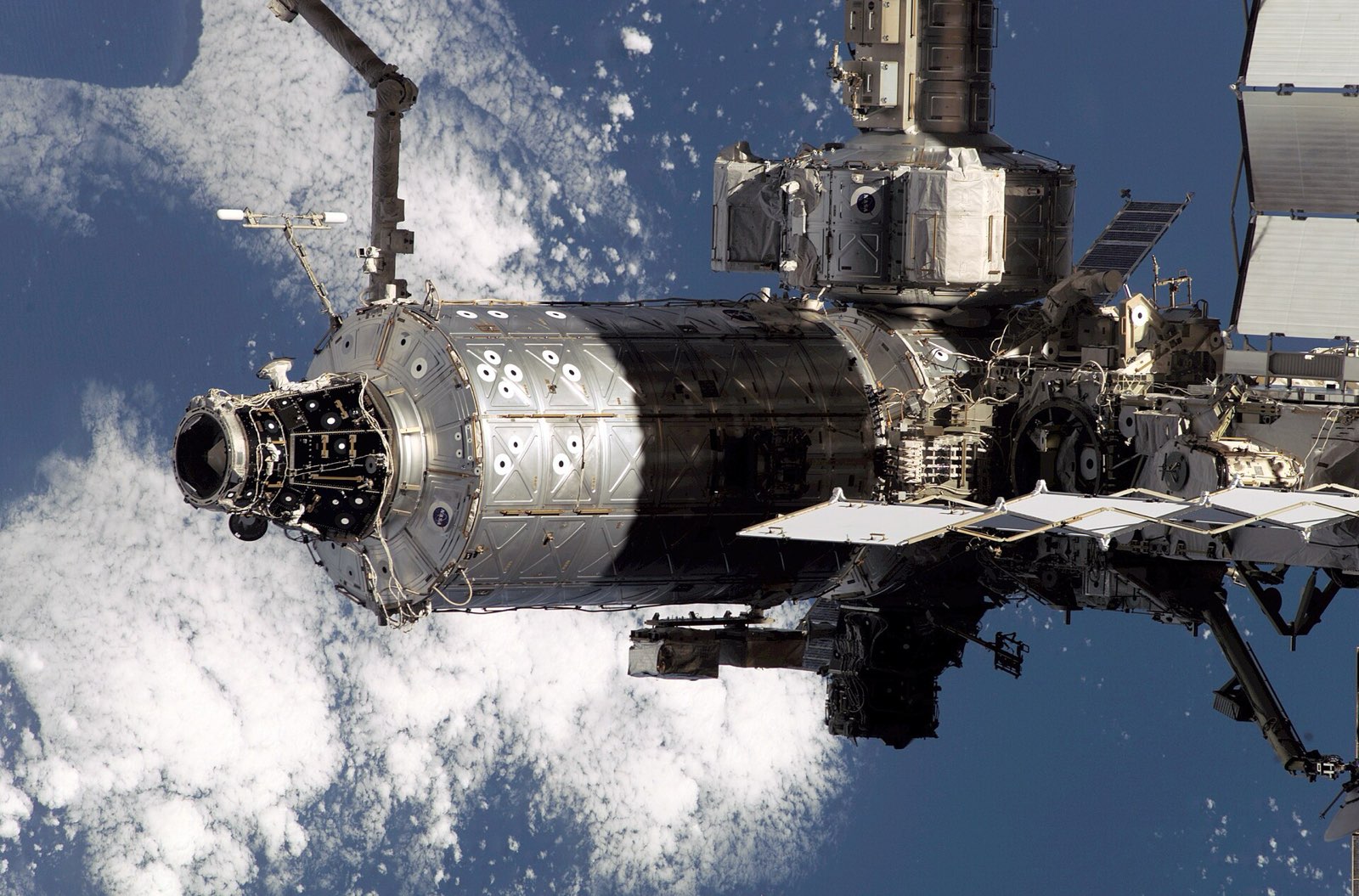
  • Tiangong space station

    First module launched; centre of the three-module T-shaped station

Carries

  • Hall-effect thruster, 80 mN class (4 units; model name not officially published)

    Xenon thrusters in the rear resource cabin, with two replaceable xenon gas-storage modules

  • Chemical orbit-control thruster (4 larger units; model not published)

    Analyst count from a thread; no official model or thrust found

  • Chemical attitude-control thruster (about 22 units; model not published)

    Analyst count from a thread; no official model or thrust found

  • Core Module Manipulator (Chinarm large robotic arm)

    10.2 m, 7-joint arm mounted outside the life control cabin

  • Control moment gyroscope (6 units on the core module)

    Main attitude actuators; thrusters assist

  • Feitian extravehicular spacesuit

    Spacewalk suits used with the node cabin airlock

Launched on

  • Long March 5B

    Tianhe flew on the second Long March 5B (Y2) from Wenchang

  • YF-77 engine

    Core-stage engines (two per core stage on the same page); launcher engine, not carried by the vehicle

  • YF-100 engine

    Booster engines (two in each of four boosters on the same page); launcher engine, not carried by the vehicle

Builds on

  • Tiangong-1 and Tiangong-2 space laboratories

    Rendezvous and docking technology proven in the space laboratory stage

  • Mir space station (block-building configuration)

    Station layout reference

Replaces

  • Tiangong-1 and Tiangong-2 space laboratories

    First station module, launched after the two precursor laboratories

Made or supplied by

  • China Academy of Space Technology (CAST)

    Constructed and tested the core module

    2 more details

    Designers of the large robotic arm

    Thermal-control fluid-loop pump sets

  • China Astronaut Research and Training Center

    Chief designer of the EVA spacesuit works there

Operated by

  • Beijing Aerospace Flight Control Center (BACC)

    Principal flight-control centre for Chinese crewed missions, including station operations

  • China Manned Space Agency (CMSA)

    Agency running the crewed programme under which Tiangong is built and flown

Products that use the same materials

  • Sparrow

    Blackwing Space

    Lithium-ion cellsGallium arsenide
    Where each one is used

    Lithium-ion cells. Here: Lithium-ion batteries. There: Puffin battery pack (Puffin Pack); Draft power module cells (Li-ion or LiFePO4).

    Gallium arsenide. Here: Flexible solar wings (x2) with triple-junction gallium arsenide cells. There: Draft solar panel cells (triple-junction GaAs).

  • Kestrel

    Blackwing Space

    Lithium-ion cellsGallium arsenide
    Where each one is used

    Lithium-ion cells. Here: Lithium-ion batteries. There: Puffin battery pack (Puffin Pack); Draft power module cells (Li-ion or LiFePO4).

    Gallium arsenide. Here: Flexible solar wings (x2) with triple-junction gallium arsenide cells. There: Draft solar panel cells (triple-junction GaAs).

  • Osprey

    Blackwing Space

    Lithium-ion cellsGallium arsenide
    Where each one is used

    Lithium-ion cells. Here: Lithium-ion batteries. There: Puffin battery pack (Puffin Pack); Draft power module cells (Li-ion or LiFePO4).

    Gallium arsenide. Here: Flexible solar wings (x2) with triple-junction gallium arsenide cells. There: Draft solar panel cells (triple-junction GaAs).

  • Proba-2

    ESA

    Lithium-ion cellsGallium arsenide
    Where each one is used

    Lithium-ion cells. Here: Lithium-ion batteries. There: Battery.

    Gallium arsenide. Here: Flexible solar wings (x2) with triple-junction gallium arsenide cells. There: Solar cells.

  • Proba-V

    ESA

    Lithium-ion cellsGallium arsenide
    Where each one is used

    Lithium-ion cells. Here: Lithium-ion batteries. There: Battery.

    Gallium arsenide. Here: Flexible solar wings (x2) with triple-junction gallium arsenide cells. There: Photovoltaic array.

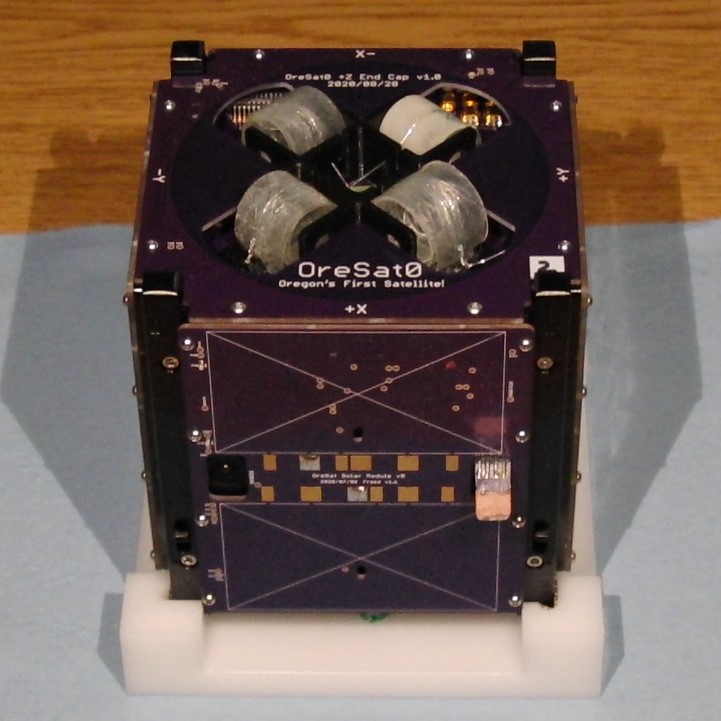
  • OreSat

    PSAS / Oregon State

    Lithium-ion cellsGallium arsenide
    Where each one is used

    Lithium-ion cells. Here: Lithium-ion batteries. There: 18650 cell (Tenergy, 4 per card); Battery cell model (README).

    Gallium arsenide. Here: Flexible solar wings (x2) with triple-junction gallium arsenide cells. There: Solar cell (SpectraLabs XTE-SF, 2 per module); Solar cell technology.

What we do not know

Several details are unknown. No materials are published for the pressure shell, windows, thermal blankets, radiators or cabling. The Hall thruster maker and model, the chemical engine models and the make of the batteries are also unstated. Published figures for the module's mass differ.

The detailed data

What is written above is built from these numbers and quotes. Each row links to the page it was taken from. Get all of it as JSON, or ask our MCP server.

Features

  • Core module and backbone of the Chinese space station
  • Xenon Hall-effect thrusters provide main propulsion on the station

Specifications

WhatValue
MassAbout 22,000 kg
Axial length16.6 m
Launch29 April 2021, 03:23 UTC, Long March 5B from Wenchang
OrbitAbout 400 km LEO, 42.5 deg inclination
Maximum diameter4.2 m
Launch mass (China Daily; the entry holds eoPortal's 22,000 kg)22.5 tonnes
Pressurised volume (eoPortal table)113 m3
Habitable volume (eoPortal table)50 m3
Crew size3 in normal operation, up to 6 during crew rotation
Design orbit band41 to 43 deg inclination, 340 to 450 km altitude
Design lifespan (station)More than 10 years
Primary bus voltage100 V
Space-to-ground link rate via relay satellitesUp to 1.2 Gbps
Separation from the core stage (SpaceNews)492 s after liftoff
Separation from the first stage (AIAA, quoting SpaceNews)490 s after liftoff
Launch engines and thrust (China Daily)10 engines, 1,068 tonnes of thrust
Control hand-overControl can move automatically from Tianhe to Wentian if Tianhe fails
Docked Tianzhou thrustersStation can use the thrusters of a docked cargo ship for attitude and orbit control
Activity space of the full three-module stationNo less than 110 m3
Design orbit band (station)41 to 43 deg inclination, 340 to 450 km altitude
Simultaneous visiting spacecraft (station-level, chief designer)Up to 3 at a time

Materials in detail

Each material named in the sources: where it is used here, which other products use it, and its key numbers when its material page exists.

  • 5A06 aluminium alloy

    aluminium-5a06

    Used in 1 partModule frame

    Material page coming soon
  • Lithium-ion cells (type not stated)

    lithium-ion-cell

    Used in 1 partLithium-ion batteries

    Also in 12 other products
    Material page coming soon
  • silicon (as reported by a secondary source)

    silicon

    Used in 1 partSolar cells

    Material page coming soon
  • Gallium arsenide

    Used in 1 partFlexible solar wings (x2) with triple-junction gallium arsenide cells

    Carry electrons fast
    8500
    Absorb and emit at a wide band gap
    1.424
    Hold up in orbit, with a cost
    30
    Also in 10 other products
  • xenon

    xenon

    Used in 1 partHall thruster propellant

    Material page coming soon

Every part we have

Only the frame alloy and thruster propellant are stated; no primary Chinese-agency source found. Components, suppliers and links were added from public sources. A material is left blank where no source states it.

Material IDs

aluminium-5a06xenonsilicongallium-arsenidelithium-ion-cell
Frame1
PartMaterialFinish and standardMade by
Module frame“The Tianhe core module’s frame is constructed of the 5A06 Aluminium alloy.” 5A06 aluminium alloyaluminium-5a06 — —
Propulsion9
PartMaterialFinish and standardMade by
Hall thruster propellant“deploying four Xenon Hall-effect thrusters on its exterior” xenonxenon — —
Hall-effect electric thrusters (x4)Medium-power xenon thrusters that supplement the chemical system for orbit maintenance“The Hall electric propulsion system consists of four 80-mN Hall thrusters and 2 gas-storage modules.” Not said — —
Xenon gas-storage modules (x2)Hold the xenon for the Hall thrusters; replaceable in orbit by the robotic arms“the gas-storage modules can be replaced in orbit by robotic arms” Not said — —
Chemical propulsion systemMain chemical engines and tanks that the Hall system supplements; refilled from Tianzhou“propulsion system to supplement the chemical propulsion system” Not said — —
Chemical orbit-control thrusters (x4, larger, canted from the module axis)Larger chemical engines for orbit changes, mounted at an angle at the rear“Among these 26 thrusters, 4 are larger orbital control thrusters, which are very visible on pictures.” Not said — —
Chemical attitude-control thrusters (about x22)Smaller chemical thrusters for attitude control, mostly on the propulsion compartment“The other 22 chemical thrusters are for attitude control, mostly located on the propulsion compartment” Not said — —
Chemical propellant tanks (resource cabin)Store the propellant for the chemical engines; resupplied by Tianzhou“containing the main engines, propellant tanks, power system and some communications components” Not said — —
Chemical orbit-control thrusters (x4, larger; count from an analyst thread)Larger chemical thrusters for orbit control; model and thrust not published“Among these 26 thrusters, 4 are larger orbital control thrusters, which are very visible on pictures.” Not said — —
Chemical attitude-control thrusters (about x22; count from an analyst thread)Smaller chemical thrusters for attitude control; model and thrust not published“The other 22 chemical thrusters are for attitude control, mostly located on the propulsion compartment” Not said — —
Solar arrays1
PartMaterialFinish and standardMade by
Solar cells“The silicon solar cells of the arrays have an efficiency of over 30%.” silicon (as reported by a secondary source)silicon — —
Pressure shell and structure8
PartMaterialFinish and standardMade by
Node cabin (docking hub)Forward hub that links the other modules and visiting spacecraft; also serves as the spacewalk airlock“The node cabin is used for module connection and spacecraft visiting” Not said — —
Life control cabin (small column segment, large column segment and rear passage)Pressurised crew living and working section between the node cabin and the resource cabin“a life control cabin (including a small column segment, a large column segment, and a rear passage)” Not said — —
Small column segment of the life control cabinNarrower section that holds the crew sleeping and sanitary areas“Sleeping and sanitary areas for the crew are arranged in the small column segment of the life control cabin.” Not said — —
Large column segment of the life control cabinWider section carrying the platform and scientific-research equipment“Devices for platform and scientific research are equipped in the large column segment of the life control cabin.” Not said — —
Resource cabin (unpressurised service compartment)Rear section housing the main engines, propellant tanks, power system and some communications hardware“These sections are surrounded by an unpressurised service compartment, containing the main engines, propellant tanks, power system and some communications components.” Not said — —
Add-on debris protection devices (station-level, installed by spacewalk)Extra micrometeoroid and orbital-debris protection fitted to the station outside during crew spacewalks; module not named in the source“install additional debris protection devices and replace external equipment” Not said — —
Life control cabin (small column segment, large column segment, rear passage)Pressurised crew living and working section between node cabin and resource cabin“a life control cabin (including a small column segment, a large column segment, and a rear passage)” Not said — —
Resource cabin and surrounding unpressurised service compartmentRear section wrapped by a compartment holding main engines, propellant tanks, power system and some communications hardware“These sections are surrounded by an unpressurised service compartment, containing the main engines, propellant tanks, power system and some communications components.” Not said — —
Docking, berthing and refuelling10
PartMaterialFinish and standardMade by
Forward docking port (node cabin)Axial port for the Shenzhou crew ship and the Xuntian telescope; the lab modules first docked here“The forward docking hatch is mainly for docking with manned spaceship and the Xuntian space telescope” Not said — —
Radial docking port (node cabin)Radial port mainly used for docking with a Shenzhou crew ship“the radial one mainly for docking with manned spaceship” Not said — —
Backward (aft) docking port with material replenishment passage (resource cabin)Rear port mainly for the Tianzhou cargo ship, with a passage for moving supplies“The resource cabin is equipped with a docking hatch and a material replenishment passage at its rear end.” Not said — —
Lateral berthing hatches (x2, node cabin)Permanent berths for the Wentian and Mengtian lab modules after transposition“两个实验舱的停泊” Not said — —
Forward and backward docking mechanisms with refuelling interfacesMechanisms at the forward and rear ports; both carry a propellant refuelling interface“Both forward and backward docking mechanisms of the Tianhe core module are equipped with a refueling interface.” Not said — —
Propellant refuelling systemReceives propellant carried by the Tianzhou cargo ship“the Tianhe core module is equipped with a propellant refueling system to receive propellants carried by the Tianzhou cargo spaceship” Not said — —
Metal bellows propellant tankTank used in the refuelling scheme; propellant is fed with pressurised-gas recycling“a propellant feeding scheme based on a metal bellows tank and pressurized-gas recycling” Not said — —
Pressurised-gas recycling compressorLong-life compressor that recycles the pressurising gas during refuelling“It is equipped with a long-life and highly reliable compressor to recycle pressurized gas.” Not said — —
Backward (aft) docking port and material replenishment passage (resource cabin)Rear port mainly for the Tianzhou cargo ship, with a passage for moving supplies“The resource cabin is equipped with a docking hatch and a material replenishment passage at its rear end.” Not said — —
Propellant refuelling system (metal bellows tank and gas-recycling compressor)Receives propellant carried by the Tianzhou cargo ship“the Tianhe core module is equipped with a propellant refueling system to receive propellants carried by the Tianzhou cargo spaceship” Not said — —
Guidance, navigation and control6
PartMaterialFinish and standardMade by
Control moment gyroscope set (6 CMGs on Tianhe)Main attitude actuators; the thrusters assist. Mounted both outside and inside the modules“CMG control is mainly adopted, assisted by the reaction control system” Not said — —
Control computers, attitude measurement sensors and rendezvous-and-docking sensorsOnboard guidance and control chain shared across modules over 1553B buses“Control computers, attitude measurement sensors, rendezvous and docking sensors, CMGs, and thrusters in the modules” Not said — —
MIL-STD-1553B data buses linking the modulesIntermodule connection and shared use of control resources“realize intermodule connection and integrated resource utilization through 1553B buses” Not said — —
Rendezvous radar and optical docking sensorsRadar and optical sensors that aid docking with the station“radar and optical sensors to aid docking with the station” Not said — —
Sun sensors between the solar panelsAllow automatic adjustment of the panel angle“with sun sensors between panels to allow automatic adjustment of the panel angle” Not said — —
1553B data buses linking the modulesIntermodule connection and shared use of control resources“realize intermodule connection and integrated resource utilization through 1553B buses” Not said — —
Power5
PartMaterialFinish and standardMade by
Flexible solar wings (x2) with triple-junction gallium arsenide cellsThird-generation flexible wings; fold to about the thickness of a book for launch“the flexible solar wings were first used on the core module Tianhe with each wing measuring 67 square meters” Triple-junction gallium arsenide cellsgallium-arsenide — Supplier: Solar wing development team of the 'Eighth Institute' (as worded in an English repost of a CAST release; institute not otherwise identified)
Solar array drive mechanisms (single degree of freedom)Turn each wing about one axis to track the Sun“single-degree-of-freedom solar arrays with their drive mechanisms are installed on both sides” Not said — —
Lithium-ion batteriesStore energy for the eclipse part of each orbit“triple-junction gallium arsenide batteries with a conversion efficiency of 30% and advanced lithium-ion batteries” Lithium-ion cells (type not stated)lithium-ion-cell — —
100 V power bus and grid-connected distributionStandard 100 V bus that feeds the modules and can power visiting craft“The Tiangong space station adopts a standard 100-V bus system, supplying power to the modules through grid connection.” Not said — —
100 V power bus with grid-connected distributionStandard 100 V bus feeding the modules and visiting craft“The Tiangong space station adopts a standard 100-V bus system, supplying power to the modules through grid connection.” Not said — —
Thermal control3
PartMaterialFinish and standardMade by
Thermal-control fluid loopsPumped liquid loops that move heat; loops of different modules can be joined for kilowatt-level transfer“intermodule thermal control fluid loops can be connected for cross-module kilowatt-level heat transfer” Not said — —
Fluid-loop extended pump sets (external, fitted by spacewalk)Circulate the coolant in the loop; hooked and locked to the outer wall of the core module“Developed by CAST, the extended pump sets are called the "heart" of the fluid loop” Not said — Supplier: China Academy of Space Technology (CAST)
Thermal control radiatorsReject heat from the fluid loops to space; a hybrid model of the core module radiative network exists“balance the heat dissipation capacity of thermal control radiators in the modules” Not said — —
Life support9
PartMaterialFinish and standardMade by
Regenerative and non-regenerative life-support systemsComplete regenerative system plus stored supplies; the core module system controls the whole station environment“Both the Tianhe core module and the Wentian experiment module are equipped with complete regenerative and nonregenerative life-support systems” Not said — —
Oxygen generation assemblyProvides the oxygen the crew breathes“The oxygen generation assembly provides oxygen necessary for the crew's lives.” Not said — —
CO2 removal assemblyRegenerable adsorbent beds; CO2 is vented by vacuum thermal desorption“CO2 produced by human bodies is adsorbed by regenerative adsorbents and then subjected to vacuum thermal desorption by extravehicular space” Not said — —
Trace contaminant removal assemblyRemoves trace gases by absorption, adsorption and catalytic oxidation“Different trace contaminants are removed by chemical absorption, physical adsorption, room-temperature catalytic oxidation, and high-temperature catalytic oxidation” Not said — —
Urine processing assemblyDistils urine into water“Human urine is distilled by the urine processing assembly to produce urine-distilled water” Not said — —
Water processing assemblyTreats distilled urine and condensate to drinking and electrolysis water quality“Water quality can meet the requirements of drinking water in aerospace medicine and water for oxygen generation assembly” Not said — —
CO2 reduction assemblyReacts collected CO2 with hydrogen from the oxygen generator to form methane and water“the CO2 collected and concentrated from the CO2 removal assembly reacts with H2, a by-product of oxygen generation assembly, to form CH4 and water” Not said — —
Pressure leakage detection systemAlarms automatically and prompts leak plugging and isolation when a sealed module depressurises“The whole space station is equipped with a pressure leakage detection system.” Not said — —
Fire control equipmentFire detection and fighting gear in the living quarters“consist of sleeping and sanitary areas, fire control equipment, computers, and ground communications equipment” Not said — —
Crew accommodation14
PartMaterialFinish and standardMade by
Crew sleeping stations (x3 private berths)One private sleeping compartment per crew member in the small column segment“each crew member on the Tiangong station gets their own separate living quarters” Not said — —
Sleeping bagsKeep the astronauts secure in microgravity while they sleep“the sleeping bags that keep the astronauts secure in microgravity while they doze” Not said — —
Sleeping-berth windows (x3)Small round windows, one in each sleeping berth“images taken out of small windows of the Tianhe space station module in low Earth orbit” Not said — —
Sanitary area and toiletHygiene and waste-handling area in the small column segment“厨房、卫生间、睡眠区” Not said — —
Kitchen with microwave ovenFood preparation and heating area in the dining zone“We have also equipped the space station with a kitchen and microwave oven” Not said — —
Refrigerator and water dispenserHousehold-type appliances that the crew can control remotely from tablets“remotely control household appliances in the cabin through tablets, such as the refrigerator, water dispenser and microwave” Not said — —
TreadmillExercise equipment in the exercise area“Running on a space treadmill” Not said — —
Spin bike (cycling exercise device)Exercise equipment for cardiovascular and leg training“astronauts may choose treadmills or spin bikes to maintain their physical health” Not said — —
Health supervision and care areaArea set aside for crew health monitoring“a sanitary area, a dining area, a storage area, a health supervision and care area, and an exercise area” Not said — —
Wireless Wi-Fi network and voice and image systemLets the crew use smartphones and tablets to manage household supplies and materials“by setting a wireless Wi-Fi network and a voice and image system” Not said — —
Adjustable cabin lightingBrightness and colour of cabin lights can be set by hand“The brightness and color of lights in the space station can be manually adjusted as required.” Not said — —
Handrails and body-limiting devicesBody assist hardware in every cabin“Each cabin is equipped with body assist equipment such as handrails and body-limiting devices” Not said — —
In-cabin console for robotic arm controlCrew control and inspection station for the robotic arms“the Tianhe core module is equipped with a console inside, through which the robotic arms can be controlled by the crewmembers” Not said — —
Exercise equipment (treadmill and spin bike)Treadmill and cycling device in the exercise area“astronauts may choose treadmills or spin bikes to maintain their physical health” Not said — —
Robotics and spacewalk provisions10
PartMaterialFinish and standardMade by
Core Module Manipulator (large robotic arm, 7 degrees of freedom)Large arm for module transposition, cargo handling, capturing visiting craft and moving spacewalkers“It consists of seven joints, two limbs, two sets of extension gears, two sets of end cameras and end effectors” Not said — Supplier: China Academy of Space Technology (CAST), per the CAST designers quoted by Xinhua
Arm end effectors and end cameras (x2 sets)Grapple the surface target adapters so the arm can crawl, and carry cameras at both ends“two sets of end cameras and end effectors (also known as end-of-arm tooling)” Not said — —
Arm elbow camera and central controllerElbow camera for inspection and a central controller for the arm“one set of central controllers, and an elbow camera” Not said — —
Robotic arm adapters (target adapters) on the exteriorFixed adapters the arm end effector docks to for crawling and for installing payloads“Several robotic arm adapters are installed on the surface of the Tiangong space station.” Not said — —
Foot restraint platform for the armPlatform on the arm end where a spacewalker stands to be carried to the work site“The end effector can dock with a foot restraint platform, where astronauts can stand.” Not said — —
Extended exposed-payload interfaceReserved external interface for assembling special exposed payloads in orbit“extended interface reserved on the Wentian experiment module and Tianhe Core module can support special exposed payload assembling in-orbit” Not said — —
Spacewalk hatch and airlock function of the node cabinHatch above the node cabin; the node cabin served as the airlock before Wentian arrived and stays as backup“with a spacewalk hatch arranged above” Not said — —
Feitian spacesuits (stowed for spacewalks)Extravehicular suits delivered by Tianzhou cargo ships and used for spacewalks from the node cabin“Zhai and Wang used Feitian spacesuits that can each support eight hours of extravehicular activity in one go.” Not said — —
Arm end effectors, end cameras, elbow camera and central controllerGrapple the surface target adapters so the arm can crawl; cameras at both ends and the elbow“two sets of end cameras and end effectors (also known as end-of-arm tooling)” Not said — —
Feitian spacesuits (extravehicular suits)EVA suits delivered by Tianzhou cargo ships and used for spacewalks“Zhai and Wang used Feitian spacesuits that can each support eight hours of extravehicular activity in one go.” Not said — —
Communications and data handling9
PartMaterialFinish and standardMade by
Relay-satellite link terminalSpace-to-ground data link through the second-generation Tianlian relay satellites“The transmission rates of space-Earth links based on the second-generation relay satellites in China reach up to 1.2 Gbps” Not said — —
Relay antenna (deployed after launch)Antenna that links the module to the relay satellites“天和已经成功展开了中继天线和柔性太阳能电池板” Not said — —
Communications antenna (angle adjustable for spacewalks)Antenna whose angle was adjusted to prepare for spacewalks“we made special adjustments involving the flying attitude, solar arrays, and angle of the communications antenna” Not said — —
High-speed Ethernet service for experiment loadsNetwork service provided directly to scientific experiment loads“A service system is directly provided for scientific experiment loads through high-speed Ethernet.” Not said — —
Ground communications equipment and computers in the living quartersComputers and equipment for contact with ground control“consist of sleeping and sanitary areas, fire control equipment, computers, and ground communications equipment” Not said — —
Panoramic cameras (external)External cameras for station monitoring; one was lifted into place on a spacewalk“再加上4个全景摄像机” Not said — —
High-performance autonomous fault-diagnosis computer systemDiagnoses failures and isolates danger sources automatically“the high-performance computer system can be used to diagnose failures autonomously and isolate danger sources automatically for safe disposal” Not said — —
Space-to-ground data link via second-generation relay satellitesCarries station data and video to the ground through the Tianlian relay network“The transmission rates of space-Earth links based on the second-generation relay satellites in China reach up to 1.2 Gbps” Not said — —
Relay and communications antennaLinks the module to the relay satellites; deployed after launch“天和已经成功展开了中继天线和柔性太阳能电池板” Not said — —
Launch interface1
PartMaterialFinish and standardMade by
Cabin-rocket separation system (large diameter)Separates the 4.2 m module from the Long March 5B core stage in a direct-to-orbit launch“大直径舱箭分离技术” Not said — —

What the sources leave out

No primary CMSA source with materials was found; the 5A06 frame comes from eoPortal and a hobbyist report. The silicon-cell claim is from China Space Report and its stated efficiency (over 30%) is doubtful for silicon, so treat it as low confidence. Pressure shell, window, thermal blanket, radiator, thruster and cabling materials are not stated. Mass is quoted as 22,000 kg (eoPortal) versus 22,500 kg elsewhere. More detail: Not found in public sources: pressure-shell wall and MMOD shield design for Tianhe (the only debris-protection source is station-level add-on devices fitted on spacewalks, module not named); official Hall-thruster maker, model and specific impulse (CAST paper gives only 4 x 80 mN and xenon; Guokr names an 'LT-100', an analyst thread names 'HET-80' from a Shanghai institute, neither is an official CMSA/CASC statement, and the 'LHT-100' of Lanzhou Institute of Physics appears only in an unrelated 2016 IAC abstract for the XX-2 satellite, so no supplied_by row was written for the thrusters); chemical engine models, thrust and propellant (the 26-thruster count, 4 orbit plus 22 attitude, and the MMH/N2O4 guess come only from an analyst thread by Dongfang Hour on Twitter/X and are unofficial); suppliers of the CMGs, computers, docking mechanisms, ECLSS hardware, cameras and radiators; radiator area; materials other than the 5A06 frame already in the entry (the gallium arsenide cells and lithium-ion cells are stated only generically; the solar-wing 'thin light composite' cover is from a translated key-data table). The CAST paper (Wang et al. 2023, Space: Science & Technology) states triple-junction gallium arsenide cells at 30% efficiency, which contradicts the 'silicon' cell row already in the entry. Discrepancies: wing length 12.6 m (CAST paper) versus 'more than 12 m' (repost) versus 13 m (Guokr); arm elbow cameras one (Xinhua) versus two (Guokr); separation 492 s versus 490 s; launch mass 22,500 kg (China Daily, SpaceNews) versus 22,000 kg (eoPortal); eoPortal expands CAST as 'China Association for Science and Technology' when it credits the arm, but Xinhua and CASC pages show CAST is the China Academy of Space Technology, so the eoPortal supplier claim was not used. The CAST design paper is cited through a copy hosted at newspaceeconomy.ca because the publisher page returns 403. The resource cabin is described as unpressurised by eoPortal and CAST says only 'resource cabin', so only the node cabin and life control cabin are treated as the pressurised shell. Docking partners (Shenzhou, Tianzhou, Wentian, Mengtian) are recorded as docking-port components and not as relation rows because none of the allowed relation types fits a docking partner. Station-level items not tied to Tianhe alone (add-on debris devices, 110 m3 activity space, orbit band, design life) are labelled as station-level. More detail: Not found in public sources: Tianhe pressure-shell wall and MMOD shield design (the only debris-protection reports are station-level add-on devices fitted on spacewalks, module not named); official Hall-thruster maker, model and specific impulse (the CAST paper gives only 4 x 80 mN and xenon; Guokr names an 'LT-100' and an analyst thread names 'HET-80' from a Shanghai institute, neither an official CMSA or CASC statement; the 'LHT-100' of Lanzhou Institute of Physics appears only in an unrelated 2016 IAC abstract for the XX-2 satellite, so no supplied_by row was written for the thrusters); chemical engine models, thrust and propellant (the 26-thruster count, 4 orbit plus 22 attitude, and the MMH/N2O4 guess come only from an analyst thread by Dongfang Hour on Twitter/X and are unofficial); suppliers of the CMGs, computers, docking mechanisms, life-support hardware, cameras and radiators; radiator area; materials other than the 5A06 frame already in the entry (gallium arsenide and lithium-ion cells are stated only generically; the solar-wing 'thin light composite' cover comes from a translated key-data table). The CAST paper (Wang et al. 2023, Space: Science & Technology) states triple-junction gallium arsenide cells at 30% efficiency, which contradicts the 'silicon' cell row already in the entry. Discrepancies: wing length 12.6 m (CAST paper) versus 'more than 12 m' (repost) versus 13 m (Guokr); arm elbow cameras one (Xinhua) versus two (Guokr); separation at 492 s versus 490 s; launch mass 22,500 kg (China Daily, SpaceNews) versus 22,000 kg (eoPortal); eoPortal expands CAST as 'China Association for Science and Technology' when it credits the arm, but Xinhua and CASC pages show CAST is the China Academy of Space Technology, so the eoPortal supplier claim was not used. The CAST design paper is cited through a copy hosted at newspaceeconomy.ca because the publisher page returns 403. eoPortal puts the engines, tanks and power system in an unpressurised service compartment around the large column segment and resource cabin; the pressurised versus unpressurised split of the resource cabin is not given, and the node cabin diameter is not published in the sources found. eoPortal says the module has two pairs of solar wings, while CAST and CGTN pages describe two wings (67 m2 each). Docking partners (Shenzhou, Tianzhou, Wentian, Mengtian) are recorded in the docking-port components because none of the allowed relation types fits a docking partner. Station-level figures (orbit band, design life, 110 m3 activity space, CMG accuracy, 30% cell efficiency) are labelled as station-level.

Where this comes from

21 pages from 19 websites

More space products

Maker credit: China Manned Space Agency (CMSA). Collected from public pages and documents, checked 4 Nov 2026.
Published · Updated