Thrust chamber assembly
- Chamber liner
- Chamber outer shell
- Aft flange and fuel inlet manifold assembly
- Regenerative cooling passages (120)
- Combustion chamber heater (added for Orion)
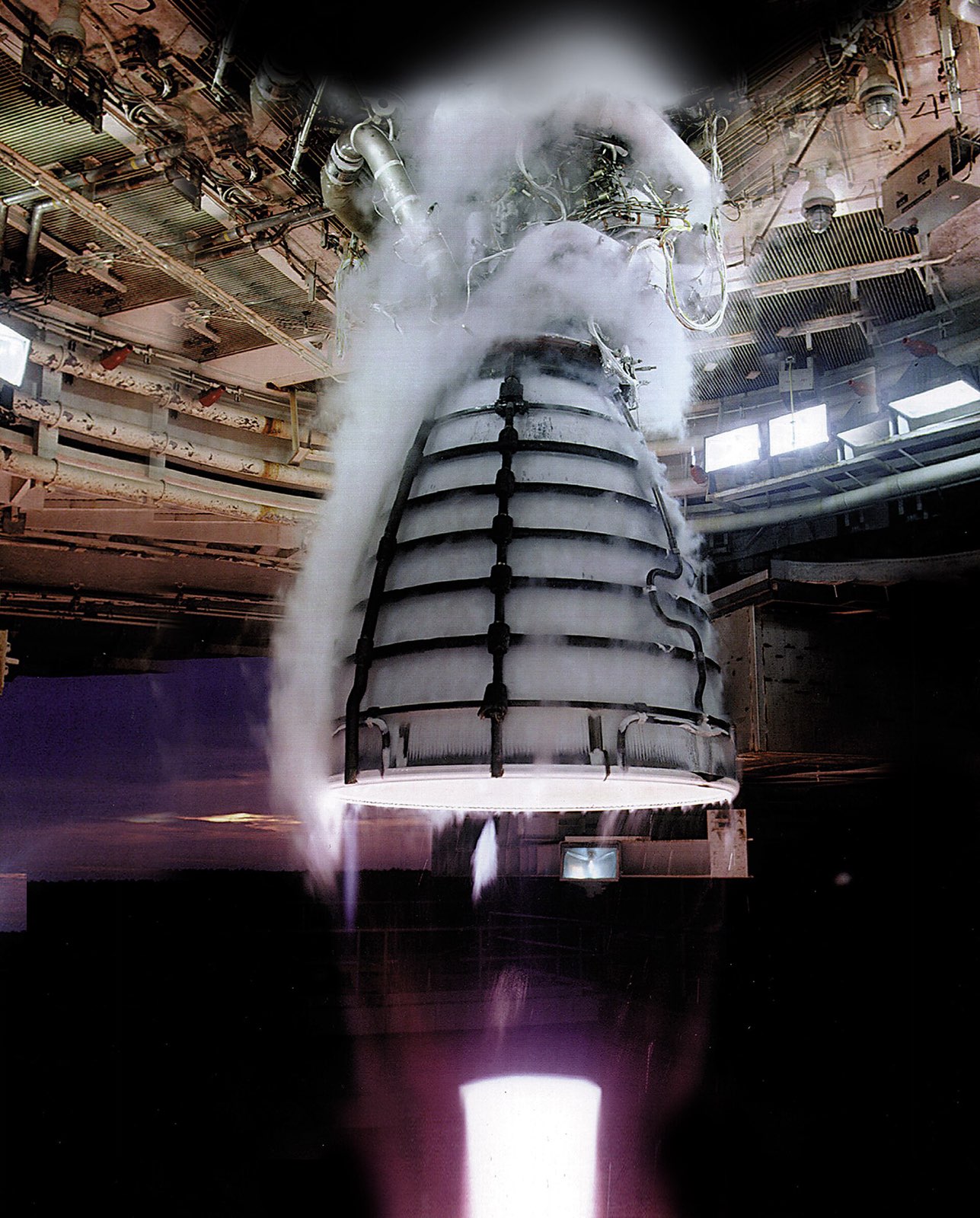
Hypergolic MMH/MON-3 engine designed by Aerojet Rocketdyne for the Space Shuttle Orbital Maneuvering System; refurbished units are the Orion European Service Module main engine. NASA's design paper names a stainless steel liner, an electroformed nickel shell and a radiation-cooled columbium nozzle extension.
aerojet-aj10-190 Hypergolic MMH/MON-3 engine designed by Aerojet Rocketdyne for the Space Shuttle Orbital Maneuvering System; refurbished units are the Orion European Service Module main engine. NASA's design paper names a stainless steel liner, an electroformed nickel shell and a radiation-cooled columbium nozzle extension.
The AJ10-190 was the Orbital Maneuvering System engine of the Space Shuttle Orbiter, one in each pod, used for orbit insertion, in-orbit manoeuvres and deorbit. Refurbished Shuttle units are now the main engine of the European Service Module that pushes NASA's Orion capsule to the Moon on Artemis missions. Its stainless-steel-lined, nickel-jacketed chamber and radiation-cooled columbium nozzle are a reuse case for storable-propellant engines.
No photos we are allowed to show yet. If you have a photo of this product and the right to share it, send it to us.
Used in Nozzle extension (area ratio 6:1 to 55:1).
Used in Chamber outer shell.
Used in Chamber liner.
NASA
Main engine (OMS-E) of the European Service Module; first six Artemis missions use refurbished Shuttle units
Main engine of the Orion European Service Module; one engine
NASA / Boeing
Space Shuttle orbital maneuvering system engine, two on the orbiter; aerojet OMS engine, 6,000 lbf, MMH/NTO; used for orbit insertion and deorbit; launcher engine, not carried by the vehicle
Artemis I flew an engine refurbished from the Shuttle OMS; 19 earlier Shuttle missions
North American Aviation
Valve-level heritage only: a NASA technology contract to improve the Apollo SPS bipropellant valve fed the OMS valve design (the 1985 paper says the results were used to design the OMS valve)
Designed and developed the OMS engine for the Shuttle program
Aerojet Rocketdyne
electroformed nickel. Here: Chamber outer shell. There: Chamber liner exterior.
stainless steel. Here: Chamber liner. There: Nozzle coolant tubes (1,080 tubes, brazed to jacket); Oxidizer heat exchanger coil.
North American Aviation
columbium. Here: Nozzle extension (area ratio 6:1 to 55:1). There: SPS nozzle extension.
stainless steel. Here: Chamber liner. There: Outer shell (heat shield structure); VHF scimitar antennas and more.
United Launch Alliance
columbium. Here: Nozzle extension (area ratio 6:1 to 55:1). There: Centaur extendible nozzle (RL10, dual engine).
stainless steel. Here: Chamber liner. There: Centaur propellant tanks.
Aerojet Rocketdyne
columbium. Here: Nozzle extension (area ratio 6:1 to 55:1). There: RL10A-4-2 fixed columbium nozzle extension (51 cm).
stainless steel. Here: Chamber liner. There: RL10C-1 thrust chamber tubes; Fuel pump drive shaft and bearings and more.
TRW
columbium. Here: Nozzle extension (area ratio 6:1 to 55:1). There: Pintle tip, qualification version.
stainless steel. Here: Chamber liner. There: Pintle tip, original; Flow-control valve bellows and more.
Stainless steel grade, columbium alloy grade, injector and valve materials, gimbal ring material and bolt or seal materials are not stated. The engine was refurbished for Orion; no source lists replaced materials beyond harnesses, sensors, heater and valve seals.
What is written above is built from these numbers and quotes. Each row links to the page it was taken from. Get all of it as JSON, or ask our MCP server.
| What | Value |
|---|---|
| Thrust | 26.7 kN |
| Thrust class | About 6,000 lbf |
| Specific impulse | 315.1 s |
| Mixture ratio (oxidizer to fuel) | 1.65 |
| Propellants | Monomethylhydrazine (MMH) and nitrogen tetroxide with 3% mixed oxides of nitrogen (MON-3) |
| Cooling and type | Pressure fed, hypergolic, regeneratively and film cooled, fixed thrust |
| Nozzle area ratio | 55:1 |
| Gimbal | Two axes, pitch and yaw |
| Maximum burn duration (Orion use) | 1030 s |
| Starts (Orion use) | 10 maximum |
| Unfuelled mass | 118 kg (260 lb), per Encyclopedia Astronautica |
| Engines per OMS pod (Shuttle) | One liquid-propellant rocket engine per OMS pod |
| Engines per spacecraft (Orion) | One main engine on the European Service Module |
| Artemis I engine history | Refurbished Shuttle engine that flew 19 missions, STS-41G (1984) to STS-112 (2002) |
| Orion flight | Artemis I launched 16 November 2022 |
| First Shuttle flight | 12 April 1981, Columbia (per Encyclopedia Astronautica) |
| Nominal thrust requirement (Shuttle design) | About 6,000 lb, 4,000 lb lower limit |
Each material named in the sources: where it is used here, which other products use it, and its key numbers when its material page exists.
Used in 1 partNozzle extension (area ratio 6:1 to 55:1)
Used in 1 partChamber outer shell
Used in 1 partChamber liner
Chamber, nozzle extension, injector, valve and gimbal inventory from NASA's 1985 OMS design paper and the 2024 Artemis I engine paper. Materials are stated for three parts only (liner, outer shell, nozzle extension); injector, valve, gimbal and harness materials are not published in the sources found.
| Part | Material | Finish and standard | Made by |
|---|---|---|---|
| Injector (flat-face, photo-etched platelets)“like-on-like pattern composed of eight photo-etched platelets” | Not said | — | — |
| Acoustic cavities“The baseline engine incorporated a platelet injector, acoustic cavities for stability” | Not said | — | Describes the 1974 baseline engine configuration |
| Part | Material | Finish and standard | Made by |
|---|---|---|---|
| Nozzle extension (area ratio 6:1 to 55:1)“was radiation cooled and was constructed entirely of columbium” | columbium (alloy grade not stated)columbium-niobium | — | The same paper says the panels were butt-welded to form two cones |
| Nozzle mounting flange“The mounting flange consisted of a bolt ring made from a forging” | Not said | — | — |
| Part | Material | Finish and standard | Made by |
|---|---|---|---|
| Bipropellant valve (series, pneumatically actuated)“The OMS-E fires via a pneumatically actuated series bipropellant valve.” | Not said | — | — |
| Series valve assembly seals (replacement planned from Artemis 3)“New seals in Series Valve Assembly (Artemis 3+)” | Not said | — | — |
| Inlet filters“Filters were contained at the inlets of the feedlines for ease of access.” | Not said | — | — |
| Engine nitrogen supply and purge“The engine carries its own supply of nitrogen to fire the engine” | Not said | — | — |
| Part | Material | Finish and standard | Made by |
|---|---|---|---|
| Gimbal ring (inlet-manifold mounted)“mounting it on the inlet manifold-mounted gimbal ring” | Not said | — | — |
| Wiring harnesses (replaced for Orion)“The wiring harnesses on the engine were also replaced” | Not said | — | — |
Stainless steel grade, columbium alloy grade, injector and valve materials, gimbal ring material and bolt or seal materials are not stated. The engine was refurbished for Orion; no source lists replaced materials beyond harnesses, sensors, heater and valve seals.
Collected from public pages and documents, checked 4 Nov 2026.
Published · Updated