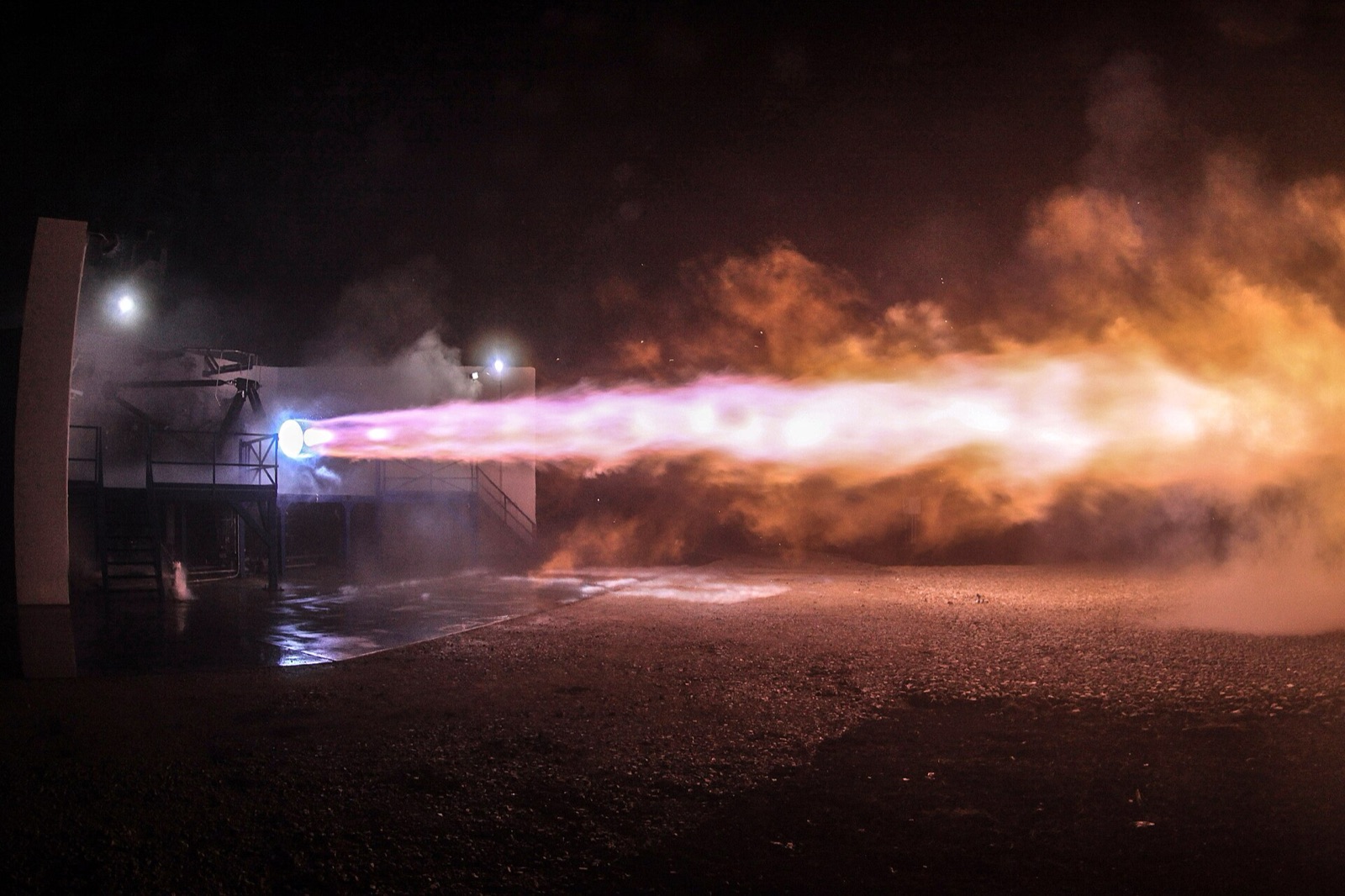
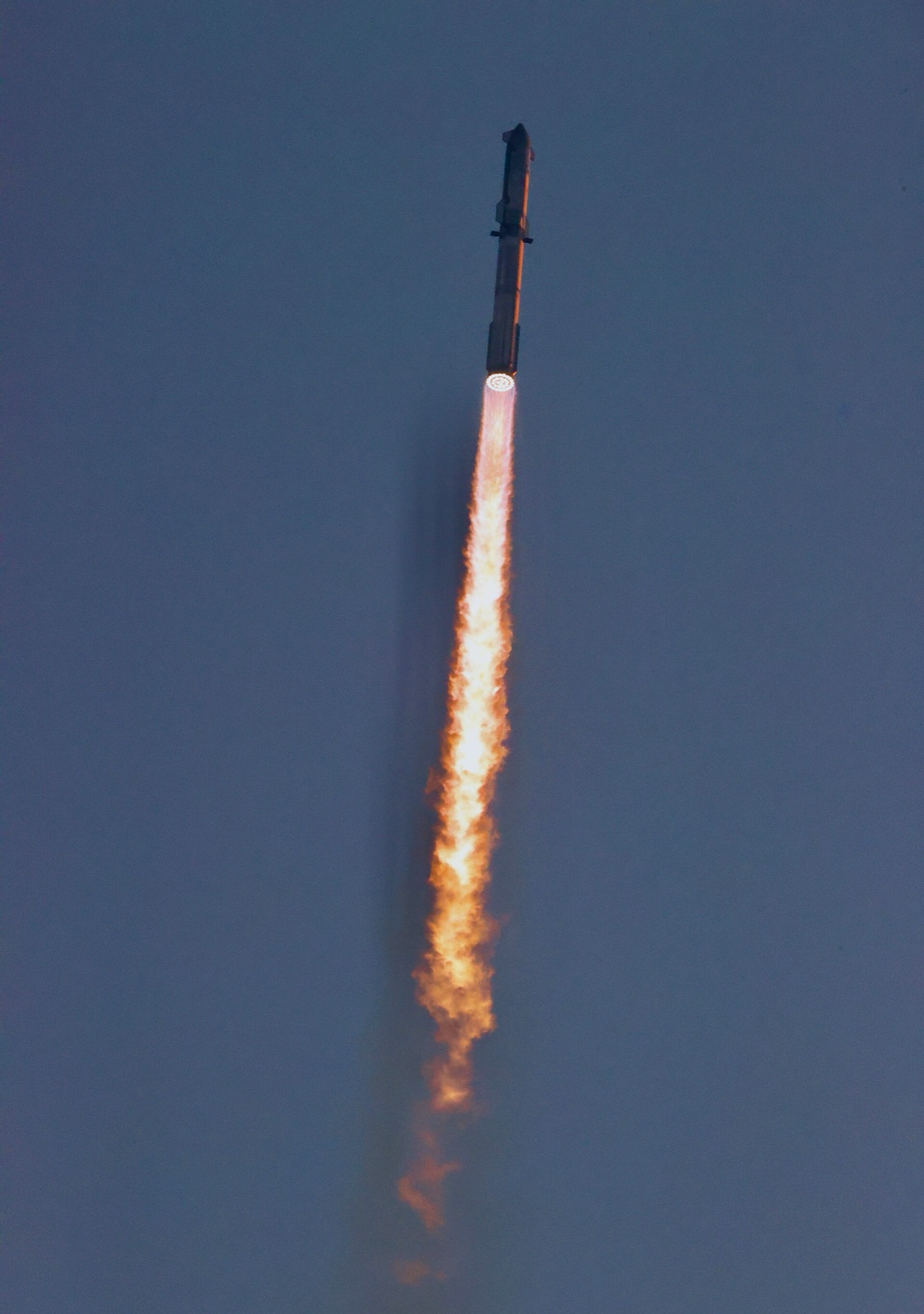
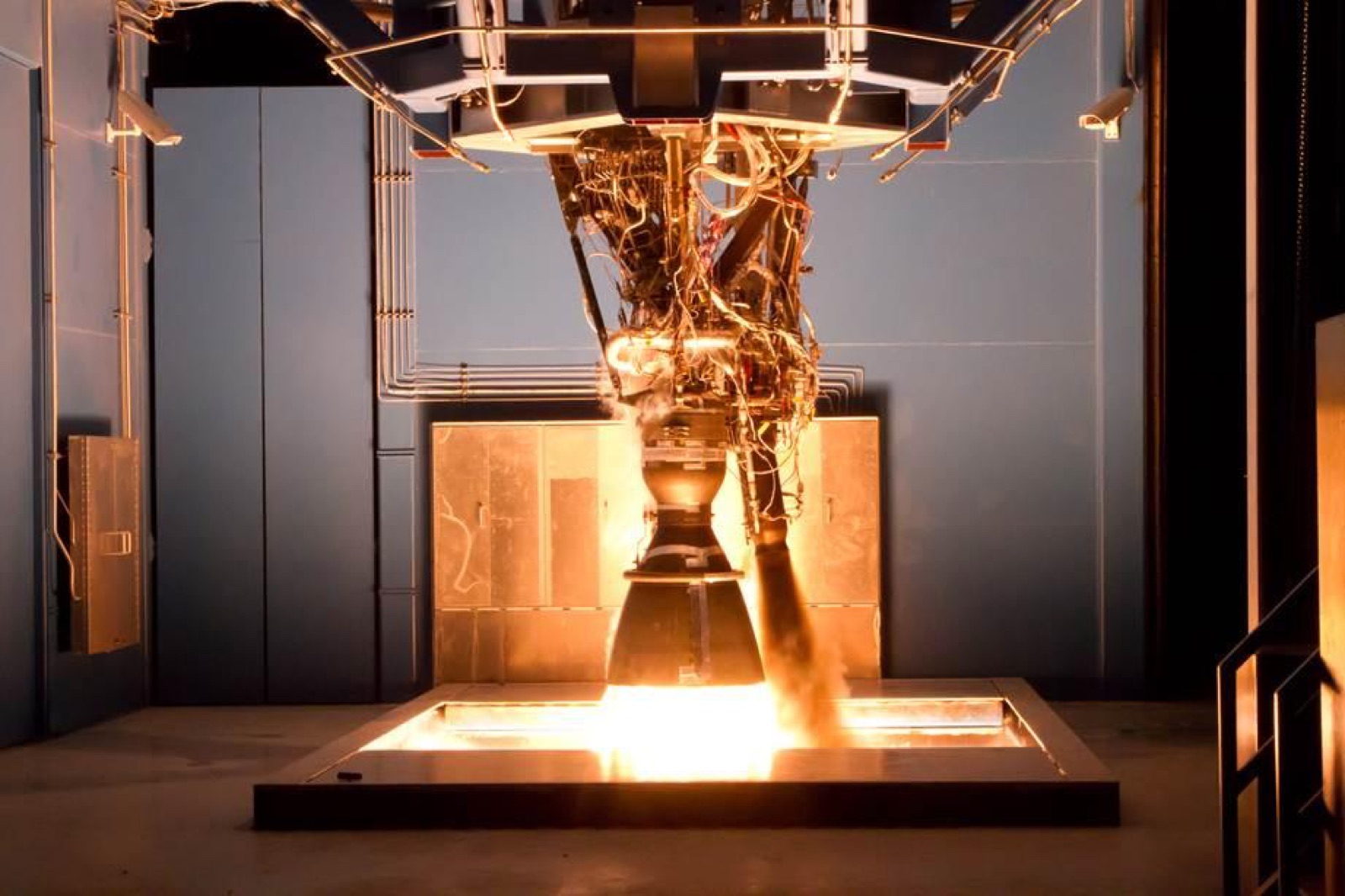
SpaceX built Raptor to power both stages of Starship. It burns liquid methane with liquid oxygen. The Super Heavy booster carries 33 of them and the ship carries six: three for sea level and three for vacuum.
Raptor was the first full-flow staged combustion engine to power a vehicle in flight. Two preburners drive its turbines: one burns all the oxygen with a little methane, the other all the methane with a little oxygen. Elon Musk has said SpaceX developed its own superalloys, SX300 and SX500, for the hot oxygen-rich turbopump.
Application
Raptor engines power SpaceX’s Super Heavy booster and Starship upper stage. Full-flow staged combustion puts hot, oxygen-rich gas through the turbopumps, which is why SpaceX developed special superalloys for them.
Photos
How it is built
Burners and pumps
Each engine has two turbopumps, pumps spun by turbines, one for oxygen and one for methane. An oxygen-rich turbine drives the oxygen pump, and a fuel-rich turbine drives the methane pump. Torch igniters light the preburners.
Oxygen-rich preburner
Fuel-rich preburner
Oxygen turbopump (driven by an oxygen-rich turbine)
Methane turbopump (driven by a fuel-rich turbine)
Torch igniters in the preburners
Chamber and nozzle
On Raptor 2, coaxial swirl injectors admit the propellants to the main chamber. The nozzle is regeneratively cooled, so propellant flowing through its walls carries heat away. The vacuum version, RVac, has an extended nozzle for higher specific impulse in space, a measure of how efficiently an engine uses propellant.
Main injector (coaxial swirl elements)
Regeneratively cooled thrust chamber nozzle
Raptor Vacuum (RVac) engine, three on the ship
Cast and superalloy parts
SpaceX casts the engine manifold in its own foundry from Inconel, a heat-resistant superalloy. In 2018 posts, Elon Musk said the oxygen-rich turbopump's hot section uses SX300, with SX500 to follow, and called them something like a modern Inconel. SX500, he said, was made for hot, oxygen-rich gas at 12,000 psi.
Engine manifold
Oxygen-rich turbopump hot section
Printing and electronics
SpaceX 3D printed many parts of early Raptor prototypes, including the turbopumps and injectors. By mass, 40 percent of a 2016 subscale engine was printed. Raptor 3 puts its sensors and controllers inside the engine's own thermal protection, and electric actuators swivel the engines in place of hydraulics.
Additively manufactured parts and assemblies
3D-printed turbopumps and injectors (early prototypes)
Engine sensors and controllers inside the engine thermal protection (Raptor 3)
Electronic thrust vector control system
Where the parts areNumber of parts we have listed in each group
Power cycle5
Engine variants4
Manifold and hot gas path2
Control and electronics2
Manufacturing2
Test infrastructure2
Thrust chamber and nozzle1
Combustion1
What it is made of
Inconel
The engine manifold, cast in SpaceX's own foundry. SpaceX does not give the exact alloy.
SX300 and SX500 superalloys
The hot section of the oxygen-rich turbopump. Elon Musk described them as a modern version of Inconel.
How it connects to other things
Raptor first flew in July 2019, on the Starhopper test vehicle. Raptor 2 is a complete redesign of the first Raptor, and Raptor 3 came after it. On Starship, Raptors lift the Super Heavy booster and the ship, and NASA says the Moon-lander version uses them too. SpaceX makes the engine itself.
6 Raptor engines on the Starship upper stage (NASA text on the HLS ship); sea-level and vacuum split in the next row
3 of the 6 ship engines are Raptor Vacuum (RVac)
Starhopper (test vehicle)
first flight of the engine on a vehicle, July 2019
Replaces
Raptor 1
Raptor 2 is a complete redesign of Raptor 1
Made or supplied by
SpaceX
NASA states that both the lander and the booster use SpaceX's Raptor engines
What we do not know
SpaceX has not published a materials list for Raptor. Only two metals are named, in posts by SpaceX's chief executive, and the make-up of SX300 and SX500 is not public. The chamber liner, injector, nozzle and pump casings are not described, and the published performance figures come from a 2019 analysis, not from Raptor 2 or 3.
The detailed data
What is written above is built from these numbers and quotes. Each row links to the page it was taken from. Get all of it as JSON, or ask our MCP server.
Features
Closed power cycle
SpaceX-developed superalloy for hot, oxygen-rich gas
Manifold cast in-house from Inconel
Specifications
What
Value
Propellants
Liquid oxygen and liquid methane
Chamber pressure (2019 baseline)
3,669.5 psia
Mixture ratio (2019 baseline)
3.60
Nozzle area ratio (booster engine)
34.34:1
Engines on baseline booster (2019)
31
Boost-stage engine count (NASA)
33
Ship engine count (NASA)
6
First flight with all 33 engines lit
18 November 2023 (second integrated flight test)
First fully stacked Super Heavy-Starship launch
20 April 2023
Raptor upgrades flown on the fourth integrated flight
6 June 2024
Lunar-landing throttle evaluation
tested under lunar landing throttle profiles
Raptor 1 target chamber pressure
250 bar (25 MPa; 3,600 psi)
Raptor 3 sea-level engine mass
1,525 kg (3,362 lb), down from 1,630 kg
Power cycle first
first full-flow staged combustion engine to power a vehicle in flight
Materials in detail
Each material named in the sources: where it is used here, which other products use it, and its key numbers when its material page exists.
Two parts (cast manifold, oxygen-rich turbopump hot section) have a stated material; both statements come from posts by SpaceX’s CEO as reported by a blog. Components, suppliers and links were added from public sources. A material is left blank where no source states it.
No primary-document materials list. Grades unknown (Inconel alloy, SX300/SX500 composition). Raptor 2 and Raptor 3 materials not covered. More detail: SpaceX has not published a Raptor bill of materials or an engine drawing; the turbopump casings, preburners, main chamber jacket, valves and igniter hardware have no stated alloys beyond the two in the current entry. FAA and NASA documents give vehicle-level engine counts but no part list. Raptor 2 and Raptor 3 chamber pressure, thrust and mass are Wikipedia statements citing SpaceX posts that could not be read (spacex.com update pages return no text). The Raptor 3 'integrated sensors and controllers' statement and the coaxial swirl injector statement are Wikipedia statements (the injector one cites an AIAA journal paper that was not opened). Autogenous pressurisation heat-exchanger, engine gimbal actuator and main valve hardware are not described in any readable primary source. Quotes from the NASA HLS papers and the NASA OIG report were machine-checked against the PDF text; Wikipedia quotes came through a text extractor and were not machine-checked. More detail: SpaceX has not published a Raptor bill of materials or an engine drawing; the turbopump casings, preburners, main chamber jacket, valves and igniter hardware have no stated alloys beyond the two in the current entry. FAA and NASA documents give vehicle-level engine counts but no part list. Raptor 2 and Raptor 3 chamber pressure, thrust and mass are Wikipedia statements citing SpaceX posts that could not be read (spacex.com update pages return no text). The Raptor 3 'integrated sensors and controllers' statement and the coaxial swirl injector statement are Wikipedia statements (the injector one cites an AIAA journal paper that was not opened). Autogenous pressurisation heat-exchanger, engine gimbal actuator and main valve hardware are not described in any readable primary source. Quotes from the NASA HLS papers and the NASA OIG report were machine-checked against the PDF text; Wikipedia quotes came through a text extractor and were re-checked in a second fetch pass but not against a saved copy of the page.