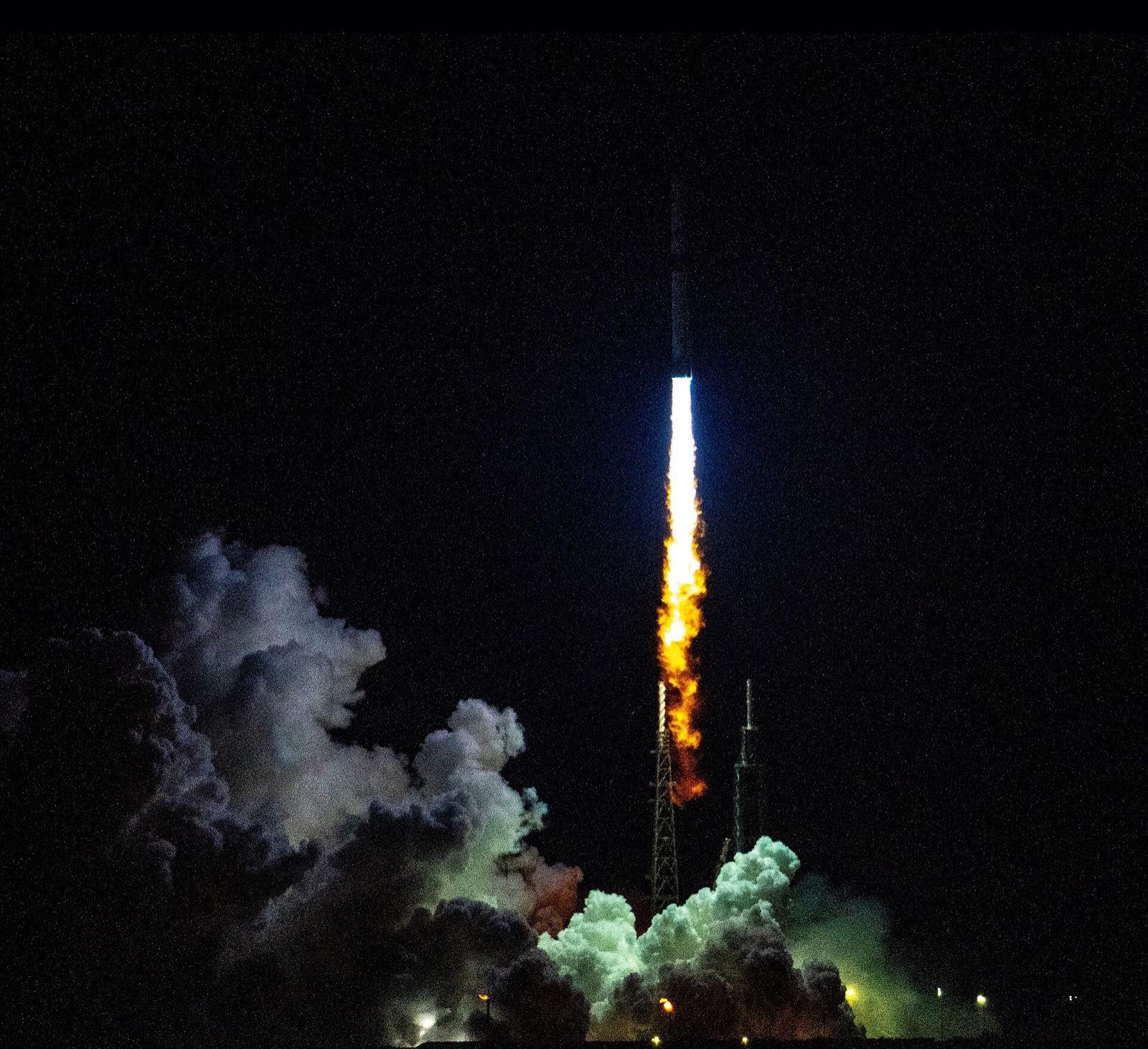
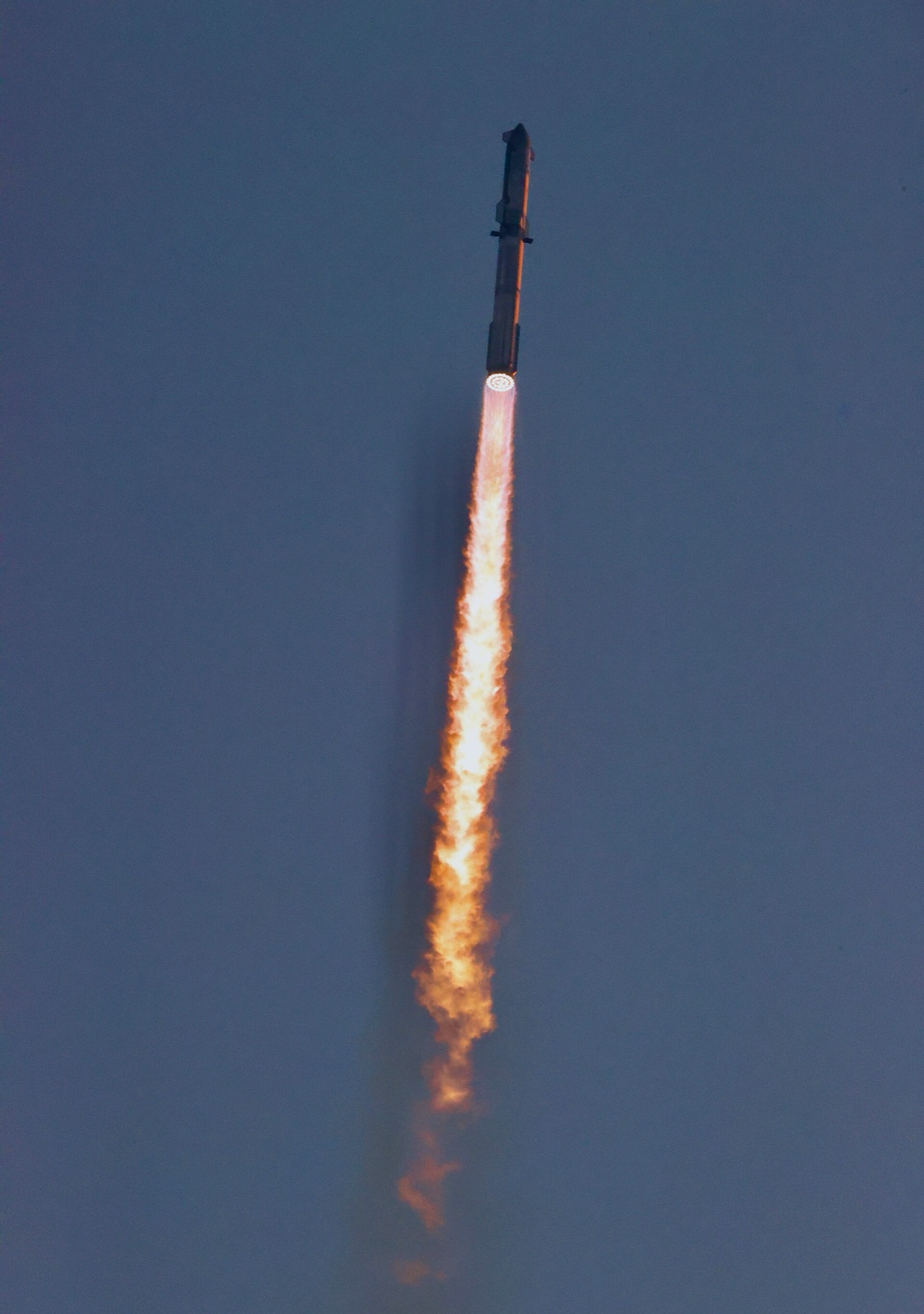
Starship upper stage and Super Heavy booster climbing under power during flight test 5, flame trail below
SpaceX

Starship and Super Heavy

Starship is a two-stage rocket system from SpaceX, built mostly of stainless steel.

Launch vehicles
Product IDspacex-starship
Propellants
liquid oxygen and liquid methane
Payload to low Earth orbit
100+ t (reusable baseline)
Ship propellant load
1,500 t (3,300,000 lb)
Booster propellant load
3,650 t (8,050,000 lb)
Payload fairing
9 m outer diameter
Ship heat-shield tiles
about 18,000 hexagonal tiles, rated to 1,400 C

In short

Starship is SpaceX's launch system for Earth orbit, the Moon and Mars. Super Heavy is the booster, and the ship, also called Starship, rides on top. The ship can act as a tanker, passing propellant to another ship in orbit, or as a lander for NASA's Artemis programme. Both stages are designed to be reusable.

Most of the vehicle is stainless steel, and SpaceX describes the metal as non-toxic and inert. For re-entry, the ship is covered in silica tiles, a material with properties similar to glass. Early ships carried about 18,000 hexagonal tiles, rated to 1,400 degrees Celsius and held on with pins.

Application

SpaceX's fully reusable launch system for Earth orbit, the Moon and Mars. Super Heavy is the first stage and Starship is the second stage, which can also act as a tanker or a lunar lander for NASA's Artemis programme.

How it is built

Super Heavy booster

Super Heavy's two tanks, liquid oxygen and liquid methane, share a dividing wall and hold 3,650 tonnes of propellant. Electric actuators swivel the inner 13 of its Raptor engines to steer. Grid fins guide it back to the launch tower, whose mechanical arms caught a booster for the first time on the fifth flight test.

  • Liquid oxygen and liquid methane tanks with a common bulkhead
  • Raptor engines (x33)
  • Electric-actuator thrust vector control on the inner 13 engines
  • Grid fins (three, electrically actuated)
  • Launch-tower catch arms (mechanical arms)

The ship

The ship's main tanks hold 1,500 tonnes of propellant. Six Raptor engines, three for sea level and three for vacuum, sit in a shielded compartment at the base. Small header tanks at the nose end of the payload bay hold propellant for re-entry and landing.

  • Main propellant tanks (liquid oxygen and liquid methane)
  • Raptor engines (x6: three sea-level, three vacuum)
  • Engine shielding compartment
  • Header tanks

Heat shield and flaps

Silica tiles, held to the stainless-steel skin with pins, protect the ship on re-entry. Four flaps control the descent, two forward and two aft, the aft pair mounted beside the engine bay and oxygen tank. SpaceX redesigned the forward flaps for the second version of the ship.

  • Heat tiles
  • Heat-shield tile attachment pins
  • Flaps (four)
  • Forward flaps (two)
  • Aft flaps (two)

Payload bay

The payload fairing is a clamshell 9 metres across. A door folds into the payload bay to release payloads, and Starlink satellites are deployed from a slot dispenser SpaceX calls the PEZ dispenser. Other payloads separate from the ship on an adapter made for each mission.

  • Payload fairing (clamshell)
  • Payload bay door
  • PEZ dispenser
  • Mission-unique payload adapter

Moon lander version

The lander SpaceX is developing for NASA's Artemis III and IV missions has a crew cabin and two airlocks for moonwalks. An elevator below the cabin, about 115 feet above the ground, lowers crew and equipment to the surface. It also has landing legs and a deployable solar array.

  • Crew compartment
  • Airlock(s)
  • Elevator from the airlock deck to the lunar surface
  • Landing legs
  • Solar array (deployable)
Where the parts areNumber of parts we have listed in each group
  • Human landing system variant11
  • Super Heavy structure8
  • Starship propulsion6
  • Starship payload4
  • Super Heavy propulsion4
  • Starship aerodynamic control3
  • Ground systems3
  • Starship thermal protection2
  • Vehicle structure1
  • Thermal protection1

What it is made of

  • Stainless steel

    The main construction material of the vehicle. SpaceX describes it as non-toxic and inert.

  • Silica heat-shield tiles

    Heat tiles on the ship, attached to the steel with pins. SpaceX says silica has properties similar to glass.

How it connects to other things

Super Heavy carries 33 of SpaceX's own Raptor engines and the ship six, three of them vacuum versions. NASA says the system draws on the flight heritage of Falcon and Dragon. As the Artemis lander it belongs to NASA's Human Landing System programme, and it must dock with Orion when the crew returns from the lunar surface. SpaceX also plans to deploy full-size Starlink V2 satellites with it.

Engines

  • Raptor engine

    SpaceX

    33 Raptor engines on the Super Heavy booster

    2 more details

    6 Raptor engines on the Starship upper stage (NASA text on the HLS ship); sea-level and vacuum split in the third row

    3 of the 6 ship engines are vacuum-optimised RVacs

Used in

  • NASA Artemis Human Landing System program

    Starship HLS is the lander for Artemis III and IV

Carries

  • Starlink V2 satellites (full-size)

    planned to be deployed with Starship; the V2 Mini is the Falcon 9 version

Launches

  • Axiom Extravehicular Mobility Unit (AxEMU)

    Axiom Space

    Planned lunar-lander ride; suit-lander integration tested on Starship development hardware; not flown. 2026 plans move the first lunar landing to Artemis IV

Builds on

  • Falcon 9

    SpaceX

    NASA: the system builds on Falcon flight heritage

  • Crew Dragon

    SpaceX

    NASA: the system builds on Dragon flight heritage

What we do not know

SpaceX does not say which grade of stainless steel it uses. Nor does it say what the tanks, engines, flaps and grid fins are made of, or who makes the tiles. The design also changes from one version to the next, so any one description may not match every ship that has flown.

The detailed data

What is written above is built from these numbers and quotes. Each row links to the page it was taken from. Get all of it as JSON, or ask our MCP server.

Features

  • Both stages designed to be reusable
  • Crew configuration for up to 100 people to LEO, Moon and Mars
  • Propellant transfer in orbit for higher payload mass

Specifications

WhatValue
Stack heightabout 400 ft (Starship on Super Heavy), design figure
Super Heavy enginesup to 37 Raptor
Propellantliquid oxygen and liquid methane
Super Heavy lift-off thrust74 MN with 37 engines
Starship lander heightabout 171 ft
Mass to LEO100+ t (reusable baseline)
Payload fairing diameter9 m outer diameter
Payload envelope8 m diameter, up to 22 m tall extended volume
Super Heavy booster size (NASA)9 m diameter, 70 m long
HLS Starship size (NASA)9 m diameter, 50 m long
HLS elevator height above groundabout 115 ft
Ship propellant load1,500 t (3,300,000 lb)
Booster propellant load3,650 t (8,050,000 lb)
Ship heat-shield tile count (Block 1 era)about 18,000 hexagonal tiles, rated to 1,400 C
Ship dry mass (SpaceX CEO statement, 2021)about 100 t (220,000 lb)
Ship Block 2 height52.1 m (171 ft)
Block 3 booster height72.3 m
Block 3 booster thrust (expected)80.8 MN (18,200,000 lbf)
First fully stacked orbital-class launch20 April 2023
All 33 booster engines lit for a full-duration burn18 November 2023
Electronic thrust vector control first flown14 March 2024 (third flight test)
First booster catchfifth flight test

Materials in detail

Each material named in the sources: where it is used here, which other products use it, and its key numbers when its material page exists.

Every part we have

Only two materials are stated in primary sources: stainless steel as the main construction and silica heat tiles. No part-level list or grades are published. Components, suppliers and links were added from public sources. A material is left blank where no source states it.

Material IDs

stainless-steelsilica-heat-shield-tile
Vehicle structure1
PartMaterialFinish and standardMade by
Starship vehicle (overall construction)“Starship is constructed primarily of stainless steel, which is non-toxic and inert.” stainless steel (grade not stated in this source)stainless-steel — —
Thermal protection1
PartMaterialFinish and standardMade by
Heat tiles“thermal heat tiles composed of silica, which has similar properties to glass” silicasilica-heat-shield-tile — —
Payload1
PartMaterialFinish and standardMade by
Payload fairing (clamshell)“The Starship payload fairing is a clamshell structure in which the payload is integrated.” Not said — —
Starship propulsion6
PartMaterialFinish and standardMade by
Raptor engines (x6: three sea-level, three vacuum)ship main engines for ascent, in-space burns and landing“Starship, powered by six SpaceX Raptor engines” Not said — Supplier: SpaceX
Engine shielding compartmenthouses the six Raptor engines“Starship is powered by six Raptor engines, which are housed within a dedicated shielding compartment.” Not said — —
Main propellant tanks (liquid oxygen and liquid methane)carry about 1,500 t of propellant“The vehicle's tanks hold 1,500 t (3,300,000 lb) of propellant,” Not said — —
Header tankssmall tanks at the nose end of the payload bay for landing and re-entry propellant“The header tanks are mounted at the tip of the payload bay.” Not said — —
Thrust structureoxygen tank terminates in the structure that carries engine thrust“The oxygen tank terminates with the thrust structure of the vehicle.” Not said — —
Cold gas thrusters (in-orbit attitude control)control authority during unpowered flight in orbit“During unpowered flight in orbit, control authority is provided by cold gas thrusters” Not said — —
Starship aerodynamic control3
PartMaterialFinish and standardMade by
Flaps (four)control the belly-flop re-entry“Starship controls its reentry with four flaps” Not said — —
Forward flaps (two)upper flaps whose design changed from Block 2“Beginning with Block 2, the design of these forward flaps was significantly changed,” Not said — —
Aft flaps (two)lower flaps beside the engine bay and LOX tank“two aft flaps mounted to the sides of the engine bay and LOX tank” Not said — —
Starship thermal protection2
PartMaterialFinish and standardMade by
Heat-shield tile attachment pinshold the silica tiles to the stainless-steel skin“The silica-based tiles are attached to Starship with pins,” Not said — —
Thermal and micro-meteoroid (MMOD) protection tiles (HLS variant)tile layer tested for the lunar lander configuration“thermal and micro-meteoroid orbital debris (MMOD) protection tiles” Not said — —
Starship payload4
PartMaterialFinish and standardMade by
Payload bay doorfolds into the payload bay to release payloads“The door opens by folding into the payload bay.” Not said — —
PEZ dispenserslot dispenser used to deploy Starlink satellites into low Earth orbit“The PEZ dispenser is used to deploy Starlink satellites into LEO.” Not said — —
Mission-unique payload adapterseparates the payload from the ship“The payload is then separated using the mission-unique payload adapter.” Not said — —
Payload supports along sidewalls or nosemounting options inside the payload bay“Starship has the ability to mount supports along the sidewalls or nose” Not said — —
Starship structure1
PartMaterialFinish and standardMade by
Nosecone with internal reinforcement and chopstick lifting pointsreinforced nose carrying catch-arm lift points“The nosecone has substantial internal reinforcement,” Not said — —
Human landing system variant11
PartMaterialFinish and standardMade by
Crew compartmentcabin for the lunar-lander crew“Early progress on the crew compartment has included construction of a mock-up crew cabin.” Not said — —
Environmental Control and Life Support System (ECLSS)air, temperature and humidity for the crew“Environmental Control Life Support System (ECLSS), Thermal Control System” Not said — —
Thermal control systemheat rejection for the crewed lander“Thermal Control System, Landing Software and Sensor System” Not said — —
Landing software and sensor systemnavigation and hazard detection for the lunar descent“Landing Software and Sensor System” Not said — —
Airlock(s)gives astronauts access to the lunar surface“Starship includes a spacious cabin and two airlocks for astronaut moonwalks.” Not said — —
Elevator from the airlock deck to the lunar surfacelowers crew, equipment and samples from about 115 ft above the ground“Starship’s elevator sits just below the crew compartment and is approximately 115 feet above the ground” Not said — —
Landing legssupport the lander on the Moon“landing legs, docking mechanisms, landing software and sensors” Not said — —
Solar array (deployable)power for the lander“solar array deployment” Not said — —
Aft docking mechanism (propellant transfer)joins ships for in-orbit propellant transfer“Aft docking mechanism designs” Not said — —
Docking interface to Orionspacecraft-to-spacecraft interface for crew transfer in lunar orbit“the Starship and Orion must execute a successful rendezvous and docking sequence when the crew returns from the lunar surface” Not said — —
Crew displays and medical systemscrew interface and health systems tested for HLS“development testing and analyses on crew displays” Not said — —
Super Heavy propulsion4
PartMaterialFinish and standardMade by
Raptor engines (x33)booster main engines“Super Heavy Booster first stage, which is 9m in diameter, 70m long, and is powered by 33 SpaceX Raptor engines” Not said — Supplier: SpaceX
Electric-actuator thrust vector control on the inner 13 enginessteers the booster, including the landing burn“This system uses electric actuators on the thirteen engines in the middle and center rings.” Not said — —
Thrust plate supporting the inner 13 enginescarries engine thrust into the tank structure“which supports the inner thirteen engines,” Not said — —
Aft bay engine shieldingshields the engines and forms the aft bay“alongside their shielding, which forms the aft bay.” Not said — —
Super Heavy structure8
PartMaterialFinish and standardMade by
Liquid oxygen and liquid methane tanks with a common bulkheadcarry about 3,650 t of propellant“The two cryogenic propellant tanks on Super Heavy are separated by a common bulkhead” Not said — —
Liquid oxygen header tankbuilt from tall rings inside the booster“tall ring are used to construct the liquid oxygen header tank.” Not said — —
Aft section ringsring-built skirt around the engines“The aft section is constructed solely from the four 1.4 m (4 ft 7 in) rings.” Not said — —
Hot-stage ring and forward heat shield (integrated interstage)interstage section that survives ship engine ignition“directly integrated into the methane tank” Not said — —
Quick disconnects (two)propellant loading connections“Two quick disconnects are used for loading propellant onto the booster,” Not said — —
Grid fins (three, electrically actuated)steer the booster back to the tower“Also embedded into the methane tank are three electrically actuated grid fins,” Not said — —
Catch hardpoints on two grid finslift points used to lift the booster onto the launch mount and to catch it“Two of these fins have hardpoints,” Not said — —
Cold gas thrusters fed by ullage gasattitude control outside powered flight“control authority is provided by cold gas thrusters fed with residual ullage gas.” Not said — —
Stage separation1
PartMaterialFinish and standardMade by
Hot-stage separationthe ship engines light before the booster separates“for this flight SpaceX began to employ hot-stage separation to separate the booster and upper stage” Not said — —
Ground systems3
PartMaterialFinish and standardMade by
Launch-tower catch arms (mechanical arms)catch the returning Super Heavy booster“being “caught” by mechanical arms” Not said — —
Second orbital launch pad at the Texas sitefaster reuse cadence“SpaceX has begun construction of a second orbital launch pad at the company’s Texas facility.” Not said — —
Launch facilities at Kennedy Space Center (under construction)Florida launch site“The company also has launch facilities under construction at NASA’s Kennedy Space Center in Florida.” Not said — —

What the sources leave out

No grades, tank, engine or control-surface materials in the primary sources read. More detail: SpaceX publishes only a six-page user's guide for Starship; it gives no part list or materials. NASA documents describe the human-landing-system variant (crew cabin, airlocks, elevator, landing legs, solar array, docking) but give no materials or suppliers. Block 1, Block 2 and Block 3 hardware differ (flaps, tile layout, grid-fin count, hot-stage ring, thrust plate); the Wikipedia statements used here are not tied to one block except where stated, and the FAA documents that would fix the as-flown configuration returned HTTP 403. Not found in any readable source: stainless steel grades (the entry deliberately omits blog-level 304L/301/30X claims), tank and bulkhead alloys, tile supplier and tile count for later blocks, flap actuator hardware, thrust-plate material, header-tank construction, and any named suppliers. The user's guide is cited by its working relayto copy because the spacex.com PDF address now returns 404. Quotes from the NASA HLS papers and the NASA OIG report were machine-checked against the PDF text; quotes from Wikipedia, the NASA selection page and Spaceflight Now came through a text extractor and were not machine-checked. More detail: SpaceX publishes only a six-page user's guide for Starship; it gives no part list or materials. NASA documents describe the human-landing-system variant (crew cabin, airlocks, elevator, landing legs, solar array, docking) but give no materials or suppliers. Block 1, Block 2 and Block 3 hardware differ (flaps, tile layout, grid-fin count, hot-stage ring, thrust plate); the Wikipedia statements used here are not tied to one block except where stated, and the FAA documents that would fix the as-flown configuration returned HTTP 403. Not found in any readable source: stainless steel grades (the entry deliberately omits blog-level 304L/301/30X claims), tank and bulkhead alloys, tile supplier and tile count for later blocks, flap actuator hardware, thrust-plate material, header-tank construction, and any named suppliers. The user's guide is cited by its working relayto copy because the spacex.com PDF address now returns 404. Quotes from the NASA HLS papers and the NASA OIG report were machine-checked against the PDF text; quotes from Wikipedia, the NASA selection page and Spaceflight Now came through a text extractor and were re-checked in a second fetch pass but not against a saved copy of the page.
Where this comes from

10 pages from 7 websites

More space products

Collected from public pages and documents, checked 4 Nov 2026.

Published · Updated