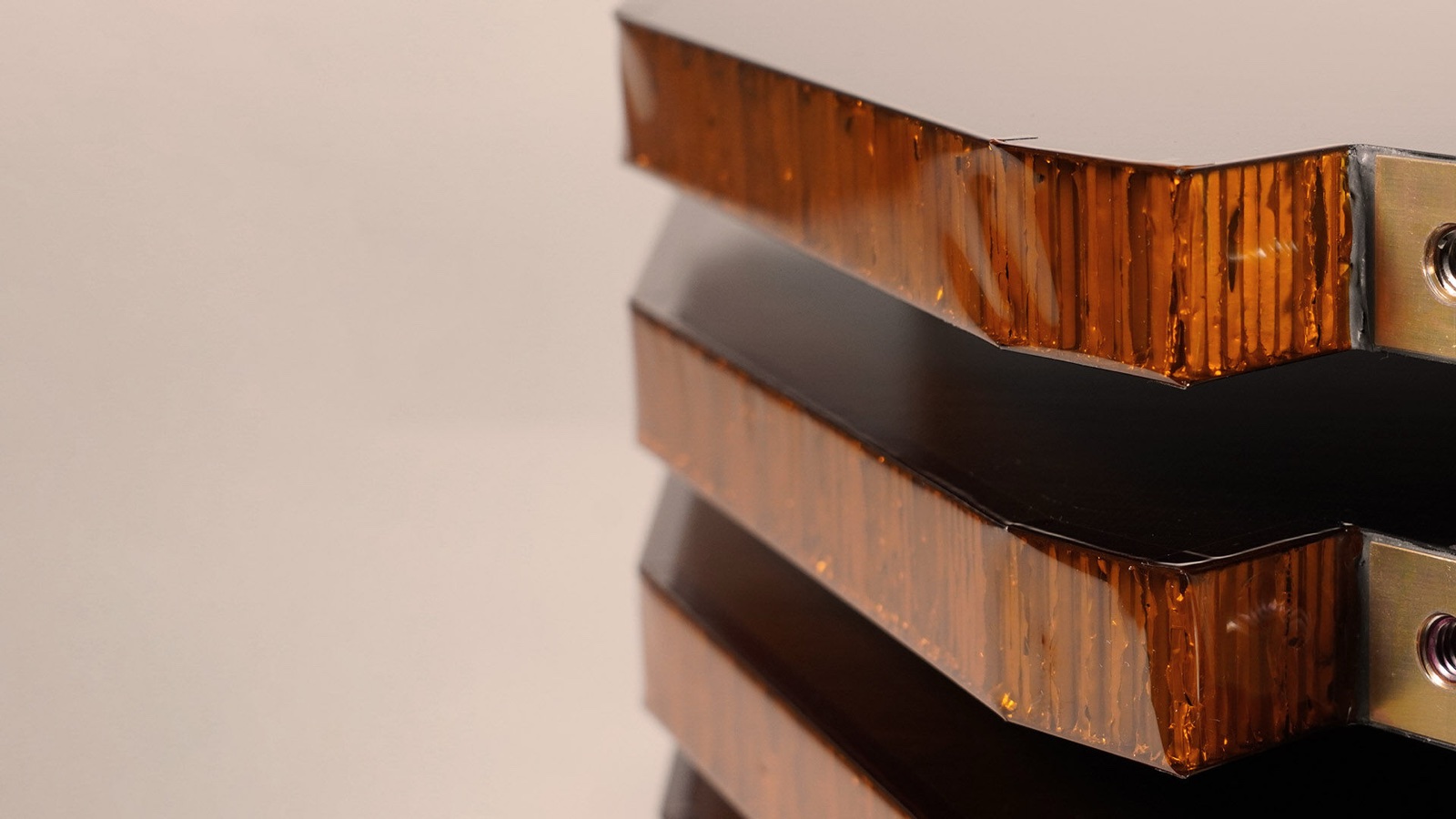
Stack of dark-faced sandwich panels with amber honeycomb edgesRock West solar panel
Rockwest Composites

Rockwest GEO solar array panel

This panel is a stiff, light base for solar cells in geostationary orbit, built from carbon fibre and aluminium.

Solar arrays and cells
Product IDrockwest-geo-solar-array-panel
Size
48 in x 96 in (1219.2 mm x 2438.4 mm)
Panel thickness
0.272 in
Thickness of each skin
0.008 in
Core thickness
0.25 in
Max suggested use temperature
300 F (150 C)
Target orbits
Medium Earth Orbit, Geostationary Orbit, deep space

In short

Rockwest Composites sells this flat panel as a base for solar cells. It is made for arrays in geostationary orbit, medium Earth orbit and deep space. It measures 48 by 96 inches (1219.2 by 2438.4 millimetres) but is only 0.272 inches thick. Each order comes with a certificate package.

Two thin skins of carbon fibre sandwich an aluminium honeycomb core. Each skin is 0.008 inches thick. The fibre is Toray M55J, a stiff, high-modulus type, and the resin is a toughened cyanate ester. The layers are laid in a quasi-isotropic pattern, with the fibre direction turned from layer to layer.

Application

A lightweight, stiff backing panel for geostationary-orbit solar arrays. An aluminium honeycomb core between carbon-fibre skins carries the solar cells, with a Kapton surface to bond them to. It helps array designers who need high stiffness at very low mass.

How it is built

Carbon fibre skins

The two skins carry the bending load. Each one is cured on its own in an autoclave, a heated pressure vessel. The finished panel is then consolidated under a vacuum bag in an oven.

  • Face skin carbon fibre
  • Face skin matrix resin
  • Face skin laminate pair (2 x 0.008 in), STRATOplateGEO

Core and adhesive

The core is perforated aluminium honeycomb, 0.25 inches thick. Cytec FM300-2 film adhesive bonds it to the skins. Rockwest says the perforated core and the film adhesive are combined to tune the panel's bending stiffness.

  • Core
  • Core-to-skin film adhesive

Kapton face

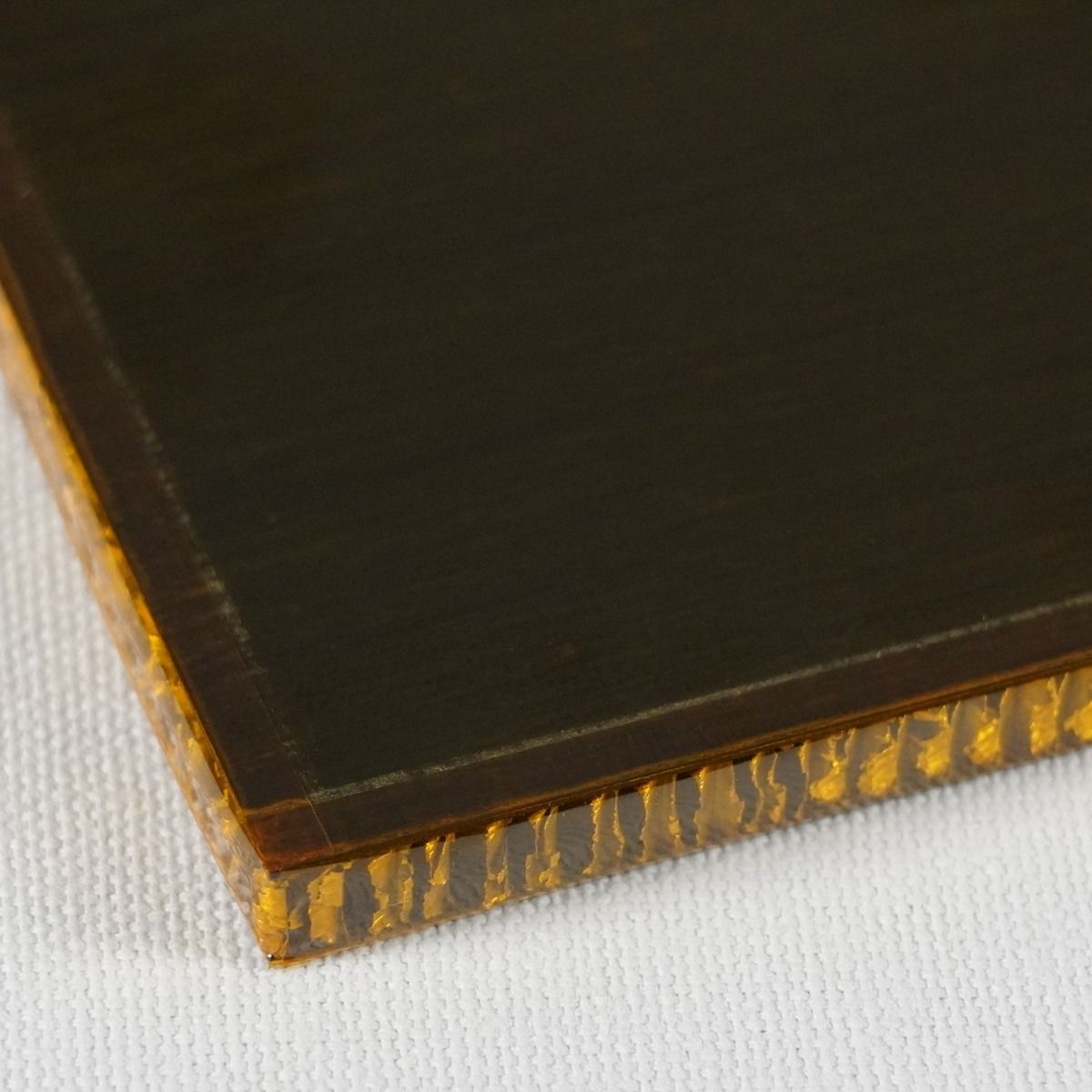
A Kapton film 0.002 inches thick is cured together with the skin on one face. It is the surface the solar cells are bonded to, and the cells themselves are not part of the product. Both faces of the panel are finished matte black.

  • Kapton film, co-cured to one skin face
  • Panel surfaces (both faces)

Certificates and tests

Every order includes a certificate package with dimensional inspection, material certificates, traceability and a statement of verification. Extra tests can be ordered, among them short-beam shear, flatwise tension and long-beam flexure on the sandwich, and resin-content tests on the skins.

  • Certificate package
  • Full traveler verification (option)
  • Short beam shear test coupons (option)
  • Flatwise tension and long beam flexure tests on the sandwich (option)
  • Resin content tests on the face skins (option)
Where the parts areNumber of parts we have listed in each group
  • Deliverables and options5
  • Stock plates and sibling panels (same material system)4
  • Face skins3
  • Panel hardware shown on Rock West solar-array pages (not itemised on the product page)3
  • Face skins (STRATOplate)2
  • Core and bonding2
  • Solar cell bonding surface1
  • Panel surface1

What it is made of

  • Carbon fibre (Toray M55J)

    The fibre in both face skins.

  • Cyanate ester resin (Patz PMT-F33)

    The resin that holds the fibres together in the skins.

  • Kapton film

    A 0.002 inch layer on one face, where the solar cells are bonded.

  • Aluminium honeycomb

    The perforated core, 0.25 inches thick.

  • Cytec FM300-2 film adhesive

    Bonds the core to the skins.

  • Matte black finish

    Both faces of the panel.

The materials by familyHow many of the parts that name a material use each one
  • Carbon fibre5
  • Other3
  • Polyimide2
  • Polymers and foams1
  • Aluminium1

How it connects to other things

This panel is a sibling of Rockwest's low-Earth-orbit substrate, which has the same size and core but a different resin. Toray supplies the carbon fibre, Patz the resin and Cytec the adhesive. Rockwest says every material in its STRATO range meets NASA and ESA outgassing requirements, the limits on gas released in a vacuum. It names no mission that has used this panel.

Carries

  • Solar cells (bonded to the Kapton face)

    The Kapton layer is the solar-cell bonding substrate; cells are not part of the product

Builds on

  • Rockwest solar array substrate

    Rockwest Composites

    Sibling in the STRATOSubstrate line: same size and core, LEO resin system instead of the GEO cyanate ester

Passed on to

Built on

  • ASTM E595 outgassing test

    PMT-F33 resin outgassing data on the supplier datasheet

  • NASA and ESA outgassing requirements (STRATO line claim)

    Maker's claim for all STRATO materials

Made or supplied by

  • Toray Carbon Fibers America (M55J fibre)

    Fibre of the skins; datasheet CFA-017

  • Patz Materials and Technology (PMT-F33 resin)

    Resin of the skins

  • Cytec (FM300-2 film adhesive)

    Core-to-skin film adhesive

Products that use the same materials

  • Rockwest solar array substrate

    Rockwest Composites

    Carbon fibreKapton filmKapton HN polyimide filmMatte black finish+1 more
    Where each one is used

    Carbon fibre. Here: Face skin carbon fibre; Face skin laminate pair (2 x 0.008 in), STRATOplateGEO and more. There: Face skin carbon fibre; HR40 / NB321 unidirectional prepreg and more.

    Kapton film. Here: Kapton edging on STRATOSubstrate panels. There: Kapton edging on STRATOSubstrate panels.

    Kapton HN polyimide film. Here: Kapton film, co-cured to one skin face. There: Kapton film, co-cured to one skin face.

    Matte black finish. Here: Panel surfaces (both faces). There: Panel surfaces (both faces).

    Aluminium honeycomb core. Here: Core. There: Core.

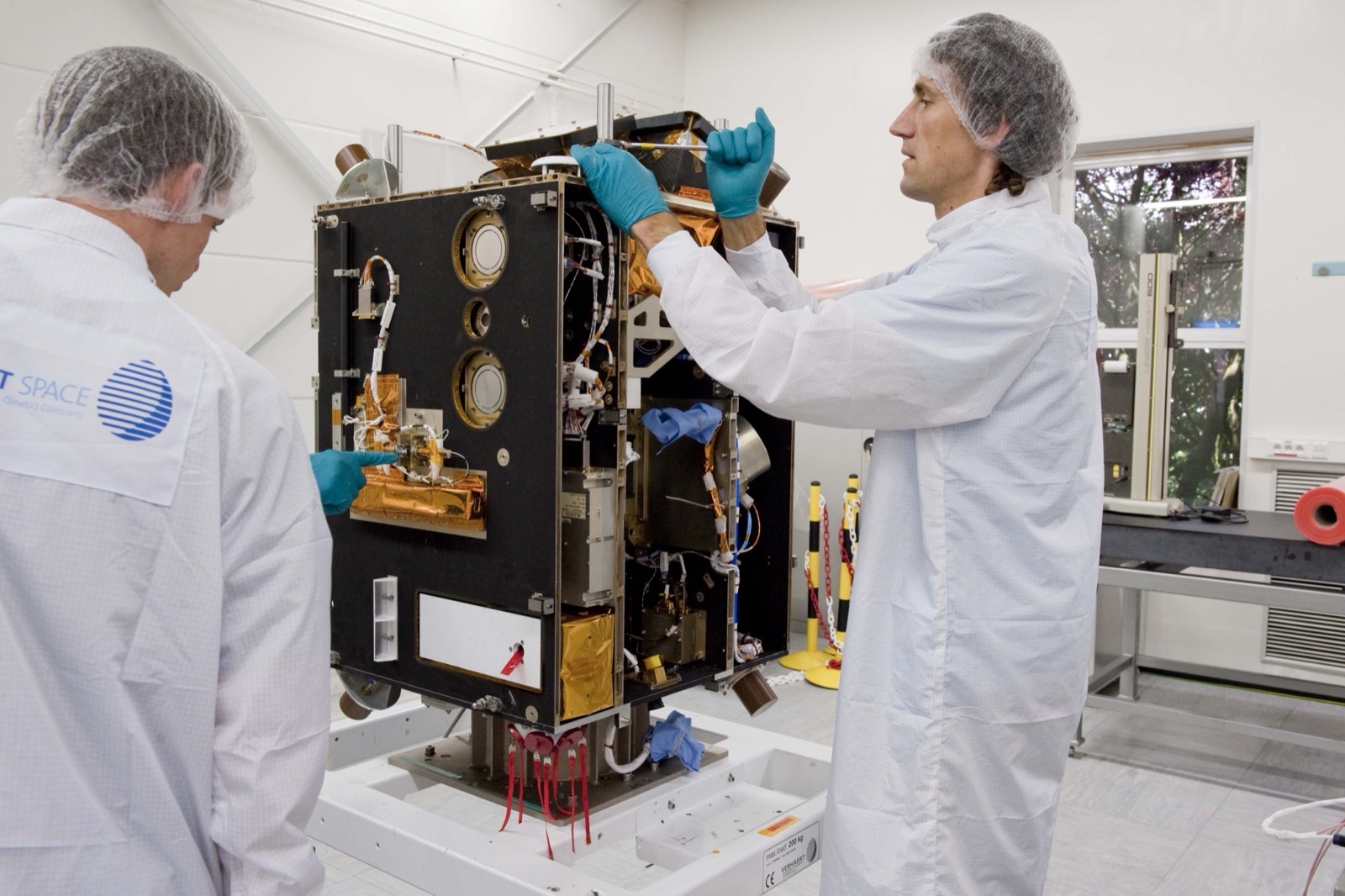
  • Proba-2

    ESA

    Carbon fibreAluminium honeycomb core
    Where each one is used

    Carbon fibre. Here: Face skin carbon fibre; Face skin laminate pair (2 x 0.008 in), STRATOplateGEO and more. There: Platform structure supplier (eoPortal).

    Aluminium honeycomb core. Here: Core. There: H-configuration inner panels (3); Outer panels without cells and more.

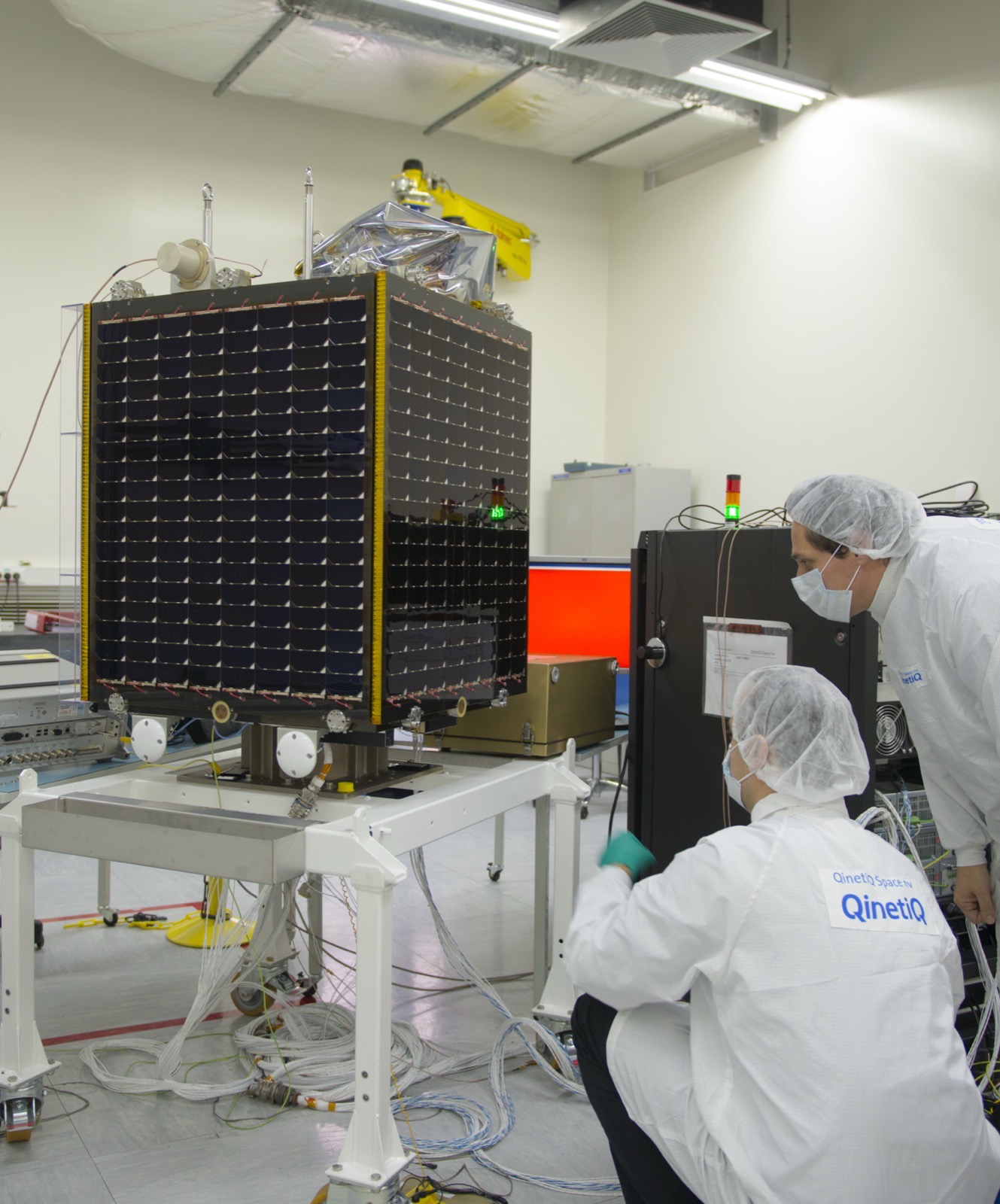
  • Proba-V

    ESA

    Carbon fibreAluminium honeycomb core
    Where each one is used

    Carbon fibre. Here: Face skin carbon fibre; Face skin laminate pair (2 x 0.008 in), STRATOplateGEO and more. There: Outer panels (3).

    Aluminium honeycomb core. Here: Core. There: Structure (summary).

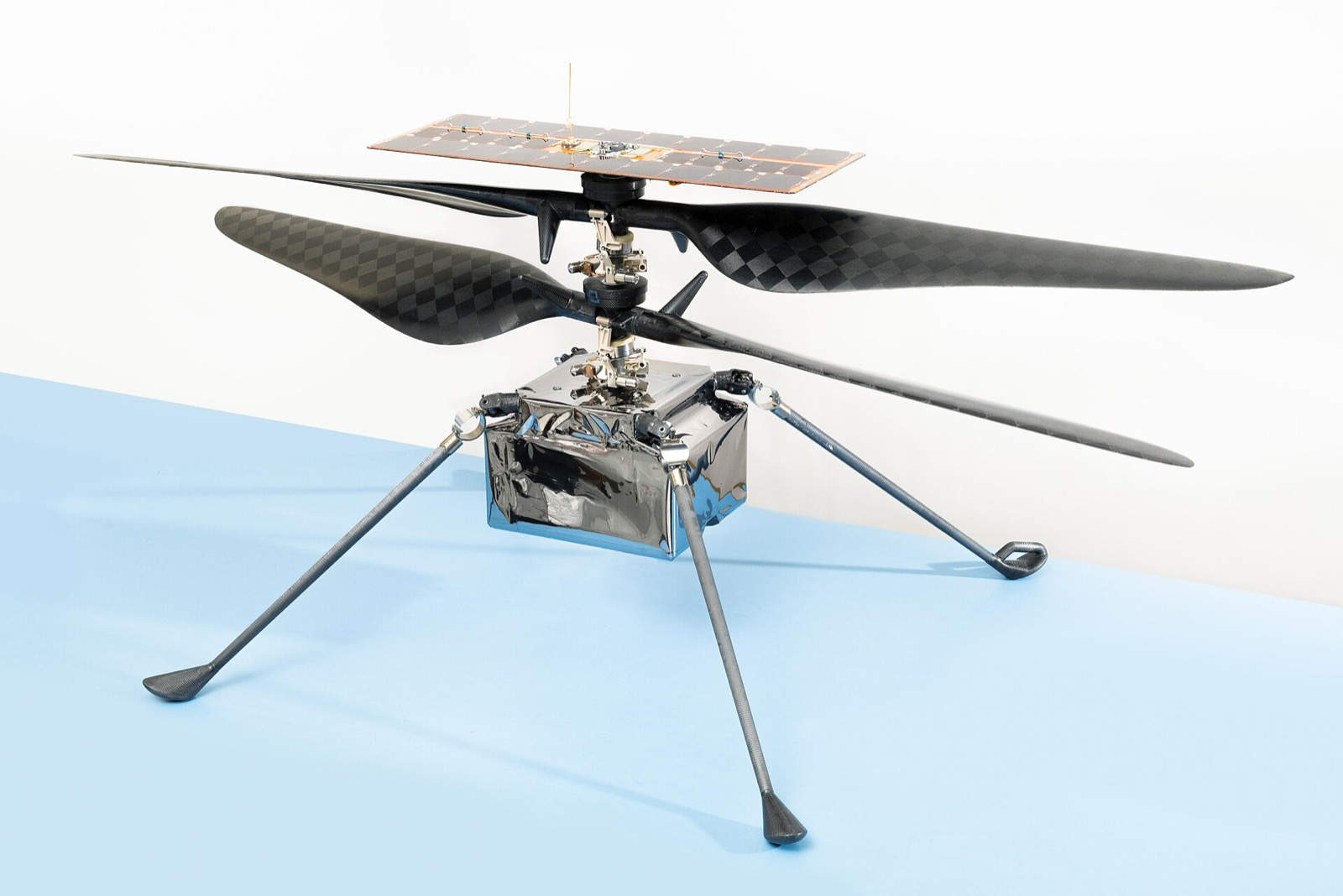
  • Ingenuity Mars Helicopter

    NASA / JPL

    Carbon fibreKapton film
    Where each one is used

    Carbon fibre. Here: Face skin carbon fibre; Face skin laminate pair (2 x 0.008 in), STRATOplateGEO and more. There: Rotor blades (upper and lower); Rotor primary structure and more.

    Kapton film. Here: Kapton edging on STRATOSubstrate panels. There: Battery heaters.

  • Falcon 9

    SpaceX

    Carbon fibreAluminium honeycomb core
    Where each one is used

    Carbon fibre. Here: Face skin carbon fibre; Face skin laminate pair (2 x 0.008 in), STRATOplateGEO and more. There: Interstage face sheets; Landing legs.

    Aluminium honeycomb core. Here: Core. There: Interstage; Fairing shell (aluminium honeycomb with carbon fibre face sheets).

  • Falcon Heavy

    SpaceX

    Carbon fibreAluminium honeycomb core
    Where each one is used

    Carbon fibre. Here: Face skin carbon fibre; Face skin laminate pair (2 x 0.008 in), STRATOplateGEO and more. There: Landing legs (Falcon 9 booster).

    Aluminium honeycomb core. Here: Core. There: Interstage (Falcon 9); Centre-core interstage (4.5 m).

What we do not know

The page shows a weight with no unit, so the panel's mass isn't clear. Rockwest publishes no thermal, expansion, stiffness or strength figures for the finished panel. The Kapton grade and supplier are not named, and the exact order and angles of the layers are shared only under a non-disclosure agreement. Nor does Rockwest say whether this panel has flown.

The detailed data

What is written above is built from these numbers and quotes. Each row links to the page it was taken from. Get all of it as JSON, or ask our MCP server.

Features

  • Kapton film co-cured to one face serves as the solar cell bonding surface
  • Sandwich panel is a high stiffness, ultra-low weight backing structure
  • Readily available, made to order with short lead time
  • Full traceability to material lots, cure cycle and coupon testing
  • Each order includes a certificate package; panels serialized and traceable
  • Perforated core and film adhesive combined to tune bending stiffness

Specifications

WhatValue
Size48 in x 96 in (1219.2 mm x 2438.4 mm)
Core materialAluminium honeycomb (perforated)
Core thickness0.25 in
Core density2.3 pcf
Colour / finishBlack, matte on both sides
Length tolerance+/- 0.125 in
Width tolerance+/- 0.125 in
Skin thickness tolerance (each)+/- 10%
Core thickness tolerance+/- 0.010 in
Flatness0.040 in (0.010 per 12 x 12 in)
ApplicationSpace and stable structures
Panel thickness0.272 in
Skin thickness (each)0.008 in
Max suggested use temperature300 F (150 C)
Target orbitsMedium Earth Orbit, Geostationary Orbit, deep space
Skin fibre modulus78 Msi (M55J)
Skin layupQuasi-isotropic
Cure processSkins autoclave cured individually; panels vacuum bag/oven consolidated
M55J fibre tensile modulus78.2 Msi (540 GPa)
M55J fibre density1.91 g/cm3
PMT-F33 / M55J laminate, 0-degree tensile strength (60 % fibre volume)310 ksi
PMT-F33 / M55J laminate, 0-degree tensile modulus48.5 Msi
PMT-F33 recommended cure350 F for 4 hours (autoclave, 80 psi)
PMT-F33 storage life1 year below 10 F; handling life 30 days at 75 F
PMT-F33 dielectric propertiesDk/Df 2.75/0.003 at 3 GHz
Resin system use limit (STRATOplateGEO)450 F (230 C) for the plate
Constellation experience (maker claim)38 plus satellites

Materials in detail

Each material named in the sources: where it is used here, which other products use it, and its key numbers when its material page exists.

  • Carbon fibre (PAN-based, pitch-based) and carbon/carbon

    Used in 5 partsFace skin carbon fibre · Face skin laminate pair (2 x 0.008 in), STRATOplateGEO · Toray M55J fibre, 6K untwisted tow, sizing 50B · +2 more

    Strength and stiffness
    4100 MPa
    Thermal conduction
    140 W/(m·K)
    Heat tolerance in carbon/carbon
    Oxidises above about 500 C
    Also in 19 other products
  • Patz PMT-F33 cyanate ester resin

    cyanate-ester-pmt-f33

    Used in 2 partsFace skin matrix resin · Patz PMT-F33 toughened cyanate ester resin system

    Material page coming soon
  • Cytec FM300-2 film adhesive

    fm300-2-film-adhesive

    Used in 1 partCore-to-skin film adhesive

    Material page coming soon
  • Kapton film (grade not stated for the edging)

    kapton-film-grade-unstated

    Used in 1 partKapton edging on STRATOSubstrate panels

    Material page coming soon
  • Kapton HN polyimide film

    Used in 1 partKapton film, co-cured to one skin face

    Strength
    231 MPa
    Heat and cold
    -269 °C to 400 °C
    Electrical insulation
    303 kV/mm
  • Matte black finish (colour Black, finish Matte / Matte)

    matte-black-finish

    Used in 1 partPanel surfaces (both faces)

    Also in 1 other product
    Material page coming soon
  • Aluminium honeycomb core (Hexcel HexWeb CR III, 5052 and 5056)

    Used in 1 partCore

    Compressive strength
    335 psi
    Shear strength
    210 psi
    Corrosion protection
    About 88 percent retained
    Also in 8 other products

Every part we have

The page names the fibre, resin, adhesive, Kapton film and core of the sandwich panel, but gives no drawing, ply table or numbered parts list (technical drawing is NDA-only). Components, suppliers and links were added from public sources. A material is left blank where no source states it.

Material IDs

carbon-fibrecyanate-ester-pmt-f33pi-kapton-hnaluminium-honeycomb-hexwebfm300-2-film-adhesivematte-black-finishkapton-film-grade-unstated
Face skins (STRATOplate)2
PartMaterialFinish and standardMade by
Face skin carbon fibre“use M55J carbon fiber (78 Msi) with PMT-F33 cyanate ester resin in a quasi-isotropic layup” Toray M55J high modulus fiber (78 Msi)carbon-fibre — Toray M55J datasheet No. CFA-017
Face skin matrix resin“use M55J carbon fiber (78 Msi) with PMT-F33 cyanate ester resin in a quasi-isotropic layup” Patz PMT-F33 cyanate ester resincyanate-ester-pmt-f33 — Patz PMT-F33 datasheet
Solar cell bonding surface1
PartMaterialFinish and standardMade by
Kapton film, co-cured to one skin face“0.002” Kapton film co-cured to one face” Kapton film, 0.002 inpi-kapton-hn — —
Core and bonding2
PartMaterialFinish and standardMade by
Core“2.3 Pcf AL Core - 0.25 Inch Thick” Perforated aluminum honeycombaluminium-honeycomb-hexweb — Panel P/N 22Z002103-K1-4-R-2.3-0.250-P-0.250-A
Core-to-skin film adhesive“Cytec FM300-2 film adhesive.” Cytec FM300-2 film adhesivefm300-2-film-adhesive — —
Panel surface1
PartMaterialFinish and standardMade by
Panel surfaces (both faces)“Color Black Finish Matte / Matte” Matte black finish (colour Black, finish Matte / Matte)matte-black-finish Matte / Matte —
Face skins3
PartMaterialFinish and standardMade by
Face skin laminate pair (2 x 0.008 in), STRATOplateGEOTwo co-cured-Kapton skins that carry the bending load; autoclave cured individually“Skins are autoclave cured individually and sandwich panels are then vacuum bag/oven consolidated.” M55J carbon fibre / PMT-F33 cyanate ester, quasi-isotropiccarbon-fibre — Supplier: Rock West Composites
Toray M55J fibre, 6K untwisted tow, sizing 50BHigh-modulus fibre of the skins as described on the maker's datasheet CFA-017“MJ type high modulus fiber with enhanced tensile and compressive strength over M series fibers” Carbon fibre (M55J)carbon-fibre — Supplier: Toray Carbon Fibers America
Patz PMT-F33 toughened cyanate ester resin systemSkin matrix; medium/dry tack; vacuum bag, press or autoclave cure“PMT-F33 is a toughened cyanate ester resin system” Cyanate ester (PMT-F33)cyanate-ester-pmt-f33 — Supplier: Patz Materials and Technology
Stock plates and sibling panels (same material system)4
PartMaterialFinish and standardMade by
STRATOplateGEO laminate 0.044 in (P/N 22Z002102-3-0.044-96-48)Stock plate of the same M55J / PMT-F33 quasi-isotropic system, 96 x 48 in; autoclave cured, use limit 450 F (230 C)“STRATOplateGEO laminates are autoclave cured.” M55J carbon fibre / PMT-F33 cyanate estercarbon-fibre — Supplier: Rock West Composites
STRATOplateGEO laminate 0.089 in (P/N 22Z002102-5-0.089-96-48)Thicker stock plate of the same system“Laminate - Space Grade - M55J - Cyanate Ester - Quasi-iso Unidirectional - 96.0 x 48.0 x 0.089 inch” M55J carbon fibre / PMT-F33 cyanate estercarbon-fibre — Supplier: Rock West Composites
STRATOsubstrate GEO variant with 0.017 in skins (P/N 22Z002103-K5-4-R)Sibling GEO substrate: M55J skins 0.017 in, FM300-2, 0.289 in thick“Substrate - Space Grade - Kapton Surface - M55J - Cyanate Ester - 0.017" Thick Skins - FM300-2 Film Adhesive” Not said — Supplier: Rock West Composites
STRATOPanel GEO sandwich panels, 1.0 in thick, 3.1 pcf core (0.022 in and 0.045 in skins)Thicker M55J / cyanate ester sandwich panels with FM300-2 film adhesive“Panel - Space Grade - M55J - Cyanate Ester - 0.022" Thick Quasi-Iso Skins - FM300-2 Film Adhesive” Not said — Supplier: Rock West Composites
Deliverables and options5
PartMaterialFinish and standardMade by
Certificate packageDimensional inspection, material certificates, traceability and statement of verification, per order“Each space grade order includes a certificate package with dimensional inspection, material certificates, traceability, and a statement of verification.” Not said — Supplier: Rock West Composites
Full traveler verification (option)Copies of out-time tracking, ply angle and cure verifications, per panel“Include Full Traveler Verification (Per panel. Includes out time tracking, ply angle, and cure verifications)” Not said — Supplier: Rock West Composites
Short beam shear test coupons (option)Three tests per batch, ordered with the first order“Short beam shear testing (3 tests per batch. Must be ordered at time of initial order.)” Not said — Supplier: Rock West Composites
Flatwise tension and long beam flexure tests on the sandwich (option)Panel-level mechanical tests offered with the order“flatwise tension testing and long beam flexure testing on the sandwich panel” Not said — Supplier: Rock West Composites
Resin content tests on the face skins (option)Up to three tests per face skin“resin content testing (up to three tests per face skin available)” Not said — Supplier: Rock West Composites
Panel hardware shown on Rock West solar-array pages (not itemised on the product page)3
PartMaterialFinish and standardMade by
Kapton edging on STRATOSubstrate panelsKapton along the panel edge, seen on DiskSat panel images“Shows Kapton edging and metallic inserts” Kapton film (grade not stated for the edging)kapton-film-grade-unstated — Supplier: Rock West Composites
Precision metallic insertsInserts bonded into the sandwich panel for mounting; shown on the DiskSat panel images“Image shows exposed aluminum core, precision inserts and Kapton edging” Not said — Supplier: Rock West Composites
Cup/cone fittings (match-bonded in solar wings)Fittings that stack panels into deployable solar array wings“Our team excels at precision assembly and match bonding of cup/cone fittings.” Not said — Supplier: Rock West Composites

Standards named

  • ASTM E595 (outgassing; TML 0.21%, VCM 0.01%) · PMT-F33 resin, per Patz datasheet linked from the page
  • ISO 9001:2015 / AS9100D (quality certification of the maker) · Maker certification, not a material standard

What the sources leave out

The page cites no material or process specification (no AMS/ASTM/ECSS callout) for the fibre, resin, adhesive, Kapton or core. The aluminium honeycomb alloy and cell size, the Kapton grade and the 'reticulated' adhesive form are not specified beyond the title. Technical drawing, layup and cure details are only available under NDA. Ply count and orientation table is not shown. Solar cell, adhesive for cells and mounting inserts are not part of this product. More detail: Not published: panel mass with a unit (the page shows Weight 8.67 with none), insert specification, whether this GEO part has flown, adhesive thickness, honeycomb alloy and cell size, Kapton grade (the LEO release says HN for that product), ply-by-ply layup (drawing under NDA). The edging, insert and cup/cone items come from Rock West solar-array pages and DiskSat images (a LEO product), not from this GEO product page. No GEO mission is named for this substrate. More detail: Not published: panel mass with a unit (the page shows Weight 8.67 with none), insert specification, whether this GEO part has flown, adhesive thickness, honeycomb alloy and cell size, Kapton grade (the LEO release says HN for that product), ply-by-ply layup (drawing under NDA). The edging, insert and cup/cone items come from Rock West solar-array pages and DiskSat images (a LEO product), not from this GEO product page. No GEO mission is named for this substrate.
Where this comes from

8 pages from 1 website

More space products

Collected from public pages and documents, checked 4 Nov 2026.

Published · Updated