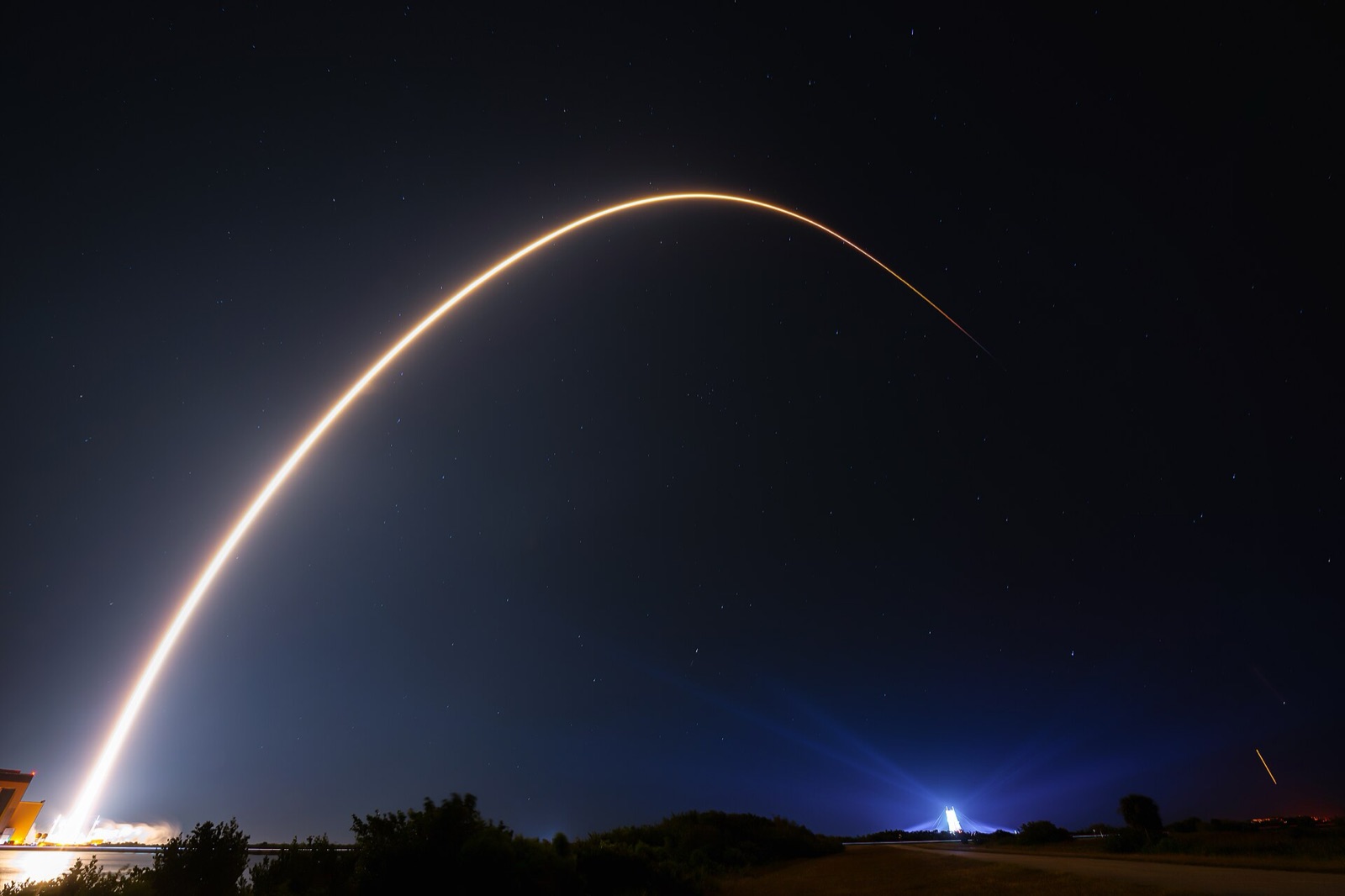
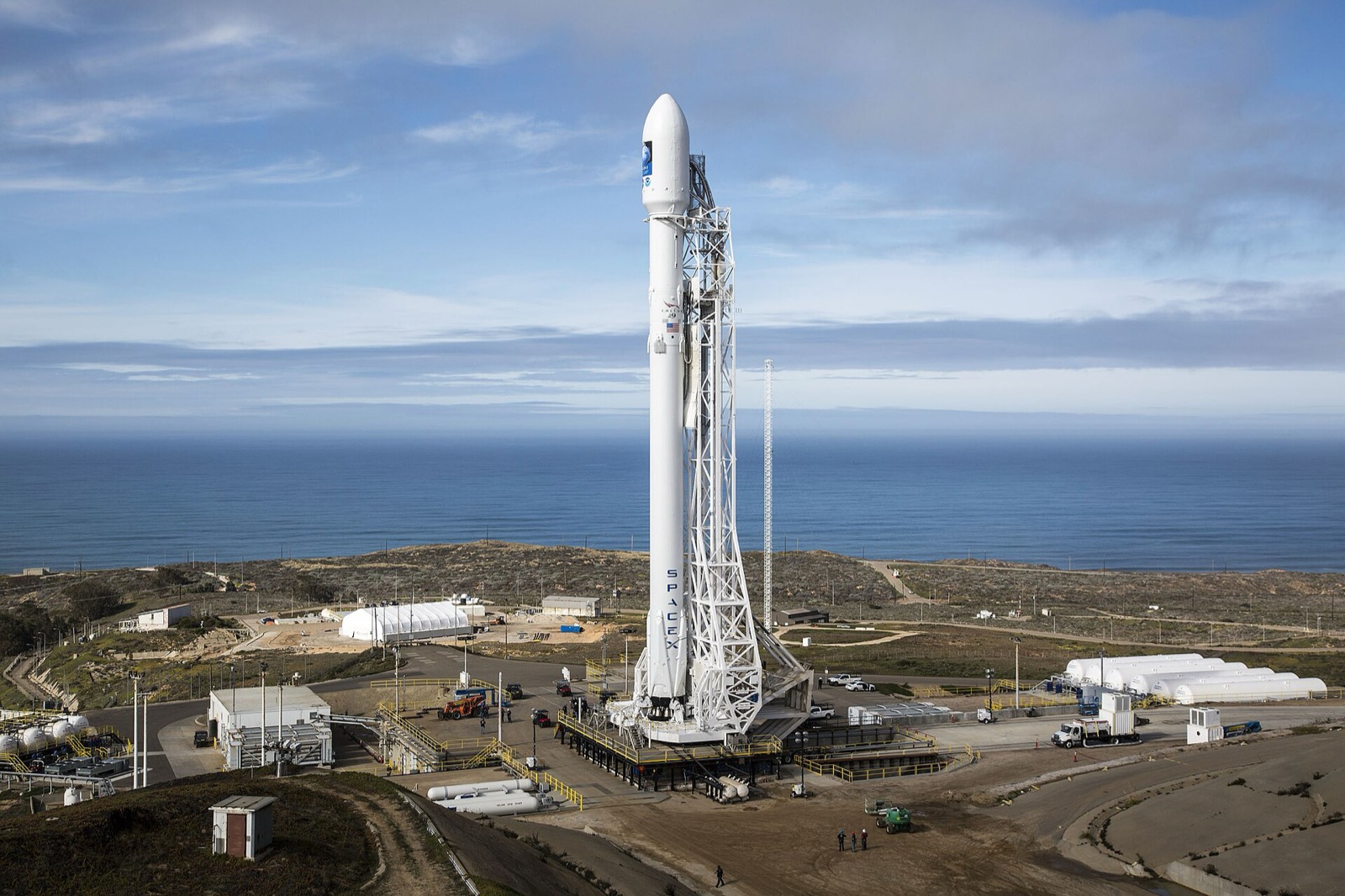
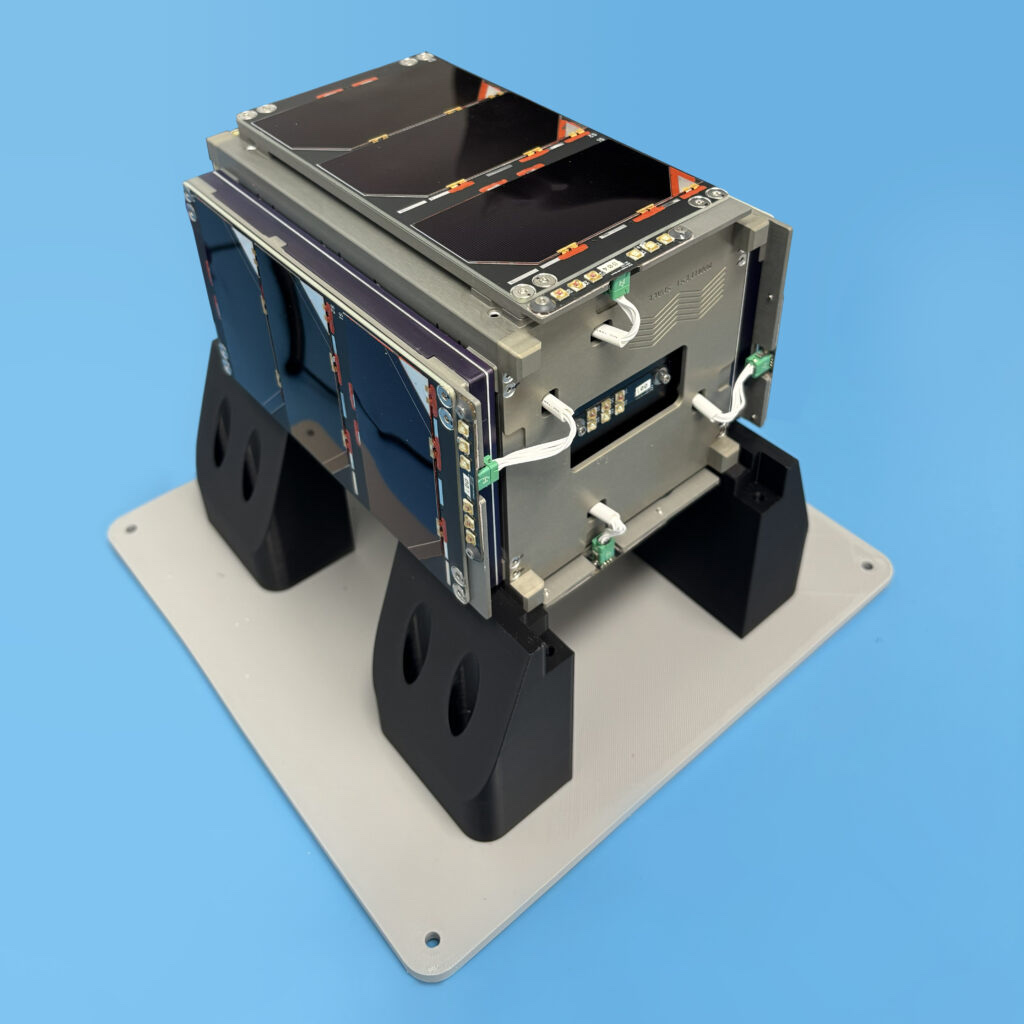
SpaceX built the V2 Mini for its Starlink network. It is larger than the first generation, with more powerful antennas and bigger solar arrays, and it has four times the capacity for serving users. SpaceX launches them in batches on Falcon 9 rockets.
The satellite weighs about 800 kg at launch and has a body more than 4.1 m wide. Once in orbit it unfurls two solar array wings to a span of about 30 m. It manoeuvres with an electric Hall thruster fuelled by argon gas, the only material named for the satellite itself.
Application
A broadband internet satellite in SpaceX's Starlink constellation, launched on Falcon 9 in batches. It is larger than the first generation, with more powerful phased array antennas and bigger solar arrays. It manoeuvres with an argon Hall thruster.
Photos
How it is built
Body, wings and thruster
The body is more than 4.1 m wide. Two solar array wings unfurl from it to a span of about 30 m. A Hall thruster, an electric engine, uses argon gas as its propellant to manoeuvre the satellite in orbit.
Spacecraft body (bus)
Solar array wings (2)
Hall thruster propellant
Argon Hall-effect thruster unit
Antennas and brightness
Its phased array antennas are more powerful than those on older Starlink satellites. A new E-band system adds backhaul capacity, the link back into the wider network. To reduce brightness, SpaceX uses a combination of mirrors and a new type of low-reflectivity paint.
Phased array antennas
E-band backhaul system
Low-reflectivity paint
Mirrors
The launch stack
For the first satellites on Falcon 9, spacers and tension rods sit between the stacked satellites. The stack also has four deployment rod assemblies, each of two rods made of lightweight aluminium, 1.5 inches in diameter and about six metres long.
Deployment rod assemblies (four, two rods each) for the Falcon 9 stack
Spacers and tension rods between stacked satellites (initial Falcon 9 launches)
Where the parts areNumber of parts we have listed in each group
Communications6
Propulsion3
Brightness mitigation2
Launch stack2
Solar array1
Structure1
Avionics and safety1
What it is made of
Argon
The gas propellant for the Hall thruster. It is the only material named for the satellite itself.
The deployment rods in the Falcon 9 launch stack, about six metres long. The alloy is not stated.
How it connects to other things
SpaceX builds the V2 Mini and launches it on Falcon 9 rockets. The first launch carried 21 satellites. Its argon Hall thruster is a SpaceX design. The V2 Mini grew out of the first-generation Starlink satellites and has four times their capacity for serving users. It belongs to the Gen2 constellation, whose first 7,500 satellites the US Federal Communications Commission has authorised to operate at 525, 530 and 535 km.
Used in
Starlink Gen2 constellation (FCC authorisation)
FCC authorised up to 7,500 Gen2 satellites at 525, 530 and 535 km
Carries
Argon Hall-effect thruster (SpaceX)
electric propulsion for on-orbit manoeuvring; not a catalog product
V2 Mini has four times the user capacity of earlier satellites
What we do not know
SpaceX does not publish what the structure, solar panels and cells, antennas, paint and wiring are made of. It also names no suppliers, and gives no details of the battery, star trackers or reaction wheels.
The detailed data
What is written above is built from these numbers and quotes. Each row links to the page it was taken from. Get all of it as JSON, or ask our MCP server.
Features
Argon-fuelled Hall thruster for on-orbit manoeuvring
Phased array antennas and E-band backhaul
Specifications
What
Value
Mass
About 800 kg (1,760 lb) at launch
Body width
More than 4.1 m (13 ft)
Solar array span
About 30 m (100 ft)
Total surface area
About 116 m2
Launch vehicle
Falcon 9
Operating altitudes authorised for the first 7,500 Gen2 satellites
525, 530 and 535 km
Design life assumed in the Gen2 filing
five years
Re-entry
fully demise on re-entry (SpaceX analysis)
User capacity versus earlier satellites
four times
V2 Mini Optimized (2025) mass
about 575 kg (1,267 lb), nearly 22 percent lighter
V2 Mini Optimized satellites per Falcon 9
up to 29
Laser link rate (V2 Mini Optimized)
up to 200 Gbps each
Materials in detail
Each material named in the sources: where it is used here, which other products use it, and its key numbers when its material page exists.
Only the argon propellant is stated; structural materials are not published. Components, suppliers and links were added from public sources. A material is left blank where no source states it.
SpaceX does not publish structure, panel, solar-cell, antenna, paint or harness materials for V2 Mini; the only material stated in the source is the argon propellant. Quotes were retrieved through a text extractor because the site blocks direct download; they were not machine-checked against the page. Figures come from FCC filings as reported by Spaceflight Now. Nothing was inferred. More detail: SpaceX does not publish a V2 Mini bill of materials, solar-cell type, antenna substrate, structure, battery, star-tracker or reaction-wheel details for this satellite; the starlink.com technology page that would carry them returns no text to the fetcher, and no readable primary source was found for star trackers or reaction wheels on the V2 Mini. Laser-link, Doppio antenna and mass figures for the 2025 'V2 Mini Optimized' version are from Spaceflight Now coverage of SpaceX statements and describe a later, lighter variant than the 800 kg satellite in the entry. FCC rows describe the whole Gen2 constellation (Ku- and Ka-band beams, cold-gas mode, collision-avoidance, propellant budget), not the V2 Mini alone. No supplier is named for any V2 Mini part. The FCC order quotes were machine-checked against the downloaded PDF text; Spaceflight Now and Via Satellite quotes came through a text extractor and were not machine-checked. More detail: SpaceX does not publish a V2 Mini bill of materials, solar-cell type, antenna substrate, structure, battery, star-tracker or reaction-wheel details for this satellite; the starlink.com technology page that would carry them returns no text to the fetcher, and no readable primary source was found for star trackers or reaction wheels on the V2 Mini. Laser-link, Doppio antenna and mass figures for the 2025 'V2 Mini Optimized' version are from Spaceflight Now coverage of SpaceX statements and describe a later, lighter variant than the 800 kg satellite in the entry. FCC rows describe the whole Gen2 constellation (Ku- and Ka-band beams, cold-gas mode, collision-avoidance, propellant budget), not the V2 Mini alone. No supplier is named for any V2 Mini part. The FCC order quotes were machine-checked against the downloaded PDF text; Spaceflight Now and Via Satellite quotes came through a text extractor and were re-checked in a second fetch pass but not against a saved copy of the page.