Lithium nickel manganese cobalt oxide NMC
LiNixMnyCozO2 (x+y+z=1) · CAS 346417-97-8 · layered alpha-NaFeO2 type, R-3m
NMC is a family of layered nickel-manganese-cobalt oxide cathodes; the numbers in the name (111, 622, 811) are the nickel:manganese:cobalt ratio.
Evidence level
2 of 5
Lab-measured
- 0Predicted only. No one has made it, or no measurement exists.
- 1Calculated. Only calculated or predicted values from sources.
- 2Lab-measured. Measured properties with their conditions stated.
- 3Space-relevant tests. Measured in conditions relevant to space, such as vacuum or atomic oxygen.
- 4Ground-qualified. Qualified for an application on the ground.
- 5Flown or field-proven. Flight or field results exist.
Capacity in cells
Up to 177.8 mAh/g
Oxygen release
4.3 to 4.7 V
Thermal behavior
Peaked at 731 °C
Cycle life
94% after 300 cycles
Low temperature
About 70% at -20 °C
Recipe, share of the weight
- Li not statedLithium
- Ni not statedNickel
- Mn not statedManganese
- Co not statedCobalt
- O not statedOxygen
Best for
High capacity per gram, with the Ni-rich versions giving the most
Weakest at
Heat tolerance: charged NMC releases oxygen, and nickel-rich versions cycle stably only to lower voltage limits
Risk at a glance
- People High. Mixed, some serious classifications
- If it fails High. Oxygen release from charged NMC
- Corrosion Moderate. In air, nickel-rich powders form surface residues that cost capacity at high voltage.
Why it exists
NMC (lithium nickel manganese cobalt oxide, LiNiₓMnᵧCo_zO₂) is a family of layered-oxide cathodes with the α-NaFeO₂-type structure (hexagonal setting, space group R-3m). The numbers in a name such as NMC111, NMC622 or NMC811 give the nickel:manganese:cobalt ratio. Raising the nickel fraction increases the capacity per gram, but the sources collected here show that nickel-rich compositions also release oxygen from the charged material at a lower voltage, which makes a cell heat faster and hotter when it fails. NMC therefore sits at the high-energy end of the trade that LFP makes in the opposite direction.
Recipe
LiNixMnyCozO2 (x+y+z=1); NMC111 = LiNi1/3Mn1/3Co1/3O2, NMC622 = LiNi0.6Mn0.2Co0.2O2, NMC811 = LiNi0.8Mn0.1Co0.1O2; NMC532 = LiNi0.5Mn0.3Co0.2O2
NMC is a layered oxide with one lithium, one oxygen-rich lattice and three metals: nickel (Ni), manganese (Mn) and cobalt (Co). The general formula is LiNixMnyCozO2 with x + y + z = 1, and the three digits in the name give the metal ratio. NMC111 has one third of each metal, NMC532 has 0.5 nickel, 0.3 manganese and 0.2 cobalt, NMC622 has 0.6, 0.2 and 0.2, and NMC811 has 0.8, 0.1 and 0.1. It is made by co-precipitation: metal salt solutions are mixed with a chelating agent so mixed nickel, manganese and cobalt hydroxide or carbonate particles form, then they are mixed with a lithium source and calcined (heated) at high temperature. A sol-gel route, which makes a gel from metal and lithium salts and then calcines it in two stages, is the other common method.
| Ingredient | Share of the weight | What it does |
|---|---|---|
| Lithium Li | not stated | The mobile species that moves in and out of the layers as the cell charges and discharges. |
| Nickel Ni | not stated | Adds capacity per gram; more nickel means more capacity but less heat tolerance. |
| Manganese Mn | not stated | Structural element that stays in a stable oxidation state while the cell cycles. |
| Cobalt Co | not stated | Helps the layered structure hold together; cobalt content is being reduced because of cost. |
| Oxygen O | not stated | Forms the oxide lattice with the metals. |
Weight shares are as printed in the sources.
What it can do
Capacity in cells
Up to 177.8 mAh/g
The theoretical specific capacity of layered nickel-manganese-cobalt oxides is as high as about 275 mAh/g, which would require removing all the lithium and is not possible in practice. In NMC/graphite full cells cycled at 1 C and 25 °C, the capacity per gram of NMC was 162.8 mAh/g for NMC111 and 177.8 mAh/g for NMC622 at a 4.4 V cutoff, and 172.5 mAh/g for NMC811 at a 4.2 V cutoff.
Oxygen release
4.3 to 4.7 V
In half cells at 25 °C, oxygen release from the charged material began near 4.7 V for NMC111 and NMC622 and near 4.3 V for NMC811, versus Li/Li⁺. The more nickel, the lower the voltage at which release begins.
Thermal behavior
Peaked at 731 °C
A charged commercial 2.2 Ah NMC111 cell began to heat itself at about 91 °C in an accelerating-rate calorimetry test and reached 731 °C at up to 7,580 °C/min. The LFP cell tested the same way peaked at 259 °C. The authors note that the NMC cell holds twice the nominal capacity.
Cycle life
94% after 300 cycles
Cycled against graphite at 1 C and 25 °C with a 4.4 V cutoff, NMC111 and NMC622 each retained 94% of their capacity between cycle 5 and cycle 300. NMC811 retained 66% at a 4.2 V cutoff and 90% at 4.0 V. At 4.6 V, NMC111 retained only 42%.
Low temperature
About 70% at -20 °C
Pouch cells of about 4 Ah, which the report's authors believe to contain NMC but did not confirm, delivered about 70% of their room-temperature capacity at -20 °C, 60% at -30 °C, 40% at -40 °C and 25% at -50 °C.
How it compares
NMC offers more capacity per gram than LFP, about 275 mAh/g in theory against 170 mAh/g. The cost is heat tolerance. Charged NMC releases oxygen, and in the one side-by-side test collected here the NMC111 cell peaked at 731 °C against 259 °C for the LFP cell. The table compares NMC with the other cathodes in the collection.
The same measurements for each material, so you can compare them. Each row names the key condition under the value; the full conditions and methods are in the numbered notes under Technical details. Other materials are shown beside it; each was measured under its own conditions, so open its page before comparing closely. See the full ranking.
| Measurement | NMC | LFP | LCO | NCA | LNO | LMO |
|---|---|---|---|---|---|---|
| Capacity and energy | ||||||
| Theoretical specific capacity | 275 mAh/g1 | 170 mAh/g | 274 mAh/g | 278 mAh/g | 275 mAh/g | 285 mAh/g |
| Thermal behavior and safety | ||||||
| Oxygen release onset, NMC111 (half cell)On-line electrochemical mass spectrometry (OEMS) | 4.7 V vs Li/Li+2 | no data | no data | no data | no data | no data |
| Oxygen release onset, NMC622 (half cell)On-line electrochemical mass spectrometry (OEMS) | 4.7 V vs Li/Li+3 | no data | no data | no data | no data | no data |
| Oxygen release onset, NMC811 (half cell)On-line electrochemical mass spectrometry (OEMS) | 4.3 V vs Li/Li+4 | no data | no data | no data | no data | no data |
| Lifetime and stability | ||||||
| Volume change on cycling | 7.8 %5 | 6.6 % | no data | no data | no data | 16 % |
Why choose it, and why not
Good for
- High capacity per gram, highest in the nickel-rich versions.
- A tunable family. Composition trades capacity against stability, and a review citing Bak et al. judges NMC532 the best compromise of thermal stability and capacity among the compositions it studied.
Watch out for
- Oxygen release from the charged material begins at a lower voltage as nickel rises, about 4.3 V for NMC811 against 4.7 V for NMC111, and the oxygen can feed thermal runaway.
- Nickel-rich NMC811 is the least stable to cycle at high cutoff voltage. It retained 66% after 300 cycles at 4.2 V against 94% for NMC111 and NMC622 at 4.4 V.
- Powder hazards are significant and depend on the supplier. Check the safety data sheet of the exact powder.
NMC is the high-energy choice. It stores more charge per gram than LFP, and the price is heat: charged NMC releases oxygen, and the tests collected here show it failing far hotter.
Technical details
For scientists and researchers. Everything above comes from the record below: every number with its method, its conditions and its source.
Cell-level benchmarks
Values for finished cells. These vary by manufacturer, so read the conditions in the notes. Other materials are shown beside it; each was measured under its own conditions, so open its page before comparing closely. See the full ranking.
| Measurement | NMC | LFP | LCO | NCA | LNO | LMO |
|---|---|---|---|---|---|---|
| Capacity and energy | ||||||
| Specific capacity of NMC111 in an NMC/graphite full cell, 5th cycle | 162.8 mAh/g6 | no data | no data | no data | no data | no data |
| Specific capacity of NMC622 in an NMC/graphite full cell, 5th cycle | 177.8 mAh/g7 | no data | no data | no data | no data | no data |
| Specific capacity of NMC811 in an NMC/graphite full cell, 5th cycle | 172.5 mAh/g8 | no data | no data | no data | no data | no data |
| Cold capacity retentionCell discharge tests at low temperature (JPL) | 70 % of room-temperature capacity14 | 81.8 % of 20 °C capacity | no data | no data | no data | no data |
| Thermal behavior and safety | ||||||
| Self-heating onset, 2.2 Ah 18650 NMC111 cellAccelerating-rate calorimetry | 91 °C9 | 116.7 °C | 111.8 °C | 101.7 °C | no data | no data |
| Maximum temperature reached, 2.2 Ah 18650 NMC111 cellAccelerating-rate calorimetry | 731 °C10 | no data | no data | no data | no data | no data |
| Lifetime and stability | ||||||
| Cycle lifeFull-cell cycling | 300 cycles11 | 275 cycles | > 16000 cycles | 500 to 1500 cycles | 69.2 % retained | no data |
| Cycle lifeFull-cell cycling | 300 cycles12 | 275 cycles | > 16000 cycles | 500 to 1500 cycles | 69.2 % retained | no data |
| Cycle lifeFull-cell cycling | 300 cycles13 | 275 cycles | > 16000 cycles | 500 to 1500 cycles | 69.2 % retained | no data |
| Cycling at 60 degC, Quallion pouch cell with baseline electrolyteAccelerated high-temperature cycling (JPL) | 20 to 30 cycles15 | 275 cycles | > 16000 cycles | 500 to 1500 cycles | 69.2 % retained | no data |
Notes
The method, full conditions and any caveat for the numbered rows above.
| # | Measurement | Method | Conditions | Caveat |
|---|---|---|---|---|
| 1 | Theoretical specific capacity | Value stated in an open-access review ("as high as about 275") | composition NCM layered oxides in general (the review does not give it per Ni:Mn:Co ratio)basis all lithium removed; in practice not all lithium can be removed | — |
| 2 | Oxygen release onset, NMC111 (half cell) | — | composition NMC111cell NMC/Li half cellelectrolyte LP57 (1 M LiPF6 in EC:EMC 3:7)rate 0.05 C charge to 5 Vtemperature 25 °Cstate of charge about 80 to 90% for the three compositions together; the paper names about 80% explicitly only for NMC111 | Read from the paper's Fig. 5b; the paper states the onset follows the last high-voltage dQ/dV feature, not a fixed potential. |
| 3 | Oxygen release onset, NMC622 (half cell) | — | composition NMC622cell NMC/Li half cellelectrolyte LP57 (1 M LiPF6 in EC:EMC 3:7)rate 0.05 C charge to 5 Vtemperature 25 °Cstate of charge about 80 to 90% for the three compositions together; the paper names about 80% explicitly only for NMC111 | — |
| 4 | Oxygen release onset, NMC811 (half cell) | — | composition NMC811cell NMC/Li half cellelectrolyte LP57 (1 M LiPF6 in EC:EMC 3:7)rate 0.05 C charge to 5 Vtemperature 25 °Cstate of charge about 80 to 90% | The paper reports that all three materials release oxygen from the particle surface, and that the release stays in the surface-near region as a disordered spinel or rock-salt layer. |
| 5 | Volume change on cycling | In-situ diffraction, as reported by Kim et al. and summarised in the review | composition Li[Ni0.90Co0.05Mn0.05]O2 (NCM90)direction unit-cell volume shrinksregion charging beyond about 4.2 V (H2 to H3 phase transition)comparison LiNiO2 shrinks 10% | A Ni-rich composition, not NMC111. The review also says the c-axis shrinks 5.7% (NCM90) and 7.9% (LiNiO2) and that the volume change grows as the Ni fraction rises. |
| 6 | Specific capacity of NMC111 in an NMC/graphite full cell, 5th cycle | Full-cell cycling (not a half-cell); capacity per gram of NMC | composition NMC111cell NMC/graphite full cellupper cutoff 4.4 Vlower cutoff 3.0 Vrate 1 Ctemperature 25 °Ccycle 5units per gram of NMC | At a 4.2 V upper cutoff the same table gives 140.2 mAh/g for NMC111. |
| 7 | Specific capacity of NMC622 in an NMC/graphite full cell, 5th cycle | Full-cell cycling (not a half-cell); capacity per gram of NMC | composition NMC622cell NMC/graphite full cellupper cutoff 4.4 Vlower cutoff 3.0 Vrate 1 Ctemperature 25 °Ccycle 5units per gram of NMC | At a 4.2 V upper cutoff the same table gives 155.4 mAh/g for NMC622. |
| 8 | Specific capacity of NMC811 in an NMC/graphite full cell, 5th cycle | Full-cell cycling (not a half-cell); capacity per gram of NMC | composition NMC811cell NMC/graphite full cellupper cutoff 4.2 Vlower cutoff 3.0 Vrate 1 Ctemperature 25 °Ccycle 5units per gram of NMC | At a 4.0 V upper cutoff the same table gives 131.9 mAh/g for NMC811. |
| 9 | Self-heating onset, 2.2 Ah 18650 NMC111 cell | — | composition NMC111, Li(Ni0.33Mn0.33Co0.33)O2state of charge 100%cell commercial 2.2 Ah 18650 NMC/graphitemethod es-ARC, heated 30 to 250 °C in 5 °C stepsdetection 0.01 °C/min | Table 1 lists 91 degC; the text says the onset was about 90 degC for all three cell types tested (LMO, LFP, NMC111). |
| 10 | Maximum temperature reached, 2.2 Ah 18650 NMC111 cell | — | composition NMC111state of charge 100%cell commercial 2.2 Ah 18650 NMC/graphitemethod es-ARCcomparison LFP 1.1 Ah cell reached 259 °C | Maximum self-heating rate was 7580 degC/min in the text (7577 in Table 3). The authors point out the NMC cell has twice the nominal capacity of the LFP cell. |
| 11 | Cycle life | — | composition NMC111capacity retained 94% (cycle 5 to cycle 300)cell NMC/graphite full cellupper cutoff 4.4 Vlower cutoff 3.0 Vrate 1 Ctemperature 25 °Celectrolyte LP57 | At a 4.2 V cutoff NMC111 retained 93%; at 4.6 V only 42%. |
| 12 | Cycle life | — | composition NMC622capacity retained 94% (cycle 5 to cycle 300)cell NMC/graphite full cellupper cutoff 4.4 Vlower cutoff 3.0 Vrate 1 Ctemperature 25 °Celectrolyte LP57 | At a 4.2 V cutoff NMC622 retained 95%; at 4.6 V only 39%. |
| 13 | Cycle life | — | composition NMC811capacity retained 66% (cycle 5 to cycle 300)cell NMC/graphite full cellupper cutoff 4.2 Vlower cutoff 3.0 Vrate 1 Ctemperature 25 °Celectrolyte LP57 | At a 4.0 V cutoff NMC811 retained 90%; at 4.1 V 77%. The authors conclude stable cycling is possible up to 4.4 V for NMC111 and NMC622 but only up to 4.0 V for NMC811. |
| 14 | Cold capacity retention | — | cell Quallion pouch cells, about 4 Ahcathode believed by the report's authors to be NMC (0.33:0.33:0.33 Ni:Mn:Co); not confirmed in the reporttemperature -20 °C vs room temperaturedischarge C/2 to a 2.0 V cutoffelectrolyte two JPL low-temperature electrolytes (the baseline Quallion electrolyte did as well down to -40 °C) | The report gives about 70%, 60%, 40% and 25% of the room-temperature value at -20, -30, -40 and -50 degC. At -50 degC the baseline-electrolyte cell was non-operational. |
| 15 | Cycling at 60 degC, Quallion pouch cell with baseline electrolyte | — | cell Quallion pouch cell, about 4 Ahcathode believed by the report's authors to be NMC (0.33:0.33:0.33 Ni:Mn:Co); not confirmed in the reporttemperature 60 °Ccharge 4.1 V with taperelectrolyte Quallion baseline electrolyte (composition unknown) | The report says the cell survived barely 20 to 30 cycles and the low-temperature-electrolyte cell failed right away. The authors point to electrolyte oxidation and possible internal pressure build-up, and say no single cause can be assigned. |
Corrosion and compatibility
What happens when it meets other materials and environments.
| Environment | Concern | What happens |
|---|---|---|
| Air storage (moisture and CO2), Ni-rich NCM | moderate | In air, nickel-rich powders form surface residues that cost capacity at high voltage.1 |
| Carbonate electrolyte with LiPF6 (transition-metal dissolution) | moderate | Transition metals dissolve into the electrolyte, more at high cutoff voltage, and reach the graphite.2 |
| Humid laboratory air (about 25 degC, about 50% humidity) | moderate | Cathodes opened in humid air corroded and lost capacity quickly, far more than the LFP cathode in the same study.3 |
| Aluminium current collector (after humid-air exposure) and in LiPF6 electrolyte | not rated | After humid-air exposure the aluminium current collector showed signs of corrosion.4 |
| # | Environment | Details | Test conditions |
|---|---|---|---|
| 1 | Air storage (moisture and CO2), Ni-rich NCM | Lithium hydroxide and lithium carbonate impurities form on the surface during preparation and storage because Ni3+ slowly and spontaneously reduces to Ni2+. At high voltage these residues decompose and cost capacity; the review also says they react with LiPF6 to form HF. | material Ni-rich NCM (review text; exact compositions and humidity not given) |
| 2 | Carbonate electrolyte with LiPF6 (transition-metal dissolution) | Transition metals dissolve out of NCM into the electrolyte, more at high cutoff voltage; Wachs et al. saw the metal level in the electrolyte rise over time for NCM811, and Mn dissolution was detected for NCM111 at high cutoff. The review says HF attacks the electrode surface. Dissolved metals reach the graphite surface layer. | materials NCM811 and NCM111 (as summarised in the review)trigger high operating cutoff voltage |
| 3 | Humid laboratory air (about 25 degC, about 50% humidity) | NMC532/LMO cathodes taken from used Sony US18650V3 cells and opened in humid air developed a compact film of corrosion products over the original granular surface, lost manganese, and then showed an immediate and drastic capacity drop in coin cells. The paper says this cathode was much less resilient than the LFP one it tested alongside. | exposure cells opened in air at about 25 °C and about 50% humidity, then vacuum dried at 80 °C overnight; exposure time not statedcathode blend of 83.6% NMC532 and 16.4% LiMn2O4 (measured by ICP-OES), not pure NMCtest coin cells with 1.0 M LiPF6 in EC/DMC, C/10, 3.2 to 4.25 V |
| 4 | Aluminium current collector (after humid-air exposure) and in LiPF6 electrolyte | In the humidity-damaged NMC532/LMO electrodes, element maps showed more fluorine and aluminium and less manganese; the authors read the aluminium as coming from current-collector corrosion and the fluorine from HF formed when the cell was opened. Separately, a paper on aluminium passivation says LiPF6 electrolytes passivate aluminium at present-day operating potentials but still corrode current collectors at the higher potentials where high-potential cathodes operate. | humid air case cells opened at about 25 °C and about 50% humiditycathode NMC532/LMO blendelectrolyte LiPF6 in organic carbonates |
Risks and side effects
Hazards to people, what happens when a cell overheats, and how the material is handled and stored.
For people
The classification of NMC powders is mixed and, for some powders, serious. The safety data sheet of the exact powder should be checked.
- Database entries
- Across PubChem notifications for this CAS entry, the most common hazard codes are fatal if inhaled, may cause cancer, may damage fertility or the unborn child, causes damage to organs through prolonged or repeated exposure, may cause allergic skin reaction or asthma-like symptoms, and harmful to aquatic life with long lasting effects.
- A supplier sheet
- A supplier safety data sheet for NMC811 powder (Stanford Advanced Materials, 2018) is milder: skin sensitisation category 1A (H317) and carcinogenicity category 2 (H351), with the signal word Warning and an ACGIH exposure limit of 0.02 mg/m³ for the component. Classification therefore differs between suppliers and depends on nickel and cobalt content and impurities.
- Dust and contact
- Avoid dust and aerosols and contact with skin and eyes, and use exhaust ventilation where dust forms. The label statements include 'store locked up' and wear protective gloves.
- In a fire
- The fire products listed are nickel, lithium, cobalt and manganese oxides.
If a cell overheats
These results come from laboratory tests, not from incidents in the field.
- A charged NMC111 cell
- A commercial 2.2 Ah 18650 NMC/graphite cell at 100% state of charge was heated from 30 to 250 °C in 5 °C steps (es-ARC). It began to heat itself at about 91 °C and reached 731 °C at up to 7,580 °C/min. The LFP cell tested the same way peaked at 259 °C and stayed below 3 °C/min. The NMC cell holds twice the nominal capacity.
- Oxygen release
- At high delithiation, NMC and NCA release oxygen as Ni⁴⁺ is reduced on heating. The oxygen can react with the flammable electrolyte and lead to thermal runaway. In half cells at 25 °C, release began near 4.7 V for NMC111 and NMC622 and near 4.3 V for NMC811 versus Li/Li⁺.
- Gas in the cell
- More than 90% of the CO and CO₂ formed during cycling at high voltage came from released lattice oxygen reacting with the electrolyte, so oxygen release shows up as gas generation inside the cell.
- Metals on the anode
- Dissolved transition metals deposit in the graphite anode's surface layer, which the review links to higher cell impedance and trapped lithium.
Handling and storage
- Storage
- Keep the container tightly closed in a dry, well-ventilated place.
- Air exposure
- Nickel-rich powders form lithium hydroxide and lithium carbonate on the surface in air, because Ni³⁺ slowly and spontaneously reduces to Ni²⁺. These residues cost capacity at high voltage and can gel the NMP binder solution during mixing, so washing is used to remove them.
- Charge limit
- Limit the upper charge cutoff. Stable cycling with graphite was found up to 4.4 V for NMC111 and NMC622 but only to 4.0 V for NMC811.
Test details
The original wording and numbers from the sources, for readers who want them.
Failure risks
| Failure | Trigger and consequence |
|---|---|
| Oxygen release from charged NMChigh severity | Charging high, or heating a delithiated cathodeAt high delithiation NMC and NCA release oxygen as Ni4+ is reduced on heating; the oxygen can react with flammable electrolyte and lead to thermal runaway. In half cells at 25 degC the oxygen release began near 4.7 V (NMC111, NMC622) and 4.3 V (NMC811) vs Li. |
| Thermal runaway of a charged NMC111 cellhigh severity | es-ARC heating of a 2.2 Ah 18650 cell at 100% state of chargePeak temperature 731 degC and a self-heating rate up to 7580 degC/min, compared with 259 degC and below 3 degC/min for the LFP cell tested the same way. |
Side effects on surrounding parts
| Affects | Effect |
|---|---|
| Cell pressure and swelling | More than 90% of the CO and CO2 formed during cycling at high voltage came from released lattice oxygen reacting with the electrolyte, so oxygen release shows up as gas generation inside the cell. |
| Graphite anode | Dissolved transition metals deposit in the graphite anode's surface layer, which the review links to higher cell impedance and trapped lithium. |
Handling and storage
- SDS for NMC811 powder: avoid contact with skin and eyes, avoid dust and aerosols, provide exhaust ventilation where dust forms, keep the container tightly closed in a dry, well-ventilated place; its label statements include 'store locked up' and wear protective gloves. Fire products listed are nickel, lithium, cobalt and manganese oxides.
- Residual lithium compounds on Ni-rich powder react with slurry components during mixing and can gel the NMP binder solution, which makes coating on aluminium foil difficult; washing is used to remove them.
Mitigations
- Limit the upper charge cutoff: stable cycling with graphite was found up to 4.4 V for NMC111 and NMC622 but only to 4.0 V for NMC811.
- The review, citing Bak et al., judges NCM532 the best compromise of thermal stability and capacity among the compositions studied; higher Mn in the surface raises thermal stability.
Supply and geography
How common the raw materials are and where they come from.
Lithium
20 ppm in the Earth's crust (USGS table of crustal abundances, citing Jefferson Science Associates, 2014)
- Top producers (2025)
- Australia 31.7%, China 21.4%, Chile 19.3%, Zimbabwe 9.7%, Argentina 7.9%
- Critical mineral lists
- US: listed, EU: listed
- Recycling
- USGS: construction of lithium battery recycling plants continued throughout 2025, with automobile companies and battery recyclers partnering to supply battery materials.
- Substitutes
- USGS: substitution for lithium compounds is possible in batteries, ceramics, greases and manufactured glass (the examples it gives are for primary batteries, greases and ceramics, not lithium-ion cathodes).
Nickel
- Top producers (2025)
- Indonesia 66.7%, Philippines 6.9%, Russia 5.1%, Canada 3.6%, New Caledonia 3.6%
- Critical mineral lists
- US: listed, EU: listed
- Recycling
- USGS (U.S. figures): nickel recovered from scrap was about 60% of apparent consumption in 2025, mostly nickel in stainless-steel scrap; the chapter does not give a battery-recycling rate.
- Substitutes
- USGS substitutes text covers stainless steels, specialty steels and titanium alloys, not battery cathodes.
Manganese
950 ppm in the Earth's crust (USGS table of crustal abundances, citing Jefferson Science Associates, 2014)
- Top producers (2025)
- South Africa 38%, Gabon 25%, Ghana 10%, Australia 8%
- Critical mineral lists
- US: listed, EU: listed
- Recycling
- USGS: manganese is recycled incidentally in ferrous and nonferrous scrap; scrap recovery specifically for manganese was negligible.
- Substitutes
- USGS: manganese has no satisfactory substitute in its major applications.
Cobalt
25 ppm in the Earth's crust (USGS table of crustal abundances, citing Jefferson Science Associates, 2014)
- Top producers (2025)
- Congo (Kinshasa) 73%, Indonesia 14%
- Critical mineral lists
- US: listed, EU: listed
- Recycling
- USGS (U.S. figure): the cobalt content of purchased scrap was 25% of estimated cobalt consumption in 2025.
- Substitutes
- USGS: the cobalt content of lithium-ion batteries was being decreased, and cobalt-free substitutes that use iron and phosphorus held significant market share in China.
Gallery
Documents
Datasheets, safety data sheets, papers and standards you can open.
Full record
The complete spore, as stored. Free to reuse under CC-BY-4.0. Images keep the licence shown with each one.
Show the full YAML
spore: profile
id: nmc
spore_version: 0.2
family: lithium
name: Lithium nickel manganese cobalt oxide
abbreviation: NMC
role: cathode
category: energy
type: li-ion-cathodes
summary: |
  NMC is a family of layered nickel-manganese-cobalt oxide cathodes; the numbers in the name (111, 622, 811) are the nickel:manganese:cobalt ratio. More nickel gives more capacity per gram, but the sources here show it also releases oxygen from the charged material at lower voltage, which makes a cell heat up faster and hotter when it fails. This profile cites NMC111, NMC622 and NMC811 separately wherever a source names the composition.
best_for: High capacity per gram, with the Ni-rich versions giving the most
weakest_at: 'Heat tolerance: charged NMC releases oxygen, and nickel-rich versions cycle stably only to lower voltage limits'
identity:
  formula: LiNixMnyCozO2 (x+y+z=1); NMC111 = LiNi1/3Mn1/3Co1/3O2, NMC622 = LiNi0.6Mn0.2Co0.2O2, NMC811 = LiNi0.8Mn0.1Co0.1O2; NMC532 = LiNi0.5Mn0.3Co0.2O2
  cas: 346417-97-8
  crystal_system: layered alpha-NaFeO2 type, hexagonal setting
  space_group: R-3m
  source: ahangari2024
  where: Introduction (layered LiCoO2 / LiNixCoyMnzO2 lattice, R-3m); CAS number from PubChem CID 134693645, which lists it among synonyms; NMC532 formula from Wikipedia (Lithium nickel manganese cobalt oxides, lead section)
tags:
  environments: []
  stresses: []
  applications:
    - batteries
properties:
  - benchmark: theoretical_capacity
    value: 275
    unit: mAh/g
    scope: material
    conditions:
      composition: NCM layered oxides in general (the review does not give it per Ni:Mn:Co ratio)
      basis: all lithium removed; in practice not all lithium can be removed
    method: Value stated in an open-access review ("as high as about 275")
    status: calculated
    source: geldasa2022
    where: Section on Ni-rich NCM and cut-off voltage (statement on theoretical capacity of NCM)
  - benchmark: practical_capacity
    label: Specific capacity of NMC111 in an NMC/graphite full cell, 5th cycle
    value: 162.8
    unit: mAh/g
    scope: cell
    conditions:
      composition: NMC111
      cell: NMC/graphite full cell
      upper_cutoff: 4.4 V
      lower_cutoff: 3.0 V
      rate: 1 C
      temperature: 25 degC
      cycle: 5
      units: per gram of NMC
    method: Full-cell cycling (not a half-cell); capacity per gram of NMC
    status: ground
    note: At a 4.2 V upper cutoff the same table gives 140.2 mAh/g for NMC111.
    source: jung2017
    where: Table I
  - benchmark: practical_capacity
    label: Specific capacity of NMC622 in an NMC/graphite full cell, 5th cycle
    value: 177.8
    unit: mAh/g
    scope: cell
    conditions:
      composition: NMC622
      cell: NMC/graphite full cell
      upper_cutoff: 4.4 V
      lower_cutoff: 3.0 V
      rate: 1 C
      temperature: 25 degC
      cycle: 5
      units: per gram of NMC
    method: Full-cell cycling (not a half-cell); capacity per gram of NMC
    status: ground
    note: At a 4.2 V upper cutoff the same table gives 155.4 mAh/g for NMC622.
    source: jung2017
    where: Table I
  - benchmark: practical_capacity
    label: Specific capacity of NMC811 in an NMC/graphite full cell, 5th cycle
    value: 172.5
    unit: mAh/g
    scope: cell
    conditions:
      composition: NMC811
      cell: NMC/graphite full cell
      upper_cutoff: 4.2 V
      lower_cutoff: 3.0 V
      rate: 1 C
      temperature: 25 degC
      cycle: 5
      units: per gram of NMC
    method: Full-cell cycling (not a half-cell); capacity per gram of NMC
    status: ground
    note: At a 4.0 V upper cutoff the same table gives 131.9 mAh/g for NMC811.
    source: jung2017
    where: Table I
  - benchmark: o2_release_onset
    label: Oxygen release onset, NMC111 (half cell)
    value: 4.7
    unit: V vs Li/Li+
    scope: material
    conditions:
      composition: NMC111
      cell: NMC/Li half cell
      electrolyte: LP57 (1 M LiPF6 in EC:EMC 3:7)
      rate: 0.05 C charge to 5 V
      temperature: 25 degC
      state_of_charge: about 80 to 90% for the three compositions together; the paper names about 80% explicitly only for NMC111
    method: On-line electrochemical mass spectrometry (OEMS)
    status: ground
    note: Read from the paper's Fig. 5b; the paper states the onset follows the last high-voltage dQ/dV feature, not a fixed potential.
    source: jung2017
    where: Results (Fig. 5b); Discussion
  - benchmark: o2_release_onset
    label: Oxygen release onset, NMC622 (half cell)
    value: 4.7
    unit: V vs Li/Li+
    scope: material
    conditions:
      composition: NMC622
      cell: NMC/Li half cell
      electrolyte: LP57 (1 M LiPF6 in EC:EMC 3:7)
      rate: 0.05 C charge to 5 V
      temperature: 25 degC
      state_of_charge: about 80 to 90% for the three compositions together; the paper names about 80% explicitly only for NMC111
    method: On-line electrochemical mass spectrometry (OEMS)
    status: ground
    source: jung2017
    where: Results (Fig. 5b); Discussion
  - benchmark: o2_release_onset
    label: Oxygen release onset, NMC811 (half cell)
    value: 4.3
    unit: V vs Li/Li+
    scope: material
    conditions:
      composition: NMC811
      cell: NMC/Li half cell
      electrolyte: LP57 (1 M LiPF6 in EC:EMC 3:7)
      rate: 0.05 C charge to 5 V
      temperature: 25 degC
      state_of_charge: about 80 to 90%
    method: On-line electrochemical mass spectrometry (OEMS)
    status: ground
    note: The paper reports that all three materials release oxygen from the particle surface, and that the release stays in the surface-near region as a disordered spinel or rock-salt layer.
    source: jung2017
    where: Results (Fig. 5b); Discussion
  - benchmark: volume_change
    value: 7.8
    unit: '%'
    scope: material
    conditions:
      composition: Li[Ni0.90Co0.05Mn0.05]O2 (NCM90)
      direction: unit-cell volume shrinks
      region: charging beyond about 4.2 V (H2 to H3 phase transition)
      comparison: LiNiO2 shrinks 10%
    method: In-situ diffraction, as reported by Kim et al. and summarised in the review
    status: ground
    note: A Ni-rich composition, not NMC111. The review also says the c-axis shrinks 5.7% (NCM90) and 7.9% (LiNiO2) and that the volume change grows as the Ni fraction rises.
    source: ahangari2024
    where: Section on structural degradation (paragraph on Kim et al., Fig. 6a-c)
  - benchmark: thermal_runaway_onset
    label: Self-heating onset, 2.2 Ah 18650 NMC111 cell
    value: 91
    unit: degC
    scope: cell
    conditions:
      composition: NMC111, Li(Ni0.33Mn0.33Co0.33)O2
      state_of_charge: 100%
      cell: commercial 2.2 Ah 18650 NMC/graphite
      method: es-ARC, heated 30 to 250 degC in 5 degC steps
      detection: 0.01 degC/min
    method: Accelerating-rate calorimetry
    status: ground
    note: Table 1 lists 91 degC; the text says the onset was about 90 degC for all three cell types tested (LMO, LFP, NMC111).
    source: lei2017
    where: Table 1 ("This work") and Section 3.2
  - benchmark: thermal_runaway_max_temp
    label: Maximum temperature reached, 2.2 Ah 18650 NMC111 cell
    value: 731
    unit: degC
    scope: cell
    conditions:
      composition: NMC111
      state_of_charge: 100%
      cell: commercial 2.2 Ah 18650 NMC/graphite
      method: es-ARC
      comparison: LFP 1.1 Ah cell reached 259 degC
    method: Accelerating-rate calorimetry
    status: ground
    note: Maximum self-heating rate was 7580 degC/min in the text (7577 in Table 3). The authors point out the NMC cell has twice the nominal capacity of the LFP cell.
    source: lei2017
    where: Section 3.2, Table 3
  - benchmark: cycle_life
    value: 300
    unit: cycles
    scope: cell
    conditions:
      composition: NMC111
      capacity_retained: 94% (cycle 5 to cycle 300)
      cell: NMC/graphite full cell
      upper_cutoff: 4.4 V
      lower_cutoff: 3.0 V
      rate: 1 C
      temperature: 25 degC
      electrolyte: LP57
    method: Full-cell cycling
    status: ground
    note: At a 4.2 V cutoff NMC111 retained 93%; at 4.6 V only 42%.
    source: jung2017
    where: Table I; Results (cycling)
  - benchmark: cycle_life
    value: 300
    unit: cycles
    scope: cell
    conditions:
      composition: NMC622
      capacity_retained: 94% (cycle 5 to cycle 300)
      cell: NMC/graphite full cell
      upper_cutoff: 4.4 V
      lower_cutoff: 3.0 V
      rate: 1 C
      temperature: 25 degC
      electrolyte: LP57
    method: Full-cell cycling
    status: ground
    note: At a 4.2 V cutoff NMC622 retained 95%; at 4.6 V only 39%.
    source: jung2017
    where: Table I; Results (cycling)
  - benchmark: cycle_life
    value: 300
    unit: cycles
    scope: cell
    conditions:
      composition: NMC811
      capacity_retained: 66% (cycle 5 to cycle 300)
      cell: NMC/graphite full cell
      upper_cutoff: 4.2 V
      lower_cutoff: 3.0 V
      rate: 1 C
      temperature: 25 degC
      electrolyte: LP57
    method: Full-cell cycling
    status: ground
    note: At a 4.0 V cutoff NMC811 retained 90%; at 4.1 V 77%. The authors conclude stable cycling is possible up to 4.4 V for NMC111 and NMC622 but only up to 4.0 V for NMC811.
    source: jung2017
    where: Table I; Abstract
  - benchmark: cold_capacity
    value: 70
    unit: '% of room-temperature capacity'
    scope: cell
    conditions:
      cell: Quallion pouch cells, about 4 Ah
      cathode: believed by the report's authors to be NMC (0.33:0.33:0.33 Ni:Mn:Co); not confirmed in the report
      temperature: '-20 degC vs room temperature'
      discharge: C/2 to a 2.0 V cutoff
      electrolyte: two JPL low-temperature electrolytes (the baseline Quallion electrolyte did as well down to -40 degC)
    method: Cell discharge tests at low temperature (JPL)
    status: ground
    note: The report gives about 70%, 60%, 40% and 25% of the room-temperature value at -20, -30, -40 and -50 degC. At -50 degC the baseline-electrolyte cell was non-operational.
    source: nasa-tm2010
    where: Volume II, Quallion Pouch Cells section, p. 112 of 206 (text under Figs. 6 to 10)
  - benchmark: cycle_life
    label: Cycling at 60 degC, Quallion pouch cell with baseline electrolyte
    value: 20
    value_high: 30
    bound: range
    unit: cycles
    scope: cell
    conditions:
      cell: Quallion pouch cell, about 4 Ah
      cathode: believed by the report's authors to be NMC (0.33:0.33:0.33 Ni:Mn:Co); not confirmed in the report
      temperature: 60 degC
      charge: 4.1 V with taper
      electrolyte: Quallion baseline electrolyte (composition unknown)
    method: Accelerated high-temperature cycling (JPL)
    status: ground
    note: The report says the cell survived barely 20 to 30 cycles and the low-temperature-electrolyte cell failed right away. The authors point to electrolyte oxidation and possible internal pressure build-up, and say no single cause can be assigned.
    source: nasa-tm2010
    where: Volume II, High Temperature Cycling, pp. 115-116 of 206
corrosion:
  - environment: Air storage (moisture and CO2), Ni-rich NCM
    headline: In air, nickel-rich powders form surface residues that cost capacity at high voltage.
    effect: Lithium hydroxide and lithium carbonate impurities form on the surface during preparation and storage because Ni3+ slowly and spontaneously reduces to Ni2+. At high voltage these residues decompose and cost capacity; the review also says they react with LiPF6 to form HF.
    rating: moderate
    conditions:
      material: Ni-rich NCM (review text; exact compositions and humidity not given)
    source: ahangari2024
    where: Section on surface residual lithium and gas evolution (paragraphs on LiOH/Li2CO3)
  - environment: Carbonate electrolyte with LiPF6 (transition-metal dissolution)
    headline: Transition metals dissolve into the electrolyte, more at high cutoff voltage, and reach the graphite.
    effect: Transition metals dissolve out of NCM into the electrolyte, more at high cutoff voltage; Wachs et al. saw the metal level in the electrolyte rise over time for NCM811, and Mn dissolution was detected for NCM111 at high cutoff. The review says HF attacks the electrode surface. Dissolved metals reach the graphite surface layer.
    rating: moderate
    conditions:
      materials: NCM811 and NCM111 (as summarised in the review)
      trigger: high operating cutoff voltage
    source: ahangari2024
    where: Section on transition-metal dissolution (Wachs et al.; Gilbert et al.)
  - environment: Humid laboratory air (about 25 degC, about 50% humidity)
    headline: Cathodes opened in humid air corroded and lost capacity quickly, far more than the LFP cathode in the same study.
    effect: NMC532/LMO cathodes taken from used Sony US18650V3 cells and opened in humid air developed a compact film of corrosion products over the original granular surface, lost manganese, and then showed an immediate and drastic capacity drop in coin cells. The paper says this cathode was much less resilient than the LFP one it tested alongside.
    rating: moderate
    conditions:
      exposure: cells opened in air at about 25 degC and about 50% humidity, then vacuum dried at 80 degC overnight; exposure time not stated
      cathode: blend of 83.6% NMC532 and 16.4% LiMn2O4 (measured by ICP-OES), not pure NMC
      test: coin cells with 1.0 M LiPF6 in EC/DMC, C/10, 3.2 to 4.25 V
    source: mele2025
    where: Sections 2.2, 2.3, 3.2 and 4 (Conclusions)
  - environment: Aluminium current collector (after humid-air exposure) and in LiPF6 electrolyte
    headline: After humid-air exposure the aluminium current collector showed signs of corrosion.
    effect: In the humidity-damaged NMC532/LMO electrodes, element maps showed more fluorine and aluminium and less manganese; the authors read the aluminium as coming from current-collector corrosion and the fluorine from HF formed when the cell was opened. Separately, a paper on aluminium passivation says LiPF6 electrolytes passivate aluminium at present-day operating potentials but still corrode current collectors at the higher potentials where high-potential cathodes operate.
    rating: unknown
    conditions:
      humid_air_case: cells opened at about 25 degC and about 50% humidity
      cathode: NMC532/LMO blend
      electrolyte: LiPF6 in organic carbonates
    source: mele2025
    where: Section 3.2 (EDS mapping, Figure 7g); general statement from theivaprakasam2018, Introduction
risks:
  hazards:
    - text: PubChem lists mixed-notification classifications for this CAS entry. The most common codes across the notifications are fatal if inhaled, may cause cancer, may damage fertility or the unborn child, causes damage to organs through prolonged or repeated exposure, may cause allergic skin reaction or asthma-like symptoms, and harmful to aquatic life with long lasting effects. These depend on supplier, nickel and cobalt content and impurities, so check the SDS for the exact powder.
      ghs:
        - H330
        - H350
        - H360
        - H372
        - H317
        - H334
        - H412
      source: pubchem-nmc
      where: Safety and Hazards, GHS Classification (CID 134693645; 119, 108 and 50 reports in three groups)
    - text: 'Supplier safety data sheet for LiNi0.8Mn0.1Co0.1O2 (NMC811) powder, CAS 346417-97-8 (Stanford Advanced Materials, rev. July 2018): skin sensitisation category 1A (H317) and carcinogenicity category 2 (H351); signal word Warning. Section 8 lists an ACGIH TWA of 0.02 mg/m3 for the component. This is a milder classification than the most common PubChem notifications, so classification clearly differs between suppliers.'
      ghs:
        - H317
        - H351
      source: sam-nmc811-sds
      where: Sections 2, 3 and 8
  failure_risks:
    - mode: Oxygen release from charged NMC
      trigger: Charging high, or heating a delithiated cathode
      consequence: At high delithiation NMC and NCA release oxygen as Ni4+ is reduced on heating; the oxygen can react with flammable electrolyte and lead to thermal runaway. In half cells at 25 degC the oxygen release began near 4.7 V (NMC111, NMC622) and 4.3 V (NMC811) vs Li.
      severity: high
      source: jung2017
      where: Results (OEMS, Fig. 5b); ahangari2024 Section on thermal stability
    - mode: Thermal runaway of a charged NMC111 cell
      trigger: es-ARC heating of a 2.2 Ah 18650 cell at 100% state of charge
      consequence: Peak temperature 731 degC and a self-heating rate up to 7580 degC/min, compared with 259 degC and below 3 degC/min for the LFP cell tested the same way.
      severity: high
      source: lei2017
      where: Section 3.2, Table 3
  side_effects:
    - text: More than 90% of the CO and CO2 formed during cycling at high voltage came from released lattice oxygen reacting with the electrolyte, so oxygen release shows up as gas generation inside the cell.
      affects: Cell pressure and swelling
      source: jung2017
      where: Discussion, connection between released O2 and CO/CO2
    - text: Dissolved transition metals deposit in the graphite anode's surface layer, which the review links to higher cell impedance and trapped lithium.
      affects: Graphite anode
      source: ahangari2024
      where: Section on transition-metal dissolution (Gilbert et al. model)
  handling:
    - text: 'SDS for NMC811 powder: avoid contact with skin and eyes, avoid dust and aerosols, provide exhaust ventilation where dust forms, keep the container tightly closed in a dry, well-ventilated place; its label statements include ''store locked up'' and wear protective gloves. Fire products listed are nickel, lithium, cobalt and manganese oxides.'
      source: sam-nmc811-sds
      where: Sections 2, 5 and 7
    - text: Residual lithium compounds on Ni-rich powder react with slurry components during mixing and can gel the NMP binder solution, which makes coating on aluminium foil difficult; washing is used to remove them.
      source: geldasa2022
      where: Section on residual lithium
  mitigations:
    - text: 'Limit the upper charge cutoff: stable cycling with graphite was found up to 4.4 V for NMC111 and NMC622 but only to 4.0 V for NMC811.'
      source: jung2017
      where: Abstract; Table I
    - text: The review, citing Bak et al., judges NCM532 the best compromise of thermal stability and capacity among the compositions studied; higher Mn in the surface raises thermal stability.
      source: ahangari2024
      where: Section on thermal stability of NCM cathodes
uses:
  - application: batteries
    device: Cathode in lithium-ion cells for electric vehicles
    example: A review of Ni-rich NCM cathodes names electric vehicles as the main application that drives their use and the problems that hold them back.
    source: ahangari2024
    where: Opening text of the review (electric vehicle challenge)
  - application: batteries
    device: Cathode in lithium-ion cells for mobile devices
    example: Wikipedia says NMC materials are commonly used in lithium-ion batteries for mobile devices and electric vehicles.
    source: wiki-nmc
    where: Lead paragraph
supply:
  - subject: Lithium
    abundance: 20 ppm in the Earth's crust (USGS table of crustal abundances, citing Jefferson Science Associates, 2014)
    producers:
      - country: Australia
        share_percent: 31.7
        year: 2025
      - country: China
        share_percent: 21.4
        year: 2025
      - country: Chile
        share_percent: 19.3
        year: 2025
      - country: Zimbabwe
        share_percent: 9.7
        year: 2025
      - country: Argentina
        share_percent: 7.9
        year: 2025
    critical_lists:
      - list: USGS 2025 List of Critical Minerals
        listed: true
      - list: EU critical raw materials list (Regulation (EU) 2024/1252, as shown on the European Commission page)
        listed: true
    recycling: 'USGS: construction of lithium battery recycling plants continued throughout 2025, with automobile companies and battery recyclers partnering to supply battery materials.'
    substitutes:
      - 'USGS: substitution for lithium compounds is possible in batteries, ceramics, greases and manufactured glass (the examples it gives are for primary batteries, greases and ceramics, not lithium-ion cathodes).'
    source: usgs-mcs2026-lithium
    where: 'World Mine Production and Reserves table (2025e; shares calculated by Space Mushroom against the 290,000 t world total, which excludes U.S. output); Recycling; Substitutes. Abundance: USGS PP 1802-A Table A1 (p. A7). Lists: USGS and European Commission pages (see sources).'
  - subject: Nickel
    producers:
      - country: Indonesia
        share_percent: 66.7
        year: 2025
      - country: Philippines
        share_percent: 6.9
        year: 2025
      - country: Russia
        share_percent: 5.1
        year: 2025
      - country: Canada
        share_percent: 3.6
        year: 2025
      - country: New Caledonia
        share_percent: 3.6
        year: 2025
    critical_lists:
      - list: USGS 2025 List of Critical Minerals
        listed: true
      - list: EU critical raw materials list (Regulation (EU) 2024/1252, as shown on the European Commission page)
        listed: true
    recycling: 'USGS (U.S. figures): nickel recovered from scrap was about 60% of apparent consumption in 2025, mostly nickel in stainless-steel scrap; the chapter does not give a battery-recycling rate.'
    substitutes:
      - USGS substitutes text covers stainless steels, specialty steels and titanium alloys, not battery cathodes.
    source: usgs-mcs2026-nickel
    where: World Mine Production table, 2025e (world total 3,900,000 t; shares calculated by Space Mushroom); Recycling; Substitutes. EU page shows nickel as a strategic raw material that does not meet the critical thresholds but is on the list.
  - subject: Manganese
    abundance: 950 ppm in the Earth's crust (USGS table of crustal abundances, citing Jefferson Science Associates, 2014)
    producers:
      - country: South Africa
        share_percent: 38
        year: 2025
      - country: Gabon
        share_percent: 25
        year: 2025
      - country: Ghana
        share_percent: 10
        year: 2025
      - country: Australia
        share_percent: 8
        year: 2025
    critical_lists:
      - list: USGS 2025 List of Critical Minerals
        listed: true
      - list: EU critical raw materials list (Regulation (EU) 2024/1252, as shown on the European Commission page)
        listed: true
    recycling: 'USGS: manganese is recycled incidentally in ferrous and nonferrous scrap; scrap recovery specifically for manganese was negligible.'
    substitutes:
      - 'USGS: manganese has no satisfactory substitute in its major applications.'
    source: usgs-mcs2026-manganese
    where: 'World Mine Production table (manganese content, 2025e; world total 20,000 thousand t; shares calculated by Space Mushroom); Recycling; Substitutes. Abundance: USGS PP 1802-A Table A1.'
  - subject: Cobalt
    abundance: 25 ppm in the Earth's crust (USGS table of crustal abundances, citing Jefferson Science Associates, 2014)
    producers:
      - country: Congo (Kinshasa)
        share_percent: 73
        year: 2025
      - country: Indonesia
        share_percent: 14
        year: 2025
    critical_lists:
      - list: USGS 2025 List of Critical Minerals
        listed: true
      - list: EU critical raw materials list (Regulation (EU) 2024/1252, as shown on the European Commission page)
        listed: true
    recycling: 'USGS (U.S. figure): the cobalt content of purchased scrap was 25% of estimated cobalt consumption in 2025.'
    substitutes:
      - 'USGS: the cobalt content of lithium-ion batteries was being decreased, and cobalt-free substitutes that use iron and phosphorus held significant market share in China.'
    source: usgs-mcs2026-cobalt
    where: 'Events, Trends, and Issues (73% and 14% are the USGS''s own stated shares of 2025 world mine production); Recycling; Substitutes. Abundance: USGS PP 1802-A Table A1. Congo (Kinshasa) share: the USGS text states 73%, while its table gives 230,000 of 310,000 t, which is 74.2%.'
media:
  - file: /media/lithium/nmc-1.jpg
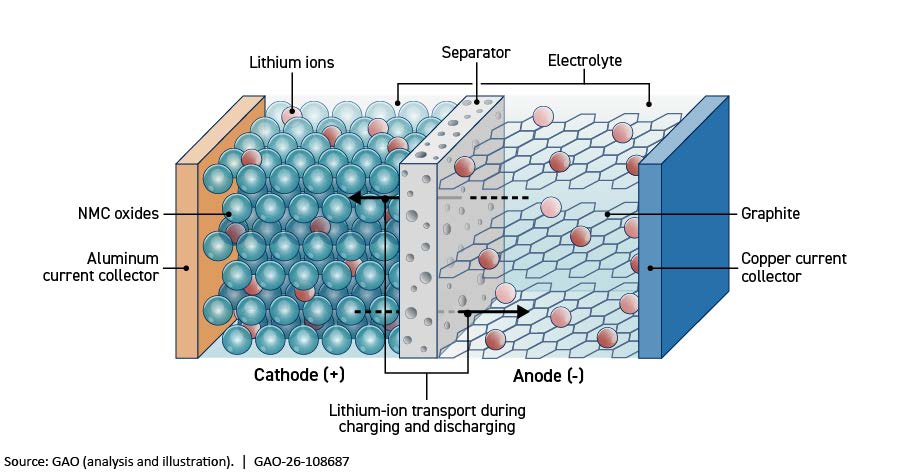
    caption: Cutaway diagram of an NMC lithium-ion cell.
    shows: Aluminium current collector with NMC oxide cathode, separator, electrolyte, graphite anode and copper current collector, with lithium-ion flow during charging and discharging.
    conditions: Schematic illustration, not a measurement
    alt: 'Diagram of a battery: orange aluminium collector and NMC oxide layer on the left, grey porous separator in the middle, graphite and blue copper collector on the right, arrows showing lithium-ion transport.'
    credit: U.S. Government Accountability Office (GAO-26-108687, Figure 2)
    license: Public domain (U.S. government work)
    license_url: https://commons.wikimedia.org/wiki/File:Figure_2-_Rechargeable_lithium_nickel_manganese_cobalt_oxide_(NMC)_battery_(55534980512).jpg
    source_url: https://commons.wikimedia.org/wiki/File:Figure_2-_Rechargeable_lithium_nickel_manganese_cobalt_oxide_(NMC)_battery_(55534980512).jpg
  - file: /media/lithium/nmc-2.jpg
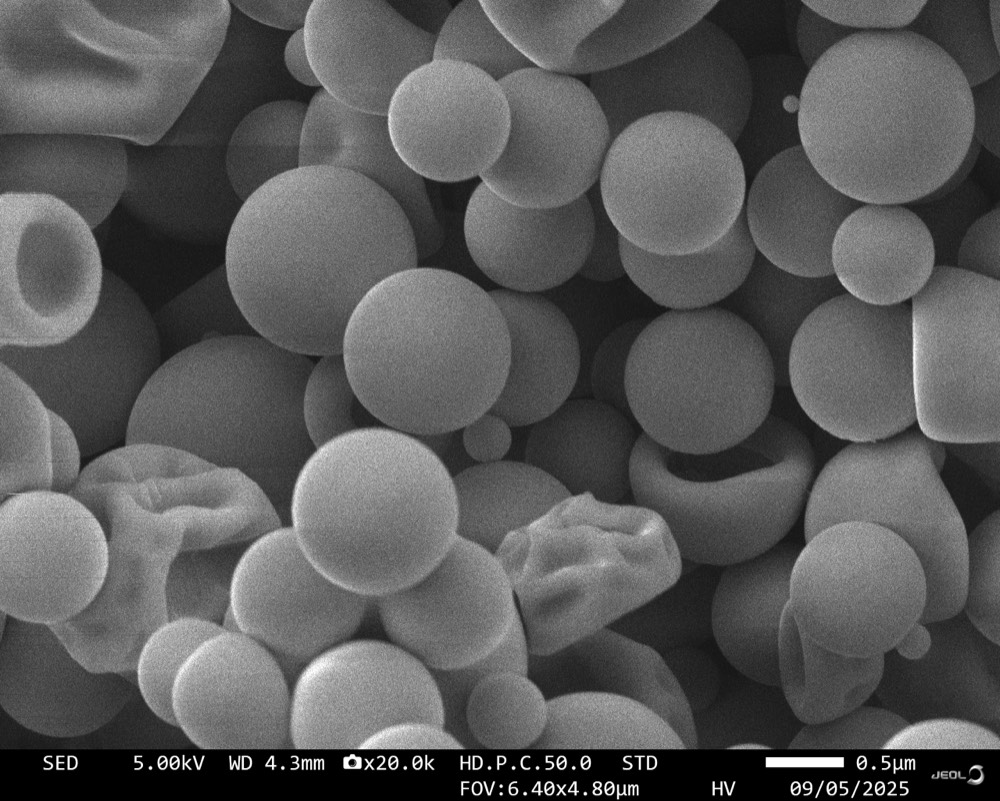
    caption: NCM811 powder particles under a scanning electron microscope.
    shows: Near-round NCM811 (LiNi0.8Co0.1Mn0.1O2) microspheres, with a few collapsed or hollow shells.
    conditions: SEM, 5.00 kV, x20.0k, 0.5 um scale bar; powder labelled as made by ultrasonic spray pyrolysis in the file name
    alt: Grey electron-microscope image of many smooth, round particles of different sizes packed together, a few cup-shaped or crumpled.
    credit: Altynay.Kaiyrgali (Wikimedia Commons)
    license: CC BY 4.0
    license_url: https://creativecommons.org/licenses/by/4.0/
    source_url: https://commons.wikimedia.org/wiki/File:SEM_of_spherical_NCM_by_USP.jpg
  - file: /media/lithium/nmc-3.jpg
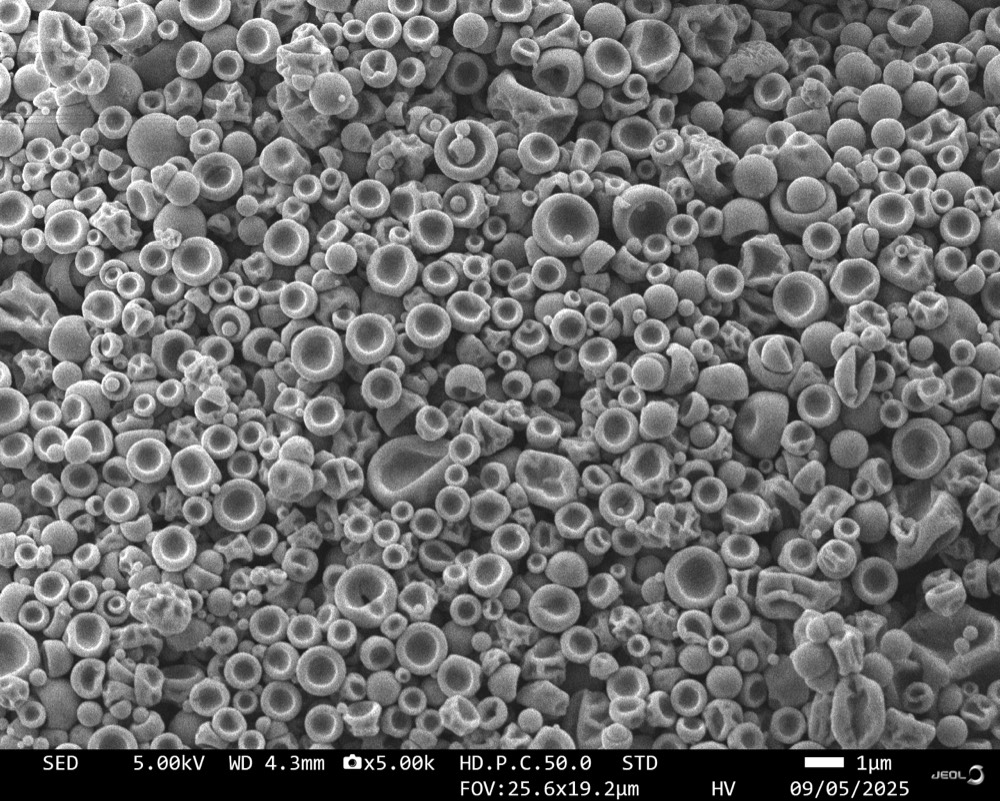
    caption: NCM811 powder with many hollow, ring-shaped particles.
    shows: A wide field of NCM811 particles; many are hollow or partly collapsed shells that look like rings or cups.
    conditions: SEM, 5.00 kV, x5.00k, 1 um scale bar
    alt: Grey electron-microscope image of a dense field of small round and ring-shaped particles, many with a hollow centre.
    credit: Altynay.Kaiyrgali (Wikimedia Commons)
    license: CC BY 4.0
    license_url: https://creativecommons.org/licenses/by/4.0/
    source_url: https://commons.wikimedia.org/wiki/File:NCM_donut_galaxy_hollow_spheres_(SEM).jpg
documents:
  - title: 'Stanford Advanced Materials safety data sheet: Lithium nickel manganese cobalt oxide LiNi0.8Mn0.1Co0.1O2, CAS 346417-97-8 (rev. July 2018)'
    type: sds
    url: https://samaterials.com/tds/1690966042-21-lithium-nickel-manganese-cobalt-oxide.pdf
    year: 2018
  - title: 'NASA Aerospace Flight Battery Program: Generic Safety, Handling and Qualification Guidelines for Lithium-Ion Batteries, Volume II (NASA/TM-2010-216727)'
    type: report
    url: https://ntrs.nasa.gov/citations/20100028067
    year: 2010
  - title: 'PubChem: Cobalt lithium manganese nickel oxide (CID 134693645), GHS classification summary'
    type: database
    url: https://pubchem.ncbi.nlm.nih.gov/compound/134693645
    year: 2026
  - title: Oxygen Release and Its Effect on the Cycling Stability of LiNixMnyCozO2 (NMC) Cathode Materials for Li-Ion Batteries
    type: paper
    url: https://doi.org/10.1149/2.0021707jes
    year: 2017
  - title: Advancements and Challenges in High-Capacity Ni-Rich Cathode Materials for Lithium-Ion Batteries (open access)
    type: paper
    url: https://pmc.ncbi.nlm.nih.gov/articles/PMC10890397/
    year: 2024
  - title: Experimental Analysis of Thermal Runaway in 18650 Cylindrical Li-Ion Cells Using an Accelerating Rate Calorimeter (open access)
    type: paper
    url: https://doi.org/10.3390/batteries3020014
    year: 2017
  - title: Lithium nickel manganese cobalt oxides (Wikipedia)
    type: database
    url: https://en.wikipedia.org/wiki/Lithium_nickel_manganese_cobalt_oxides
gaps:
  - No sourced average voltage, crystal density or electronic conductivity for NMC with stated conditions.
  - No named spacecraft or mission using NMC cells confirmed from a source. The only space-related data are NASA/JPL ground tests on Quallion pouch cells whose cathode the report only says it believes is NMC (0.33:0.33:0.33).
  - No vacuum, radiation or flight result for NMC cells found; the NASA report says thermal-vacuum cycling of those cells had only been initiated and gives no result.
  - No NMC-specific aluminium-corrosion test with stated conditions; the only evidence is an EDS observation on an NMC532/LMO blend after humid-air opening plus a general statement about LiPF6 electrolytes.
  - Crustal abundance of nickel not found in a source we could open.
  - DSC/ARC data on charged NMC powder (Bak et al. 2014) could not be opened; the Golubkov et al. 2014 comparison of NMC and LFP cells could not be opened either.
  - Volume change is given only for a Ni-rich composition (Ni 0.90), not for NMC111, NMC622 or NMC811.
  - The theoretical capacity (about 275 mAh/g) is a general NCM figure from a review, not computed for each composition.
  - SDS hazard classes differ between suppliers and from PubChem's aggregated entry; the one SDS opened is for NMC811 only.
sources:
  jung2017:
    title: Oxygen Release and Its Effect on the Cycling Stability of LiNixMnyCozO2 (NMC) Cathode Materials for Li-Ion Batteries
    id: doi:10.1149/2.0021707jes (J. Electrochem. Soc. 164, A1361)
    url: https://iopscience.iop.org/article/10.1149/2.0021707jes
    year: 2017
    kind: paper
    license: CC BY-NC-ND 4.0
  ahangari2024:
    title: Advancements and Challenges in High-Capacity Ni-Rich Cathode Materials for Lithium-Ion Batteries
    id: doi:10.3390/ma17040801 (Materials 17, 801, PMC10890397)
    url: https://pmc.ncbi.nlm.nih.gov/articles/PMC10890397/
    year: 2024
    kind: paper
    license: CC BY 4.0
  geldasa2022:
    title: Identifying surface degradation, mechanical failure, and thermal instability phenomena of high energy density Ni-rich NCM cathode materials for lithium-ion batteries - a review
    id: doi:10.1039/d1ra08401a (RSC Advances 12, PMC8982025)
    url: https://pmc.ncbi.nlm.nih.gov/articles/PMC8982025/
    year: 2022
    kind: paper
    license: CC BY-NC 3.0
  lei2017:
    title: Experimental Analysis of Thermal Runaway in 18650 Cylindrical Li-Ion Cells Using an Accelerating Rate Calorimeter
    id: doi:10.3390/batteries3020014 (Batteries 3, 14)
    url: https://doi.org/10.3390/batteries3020014
    year: 2017
    kind: paper
    license: CC BY 4.0
  pubchem-nmc:
    title: PubChem compound record, Cobalt lithium manganese nickel oxide (CID 134693645)
    id: CID 134693645; CAS 346417-97-8
    url: https://pubchem.ncbi.nlm.nih.gov/compound/134693645
    year: 2026
    kind: database
    license: public domain (NCBI)
  usgs-mcs2026-lithium:
    title: Mineral Commodity Summaries 2026, Lithium
    id: USGS MCS 2026, February 2026
    url: https://pubs.usgs.gov/periodicals/mcs2026/mcs2026-lithium.pdf
    year: 2026
    kind: report
    license: public domain (USGS)
  mele2025:
    title: 'Raman Spectroscopy of Practical LIB Cathodes: A Study of Humidity-Induced Degradation'
    id: doi:10.3390/molecules30163448 (Molecules 30, 3448, PMC12388750)
    url: https://pmc.ncbi.nlm.nih.gov/articles/PMC12388750/
    year: 2025
    kind: paper
    license: CC BY 4.0
  theivaprakasam2018:
    title: Passivation behaviour of aluminium current collector in ionic liquid alkyl carbonate (hybrid) electrolytes
    id: doi:10.1038/s41529-018-0033-6 (npj Materials Degradation 2, 13)
    url: https://www.nature.com/articles/s41529-018-0033-6
    year: 2018
    kind: paper
    license: CC BY 4.0
  nasa-tm2010:
    title: 'NASA Aerospace Flight Battery Program: Generic Safety, Handling and Qualification Guidelines for Lithium-Ion (Li-Ion) Batteries, Volume II'
    id: NASA/TM-2010-216727/Volume II; NESC-RP-08-75; NTRS 20100028067
    url: https://ntrs.nasa.gov/citations/20100028067
    year: 2010
    kind: report
    license: public domain (NASA)
  sam-nmc811-sds:
    title: 'Safety Data Sheet: Lithium nickel manganese cobalt oxide, LiNi0.8Mn0.1Co0.1O2 (Stanford Advanced Materials)'
    id: revision July 2018; CAS 346417-97-8
    url: https://samaterials.com/tds/1690966042-21-lithium-nickel-manganese-cobalt-oxide.pdf
    year: 2018
    kind: datasheet
    license: supplier document, linked not reproduced
  usgs-mcs2026-nickel:
    title: Mineral Commodity Summaries 2026, Nickel
    id: USGS MCS 2026, February 2026
    url: https://pubs.usgs.gov/periodicals/mcs2026/mcs2026-nickel.pdf
    year: 2026
    kind: report
    license: public domain (USGS)
  usgs-mcs2026-manganese:
    title: Mineral Commodity Summaries 2026, Manganese
    id: USGS MCS 2026, February 2026
    url: https://pubs.usgs.gov/periodicals/mcs2026/mcs2026-manganese.pdf
    year: 2026
    kind: report
    license: public domain (USGS)
  usgs-mcs2026-cobalt:
    title: Mineral Commodity Summaries 2026, Cobalt
    id: USGS MCS 2026, February 2026
    url: https://pubs.usgs.gov/periodicals/mcs2026/mcs2026-cobalt.pdf
    year: 2026
    kind: report
    license: public domain (USGS)
  usgs-pp1802a:
    title: Critical Mineral Resources of the United States - An Introduction (Professional Paper 1802-A), Table A1, crustal abundances
    id: USGS PP 1802-A
    url: https://pubs.usgs.gov/pp/1802/a/pp1802a.pdf
    year: 2017
    kind: report
    license: public domain (USGS)
  usgs-crit2025:
    title: About the 2025 List of Critical Minerals (USGS, final list of 60 minerals)
    id: Final 2025 List of Critical Minerals, November 2025
    url: https://www.usgs.gov/programs/mineral-resources-program/science/about-2025-list-critical-minerals
    year: 2025
    kind: web
    license: public domain (USGS)
  ec-crm:
    title: Critical raw materials (European Commission, list of 34 critical raw materials under Regulation (EU) 2024/1252)
    id: Regulation (EU) 2024/1252
    url: https://single-market-economy.ec.europa.eu/sectors/raw-materials/areas-specific-interest/critical-raw-materials_en
    year: 2024
    kind: web
    license: European Commission web page
  wiki-nmc:
    title: Lithium nickel manganese cobalt oxides (Wikipedia, composition, naming, synthesis and uses)
    url: https://en.wikipedia.org/wiki/Lithium_nickel_manganese_cobalt_oxides
    kind: web
license: CC-BY-4.0
updated: '2026-10-16'
review:
  status: draft
  method: assistant
  checked_values: 15
  unreachable: 0
  caveats: 2
  note: 'Re-read by an AI assistant on 2026-10-16: 15 of 15 benchmark values match their cited source; 0 could not be opened; 0 did not match.'
story:
  why: NMC (lithium nickel manganese cobalt oxide, LiNiₓMnᵧCo_zO₂) is a family of layered-oxide cathodes with the α-NaFeO₂-type structure (hexagonal setting, space group R-3m). The numbers in a name such as NMC111, NMC622 or NMC811 give the nickel:manganese:cobalt ratio. Raising the nickel fraction increases the capacity per gram, but the sources collected here show that nickel-rich compositions also release oxygen from the charged material at a lower voltage, which makes a cell heat faster and hotter when it fails. NMC therefore sits at the high-energy end of the trade that LFP makes in the opposite direction.
  can_do:
    - label: Capacity in cells
      value: Up to 177.8 mAh/g
      line: The theoretical specific capacity of layered nickel-manganese-cobalt oxides is as high as about 275 mAh/g, which would require removing all the lithium and is not possible in practice. In NMC/graphite full cells cycled at 1 C and 25 °C, the capacity per gram of NMC was 162.8 mAh/g for NMC111 and 177.8 mAh/g for NMC622 at a 4.4 V cutoff, and 172.5 mAh/g for NMC811 at a 4.2 V cutoff.
    - label: Oxygen release
      value: 4.3 to 4.7 V
      line: In half cells at 25 °C, oxygen release from the charged material began near 4.7 V for NMC111 and NMC622 and near 4.3 V for NMC811, versus Li/Li⁺. The more nickel, the lower the voltage at which release begins.
    - label: Thermal behavior
      value: Peaked at 731 °C
      line: A charged commercial 2.2 Ah NMC111 cell began to heat itself at about 91 °C in an accelerating-rate calorimetry test and reached 731 °C at up to 7,580 °C/min. The LFP cell tested the same way peaked at 259 °C. The authors note that the NMC cell holds twice the nominal capacity.
    - label: Cycle life
      value: 94% after 300 cycles
      line: Cycled against graphite at 1 C and 25 °C with a 4.4 V cutoff, NMC111 and NMC622 each retained 94% of their capacity between cycle 5 and cycle 300. NMC811 retained 66% at a 4.2 V cutoff and 90% at 4.0 V. At 4.6 V, NMC111 retained only 42%.
    - label: Low temperature
      value: About 70% at -20 °C
      line: Pouch cells of about 4 Ah, which the report's authors believe to contain NMC but did not confirm, delivered about 70% of their room-temperature capacity at -20 °C, 60% at -30 °C, 40% at -40 °C and 25% at -50 °C.
  compare: NMC offers more capacity per gram than LFP, about 275 mAh/g in theory against 170 mAh/g. The cost is heat tolerance. Charged NMC releases oxygen, and in the one side-by-side test collected here the NMC111 cell peaked at 731 °C against 259 °C for the LFP cell. The table compares NMC with the other cathodes in the collection.
  good_for:
    - High capacity per gram, highest in the nickel-rich versions.
    - A tunable family. Composition trades capacity against stability, and a review citing Bak et al. judges NMC532 the best compromise of thermal stability and capacity among the compositions it studied.
  watch_out:
    - Oxygen release from the charged material begins at a lower voltage as nickel rises, about 4.3 V for NMC811 against 4.7 V for NMC111, and the oxygen can feed thermal runaway.
    - Nickel-rich NMC811 is the least stable to cycle at high cutoff voltage. It retained 66% after 300 cycles at 4.2 V against 94% for NMC111 and NMC622 at 4.4 V.
    - Powder hazards are significant and depend on the supplier. Check the safety data sheet of the exact powder.
  verdict: 'NMC is the high-energy choice. It stores more charge per gram than LFP, and the price is heat: charged NMC releases oxygen, and the tests collected here show it failing far hotter.'
  risk_groups:
    - title: For people
      level: 3
      verdict: Mixed, some serious classifications
      lead: The classification of NMC powders is mixed and, for some powders, serious. The safety data sheet of the exact powder should be checked.
      points:
        - label: Database entries
          line: Across PubChem notifications for this CAS entry, the most common hazard codes are fatal if inhaled, may cause cancer, may damage fertility or the unborn child, causes damage to organs through prolonged or repeated exposure, may cause allergic skin reaction or asthma-like symptoms, and harmful to aquatic life with long lasting effects.
        - label: A supplier sheet
          line: 'A supplier safety data sheet for NMC811 powder (Stanford Advanced Materials, 2018) is milder: skin sensitisation category 1A (H317) and carcinogenicity category 2 (H351), with the signal word Warning and an ACGIH exposure limit of 0.02 mg/m³ for the component. Classification therefore differs between suppliers and depends on nickel and cobalt content and impurities.'
        - label: Dust and contact
          line: Avoid dust and aerosols and contact with skin and eyes, and use exhaust ventilation where dust forms. The label statements include 'store locked up' and wear protective gloves.
        - label: In a fire
          line: The fire products listed are nickel, lithium, cobalt and manganese oxides.
    - title: If a cell overheats
      lead: These results come from laboratory tests, not from incidents in the field.
      points:
        - label: A charged NMC111 cell
          line: A commercial 2.2 Ah 18650 NMC/graphite cell at 100% state of charge was heated from 30 to 250 °C in 5 °C steps (es-ARC). It began to heat itself at about 91 °C and reached 731 °C at up to 7,580 °C/min. The LFP cell tested the same way peaked at 259 °C and stayed below 3 °C/min. The NMC cell holds twice the nominal capacity.
        - label: Oxygen release
          line: At high delithiation, NMC and NCA release oxygen as Ni⁴⁺ is reduced on heating. The oxygen can react with the flammable electrolyte and lead to thermal runaway. In half cells at 25 °C, release began near 4.7 V for NMC111 and NMC622 and near 4.3 V for NMC811 versus Li/Li⁺.
        - label: Gas in the cell
          line: More than 90% of the CO and CO₂ formed during cycling at high voltage came from released lattice oxygen reacting with the electrolyte, so oxygen release shows up as gas generation inside the cell.
        - label: Metals on the anode
          line: Dissolved transition metals deposit in the graphite anode's surface layer, which the review links to higher cell impedance and trapped lithium.
    - title: Handling and storage
      points:
        - label: Storage
          line: Keep the container tightly closed in a dry, well-ventilated place.
        - label: Air exposure
          line: Nickel-rich powders form lithium hydroxide and lithium carbonate on the surface in air, because Ni³⁺ slowly and spontaneously reduces to Ni²⁺. These residues cost capacity at high voltage and can gel the NMP binder solution during mixing, so washing is used to remove them.
        - label: Charge limit
          line: Limit the upper charge cutoff. Stable cycling with graphite was found up to 4.4 V for NMC111 and NMC622 but only to 4.0 V for NMC811.
  compare_rows:
    - label: Theoretical capacity
      benchmark: theoretical_capacity
      scope: material
    - label: O2 release onset
      benchmark: o2_release_onset
      scope: material
    - label: Volume change
      benchmark: volume_change
      scope: material
  recipe:
    line: 'NMC is a layered oxide with one lithium, one oxygen-rich lattice and three metals: nickel (Ni), manganese (Mn) and cobalt (Co). The general formula is LiNixMnyCozO2 with x + y + z = 1, and the three digits in the name give the metal ratio. NMC111 has one third of each metal, NMC532 has 0.5 nickel, 0.3 manganese and 0.2 cobalt, NMC622 has 0.6, 0.2 and 0.2, and NMC811 has 0.8, 0.1 and 0.1. It is made by co-precipitation: metal salt solutions are mixed with a chelating agent so mixed nickel, manganese and cobalt hydroxide or carbonate particles form, then they are mixed with a lithium source and calcined (heated) at high temperature. A sol-gel route, which makes a gel from metal and lithium salts and then calcines it in two stages, is the other common method.'
    parts:
      - name: Lithium
        symbol: Li
        atoms: 1
        role: The mobile species that moves in and out of the layers as the cell charges and discharges.
      - name: Nickel
        symbol: Ni
        share: x in LiNixMnyCozO2 (varies by family)
        role: Adds capacity per gram; more nickel means more capacity but less heat tolerance.
      - name: Manganese
        symbol: Mn
        share: y in LiNixMnyCozO2 (varies by family)
        role: Structural element that stays in a stable oxidation state while the cell cycles.
      - name: Cobalt
        symbol: Co
        share: z in LiNixMnyCozO2 (varies by family)
        role: Helps the layered structure hold together; cobalt content is being reduced because of cost.
      - name: Oxygen
        symbol: O
        atoms: 2
        role: Forms the oxide lattice with the metals.
References
Every number above carries a reference number. Click one to see the source and where in it the value comes from.