Graphite Gr
C · CAS 7782-42-5
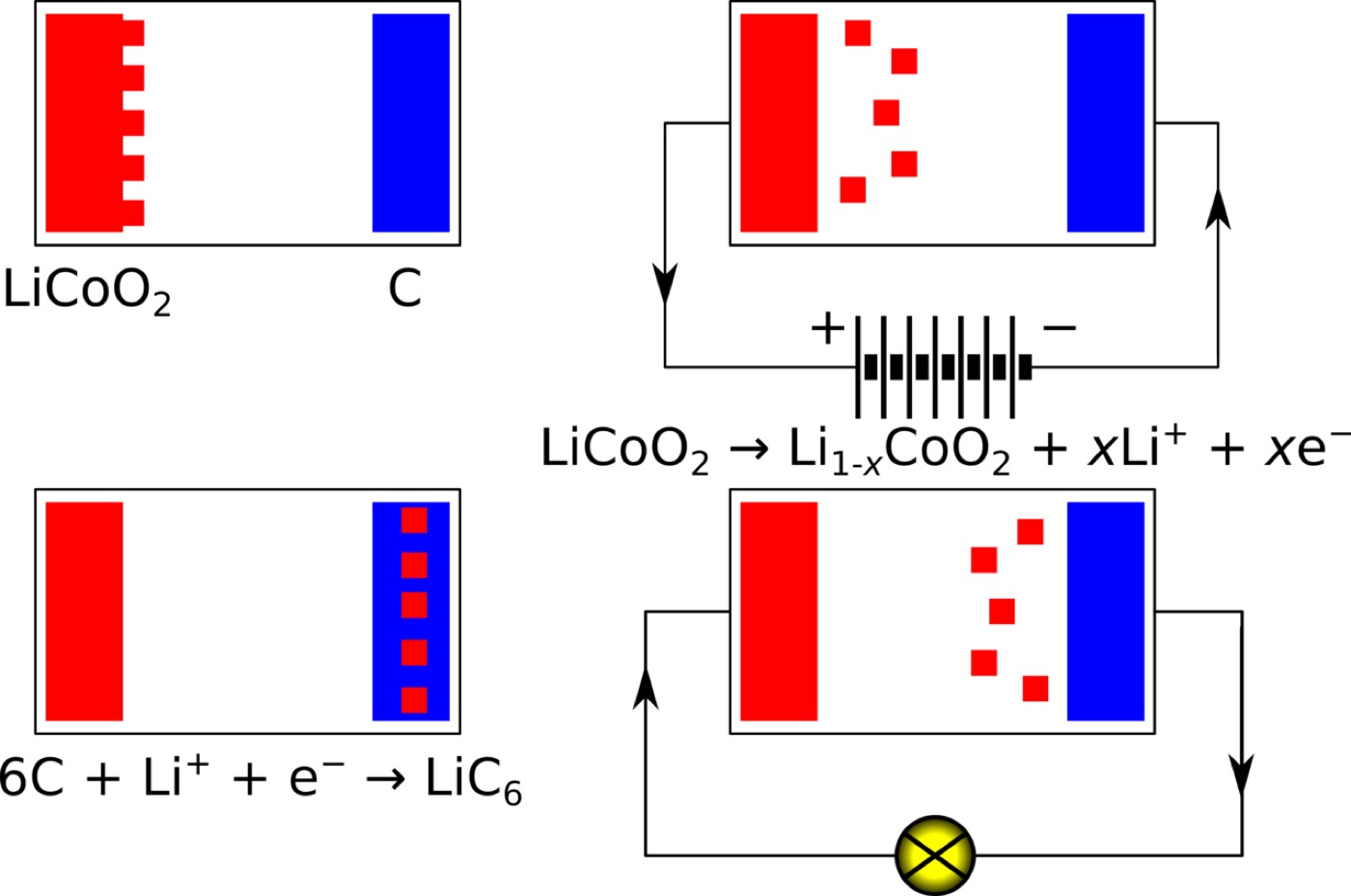
Graphite is the layered carbon that holds lithium between its sheets in most lithium-ion cells.
Evidence level
2 of 5
Lab-measured
- 0Predicted only. No one has made it, or no measurement exists.
- 1Calculated. Only calculated or predicted values from sources.
- 2Lab-measured. Measured properties with their conditions stated.
- 3Space-relevant tests. Measured in conditions relevant to space, such as vacuum or atomic oxygen.
- 4Ground-qualified. Qualified for an application on the ground.
- 5Flown or field-proven. Flight or field results exist.
Capacity
372 mAh/g
Swelling
About 10%
Heat
Film breaks down at 90 to 120 °C
Cold charging
106 mAh/g at -40 °C
A flight cell
155 Wh/kg
Recipe, share of the weight
- C not statedCarbon
Best for
Mature, low-cost anode with high capacity per gram at a low lithiation voltage.
Weakest at
Fast or cold charging (lithium plating) and heating (its protective film starts to break down at about 90 to 120 C).
Risk at a glance
- People Low. Mostly not hazardous; dust can explode
- If it fails High. Lithium plating
- Corrosion No data. No corrosion data recorded
Quick facts: Gr
| Property | Value | Basis |
|---|---|---|
| Density | 1.9 to 2.3 g/cm³ | 1 sourced value |
What is the density of Graphite?
Graphite has a density of 1.9 to 2.3 g/cm³. The source and test conditions are listed in the properties table on this page.
What is Graphite used for?
Uses recorded in the sources include ISS main lithium-ion battery cells; Lithium-ion anode in electric-vehicle batteries; Brake linings, lubricants and powdered metals.
Why it exists
Graphite is the layered carbon that holds lithium between its sheets in most lithium-ion cells. Lithium ions slot in between the carbon layers as the cell charges and leave as it discharges, so graphite serves as the anode, the negative electrode. NASA lists it as the anode material of the GS Yuasa lithium-ion cells chosen for the batteries of the International Space Station. It stores charge at a very low voltage, which is good for the energy of the cell, but that same low voltage means lithium metal can plate onto the surface when a cell is charged fast or cold.
Where it's used
International Space Station main power
The GS Yuasa 134 Ah cells are described by NASA as lithium cobalt oxide with a carbon-graphite anode. Twenty-four lithium-ion units, with 30 cells per battery, were planned to replace 48 nickel-hydrogen units on the station.
Recipe
C
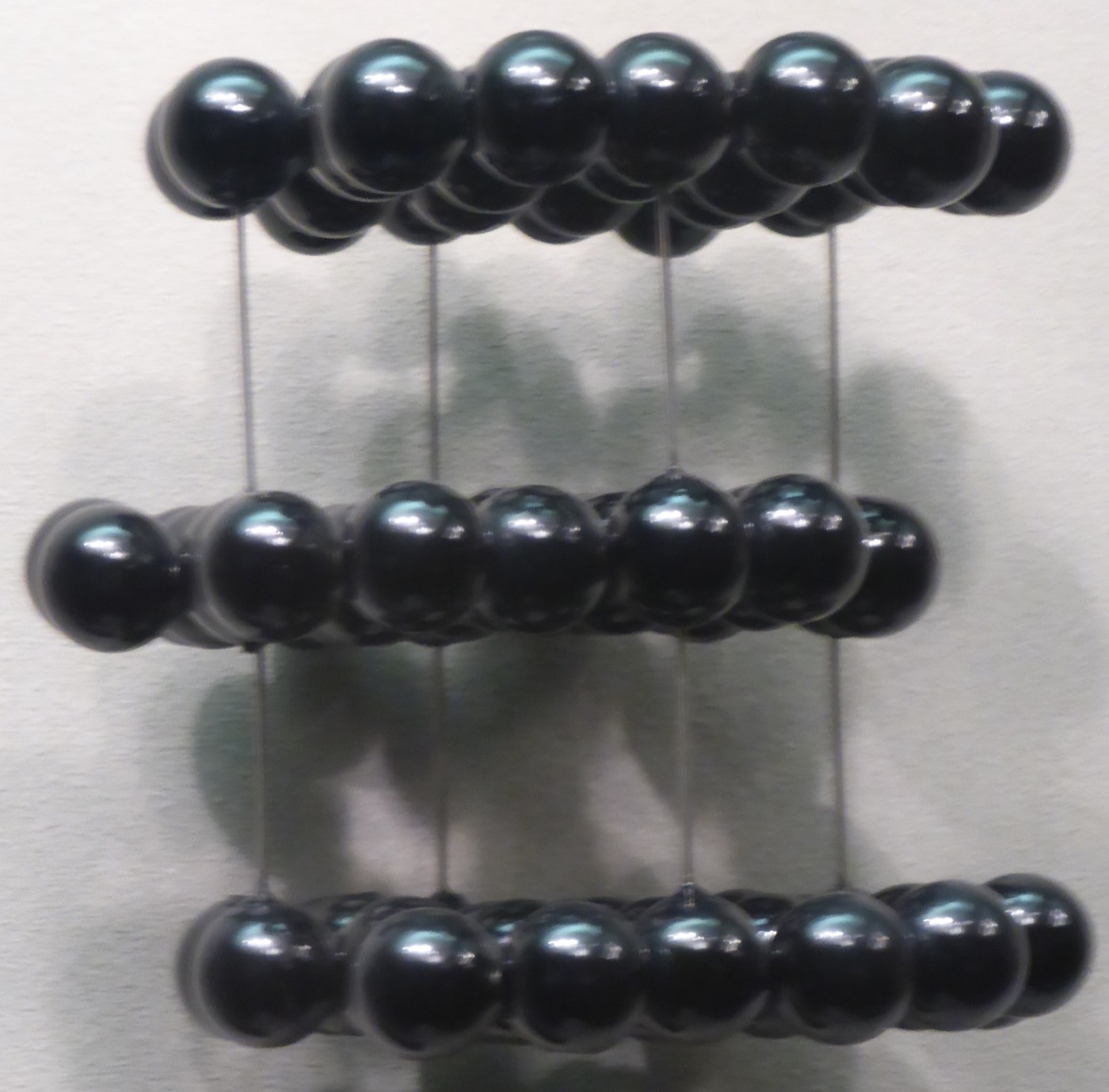
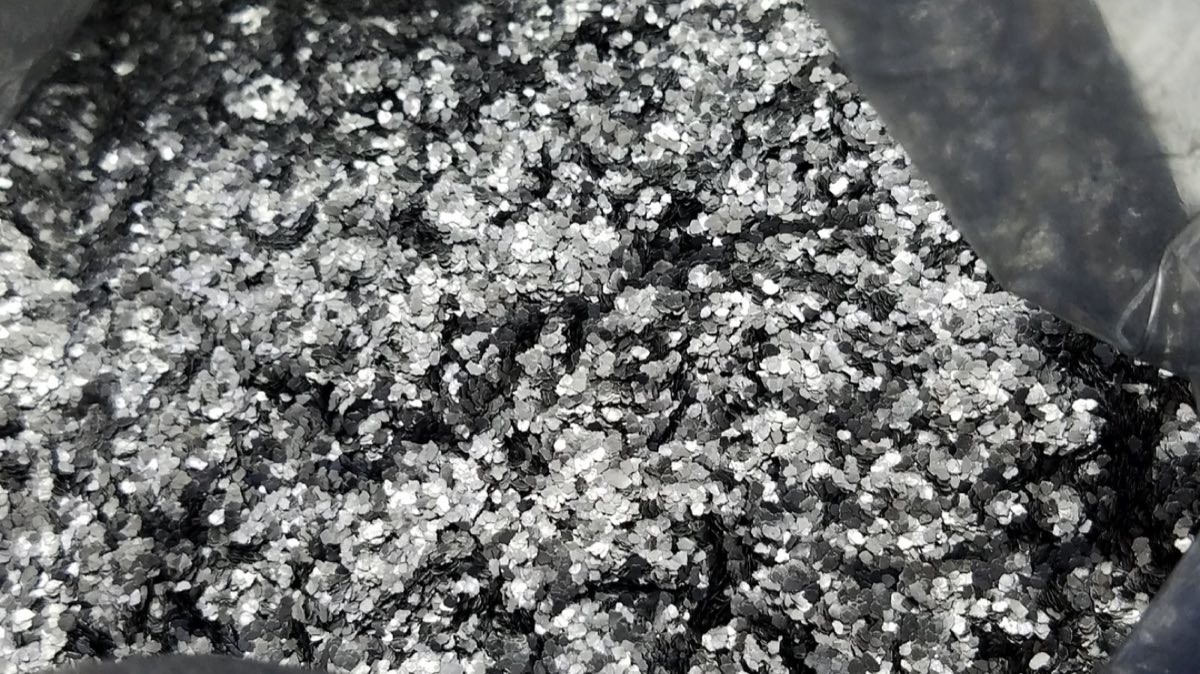
Graphite is pure carbon. Its atoms form flat sheets of six-sided rings, like a honeycomb, and the sheets stack on each other with weak bonds between them, leaving room for lithium to sit between the layers. Natural graphite comes from geologic deposits: it is mined, concentrated, then ground and sorted by flake size. Synthetic graphite is made by heating hydrocarbon materials to a very high temperature until they turn into graphite, a process called thermal graphitization, most often done in an Acheson furnace.
| Ingredient | Share of the weight | What it does |
|---|---|---|
| Carbon C | not stated | Forms the layered sheets. Lithium ions enter between the sheets when the cell charges and leave when it discharges. |
Weight shares are as printed in the sources.
What it can do
Capacity
372 mAh/g
The theoretical specific capacity of 372 mAh/g follows from the reaction to LiC₆, which holds one lithium atom for every six carbon atoms.
Swelling
About 10%
Graphite swells by around 10% on lithiation, and the spacing between its layers grows from about 0.335 nm when uncharged to about 0.370 nm when fully lithiated as LiC₆.
Heat
Film breaks down at 90 to 120 °C
The protective film on the anode, the solid electrolyte interphase, begins to decompose at about 90 to 120 °C and releases CO₂, H₂, CH₄ and sometimes HF. Reported onsets for thermal runaway of lithiated graphite range from 80 to 160 °C, depending on the lithiation state, electrolyte and aging. One comparison value gives 2,700 J/g of heat for fully lithiated graphite.
Cold charging
106 mAh/g at -40 °C
In a three-electrode Li/graphite cell, at -30 °C and -40 °C the graphite potential crossed 0 V versus Li/Li⁺ after only 160 and 106 mAh/g, against 412 mAh/g at -20 °C. Once the potential reaches 0 V, lithium plating begins.
A flight cell
155 Wh/kg
The GS Yuasa LSE134-101 cell with a 134 Ah nameplate is listed at 155 Wh/kg at beginning of life, and its charge temperature range is 10 to 35 °C. The slide's own nameplate energy and mass work out to about 140.5 Wh/kg.
How it compares
Graphite is one of two anodes in this collection, and the other is lithium titanate. Graphite stores much more charge per gram (372 mAh/g, against a lower figure for lithium titanate that is not entered here) and operates at a very low voltage. Its weaknesses are fast or cold charging, where lithium plates, and heating, where its protective film breaks down at about 90 to 120 °C. The table compares graphite with the other anodes in the collection.
The same measurements for each material, so you can compare them. Each row names the key condition under the value; the full conditions and methods are in the numbered notes under Technical details. Other materials are shown beside it; each was measured under its own conditions, so open its page before comparing closely. See the full ranking.
| Measurement | Gr | LTO |
|---|---|---|
| Capacity and energy | ||
| Theoretical specific capacity | 372 mAh/g1 | 175 mAh/g |
| Capacity reached before graphite potential falls to 0 V vs Li/Li+ (-20 C) | 412 mAh/g6 | no data |
| Capacity reached before graphite potential falls to 0 V vs Li/Li+ (-30 C) | 160 mAh/g7 | no data |
| Capacity reached before graphite potential falls to 0 V vs Li/Li+ (-40 C) | 106 mAh/g8 | no data |
| Thermal behavior and safety | ||
| Heat-release onset of carbon or graphite anodes | 80 to 160 °C3 | 125 °C |
| DSC onset, fully lithiated graphite with electrolyteDSC | 100 °C5 | 125 °C |
| SEI exothermic decomposition temperature rangeLiterature statement in a review | 90 to 120 °C | no data |
| Lifetime and stability | ||
| Volume change on cycling | 10 %2 | 0.2 % |
| Physical and electrical | ||
| Layer spacing, pristine graphiteStructural value quoted in a review | 0.335 nm | no data |
| Layer spacing, fully lithiated LiC6Structural value quoted in a review | 0.37 nm | no data |
| Specific gravity of graphite (carbon record) | 1.9 to 2.3 g/cm³4 | no data |
Why choose it, and why not
Good for
- A mature, low-cost anode with high capacity per gram at a low lithiation voltage.
- Established in flight batteries, including the batteries of the International Space Station.
Watch out for
- Fast or cold charging plates lithium metal on the surface, which loses active lithium and can be unsafe.
- The protective film breaks down at about 90 to 120 °C, and the exposed lithiated graphite then reacts strongly with the electrolyte.
- Graphite dust can explode in air and is electrically conductive, so it can short electronics.
Graphite is the proven workhorse anode. It stores a lot of charge cheaply, and it needs protection from fast charging, cold charging and heat.
Technical details
For scientists and researchers. Everything above comes from the record below: every number with its method, its conditions and its source.
Cell-level benchmarks
Values for finished cells. These vary by manufacturer, so read the conditions in the notes. Other materials are shown beside it; each was measured under its own conditions, so open its page before comparing closely. See the full ranking.
Notes
The method, full conditions and any caveat for the numbered rows above.
| # | Measurement | Method | Conditions | Caveat |
|---|---|---|---|---|
| 1 | Theoretical specific capacity | Faraday calculation for one lithium per six carbon atoms (value as stated by the review) | reaction graphite to LiC6, full lithiationstated as approximately 372 mAh/g | — |
| 2 | Volume change on cycling | Statement in a review of electrochemical dilatometry (operando electrode thickness measurement) | event lithiation of graphitestated as around 10% | — |
| 3 | Heat-release onset of carbon or graphite anodes | Literature summary of calorimetry results in a review | depends on lithiation state, electrolyte composition, aging historynote reported range, not a single threshold | — |
| 4 | Specific gravity of graphite (carbon record) | Reference value quoted in the PubChem carbon record | form graphite, general reference value for the element carbonnote not battery-grade electrode density | — |
| 5 | DSC onset, fully lithiated graphite with electrolyte | — | material fully lithiated graphitetest differential scanning calorimetry, comparison value given in an LTO papertest conditions for graphite not given in the abstract | Total heat for fully lithiated graphite was given as 2700 J/g (unit printed as "Jg" on the page, read as J/g). |
| 6 | Capacity reached before graphite potential falls to 0 V vs Li/Li+ (-20 C) | Constant-current charge with a lithium reference electrode | temperature C -20current 0.1 mA/cm2 (about C/24)cell three-electrode Li/graphite, 1 M LiPF6 in EC/DMC/DEC 1:1:1formation cycling none | At 20 C and the same current, staging plateaus gave near-theoretical capacity (372 mAh/g). Reaching 0 V early means lithium plating starts before the graphite is full. |
| 7 | Capacity reached before graphite potential falls to 0 V vs Li/Li+ (-30 C) | Constant-current charge with a lithium reference electrode | temperature C -30current 0.1 mA/cm2 (about C/24)cell three-electrode Li/graphite, 1 M LiPF6 in EC/DMC/DEC 1:1:1formation cycling none | — |
| 8 | Capacity reached before graphite potential falls to 0 V vs Li/Li+ (-40 C) | Constant-current charge with a lithium reference electrode | temperature C -40current 0.1 mA/cm2 (about C/24)cell three-electrode Li/graphite, 1 M LiPF6 in EC/DMC/DEC 1:1:1formation cycling none | — |
| 9 | Specific energy of the ISS LSE134-101 cell (graphite anode, lithium cobalt oxide cathode) | Nameplate data in a NASA battery workshop presentation | cell GS Yuasa LSE134-101, 134 A-hr nameplatestate beginning of life | The slide gives 155 Wh/kg, but its own nameplate energy of 496 Wh and cell mass of 3.53 kg work out to about 140.5 Wh/kg, so the slide is internally inconsistent. |
| 10 | Allowed charge temperature of the ISS LSE134-101 cell | Temperature range listed on the cell information slide | cell GS Yuasa LSE134-101discharge range -10 to +35 C | The slide gives the range, not the reason for the lower charge limit. |
Corrosion and compatibility
What happens when it meets other materials and environments.
| Environment | Concern | What happens |
|---|---|---|
| Carbonate electrolyte during first charge (SEI formation) | not rated | On the first charge the electrolyte forms a protective film on the graphite, which can later crack and reform.1 |
| Cracked SEI on lithiated graphite | not rated | A cracked film lets electrolyte reach lithiated graphite, which damages the surface and speeds heat generation.2 |
| Propylene carbonate electrolyte | not rated | Propylene carbonate enters the graphite layers along with lithium, a damaging side reaction.3 |
| Copper current collector (anode side) during over-discharge | not rated | Over-discharge dissolves the copper current collector, which can cause short circuits and capacity loss.4 |
| Heated electrolyte-wet lithiated graphite | not rated | Once the film breaks down, heated lithiated graphite reacts strongly with the electrolyte.5 |
| # | Environment | Details | Test conditions |
|---|---|---|---|
| 1 | Carbonate electrolyte during first charge (SEI formation) | Electrolyte is reduced on the graphite surface and forms a protective film (SEI) made of an inner inorganic layer (Li2CO3, LiF, Li2O) and an outer organic layer (ROCO2Li, ROLi). It protects the graphite, but it is not static: it can decompose, crack and reform during cycling or heating. | voltage forms below about 1 V vs Li/Li+electrolyte carbonate solvents with LiPF6 |
| 2 | Cracked SEI on lithiated graphite | Cracks let electrolyte reach lithiated graphite, which can cause solvent co-intercalation, graphite exfoliation and further surface damage, and speeds up heat generation. | trigger repeated cycling or thermal exposure |
| 3 | Propylene carbonate electrolyte | Propylene carbonate co-intercalates into the graphite lattice along with lithium ions, a side reaction that dilatometry can detect. | electrolyte propylene carbonate based |
| 4 | Copper current collector (anode side) during over-discharge | Copper anode current collectors dissolve under over-discharge, which can cause contact loss, short circuits and capacity loss. | trigger over-dischargegeneral statement for Li-ion batteries, not graphite specific |
| 5 | Heated electrolyte-wet lithiated graphite | After the SEI breaks down, the exposed lithiated graphite reacts strongly and exothermically with carbonate solvents (EC, DMC, DEC), producing CO2, CH4 and other light hydrocarbons. This is the first major heat-release step in thermal runaway. | temperature starts in the 50 to 160 C initiation window of thermal runaway |
Risks and side effects
Hazards to people, what happens when a cell overheats, and how the material is handled and stored.
For people
Graphite is classified as not hazardous by some suppliers and as an irritant by others. The larger hazard is its dust.
- Database entries
- PubChem aggregates 2,727 reports from 27 notifications for the entry Carbon, which includes graphite. Of these, 55.1% report H319 (eye irritation) and 51.1% report H335 (respiratory irritation), while 40.2% say the substance does not meet GHS hazard criteria. Classification depends on the supplier and the grade.
- A supplier sheet
- A Sigma-Aldrich safety data sheet classifies graphite as not a hazardous substance or mixture, and notes that further processing of solids may form combustible dusts. Listed workplace limits include a NIOSH exposure limit of 2.5 mg/m³ and an ACGIH limit of 2 mg/m³, each averaged over a work shift.
- Dust
- An SGL Technic sheet states that graphite dust of 4 to 40 micrometre particle size can explode over a wide range of concentrations (class St1), that the dust can cause an electrical short, and that spilled powder is a slipping hazard.
If a cell overheats
These results come from laboratory studies and from reviews, not from incidents in the field.
- The first step
- Heating a charged cell breaks down the protective film at 90 to 120 °C. This releases CO₂, H₂, CH₄ and sometimes HF.
- Then the graphite reacts
- Once the film has broken down, the exposed lithiated graphite reacts strongly and exothermically with the carbonate solvents (EC, DMC and DEC), producing CO₂, CH₄ and other light hydrocarbons. This is the first major heat-release step in thermal runaway.
- Pressure in the cell
- The gases from the film breakdown raise the pressure inside the cell, which reaches the casing and neighbouring cells in a battery.
- Lithium plating
- Fast charging or low temperature polarizes the graphite so that its surface potential falls to or below 0 V versus Li/Li⁺. The result is loss of active lithium, capacity fade and potential safety risks.
Handling and storage
- Storage
- Keep the container tightly closed in a dry place. Avoid dust formation and provide exhaust ventilation where dust forms.
- Protecting the film
- Surface coating, an artificial interphase or surface-chemistry control can stabilise the film and delay the breakdown and heat release.
- Reducing plating
- Shortening the paths lithium must diffuse through the graphite (layer spacing, pores, particle size and morphology, edge sites) lowers polarization and plating tendency, at some cost in first-cycle efficiency and compaction density.
- Spacecraft protection
- The ISS batteries use two independent controls against thermal runaway, voltage and temperature monitoring of all 30 cells, cell-level fault isolation, radiant heat barriers between cell pairs, and vented gas directed away from neighbours.
Test details
The original wording and numbers from the sources, for readers who want them.
Failure risks
| Failure | Trigger and consequence |
|---|---|
| Lithium platinghigh severity | Fast charging or low temperature polarizes the graphite so its surface potential falls to or below 0 V vs Li/Li+.Loss of active lithium, capacity fade and potential safety risks. |
| Cold charging cannot fill the graphitehigh severity | Charging a Li/graphite cell below -20 CAt -30 C and -40 C the graphite potential crossed 0 V vs Li/Li+ after only 160 and 106 mAh/g, against 412 mAh/g at -20 C, so lithium intercalation drops sharply and competes with plating. |
| SEI decomposition starting thermal runawayhigh severity | Heating of a charged cell, typically at high state of chargeExothermic SEI breakdown at 90 to 120 C releases CO2, H2, CH4 and sometimes HF, then lithiated graphite reacts with the electrolyte. |
Side effects on surrounding parts
| Affects | Effect |
|---|---|
| Cell casing and neighbouring cells in a battery | Gases from SEI decomposition (CO2, H2, CH4, sometimes HF) raise pressure inside the cell. |
| Electronics near graphite powder handling | Conductive graphite dust can cause an electrical short. |
Handling and storage
- Keep the container tightly closed in a dry place. Avoid dust formation and provide exhaust ventilation where dust forms.
Mitigations
- Stabilize the SEI with surface coating, an artificial interphase or surface chemistry control, so that SEI breakdown and heat release are delayed.
- Shorten lithium diffusion paths in the graphite (layer spacing, pores, particle size and morphology, edge sites) to lower polarization and plating tendency, at some cost in first-cycle efficiency and compaction density.
- ISS lithium-ion battery safeguards: two independent controls against thermal runaway, voltage and temperature monitoring of all 30 cells, cell-level fault isolation, radiant heat barriers between cell pairs, and vented gas directed away from neighbours.
Supply and geography
How common the raw materials are and where they come from.
Natural graphite
World mine production 1,800,000 t in 2025 (estimate, rounded), world reserves 310,000,000 t, resources above 800 million tons of recoverable graphite outside the US. Country figures for 2025e: China 1,400,000 t; Madagascar 80,000 t; Tanzania 75,000 t; Brazil 65,000 t; Mozambique 60,000 t; Russia 25,000 t; India 17,000 t. USGS states China produced an estimated 82% of world natural graphite in 2025, mostly crystalline flake.
- Top producers (2025)
- China 82%
- Recycling
- USGS: graphite is recycled mainly from refractory brick and linings, and the abundance of graphite in the world market inhibits more recycling; quantity of recycled graphite was not available.
- Substitutes
- Synthetic graphite powder and secondary synthetic graphite from machining graphite shapes compete for battery use
Graphite battery anode material (natural and synthetic), US trade
US imports of graphite battery anode material in the first 8 months of 2025 were 43,400 tons (28,100 tons in the same period of 2024); leading sources China 55%, Indonesia 31%, Republic of Korea 14%. Preliminary US antidumping duties on Chinese anode material were 93.50%, countervailing duties 11.58% to 721.03%. China exported 37,400 tons of spherical purified graphite in the first 9 months of 2025.
- Recycling
- Not stated for anode material in the source.
Gallery
Documents
Datasheets, safety data sheets, papers and standards you can open.
Full record
The complete spore, as stored. Free to reuse under CC-BY-4.0. Images keep the licence shown with each one.
Show the full YAML
spore: profile
id: graphite-anode
spore_version: 0.2
family: lithium
name: Graphite
abbreviation: Gr
role: anode
category: energy
type: li-ion-anodes
summary: |
  Graphite is the layered carbon that holds lithium between its sheets in most lithium-ion cells. It is also the anode material in the GS Yuasa lithium-ion cells chosen for the International Space Station batteries, according to NASA. It stores charge at a very low voltage, which is good for cell energy but means lithium can plate on it when it is charged fast or cold.
best_for: Mature, low-cost anode with high capacity per gram at a low lithiation voltage.
weakest_at: Fast or cold charging (lithium plating) and heating (its protective film starts to break down at about 90 to 120 C).
identity:
  formula: C
  cas: 7782-42-5
  source: sds-aldrich-graphite
  where: Section 3.1
tags:
  environments:
    - low-earth-orbit
  stresses:
    - extreme-cold
    - extreme-heat
  applications:
    - batteries
properties:
  - benchmark: theoretical_capacity
    value: 372
    unit: mAh/g
    scope: material
    conditions:
      reaction: graphite to LiC6, full lithiation
      stated_as: approximately 372 mAh/g
    method: Faraday calculation for one lithium per six carbon atoms (value as stated by the review)
    status: calculated
    source: frontiers-graphite-2026
    where: Section 2
  - benchmark: volume_change
    value: 10
    unit: '%'
    scope: material
    conditions:
      event: lithiation of graphite
      stated_as: around 10%
    method: Statement in a review of electrochemical dilatometry (operando electrode thickness measurement)
    status: ground
    source: escher-2022
    where: Introduction
  - benchmark: interlayer_spacing
    label: Layer spacing, pristine graphite
    value: 0.335
    unit: nm
    scope: material
    conditions:
      state: commercial graphite, uncharged
      stated_as: approximately 0.335 nm
    method: Structural value quoted in a review
    status: ground
    source: frontiers-graphite-2026
    where: Section 3.1
  - benchmark: interlayer_spacing
    label: Layer spacing, fully lithiated LiC6
    value: 0.37
    unit: nm
    scope: material
    conditions:
      state: fully lithiated LiC6
      stated_as: approximately 0.370 nm
    method: Structural value quoted in a review
    status: ground
    source: frontiers-graphite-2026
    where: Section 3.1
  - benchmark: thermal_runaway_onset
    label: Heat-release onset of carbon or graphite anodes
    value: 80
    value_high: 160
    bound: range
    unit: °C
    scope: material
    conditions:
      depends_on: lithiation state, electrolyte composition, aging history
      note: reported range, not a single threshold
    method: Literature summary of calorimetry results in a review
    status: ground
    source: advsci-failure-2026
    where: Section 3.1
  - benchmark: density
    label: Specific gravity of graphite (carbon record)
    value: 1.9
    value_high: 2.3
    bound: range
    unit: g/cm3
    scope: material
    conditions:
      form: graphite, general reference value for the element carbon
      note: not battery-grade electrode density
    method: Reference value quoted in the PubChem carbon record
    status: ground
    source: pubchem-carbon
    where: Other Experimental Properties (specific gravity)
  - benchmark: thermal_runaway_onset
    label: DSC onset, fully lithiated graphite with electrolyte
    value: 100
    unit: °C
    scope: material
    conditions:
      material: fully lithiated graphite
      test: differential scanning calorimetry, comparison value given in an LTO paper
      test_conditions_for_graphite: not given in the abstract
    method: DSC
    status: ground
    note: Total heat for fully lithiated graphite was given as 2700 J/g (unit printed as "Jg" on the page, read as J/g).
    source: belharouak-2007
    where: Abstract
  - benchmark: sei_decomposition_onset
    label: SEI exothermic decomposition temperature range
    value: 90
    value_high: 120
    bound: range
    unit: °C
    scope: material
    conditions:
      layer: solid electrolyte interphase on the anode
      gases: CO2, H2, CH4 and in some cases HF
    method: Literature statement in a review
    status: ground
    source: advsci-failure-2026
    where: Section 3.2.1
  - benchmark: capacity_before_zero_volts
    label: Capacity reached before graphite potential falls to 0 V vs Li/Li+ (-20 C)
    value: 412
    unit: mAh/g
    scope: material
    conditions:
      temperature_C: -20
      current: 0.1 mA/cm2 (about C/24)
      cell: three-electrode Li/graphite, 1 M LiPF6 in EC/DMC/DEC 1:1:1
      formation_cycling: none
    method: Constant-current charge with a lithium reference electrode
    status: ground
    note: At 20 C and the same current, staging plateaus gave near-theoretical capacity (372 mAh/g). Reaching 0 V early means lithium plating starts before the graphite is full.
    source: chen-2025
    where: Results on variable-temperature charging, Figure 3
  - benchmark: capacity_before_zero_volts
    label: Capacity reached before graphite potential falls to 0 V vs Li/Li+ (-30 C)
    value: 160
    unit: mAh/g
    scope: material
    conditions:
      temperature_C: -30
      current: 0.1 mA/cm2 (about C/24)
      cell: three-electrode Li/graphite, 1 M LiPF6 in EC/DMC/DEC 1:1:1
      formation_cycling: none
    method: Constant-current charge with a lithium reference electrode
    status: ground
    source: chen-2025
    where: Results on variable-temperature charging, Figure 3
  - benchmark: capacity_before_zero_volts
    label: Capacity reached before graphite potential falls to 0 V vs Li/Li+ (-40 C)
    value: 106
    unit: mAh/g
    scope: material
    conditions:
      temperature_C: -40
      current: 0.1 mA/cm2 (about C/24)
      cell: three-electrode Li/graphite, 1 M LiPF6 in EC/DMC/DEC 1:1:1
      formation_cycling: none
    method: Constant-current charge with a lithium reference electrode
    status: ground
    source: chen-2025
    where: Results on variable-temperature charging, Figure 3
  - benchmark: cell_specific_energy
    label: Specific energy of the ISS LSE134-101 cell (graphite anode, lithium cobalt oxide cathode)
    value: 155
    unit: Wh/kg
    scope: cell
    conditions:
      cell: GS Yuasa LSE134-101, 134 A-hr nameplate
      state: beginning of life
    method: Nameplate data in a NASA battery workshop presentation
    status: ground
    note: The slide gives 155 Wh/kg, but its own nameplate energy of 496 Wh and cell mass of 3.53 kg work out to about 140.5 Wh/kg, so the slide is internally inconsistent.
    source: nasa-iss-graika-2017
    where: Slide "Cell Information"
  - benchmark: charge_temperature_range
    label: Allowed charge temperature of the ISS LSE134-101 cell
    value: 10
    value_high: 35
    bound: range
    unit: °C
    scope: cell
    conditions:
      cell: GS Yuasa LSE134-101
      discharge_range: '-10 to +35 C'
    method: Temperature range listed on the cell information slide
    status: ground
    note: The slide gives the range, not the reason for the lower charge limit.
    source: nasa-iss-graika-2017
    where: Slide "Cell Information"
corrosion:
  - environment: Carbonate electrolyte during first charge (SEI formation)
    headline: On the first charge the electrolyte forms a protective film on the graphite, which can later crack and reform.
    effect: |
      Electrolyte is reduced on the graphite surface and forms a protective film (SEI) made of an inner inorganic layer (Li2CO3, LiF, Li2O) and an outer organic layer (ROCO2Li, ROLi). It protects the graphite, but it is not static: it can decompose, crack and reform during cycling or heating.
    rating: unknown
    conditions:
      voltage: forms below about 1 V vs Li/Li+
      electrolyte: carbonate solvents with LiPF6
    source: advsci-failure-2026
    where: Section 3.2.1 and Section 4.2.1
  - environment: Cracked SEI on lithiated graphite
    headline: A cracked film lets electrolyte reach lithiated graphite, which damages the surface and speeds heat generation.
    effect: |
      Cracks let electrolyte reach lithiated graphite, which can cause solvent co-intercalation, graphite exfoliation and further surface damage, and speeds up heat generation.
    rating: unknown
    conditions:
      trigger: repeated cycling or thermal exposure
    source: advsci-failure-2026
    where: Section 4.2.1
  - environment: Propylene carbonate electrolyte
    headline: Propylene carbonate enters the graphite layers along with lithium, a damaging side reaction.
    effect: Propylene carbonate co-intercalates into the graphite lattice along with lithium ions, a side reaction that dilatometry can detect.
    rating: unknown
    conditions:
      electrolyte: propylene carbonate based
    source: escher-2022
    where: Section 2.3
  - environment: Copper current collector (anode side) during over-discharge
    headline: Over-discharge dissolves the copper current collector, which can cause short circuits and capacity loss.
    effect: Copper anode current collectors dissolve under over-discharge, which can cause contact loss, short circuits and capacity loss.
    rating: unknown
    conditions:
      trigger: over-discharge
      general_statement: for Li-ion batteries, not graphite specific
    source: nanomicro-corrosion-2026
    where: Section on electrochemical corrosion in batteries
  - environment: Heated electrolyte-wet lithiated graphite
    headline: Once the film breaks down, heated lithiated graphite reacts strongly with the electrolyte.
    effect: |
      After the SEI breaks down, the exposed lithiated graphite reacts strongly and exothermically with carbonate solvents (EC, DMC, DEC), producing CO2, CH4 and other light hydrocarbons. This is the first major heat-release step in thermal runaway.
    rating: unknown
    conditions:
      temperature: starts in the 50 to 160 C initiation window of thermal runaway
    source: advsci-failure-2026
    where: Section 3.1 and Section 3.2.2
risks:
  hazards:
    - text: |
        PubChem aggregates 2727 reports from 27 notifications for the entry "Carbon" (includes graphite, CAS 7782-42-5): 55.1% report H319 and 51.1% report H335, while 40.2% (1095 reports) say the substance does not meet GHS hazard criteria. Classification depends on the supplier and grade.
      ghs:
        - H319
        - H335
      source: pubchem-carbon
      where: Safety and Hazards, GHS Classification
    - text: |
        Sigma-Aldrich SDS for graphite (product 496596) classifies it as not a hazardous substance or mixture, and notes that further processing of solids may form combustible dusts. Listed workplace limits include NIOSH REL TWA 2.5 mg/m3 and ACGIH TLV TWA 2 mg/m3.
      ghs: []
      source: sds-aldrich-graphite
      where: Sections 2, 7.1 and 8.1
    - text: |
        SGL Technic SDS for a graphite powder product states that graphite dust of 4 to 40 micrometre particle size can explode over a wide range of concentrations, was classified St1, and that graphite dusts could cause an electrical short. The SDS also warns of slipping on spilled powder.
      ghs: []
      source: sds-sgl-graphite
      where: Sections 2, 9 and 10
  failure_risks:
    - mode: Lithium plating
      trigger: Fast charging or low temperature polarizes the graphite so its surface potential falls to or below 0 V vs Li/Li+.
      consequence: Loss of active lithium, capacity fade and potential safety risks.
      severity: high
      source: frontiers-graphite-2026
      where: Section 2
    - mode: Cold charging cannot fill the graphite
      trigger: Charging a Li/graphite cell below -20 C
      consequence: At -30 C and -40 C the graphite potential crossed 0 V vs Li/Li+ after only 160 and 106 mAh/g, against 412 mAh/g at -20 C, so lithium intercalation drops sharply and competes with plating.
      severity: high
      source: chen-2025
      where: Abstract and Results, Figure 3
    - mode: SEI decomposition starting thermal runaway
      trigger: Heating of a charged cell, typically at high state of charge
      consequence: Exothermic SEI breakdown at 90 to 120 C releases CO2, H2, CH4 and sometimes HF, then lithiated graphite reacts with the electrolyte.
      severity: high
      source: advsci-failure-2026
      where: Section 3.2
  side_effects:
    - text: Gases from SEI decomposition (CO2, H2, CH4, sometimes HF) raise pressure inside the cell.
      affects: Cell casing and neighbouring cells in a battery
      source: advsci-failure-2026
      where: Section 3.2.1
    - text: Conductive graphite dust can cause an electrical short.
      affects: Electronics near graphite powder handling
      source: sds-sgl-graphite
      where: Section 2
  handling:
    - text: Keep the container tightly closed in a dry place. Avoid dust formation and provide exhaust ventilation where dust forms.
      source: sds-aldrich-graphite
      where: Sections 6.1, 7.1 and 7.2
  mitigations:
    - text: Stabilize the SEI with surface coating, an artificial interphase or surface chemistry control, so that SEI breakdown and heat release are delayed.
      source: advsci-failure-2026
      where: Section 4.2.4
    - text: Shorten lithium diffusion paths in the graphite (layer spacing, pores, particle size and morphology, edge sites) to lower polarization and plating tendency, at some cost in first-cycle efficiency and compaction density.
      source: frontiers-graphite-2026
      where: Sections 1 and 3
    - text: |
        ISS lithium-ion battery safeguards: two independent controls against thermal runaway, voltage and temperature monitoring of all 30 cells, cell-level fault isolation, radiant heat barriers between cell pairs, and vented gas directed away from neighbours.
      source: nasa-iss-dalton-2016
      where: Pages 10 to 13
uses:
  - application: batteries
    device: ISS main lithium-ion battery cells
    example: |
      GS Yuasa 134 A-hr cells described by NASA as lithium cobalt oxide / carbon graphite, in 24 lithium-ion units planned to replace 48 nickel-hydrogen units on the International Space Station, 30 cells per battery.
    source: nasa-iss-dalton-2016
    where: Page 9 (cell down-select); battery count from nasa-iss-graika-2017 ORU slide
  - application: batteries
    device: Lithium-ion anode in electric-vehicle batteries
    example: Wikipedia states that graphite is the predominant anode material in lithium-ion batteries and that the anode in virtually all EV batteries is graphite.
    source: wiki-graphite
    where: Battery section
  - application: mechanisms
    device: Brake linings, lubricants and powdered metals
    example: USGS says natural graphite was widely used in batteries, brake linings, lubricants, powdered metals, refractory applications and steelmaking, with US consumption estimated at 71,000 tons in 2025.
    source: usgs-graphite-2026
    where: Domestic Production and Use (first paragraph)
supply:
  - subject: Natural graphite
    abundance: |
      World mine production 1,800,000 t in 2025 (estimate, rounded), world reserves 310,000,000 t, resources above 800 million tons of recoverable graphite outside the US. Country figures for 2025e: China 1,400,000 t; Madagascar 80,000 t; Tanzania 75,000 t; Brazil 65,000 t; Mozambique 60,000 t; Russia 25,000 t; India 17,000 t. USGS states China produced an estimated 82% of world natural graphite in 2025, mostly crystalline flake.
    producers:
      - country: China
        share_percent: 82
        year: 2025
    critical_lists: []
    recycling: |
      USGS: graphite is recycled mainly from refractory brick and linings, and the abundance of graphite in the world market inhibits more recycling; quantity of recycled graphite was not available.
    substitutes:
      - Synthetic graphite powder and secondary synthetic graphite from machining graphite shapes compete for battery use
    source: usgs-graphite-2026
    where: Graphite (Natural), World Mine Production and Reserves; Events, Trends, and Issues; Substitutes
  - subject: Graphite battery anode material (natural and synthetic), US trade
    abundance: |
      US imports of graphite battery anode material in the first 8 months of 2025 were 43,400 tons (28,100 tons in the same period of 2024); leading sources China 55%, Indonesia 31%, Republic of Korea 14%. Preliminary US antidumping duties on Chinese anode material were 93.50%, countervailing duties 11.58% to 721.03%. China exported 37,400 tons of spherical purified graphite in the first 9 months of 2025.
    producers: []
    critical_lists: []
    recycling: Not stated for anode material in the source.
    substitutes: []
    source: usgs-graphite-2026
    where: Events, Trends, and Issues
media:
  - file: /media/lithium/graphite-anode-1.jpg
    caption: Ball-and-stick model of the layered crystal structure of graphite.
    shows: Three stacked sheets of carbon atoms in a physical model; lithium ions go between such sheets when a cell charges.
    conditions: Photograph of a physical model, not a micrograph
    alt: 'Photograph of a model of graphite: three flat layers of black spheres held apart by thin rods.'
    credit: MartinThoma (Wikimedia Commons)
    license: CC0 1.0
    license_url: https://creativecommons.org/publicdomain/zero/1.0/
    source_url: https://commons.wikimedia.org/wiki/File:Graphite-crystal-structure.jpg
  - file: /media/lithium/graphite-anode-2.jpg
    caption: Scheme of a lithium-ion cell with a lithium cobalt oxide cathode and a graphite anode.
    shows: Uncharged cell, charging (lithium ions leave LiCoO2 and enter graphite as LiC6) and discharging, with the cell equations.
    conditions: Schematic drawing
    alt: 'Four box diagrams of a battery cell: uncharged, charging, charged and discharging, with red lithium ions moving to a blue carbon electrode and the reaction 6C + Li+ + e- gives LiC6.'
    credit: Sergey WereWolf (Wikimedia Commons)
    license: CC0 1.0
    license_url: https://creativecommons.org/publicdomain/zero/1.0/
    source_url: https://commons.wikimedia.org/wiki/File:Lithium_cobaltate_vs_graphite_lithium-ion_battery_scheme.png
  - file: /media/lithium/graphite-anode-3.jpg
    caption: Natural flake graphite, 32 mesh, 99% purity.
    shows: Loose silvery-black flakes of natural graphite in a bag, the raw form that is milled and rounded for battery anodes.
    conditions: Photograph; mesh size and purity as given on the Commons file page
    alt: Close-up photograph of a pile of small shiny grey graphite flakes.
    credit: 2x910 (Wikimedia Commons)
    license: CC BY-SA 4.0
    license_url: https://creativecommons.org/licenses/by-sa/4.0/
    source_url: https://commons.wikimedia.org/wiki/File:Flake_graphite.png
documents:
  - title: Sigma-Aldrich safety data sheet, graphite 496596 (revision 2015)
    type: sds
    url: https://www.physics.purdue.edu/primelab/safety/MSDS/SDS/graphite%20%20-%20Aldrich.pdf
    year: 2015
  - title: SGL Technic safety data sheet, graphite microballoons (revision 2020)
    type: sds
    url: https://docs.gato.txst.edu/139064/Graphitized%20Microballoons.pdf
    year: 2020
  - title: PubChem record for Carbon (GHS summary)
    type: database
    url: https://pubchem.ncbi.nlm.nih.gov/compound/5462310
  - title: USGS Mineral Commodity Summaries 2026, Graphite (Natural)
    type: report
    url: https://pubs.usgs.gov/periodicals/mcs2026/mcs2026-graphite.pdf
    year: 2026
  - title: A Review of Failure Modes and Safety Strategies of Lithium-Ion Batteries from Materials to Systems
    type: paper
    url: https://doi.org/10.1002/advs.76228
    year: 2026
  - title: 'NASA: International Space Station Lithium-Ion Battery (Dalton and Balcer)'
    type: report
    url: https://ntrs.nasa.gov/citations/20160012048
    year: 2016
  - title: Graphite (Wikipedia)
    type: database
    url: https://en.wikipedia.org/wiki/Graphite
gaps:
  - 'Crystal system and space group of graphite: no source opened yet.'
  - 'Average voltage vs Li/Li+: no source opened that states a figure.'
  - 'Electrode-grade density and electronic conductivity of graphite: only a general specific gravity range sourced.'
  - 'Measured reversible capacity at a stated rate and voltage window: not yet sourced.'
  - 'Cycle life of graphite cells with test conditions: not yet sourced.'
  - 'Moisture / water reaction of graphite anodes: no sourced data.'
  - 'Graphite on the USGS or other critical minerals lists: not read in the sources opened.'
  - 'Synthetic graphite supply (producers, shares): the USGS chapter covers natural graphite only.'
  - 'Flight results on graphite cell behaviour in vacuum, radiation or lunar cold: none found.'
sources:
  belharouak-2007:
    title: On the safety of the Li4Ti5O12/LiMn2O4 lithium-ion battery system (Belharouak, Sun, Lu, Amine; J. Electrochem. Soc. 154(12) A1083-A1087), abstract page at Oak Ridge National Laboratory
    id: doi 10.1149/1.2783770
    url: https://doi.org/10.1149/1.2783770
    year: 2007
    kind: paper
  usgs-graphite-2026:
    title: Mineral Commodity Summaries 2026, Graphite (Natural)
    id: USGS MCS 2026
    url: https://pubs.usgs.gov/periodicals/mcs2026/mcs2026-graphite.pdf
    year: 2026
    kind: report
    license: public domain
  pubchem-carbon:
    title: PubChem compound summary, Carbon (CID 5462310), GHS classification
    id: CID 5462310
    url: https://pubchem.ncbi.nlm.nih.gov/compound/5462310
    year: 2026
    kind: database
  sds-aldrich-graphite:
    title: Sigma-Aldrich Safety Data Sheet, Graphite, product 496596, version 4.7
    id: '496596'
    url: https://www.physics.purdue.edu/primelab/safety/MSDS/SDS/graphite%20%20-%20Aldrich.pdf
    year: 2015
    kind: datasheet
  sds-sgl-graphite:
    title: SGL Technic Safety Data Sheet, Sigratherm Microballoons (hollow graphite microspheres)
    id: OB_VAL1001008
    url: https://docs.gato.txst.edu/139064/Graphitized%20Microballoons.pdf
    year: 2020
    kind: datasheet
  nasa-iss-dalton-2016:
    title: International Space Station Lithium-Ion Battery (Dalton, NASA Glenn; Balcer, Aerojet Rocketdyne)
    id: NTRS 20160012048
    url: https://ntrs.nasa.gov/citations/20160012048
    year: 2016
    kind: report
    license: public domain
  nasa-iss-graika-2017:
    title: Assessment of International Space Station (ISS) Lithium-ion Battery Thermal Runaway (Graika)
    id: NTRS 20170003873
    url: https://ntrs.nasa.gov/citations/20170003873
    year: 2017
    kind: report
    license: public domain
  advsci-failure-2026:
    title: A Review of Failure Modes and Safety Strategies of Lithium-Ion Batteries from Materials to Systems (Yang et al.)
    id: doi 10.1002/advs.76228
    url: https://doi.org/10.1002/advs.76228
    year: 2026
    kind: paper
    license: CC BY 4.0
  frontiers-graphite-2026:
    title: Intrinsic structural design of graphite anodes for fast-charging lithium-ion batteries (Wu et al., Frontiers in Chemistry)
    id: doi 10.3389/fchem.2026.1869263
    url: https://doi.org/10.3389/fchem.2026.1869263
    year: 2026
    kind: paper
    license: CC BY
  chen-2025:
    title: Mechanistic Understanding of Lithium-Ion Adsorption, Intercalation, and Plating during Charging of Graphite Electrodes (Chen et al., ACS Electrochemistry)
    id: doi 10.1021/acselectrochem.4c00079
    url: https://doi.org/10.1021/acselectrochem.4c00079
    year: 2025
    kind: paper
    license: CC BY 4.0
  escher-2022:
    title: A Practical Guide for Using Electrochemical Dilatometry as Operando Tool in Battery and Supercapacitor Research (Escher et al., Energy Technology)
    id: doi 10.1002/ente.202101120
    url: https://doi.org/10.1002/ente.202101120
    year: 2022
    kind: paper
    license: CC BY 4.0
  nanomicro-corrosion-2026:
    title: Electrochemical Corrosion and Safety Hazards in Sustainable Batteries (Nano-Micro Letters)
    id: doi 10.1007/s40820-026-02178-9
    url: https://doi.org/10.1007/s40820-026-02178-9
    year: 2026
    kind: paper
  wiki-graphite:
    title: Graphite (Wikipedia, sections on natural graphite, milling and synthetic graphite)
    url: https://en.wikipedia.org/wiki/Graphite
    kind: web
license: CC-BY-4.0
updated: '2026-10-16'
review:
  status: draft
  method: assistant
  checked_values: 13
  unreachable: 0
  caveats: 2
  note: 'Re-read by an AI assistant on 2026-10-16: 13 of 13 benchmark values match their cited source; 0 could not be opened; 0 did not match.'
story:
  why: Graphite is the layered carbon that holds lithium between its sheets in most lithium-ion cells. Lithium ions slot in between the carbon layers as the cell charges and leave as it discharges, so graphite serves as the anode, the negative electrode. NASA lists it as the anode material of the GS Yuasa lithium-ion cells chosen for the batteries of the International Space Station. It stores charge at a very low voltage, which is good for the energy of the cell, but that same low voltage means lithium metal can plate onto the surface when a cell is charged fast or cold.
  uses:
    - where: International Space Station main power
      line: The GS Yuasa 134 Ah cells are described by NASA as lithium cobalt oxide with a carbon-graphite anode. Twenty-four lithium-ion units, with 30 cells per battery, were planned to replace 48 nickel-hydrogen units on the station.
  can_do:
    - label: Capacity
      value: 372 mAh/g
      line: The theoretical specific capacity of 372 mAh/g follows from the reaction to LiC₆, which holds one lithium atom for every six carbon atoms.
    - label: Swelling
      value: About 10%
      line: Graphite swells by around 10% on lithiation, and the spacing between its layers grows from about 0.335 nm when uncharged to about 0.370 nm when fully lithiated as LiC₆.
    - label: Heat
      value: Film breaks down at 90 to 120 °C
      line: The protective film on the anode, the solid electrolyte interphase, begins to decompose at about 90 to 120 °C and releases CO₂, H₂, CH₄ and sometimes HF. Reported onsets for thermal runaway of lithiated graphite range from 80 to 160 °C, depending on the lithiation state, electrolyte and aging. One comparison value gives 2,700 J/g of heat for fully lithiated graphite.
    - label: Cold charging
      value: 106 mAh/g at -40 °C
      line: In a three-electrode Li/graphite cell, at -30 °C and -40 °C the graphite potential crossed 0 V versus Li/Li⁺ after only 160 and 106 mAh/g, against 412 mAh/g at -20 °C. Once the potential reaches 0 V, lithium plating begins.
    - label: A flight cell
      value: 155 Wh/kg
      line: The GS Yuasa LSE134-101 cell with a 134 Ah nameplate is listed at 155 Wh/kg at beginning of life, and its charge temperature range is 10 to 35 °C. The slide's own nameplate energy and mass work out to about 140.5 Wh/kg.
  compare: Graphite is one of two anodes in this collection, and the other is lithium titanate. Graphite stores much more charge per gram (372 mAh/g, against a lower figure for lithium titanate that is not entered here) and operates at a very low voltage. Its weaknesses are fast or cold charging, where lithium plates, and heating, where its protective film breaks down at about 90 to 120 °C. The table compares graphite with the other anodes in the collection.
  good_for:
    - A mature, low-cost anode with high capacity per gram at a low lithiation voltage.
    - Established in flight batteries, including the batteries of the International Space Station.
  watch_out:
    - Fast or cold charging plates lithium metal on the surface, which loses active lithium and can be unsafe.
    - The protective film breaks down at about 90 to 120 °C, and the exposed lithiated graphite then reacts strongly with the electrolyte.
    - Graphite dust can explode in air and is electrically conductive, so it can short electronics.
  verdict: Graphite is the proven workhorse anode. It stores a lot of charge cheaply, and it needs protection from fast charging, cold charging and heat.
  risk_groups:
    - title: For people
      level: 1
      verdict: Mostly not hazardous; dust can explode
      lead: Graphite is classified as not hazardous by some suppliers and as an irritant by others. The larger hazard is its dust.
      points:
        - label: Database entries
          line: PubChem aggregates 2,727 reports from 27 notifications for the entry Carbon, which includes graphite. Of these, 55.1% report H319 (eye irritation) and 51.1% report H335 (respiratory irritation), while 40.2% say the substance does not meet GHS hazard criteria. Classification depends on the supplier and the grade.
        - label: A supplier sheet
          line: A Sigma-Aldrich safety data sheet classifies graphite as not a hazardous substance or mixture, and notes that further processing of solids may form combustible dusts. Listed workplace limits include a NIOSH exposure limit of 2.5 mg/m³ and an ACGIH limit of 2 mg/m³, each averaged over a work shift.
        - label: Dust
          line: An SGL Technic sheet states that graphite dust of 4 to 40 micrometre particle size can explode over a wide range of concentrations (class St1), that the dust can cause an electrical short, and that spilled powder is a slipping hazard.
    - title: If a cell overheats
      lead: These results come from laboratory studies and from reviews, not from incidents in the field.
      points:
        - label: The first step
          line: Heating a charged cell breaks down the protective film at 90 to 120 °C. This releases CO₂, H₂, CH₄ and sometimes HF.
        - label: Then the graphite reacts
          line: Once the film has broken down, the exposed lithiated graphite reacts strongly and exothermically with the carbonate solvents (EC, DMC and DEC), producing CO₂, CH₄ and other light hydrocarbons. This is the first major heat-release step in thermal runaway.
        - label: Pressure in the cell
          line: The gases from the film breakdown raise the pressure inside the cell, which reaches the casing and neighbouring cells in a battery.
        - label: Lithium plating
          line: Fast charging or low temperature polarizes the graphite so that its surface potential falls to or below 0 V versus Li/Li⁺. The result is loss of active lithium, capacity fade and potential safety risks.
    - title: Handling and storage
      points:
        - label: Storage
          line: Keep the container tightly closed in a dry place. Avoid dust formation and provide exhaust ventilation where dust forms.
        - label: Protecting the film
          line: Surface coating, an artificial interphase or surface-chemistry control can stabilise the film and delay the breakdown and heat release.
        - label: Reducing plating
          line: Shortening the paths lithium must diffuse through the graphite (layer spacing, pores, particle size and morphology, edge sites) lowers polarization and plating tendency, at some cost in first-cycle efficiency and compaction density.
        - label: Spacecraft protection
          line: The ISS batteries use two independent controls against thermal runaway, voltage and temperature monitoring of all 30 cells, cell-level fault isolation, radiant heat barriers between cell pairs, and vented gas directed away from neighbours.
  compare_rows:
    - label: Density
      benchmark: density
      scope: material
    - label: Theoretical capacity
      benchmark: theoretical_capacity
      scope: material
    - label: Volume change
      benchmark: volume_change
      scope: material
  recipe:
    line: 'Graphite is pure carbon. Its atoms form flat sheets of six-sided rings, like a honeycomb, and the sheets stack on each other with weak bonds between them, leaving room for lithium to sit between the layers. Natural graphite comes from geologic deposits: it is mined, concentrated, then ground and sorted by flake size. Synthetic graphite is made by heating hydrocarbon materials to a very high temperature until they turn into graphite, a process called thermal graphitization, most often done in an Acheson furnace.'
    parts:
      - name: Carbon
        symbol: C
        share: All of the material (formula C)
        role: Forms the layered sheets. Lithium ions enter between the sheets when the cell charges and leave when it discharges.
References
Every number above carries a reference number. Click one to see the source and where in it the value comes from.