Lithium iron phosphate LFP
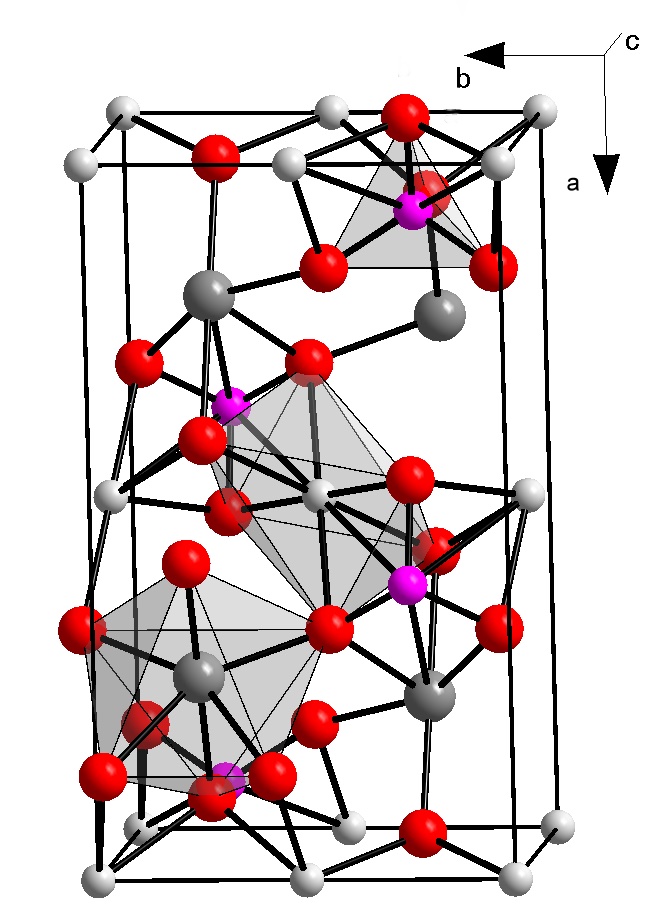
LiFePO4 · CAS 15365-14-7 · orthorhombic, Pnma
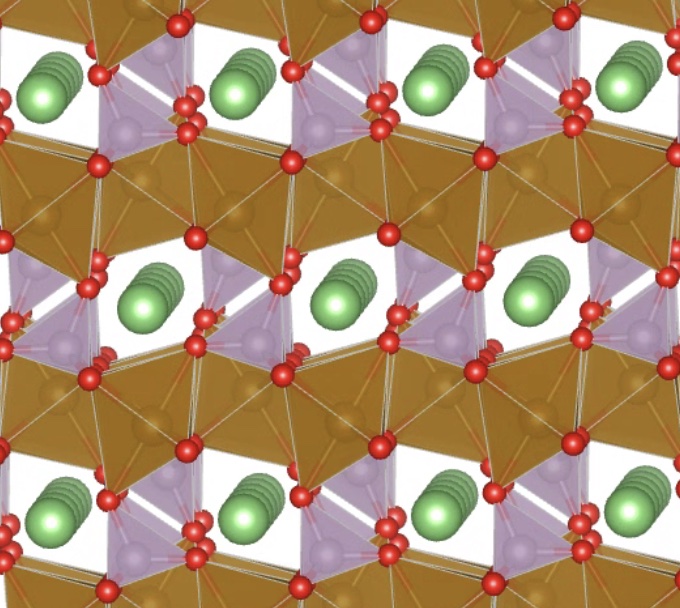
LFP is an iron-and-phosphate cathode with an olivine crystal structure.
Evidence level
2 of 5
Lab-measured
- 0Predicted only. No one has made it, or no measurement exists.
- 1Calculated. Only calculated or predicted values from sources.
- 2Lab-measured. Measured properties with their conditions stated.
- 3Space-relevant tests. Measured in conditions relevant to space, such as vacuum or atomic oxygen.
- 4Ground-qualified. Qualified for an application on the ground.
- 5Flown or field-proven. Flight or field results exist.
Capacity
170 mAh/g
Voltage
3.4 V
Thermal behavior
Peaked at 259 °C
Cycle life
About 275 cycles
Low temperature
82% of capacity
Recipe, share of the weight
- Li 4.4%Lithium
- Fe 35.4%Iron
- P 19.6%Phosphorus
- O 40.6%Oxygen
Best for
Fast-recharging cells where heat tolerance matters more than energy per kilogram (NASA called the cathode inherently safer)
Weakest at
Low specific energy and energy density compared with typical lithium-ion cells (NASA), and very low electronic conductivity
Risk at a glance
- People None found. Not classified hazardous
- If it fails Moderate. Thermal runaway of a charged LFP cell
- Corrosion Moderate. At 55 to 100 degC, iron deposits on the graphite side, and more so as it gets hotter.
Quick facts: LFP
| Property | Value | Basis |
|---|---|---|
| Density | 0.8 to 1.5 g/cm³ | 1 sourced value |
What is the density of Lithium iron phosphate (LFP)?
Lithium iron phosphate (LFP) has a density of 0.8 to 1.5 g/cm³. The source and test conditions are listed in the properties table on this page.
What is Lithium iron phosphate (LFP) used for?
Uses recorded in the sources include Electric vehicle batteries; Stationary battery storage; Portable Life Support System battery for an advanced lunar surface spacesuit (ground evaluation, not flown).
Why it exists
Lithium iron phosphate (LFP, LiFePO₄) is a cathode material for lithium-ion cells. It crystallizes in the olivine structure (orthorhombic, space group Pnma), in which iron and phosphate form a rigid framework through which lithium ions move. The design trades energy for robustness. LFP stores less charge per gram than layered-oxide cathodes such as NMC, NCA and LCO, but in the heating tests collected here its cells stayed cooler when driven to failure. That trade explains where LFP is chosen: in applications that value thermal tolerance and fast recharging over the last increment of energy density.
Where it's used
Electric vehicles
The International Energy Agency reports that LFP batteries accounted for over 55% of the electric-vehicle batteries deployed worldwide in 2025, up from nearly 50% in 2024. Deployment remains heavily concentrated in China.
Stationary energy storage
The same report finds that LFP accounted for over 90% of the world's stationary battery storage installations in 2025.
Tested on the ground as a Moon spacesuit battery
NASA Glenn evaluated LFP cells as a replacement for the silver-zinc battery in the life-support backpack of a lunar spacesuit. The evaluation used A123 M1 26650 cells in a nominal 18.5 V pack, for sorties of about 8 hours, 500 or more sorties, and discharge from -60 to 60 °C. It was a ground evaluation, not a flight, and it is the only space application for which we found a source.
Recipe
LiFePO4
LiFePO₄ is a lithium metal phosphate. Each formula unit combines one lithium ion, one iron atom and one phosphate group, which is one phosphorus atom bonded to four oxygen atoms.
| Ingredient | Atoms per unit | Share of the weight | What it does |
|---|---|---|---|
| Lithium Li | 1 | 4.4% | The mobile species. Lithium ions are extracted from the structure and reinserted as the cell charges and discharges. |
| Iron Fe | 1 | 35.4% | The redox center. Iron changes oxidation state as lithium leaves and returns, which stores and releases the charge. |
| Phosphorus P | 1 | 19.6% | Sits at the center of each phosphate group (PO₄), part of the rigid framework of the crystal. |
| Oxygen O | 4 | 40.6% | Four oxygen atoms per unit complete the phosphate group and hold the framework together as lithium moves. |
Weight shares are calculated from standard atomic weights.
What it can do
Capacity
170 mAh/g
worked out from the formula
The theoretical specific capacity of 170 mAh/g assumes that one lithium ion per formula unit is extracted and reinserted. Layered nickel-based oxides reach about 275 mAh/g. In a laboratory cell, a carbon-coated LFP sample delivered 164.1 mAh/g at a rate of 0.1 C.
Voltage
3.4 V
LFP operates on a flat plateau near 3.4 V versus Li/Li⁺, produced by a two-phase reaction between LiFePO₄ and FePO₄. The other cathodes in this collection operate at 3.6 to 4.3 V. For the same charge, a lower voltage means less stored energy.
Thermal behavior
Peaked at 259 °C
In an accelerating-rate calorimetry test of small cells at full charge, an LFP cell peaked at 259 °C, while an NMC111 cell with twice the capacity reached 731 °C. A larger 24 Ah LFP cell tested separately still entered thermal runaway at about 170 °C and reached 417 °C. LFP is therefore thermally more tolerant, not immune to failure.
Cycle life
About 275 cycles
One test of lab-scale pouch cells retained 91% of its capacity after about 275 cycles. A review article quotes lifetimes above 6,000 cycles but gives no test conditions, so the two figures should not be compared directly.
Low temperature
82% of capacity
At -20 °C the cell delivered 82% of its 20 °C capacity (1.84 Ah against 2.25 Ah, from NASA's battery-sizing table). Charging is the limitation: the NASA slides note that the cell could not be charged at 10C at -20 °C.
How it compares
LFP sits at the safe but modest end of the lithium-ion cathode family. Relative to the layered oxides it has a lower specific capacity and a lower operating voltage, and therefore a lower specific energy. The heating tests collected here show lower peak temperatures when LFP cells are pushed to failure. The table compares LFP with the other cathodes in the collection.
The same measurements for each material, so you can compare them. Each row names the key condition under the value; the full conditions and methods are in the numbered notes under Technical details. Other materials are shown beside it; each was measured under its own conditions, so open its page before comparing closely. See the full ranking.
| Measurement | LFP | NMC | LCO | NCA | LNO | LMO |
|---|---|---|---|---|---|---|
| Capacity and energy | ||||||
| Theoretical specific capacity | 170 mAh/g1 | 275 mAh/g | 274 mAh/g | 278 mAh/g | 275 mAh/g | 285 mAh/g |
| Reversible specific capacity (measured) | 164.1 mAh/g3 | no data | 140 mAh/g | 200 mAh/g | no data | 123 mAh/g |
| Voltage and potential | ||||||
| Average voltage | 3.4 V vs Li/Li+2 | no data | 3.9 to 4.2 V vs Li/Li+ | 3.6 to 4.3 V vs Li/Li+ | 4 V vs Li/Li+ | no data |
| Thermal behavior and safety | ||||||
| Thermal runaway threshold quoted in a reviewRange stated in an open-access review | 210 to 250 °C5 | no data | no data | 250 °C | no data | no data |
| Lifetime and stability | ||||||
| Volume change on cycling | 6.6 %4 | 7.8 % | no data | no data | no data | 16 % |
| Physical and electrical | ||||||
| Density used for LiFePO4 in an electrode modelValue stated in a table footnote | 3.6 g/cm³ | no data | 4.2 g/cm³ | no data | 3.3 g/cm³ | no data |
| Tap density (powder)Range stated in an open-access review | 0.8 to 1.5 g/cm³ | no data | 4.2 g/cm³ | no data | 3.3 g/cm³ | no data |
| Electronic conductivityRange stated in an open-access review | 1×10^-10 to 1×10^-9 S/cm | no data | 6×10^-8 S/cm | no data | no data | no data |
| Other measurements | ||||||
| Lithium-ion diffusivityRange stated in an open-access review | 1×10^-16 to 1×10^-14 cm²/s | no data | no data | no data | no data | no data |
Why choose it, and why not
Good for
- Thermal tolerance. In a side-by-side heating test, the LFP cell peaked at 259 °C against 731 °C for an NMC111 cell.
- Fast recharging. NASA cited this, together with inherent safety, when it evaluated LFP for a spacesuit battery.
Watch out for
- Low specific energy and energy density compared with typical lithium-ion cells.
- Very low electronic conductivity (about 10⁻¹⁰ to 10⁻⁹ S/cm), which is why the best laboratory results use carbon-coated particles.
- Large cells can still vent and reach high temperatures. A 24 Ah cell reached 417 °C.
LFP is the conservative choice. It gives up energy in exchange for tolerance of heat, and the tests collected here support that trade.
Technical details
For scientists and researchers. Everything above comes from the record below: every number with its method, its conditions and its source.
Cell-level benchmarks
Values for finished cells. These vary by manufacturer, so read the conditions in the notes. Other materials are shown beside it; each was measured under its own conditions, so open its page before comparing closely. See the full ranking.
| Measurement | LFP | NMC | LCO | NCA | LNO | LMO |
|---|---|---|---|---|---|---|
| Capacity and energy | ||||||
| Cold capacity retention | 81.8 % of 20 °C capacity12 | 70 % of room-temperature capacity | no data | no data | no data | no data |
| Specific energy of the A123 26650 cell | 105 Wh/kg13 | no data | no data | no data | no data | no data |
| Thermal behavior and safety | ||||||
| Self-heating onset, 24 Ah prismatic LFP/graphite cellAccelerating-rate calorimetry (T_SH) | 116.7 °C6 | 91 °C | 111.8 °C | 101.7 °C | no data | no data |
| Thermal runaway trigger temperature, 24 Ah prismatic LFP/graphite cellAccelerating-rate calorimetry (T_TR) | 170.3 °C7 | no data | no data | no data | no data | no data |
| Exothermic onset, 250 mAh LFP/graphite pouch cellAccelerating-rate calorimetry | 140 °C8 | 91 °C | 111.8 °C | 101.7 °C | no data | no data |
| Self-heating onset, 1.1 Ah 18650 LFP cellAccelerating-rate calorimetry | 90 °C9 | 91 °C | 111.8 °C | 101.7 °C | no data | no data |
| Lifetime and stability | ||||||
| Cycle lifeCycling of lab-scale pouch cells | 275 cycles10 | 300 cycles | > 16000 cycles | 500 to 1500 cycles | 69.2 % retained | no data |
| Cycle life quoted in a reviewStatement in an open-access review | > 6000 cycles11 | 300 cycles | > 16000 cycles | 500 to 1500 cycles | 69.2 % retained | no data |
Notes
The method, full conditions and any caveat for the numbered rows above.
| # | Measurement | Method | Conditions | Caveat |
|---|---|---|---|---|
| 1 | Theoretical specific capacity | Value stated in an open-access review (it cites earlier work for it) | basis figure quoted in the review together with a 3.4 V plateau; one lithium ion per formula unitlithium per formula unit 1 | — |
| 2 | Average voltage | Value stated in an open-access review; Roberts et al. describe the flat potential as two-phase LiFePO4/FePO4 coexistence | basis voltage quoted together with the 170 mAh/g theoretical capacity (the review says "at 3.4 V" and does not call it a plateau)electrode LiFePO4 two-phase reaction | — |
| 3 | Reversible specific capacity (measured) | Specific capacity reported by the review for one research material (other cited materials in the same review range from 121 to 163.9 mAh/g depending on synthesis and rate) | rate 0.1 Celectrode carbon-coated LFP made with a PAN-derived carbonvoltage window not stated in the review | A single literature example, not a typical value for commercial cathode powder. |
| 4 | Volume change on cycling | Calculated by Space Mushroom from the lattice parameters in the source (about 291.0 vs 271.7 A3); the source does not state a percentage | basis unit-cell volume of FePO4 (delithiated) is smaller than LiFePO4lattice parameters LiFePO4 a=10.3290 b=6.0065 c=4.6908 A; FePO4 a=9.8142 b=5.7893 c=4.7820 A (both Pnma)direction volume shrinks on removing lithium | — |
| 5 | Thermal runaway threshold quoted in a review | — | basis statement in the introduction of a review, citing earlier worktest method not given in the review | A second-hand figure; the measured cell data above show earlier self-heating onsets. |
| 6 | Self-heating onset, 24 Ah prismatic LFP/graphite cell | — | state of charge 100%cell commercial 24 Ah prismatic LFP/graphitemethod extended-volume ARC, heat-wait-search, 5 °C steps, 30 min waitsdetection 0.02 °C/minatmosphere adiabatic | — |
| 7 | Thermal runaway trigger temperature, 24 Ah prismatic LFP/graphite cell | — | state of charge 100%cell commercial 24 Ah prismatic LFP/graphitedefinition temperature rise rate of 1 °C/minmethod extended-volume ARC, heat-wait-searchatmosphere adiabatic | The paper gives 170.235 once in the running text and 170.265 in Table 1; it reached a maximum of 416.788 degC and vented at 182.582 degC. |
| 8 | Exothermic onset, 250 mAh LFP/graphite pouch cell | — | state of charge 100%cell 250 mAh LFP/graphite pouchmethod EV+ ARC, heat-wait-search 50 to 315 °C, 5 °C steps, 60 min waitsdetection self-heating rate above 0.02 °C/minatmosphere adiabatic | Small venting was seen at about 120 degC; self-heating rate stayed below 0.1 degC/min over the whole test. The paper reports no thermal-runaway or maximum temperature. |
| 9 | Self-heating onset, 1.1 Ah 18650 LFP cell | — | state of charge 100%cell commercial 1.1 Ah 18650 LFPmethod es-ARC, heated 30 to 250 °C in 5 °C stepsdetection 0.01 °C/min | The authors state that onset was about 90 degC for all three cell types they tested (LMO, LFP, NMC111), so onset here is set by early cell reactions rather than by the cathode alone. The LFP cell peaked at 259 degC, never entered the third (high-rate) stage, and stayed below 3 degC/min. |
| 10 | Cycle life | — | capacity retained 91% of initial capacityrate C/3temperature 40 °Ccell 250 mAh LFP/graphite pouchcycles reported about 275 | — |
| 11 | Cycle life quoted in a review | — | basis statement in the introduction of a review, citing earlier work ('more than 6000 cycles of lifespan')test conditions not given in the review | Second-hand figure with no stated test conditions; do not compare directly with the tested value above. |
| 12 | Cold capacity retention | Calculated by Space Mushroom as 1.84 Ah / 2.25 Ah from the two capacities in the NASA battery-sizing table | cell A123 M1 26650 LiFePO4, 2.3 Ah nameplatetemperature -20 °C vs 20 °Ccharge C/2 to 3.6 V, taper limit C/50, done at the discharge temperaturedischarge capacity used for the 8 hour case, based on a C/10 rate | Under a 4C rapid charge for 15 minutes at -20 degC the same sizing table lists only 0.74 Ah per cell, and the slides note that the cell would not charge at 10C at -20 degC. |
| 13 | Specific energy of the A123 26650 cell | Calculated by Space Mushroom as 2.3 Ah x 3.3 V / 0.072 kg (about 105.4 Wh/kg); the slides state only that specific energy is lower than typical Li-ion chemistries | cell A123 M1 26650 LiFePO4nameplate capacity 2.3 Ahnominal voltage 3.3 V at C/2cell mass 72 g | — |
Corrosion and compatibility
What happens when it meets other materials and environments.
| Environment | Concern | What happens |
|---|---|---|
| Humid laboratory air (about 25 degC, about 50% humidity) | low | Opened in humid air, the cathode surface roughened, but LFP held up better than NMC/LMO in the same test.1 |
| Aluminium current collector in LiPF6 carbonate electrolyte | low | Aluminium corrosion is a high-voltage problem. The source says nothing specific about LFP.2 |
| Iron dissolution and deposition on graphite at high temperature (LiFSI electrolyte) | moderate | At 55 to 100 degC, iron deposits on the graphite side, and more so as it gets hotter.3 |
| # | Environment | Details | Test conditions |
|---|---|---|---|
| 1 | Humid laboratory air (about 25 degC, about 50% humidity) | LFP cathodes taken from A123 26650 cells and opened in air showed a less defined, etched surface texture with looser, rounder particles, which the authors read as some corrosive attack and a surface layer. The paper calls LFP the more resilient of the two cathodes it tested: it faded slowly over about the first 50 cycles, while the NMC/LMO cathode dropped at once. | exposure cells opened in air at about 25 °C and about 50% humidity, then vacuum dried at 80 °C overnight; exposure time not statedcathode LFP from A123 ANR26650M1B cellstest coin cells with 1.0 M LiPF6 in EC/DMC, C/10, 2.5 to 3.65 V |
| 2 | Aluminium current collector in LiPF6 carbonate electrolyte | The review says LiPF6 is the usual salt because it passivates aluminium, and that such electrolytes work well at present-day operating potentials but still corrode current collectors at the higher potentials where high-potential cathodes operate. It says nothing specific about LFP; LFP's plateau is about 3.4 V (see properties). | basis general statement in the introduction of a paper on aluminium passivation; no LFP-specific testelectrolyte LiPF6 in organic carbonates |
| 3 | Iron dissolution and deposition on graphite at high temperature (LiFSI electrolyte) | In LFP/graphite pouch cells aged at 55 to 100 degC, iron deposited on the graphite negative electrode; deposition rose swiftly at higher temperatures and was far higher in cells with less vinylene carbonate additive. The authors infer iron dissolves from the cathode; dissolved iron was not measured directly, and the cathode itself stayed mostly intact (about 150 mAh/g vs about 160 mAh/g for fresh LFP in a half-cell). | temperatures 55, 70, 85 and 100 °Ccell machine-made LFP/graphite pouch cells, 2.5 to 3.8 V at C/3electrolyte 1.0 M LiFSI in EC:DEC (1:2 by weight) with 1 or 4 wt% VCmeasured iron on negative electrode by micro-XRF, in ug/cm2; 17.7 ug/cm2 on the heavily degraded 100 °C cell (Table II) |
Risks and side effects
Hazards to people, what happens when a cell overheats, and how the material is handled and stored.
For people
LFP powder is not classified as hazardous by its supplier or by most reporters to the chemical database PubChem, but little toxicological data exist.
- The powder
- A supplier safety data sheet classifies it as not a hazardous substance and requires no hazard label. PubChem records the same for 104 of 107 company reports (97.2%), and only three reports carry any hazard information.
- Dust
- Dust should be avoided. The safety data sheet advises a particulate mask (N95 or P1) where nuisance dust is a concern.
- In a fire
- Decomposition in a fire produces oxides of phosphorus, lithium and iron.
If a cell overheats
These results come from laboratory heating tests on cells, not from incidents in the field.
- A large cell at full charge
- A commercial 24 Ah prismatic LFP/graphite cell at 100% state of charge, heated in an adiabatic calorimeter, began to heat itself at 116.7 °C. Thermal runaway was triggered at 170.3 °C and gas venting began at 182.6 °C. The peak temperature was 416.8 °C. The cell swelled from 30.00 to 41.35 mm in thickness and lost 57 g on venting.
- Compared with an NMC cell
- In a separate test, a 1.1 Ah LFP cell of 18650 format peaked at 259 °C and stayed below 3 °C/min. A 2.2 Ah NMC111 cell tested the same way reached 731 °C at 7,580 °C/min. The authors note that the NMC cell holds twice the capacity.
- Vent gas
- At the runaway trigger the gas was mostly hydrogen (28.1%), carbon monoxide (27.3%), ethylene (19.5%) and methane (18.8%). At the first self-heating it was mostly carbon monoxide (47.1%) and methane (31.7%). These gases are flammable and can reach neighbouring cells and the enclosure.
- Loss of output
- Cell resistance rose about 40-fold, from 0.978 to 40.378 mΩ, by the trigger point. The authors attribute this to the closing of the separator pores, so the cell delivers much less current as it overheats.
Handling and storage
- Storage
- The safety data sheet calls for a tightly closed container in a dry, well-ventilated place, exhaust ventilation where dust forms, and separation from strong oxidizing agents.
- Voltage
- NASA's A123 cell sheet lists an operating range of 2 to 3.6 V. Higher voltages can be reached at the cost of cycle life, so charging should stay at or below 3.6 V.
- Cold charging
- Fast charging should be avoided in the cold. In NASA's tests the cell could not be charged at 10C at -20 °C, and a 4C charge for 15 minutes at -20 °C added only 0.74 Ah per cell.
Test details
The original wording and numbers from the sources, for readers who want them.
Failure risks
| Failure | Trigger and consequence |
|---|---|
| Thermal runaway of a charged LFP cellmoderate severity | Heating in an adiabatic calorimeter at 100% state of charge (24 Ah prismatic cell)Self-heating from 116.7 degC, thermal runaway trigger at 170.3 degC, venting at 182.6 degC and a peak of 416.8 degC; the cell swelled from 30.00 to 41.35 mm thick by the trigger point and lost 57 g by venting. |
| Thermal abuse of a small 18650 LFP cell compared with a layered-oxide celllow severity | es-ARC heating at 100% state of chargeThe 1.1 Ah LFP cell peaked at 259 degC and stayed below 3 degC/min; the 2.2 Ah NMC111 cell tested the same way reached 731 degC and 7580 degC/min. The authors note the NMC cell holds twice the capacity. |
Side effects on surrounding parts
| Affects | Effect |
|---|---|
| Neighbouring cells and the battery enclosure | Gas vented at the thermal runaway trigger point was mostly hydrogen (28.08%), carbon monoxide (27.27%), ethylene (19.48%) and methane (18.76%); at first self-heating it was mostly CO (47.07%) and methane (31.67%). These gases are flammable. |
| Cell's own current output during overheating | Cell resistance rose about 40-fold (0.978 to 40.378 milliohm) by the trigger point, which the authors attribute to the separator pores closing. |
Handling and storage
- Powder SDS (MSE Supplies, 2020): keep the container tightly closed in a dry, well-ventilated place; provide exhaust ventilation where dust forms; avoid dust formation. It lists strong oxidizing agents as incompatible and, in a fire, oxides of phosphorus, lithium and iron as decomposition products.
- NASA's A123 cell sheet lists a 2 to 3.6 V range and notes that higher voltages can be reached but cycle life is sacrificed.
Mitigations
- Keep charge voltage at or below 3.6 V and avoid fast charging when cold; the NASA tests could not charge the cell at 10C at -20 degC.
Supply and geography
How common the raw materials are and where they come from.
Lithium
20 ppm in the Earth's crust (USGS table of crustal abundances, citing Jefferson Science Associates, 2014)
- Top producers (2025)
- Australia 31.7%, China 21.4%, Chile 19.3%, Zimbabwe 9.7%, Argentina 7.9%
- Critical mineral lists
- US: listed, EU: listed
- Recycling
- USGS: construction of lithium battery recycling plants continued throughout 2025, with automobile companies and battery recyclers partnering to supply battery materials.
- Substitutes
- USGS: substitution for lithium compounds is possible in batteries, ceramics, greases and manufactured glass (the examples it gives are for primary batteries, greases and ceramics, not lithium-ion cathodes).
Iron
- Top producers (2025)
- Australia 37.7%, Brazil 16.2%, India 11.9%, China 11.2%
- Critical mineral lists
- US: not listed, EU: not listed
- Recycling
- USGS iron ore chapter: 'None' (it refers readers to the Iron and Steel Scrap chapter).
Phosphorus (phosphate rock)
- Top producers (2025)
- China 44%, Morocco 14.4%, United States 8%, Russia 5.6%
- Critical mineral lists
- US: listed, EU: listed
- Recycling
- USGS phosphate rock chapter: 'None'.
- Substitutes
- USGS: there are no substitutes for phosphorus in agriculture (the chapter does not discuss battery uses).
Gallery
Documents
Datasheets, safety data sheets, papers and standards you can open.
Full record
The complete spore, as stored. Free to reuse under CC-BY-4.0. Images keep the licence shown with each one.
Show the full YAML
spore: profile
id: lithium-iron-phosphate
spore_version: 0.2
family: lithium
name: Lithium iron phosphate
abbreviation: LFP
role: cathode
category: energy
type: li-ion-cathodes
summary: >
  LFP is an iron-and-phosphate cathode with an olivine crystal structure. It stores less energy per gram than
  nickel-based cathodes. In one side-by-side heating test of small cells, the LFP cell peaked at 259 degC while an
  NMC111 cell with twice the capacity reached 731 degC, though a larger LFP cell in another test still vented and reached
  417 degC. NASA Glenn tested LFP cells for a lunar spacesuit battery because the cathode is safer and the cells recharge fast.
best_for: "Fast-recharging cells where heat tolerance matters more than energy per kilogram (NASA called the cathode inherently safer)"
weakest_at: "Low specific energy and energy density compared with typical lithium-ion cells (NASA), and very low electronic conductivity"
identity:
  formula: LiFePO4
  cas: "15365-14-7"
  crystal_system: orthorhombic
  space_group: Pnma
  source: roberts2014
  where: Figure 1 caption (LiFePO4 and FePO4 both Pnma); CAS number from PubChem CID 15320824
tags:
  environments: [lunar-day]
  stresses: [extreme-cold]
  applications: [batteries, habitats-and-suits]
properties:
  - benchmark: theoretical_capacity
    value: 170
    unit: mAh/g
    scope: material
    conditions: {basis: "figure quoted in the review together with a 3.4 V plateau; one lithium ion per formula unit", lithium_per_formula_unit: 1}
    method: Value stated in an open-access review (it cites earlier work for it)
    status: calculated
    source: yin2026
    where: Section 1 (Introduction), second paragraph
  - benchmark: avg_voltage
    value: 3.4
    unit: V vs Li/Li+
    scope: material
    conditions: {basis: "voltage quoted together with the 170 mAh/g theoretical capacity (the review says \"at 3.4 V\" and does not call it a plateau)", electrode: "LiFePO4 two-phase reaction"}
    method: Value stated in an open-access review; Roberts et al. describe the flat potential as two-phase LiFePO4/FePO4 coexistence
    status: ground
    source: yin2026
    where: Section 1 (Introduction), second paragraph
  - benchmark: practical_capacity
    value: 164.1
    unit: mAh/g
    scope: material
    conditions: {rate: "0.1 C", electrode: "carbon-coated LFP made with a PAN-derived carbon", voltage_window: "not stated in the review"}
    method: Specific capacity reported by the review for one research material (other cited materials in the same review range from 121 to 163.9 mAh/g depending on synthesis and rate)
    status: ground
    note: A single literature example, not a typical value for commercial cathode powder.
    source: yin2026
    where: Section 2.5.2 (heteroatom-doped carbon coatings), reference [86] as cited
  - benchmark: density
    label: Density used for LiFePO4 in an electrode model
    value: 3.6
    unit: g/cm3
    scope: material
    conditions: {basis: "value the authors assumed for LiFePO4 when computing electrode composition", not_a: "measured crystallographic density"}
    method: Value stated in a table footnote
    status: calculated
    source: roberts2014
    where: Table 1, footnote a
  - benchmark: density
    label: Tap density (powder)
    value: 0.8
    value_high: 1.5
    bound: range
    unit: g/cm3
    scope: material
    conditions: {form: "LFP powder as quoted in the review", note: "tap density is lower than crystal density"}
    method: Range stated in an open-access review
    status: ground
    source: yin2026
    where: Section 2.1 (Design principles for LFP synthesis)
  - benchmark: volume_change
    value: 6.6
    unit: "%"
    scope: material
    conditions: {basis: "unit-cell volume of FePO4 (delithiated) is smaller than LiFePO4", lattice_parameters: "LiFePO4 a=10.3290 b=6.0065 c=4.6908 A; FePO4 a=9.8142 b=5.7893 c=4.7820 A (both Pnma)", direction: "volume shrinks on removing lithium"}
    method: Calculated by Space Mushroom from the lattice parameters in the source (about 291.0 vs 271.7 A3); the source does not state a percentage
    status: calculated
    source: roberts2014
    where: Figure 1 caption (lattice parameters)
  - benchmark: electronic_conductivity
    value: 1.0e-10
    value_high: 1.0e-9
    bound: range
    unit: S/cm
    scope: material
    conditions: {material: "LFP without conductivity-improving treatment, as quoted in the review"}
    method: Range stated in an open-access review
    status: ground
    source: yin2026
    where: Section 2.1 (Design principles for LFP synthesis)
  - benchmark: li_ion_diffusivity
    label: Lithium-ion diffusivity
    value: 1.0e-16
    value_high: 1.0e-14
    bound: range
    unit: cm2/s
    scope: material
    conditions: {material: "LFP as quoted in the review"}
    method: Range stated in an open-access review
    status: ground
    source: yin2026
    where: Section 2.1 (Design principles for LFP synthesis)
  - benchmark: thermal_runaway_onset
    label: Self-heating onset, 24 Ah prismatic LFP/graphite cell
    value: 116.743
    unit: degC
    scope: cell
    conditions: {state_of_charge: "100%", cell: "commercial 24 Ah prismatic LFP/graphite", method: "extended-volume ARC, heat-wait-search, 5 degC steps, 30 min waits", detection: "0.02 degC/min", atmosphere: adiabatic}
    method: Accelerating-rate calorimetry (T_SH)
    status: ground
    source: tang2021
    where: Results, critical temperatures (T_SH); Table 1
  - benchmark: thermal_runaway_trigger_temp
    label: Thermal runaway trigger temperature, 24 Ah prismatic LFP/graphite cell
    value: 170.265
    unit: degC
    scope: cell
    conditions: {state_of_charge: "100%", cell: "commercial 24 Ah prismatic LFP/graphite", definition: "temperature rise rate of 1 degC/min", method: "extended-volume ARC, heat-wait-search", atmosphere: adiabatic}
    method: Accelerating-rate calorimetry (T_TR)
    status: ground
    note: The paper gives 170.235 once in the running text and 170.265 in Table 1; it reached a maximum of 416.788 degC and vented at 182.582 degC.
    source: tang2021
    where: Results, critical temperatures (T_TR); Table 1
  - benchmark: thermal_runaway_onset
    label: Exothermic onset, 250 mAh LFP/graphite pouch cell
    value: 140
    unit: degC
    scope: cell
    conditions: {state_of_charge: "100%", cell: "250 mAh LFP/graphite pouch", method: "EV+ ARC, heat-wait-search 50 to 315 degC, 5 degC steps, 60 min waits", detection: "self-heating rate above 0.02 degC/min", atmosphere: adiabatic}
    method: Accelerating-rate calorimetry
    status: ground
    note: Small venting was seen at about 120 degC; self-heating rate stayed below 0.1 degC/min over the whole test. The paper reports no thermal-runaway or maximum temperature.
    source: chak2025
    where: Results, Fig. 4d and surrounding text
  - benchmark: thermal_runaway_onset
    label: Self-heating onset, 1.1 Ah 18650 LFP cell
    value: 90
    unit: degC
    scope: cell
    conditions: {state_of_charge: "100%", cell: "commercial 1.1 Ah 18650 LFP", method: "es-ARC, heated 30 to 250 degC in 5 degC steps", detection: "0.01 degC/min"}
    method: Accelerating-rate calorimetry
    status: ground
    note: The authors state that onset was about 90 degC for all three cell types they tested (LMO, LFP, NMC111), so onset here is set by early cell reactions rather than by the cathode alone. The LFP cell peaked at 259 degC, never entered the third (high-rate) stage, and stayed below 3 degC/min.
    source: lei2017
    where: Section 3.2 and Table 1 ("This work")
  - benchmark: thermal_runaway_onset
    label: Thermal runaway threshold quoted in a review
    value: 210
    value_high: 250
    bound: range
    unit: degC
    scope: material
    conditions: {basis: "statement in the introduction of a review, citing earlier work", test_method: "not given in the review"}
    method: Range stated in an open-access review
    status: ground
    note: A second-hand figure; the measured cell data above show earlier self-heating onsets.
    source: yin2026
    where: Section 1 (Introduction), second paragraph
  - benchmark: cycle_life
    value: 275
    unit: cycles
    scope: cell
    conditions: {capacity_retained: "91% of initial capacity", rate: "C/3", temperature: "40 degC", cell: "250 mAh LFP/graphite pouch", cycles_reported: "about 275"}
    method: Cycling of lab-scale pouch cells
    status: ground
    source: chak2025
    where: Abstract; Results, Fig. 3c
  - benchmark: cycle_life
    label: Cycle life quoted in a review
    value: 6000
    bound: lower
    unit: cycles
    scope: cell
    conditions: {basis: "statement in the introduction of a review, citing earlier work ('more than 6000 cycles of lifespan')", test_conditions: "not given in the review"}
    method: Statement in an open-access review
    status: ground
    note: Second-hand figure with no stated test conditions; do not compare directly with the tested value above.
    source: yin2026
    where: Section 1 (Introduction), second paragraph
  - benchmark: cold_capacity
    value: 81.8
    unit: "% of 20 degC capacity"
    scope: cell
    conditions: {cell: "A123 M1 26650 LiFePO4, 2.3 Ah nameplate", temperature: "-20 degC vs 20 degC", charge: "C/2 to 3.6 V, taper limit C/50, done at the discharge temperature", discharge: "capacity used for the 8 hour case, based on a C/10 rate"}
    method: Calculated by Space Mushroom as 1.84 Ah / 2.25 Ah from the two capacities in the NASA battery-sizing table
    status: ground
    note: Under a 4C rapid charge for 15 minutes at -20 degC the same sizing table lists only 0.74 Ah per cell, and the slides note that the cell would not charge at 10C at -20 degC.
    source: reid2007
    where: Slide 17 (Battery Sizing Results); slide 14 footnote
  - benchmark: cell_specific_energy
    label: Specific energy of the A123 26650 cell
    value: 105
    unit: Wh/kg
    scope: cell
    conditions: {cell: "A123 M1 26650 LiFePO4", nameplate_capacity: "2.3 Ah", nominal_voltage: "3.3 V at C/2", cell_mass: "72 g"}
    method: Calculated by Space Mushroom as 2.3 Ah x 3.3 V / 0.072 kg (about 105.4 Wh/kg); the slides state only that specific energy is lower than typical Li-ion chemistries
    status: calculated
    source: reid2007
    where: Slide 10 (A123 cell table)
corrosion:
  - environment: Humid laboratory air (about 25 degC, about 50% humidity)
    headline: "Opened in humid air, the cathode surface roughened, but LFP held up better than NMC/LMO in the same test."
    effect: "LFP cathodes taken from A123 26650 cells and opened in air showed a less defined, etched surface texture with looser, rounder particles, which the authors read as some corrosive attack and a surface layer. The paper calls LFP the more resilient of the two cathodes it tested: it faded slowly over about the first 50 cycles, while the NMC/LMO cathode dropped at once."
    rating: low
    conditions: {exposure: "cells opened in air at about 25 degC and about 50% humidity, then vacuum dried at 80 degC overnight; exposure time not stated", cathode: "LFP from A123 ANR26650M1B cells", test: "coin cells with 1.0 M LiPF6 in EC/DMC, C/10, 2.5 to 3.65 V"}
    source: mele2025
    where: Sections 2.2, 2.3, 3.1 and 4 (Conclusions)
  - environment: Aluminium current collector in LiPF6 carbonate electrolyte
    headline: "Aluminium corrosion is a high-voltage problem. The source says nothing specific about LFP."
    effect: "The review says LiPF6 is the usual salt because it passivates aluminium, and that such electrolytes work well at present-day operating potentials but still corrode current collectors at the higher potentials where high-potential cathodes operate. It says nothing specific about LFP; LFP's plateau is about 3.4 V (see properties)."
    rating: low
    conditions: {basis: "general statement in the introduction of a paper on aluminium passivation; no LFP-specific test", electrolyte: "LiPF6 in organic carbonates"}
    source: theivaprakasam2018
    where: Introduction
  - environment: Iron dissolution and deposition on graphite at high temperature (LiFSI electrolyte)
    headline: "At 55 to 100 degC, iron deposits on the graphite side, and more so as it gets hotter."
    effect: "In LFP/graphite pouch cells aged at 55 to 100 degC, iron deposited on the graphite negative electrode; deposition rose swiftly at higher temperatures and was far higher in cells with less vinylene carbonate additive. The authors infer iron dissolves from the cathode; dissolved iron was not measured directly, and the cathode itself stayed mostly intact (about 150 mAh/g vs about 160 mAh/g for fresh LFP in a half-cell)."
    rating: moderate
    conditions: {temperatures: "55, 70, 85 and 100 degC", cell: "machine-made LFP/graphite pouch cells, 2.5 to 3.8 V at C/3", electrolyte: "1.0 M LiFSI in EC:DEC (1:2 by weight) with 1 or 4 wt% VC", measured: "iron on negative electrode by micro-XRF, in ug/cm2; 17.7 ug/cm2 on the heavily degraded 100 degC cell (Table II)"}
    source: yue2025
    where: Results (micro-XRF, Fig. 5 and 6); Table II; Discussion (Fig. 12, 13)
risks:
  hazards:
    - text: "PubChem reports that LFP does not meet GHS hazard criteria for 97.2% (104 of 107) of the company reports; only 2.8% of reports give hazard information, so check the supplier's safety data sheet for the powder you actually handle."
      ghs: []
      source: pubchem-lfp
      where: Safety and Hazards, GHS Classification (CID 15320824)
    - text: "Supplier safety data sheet for LiFePO4 powder (MSE Supplies, rev. 2-12-2020): classified as not a hazardous substance or mixture under OSHA HCS; no GHS label elements. Toxicological data sections read 'No data available'; dust masks (N95 or P1) are advised only where nuisance dust is a concern."
      ghs: []
      source: mse-lfp-sds
      where: Sections 2, 8 and 11
  failure_risks:
    - mode: Thermal runaway of a charged LFP cell
      trigger: "Heating in an adiabatic calorimeter at 100% state of charge (24 Ah prismatic cell)"
      consequence: "Self-heating from 116.7 degC, thermal runaway trigger at 170.3 degC, venting at 182.6 degC and a peak of 416.8 degC; the cell swelled from 30.00 to 41.35 mm thick by the trigger point and lost 57 g by venting."
      severity: moderate
      source: tang2021
      where: Results, Table 1
    - mode: Thermal abuse of a small 18650 LFP cell compared with a layered-oxide cell
      trigger: "es-ARC heating at 100% state of charge"
      consequence: "The 1.1 Ah LFP cell peaked at 259 degC and stayed below 3 degC/min; the 2.2 Ah NMC111 cell tested the same way reached 731 degC and 7580 degC/min. The authors note the NMC cell holds twice the capacity."
      severity: low
      source: lei2017
      where: Section 3.2, Table 3
  side_effects:
    - text: "Gas vented at the thermal runaway trigger point was mostly hydrogen (28.08%), carbon monoxide (27.27%), ethylene (19.48%) and methane (18.76%); at first self-heating it was mostly CO (47.07%) and methane (31.67%). These gases are flammable."
      affects: "Neighbouring cells and the battery enclosure"
      source: tang2021
      where: Results, gas composition (Figure 7)
    - text: "Cell resistance rose about 40-fold (0.978 to 40.378 milliohm) by the trigger point, which the authors attribute to the separator pores closing."
      affects: "Cell's own current output during overheating"
      source: tang2021
      where: Table 1 and Separator discussion
  handling:
    - text: "Powder SDS (MSE Supplies, 2020): keep the container tightly closed in a dry, well-ventilated place; provide exhaust ventilation where dust forms; avoid dust formation. It lists strong oxidizing agents as incompatible and, in a fire, oxides of phosphorus, lithium and iron as decomposition products."
      source: mse-lfp-sds
      where: Sections 5, 6, 7 and 10
    - text: "NASA's A123 cell sheet lists a 2 to 3.6 V range and notes that higher voltages can be reached but cycle life is sacrificed."
      source: reid2007
      where: Slide 10
  mitigations:
    - text: "Keep charge voltage at or below 3.6 V and avoid fast charging when cold; the NASA tests could not charge the cell at 10C at -20 degC."
      source: reid2007
      where: Slides 10 and 14
uses:
  - application: batteries
    device: "Electric vehicle batteries"
    example: "The IEA reports that LFP batteries accounted for over 55% of EV batteries deployed globally in 2025, up from nearly 50% in 2024, and that deployment remains heavily concentrated in China."
    source: iea-gevo-2026
    where: "Battery industry trends, section on LFP in the EV market"
  - application: batteries
    device: "Stationary battery storage"
    example: "The IEA reports that LFP accounted for over 90% of global stationary battery storage installations in 2025."
    source: iea-gevo-2026
    where: "Battery industry trends, reference note on LFP and battery prices"
  - application: batteries
    device: "Portable Life Support System battery for an advanced lunar surface spacesuit (ground evaluation, not flown)"
    example: "NASA Glenn evaluated A123 M1 26650 LiFePO4 cells (nominal 18.5 V pack, sorties of about 8 hours, 500+ sorties, discharge from -60 to 60 degC) as a replacement for a silver-zinc battery of about 6.8 kg."
    source: reid2007
    where: Slides 6, 7 and 10
supply:
  - subject: Lithium
    abundance: "20 ppm in the Earth's crust (USGS table of crustal abundances, citing Jefferson Science Associates, 2014)"
    producers:
      - {country: Australia, share_percent: 31.7, year: 2025}
      - {country: China, share_percent: 21.4, year: 2025}
      - {country: Chile, share_percent: 19.3, year: 2025}
      - {country: Zimbabwe, share_percent: 9.7, year: 2025}
      - {country: Argentina, share_percent: 7.9, year: 2025}
    critical_lists:
      - {list: "USGS 2025 List of Critical Minerals", listed: true}
      - {list: "EU critical raw materials list (Regulation (EU) 2024/1252, as shown on the European Commission page)", listed: true}
    recycling: "USGS: construction of lithium battery recycling plants continued throughout 2025, with automobile companies and battery recyclers partnering to supply battery materials."
    substitutes: ["USGS: substitution for lithium compounds is possible in batteries, ceramics, greases and manufactured glass (the examples it gives are for primary batteries, greases and ceramics, not lithium-ion cathodes)."]
    source: usgs-mcs2026-lithium
    where: "World Mine Production and Reserves table (2025e; shares calculated by Space Mushroom against the 290,000 t world total, which excludes U.S. output); Recycling; Substitutes. Abundance: USGS PP 1802-A Table A1 (p. A7). Lists: USGS and European Commission pages (see sources)."
  - subject: Iron
    producers:
      - {country: Australia, share_percent: 37.7, year: 2025}
      - {country: Brazil, share_percent: 16.2, year: 2025}
      - {country: India, share_percent: 11.9, year: 2025}
      - {country: China, share_percent: 11.2, year: 2025}
    critical_lists:
      - {list: "USGS 2025 List of Critical Minerals", listed: false}
      - {list: "EU critical raw materials list (Regulation (EU) 2024/1252, as shown on the European Commission page)", listed: false}
    recycling: "USGS iron ore chapter: 'None' (it refers readers to the Iron and Steel Scrap chapter)."
    substitutes: []
    source: usgs-mcs2026-iron
    where: "World Mine Production table, usable ore, 2025e (world total 2,600,000 thousand t; shares calculated by Space Mushroom; the chapter's data are for iron ore used in steelmaking). Lists: iron is absent from both lists."
  - subject: Phosphorus (phosphate rock)
    producers:
      - {country: China, share_percent: 44.0, year: 2025}
      - {country: Morocco, share_percent: 14.4, year: 2025}
      - {country: United States, share_percent: 8.0, year: 2025}
      - {country: Russia, share_percent: 5.6, year: 2025}
    critical_lists:
      - {list: "USGS 2025 List of Critical Minerals (listed as Phosphate)", listed: true}
      - {list: "EU critical raw materials list (Phosphate Rock and Phosphorus both listed)", listed: true}
    recycling: "USGS phosphate rock chapter: 'None'."
    substitutes: ["USGS: there are no substitutes for phosphorus in agriculture (the chapter does not discuss battery uses)."]
    source: usgs-mcs2026-phosphate
    where: "World Mine Production table, marketable phosphate rock, 2025 (world total 250,000 thousand t; shares calculated by Space Mushroom); Recycling; Substitutes"
media:
  - file: /media/lithium/lithium-iron-phosphate-1.jpg
    caption: "Polyhedral drawing of the LiFePO4 crystal structure."
    shows: "Linked octahedra and tetrahedra forming the olivine framework, with open channels in which spheres sit."
    conditions: "Computer-drawn crystal-structure picture, not a measurement"
    alt: "Drawing of the LiFePO4 crystal structure: brown octahedra and purple tetrahedra joined at red oxygen atoms, with green spheres in open channels between them."
    credit: "Aherthabey (Wikimedia Commons)"
    license: CC BY-SA 4.0
    license_url: https://creativecommons.org/licenses/by-sa/4.0/
    source_url: https://commons.wikimedia.org/wiki/File:LiFePO4_crystal_structure.png
  - file: /media/lithium/lithium-iron-phosphate-2.jpg
    caption: "Unit cell of triphylite, the mineral form of LiFePO4."
    shows: "One orthorhombic unit cell with its a, b and c axes, drawn from published X-ray diffraction data; atom colours are not labelled on the source image."
    conditions: "Computer-drawn from the data of Streltsov et al., Acta Cryst. (as credited on the Commons file page)"
    alt: "Ball-and-stick drawing of one triphylite unit cell with red, grey, white and pink atoms, a few polyhedra outlined, and a, b, c axes marked."
    credit: "Orci (Wikimedia Commons)"
    license: CC BY-SA 3.0
    license_url: https://creativecommons.org/licenses/by-sa/3.0/
    source_url: https://commons.wikimedia.org/wiki/File:Crystal_structure-Triphylite.png
  - file: /media/lithium/lithium-iron-phosphate-3.jpg
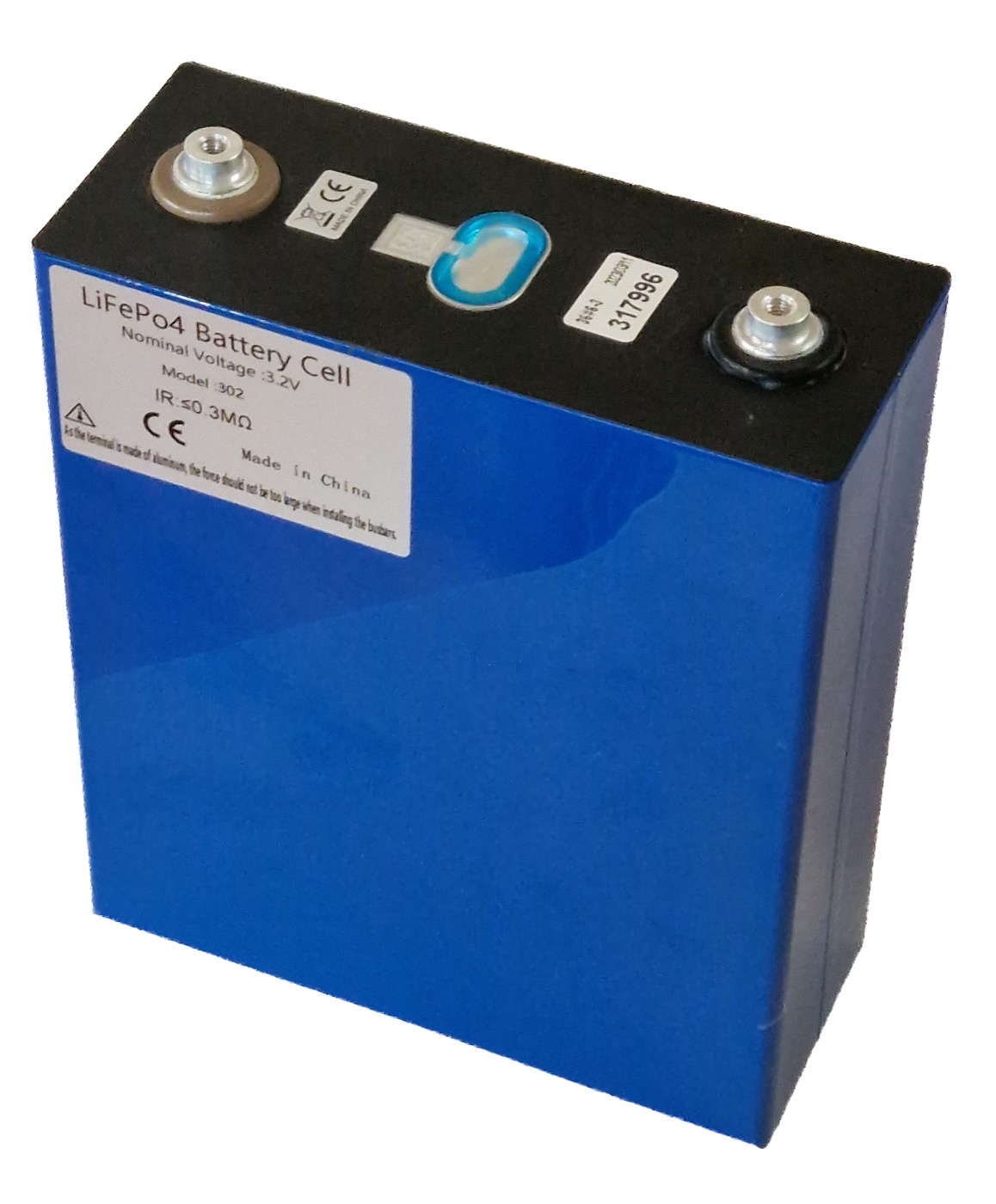
    caption: "A commercial prismatic LiFePO4 cell."
    shows: "A blue-cased cell labelled 'LiFePo4 Battery Cell, nominal voltage 3.2 V' with two aluminium terminals and a vent on top."
    conditions: "Photograph of a CATL 302 Ah cell per the Commons file description; not a space-rated cell"
    alt: "Photograph of a blue rectangular battery cell with a label reading LiFePo4 Battery Cell, nominal voltage 3.2 V, and two metal terminals and a vent on the black top."
    credit: "Aeroid (Wikimedia Commons)"
    license: CC BY-SA 4.0
    license_url: https://creativecommons.org/licenses/by-sa/4.0/
    source_url: https://commons.wikimedia.org/wiki/File:CATL_Lifepo4_302Ah.jpg
documents:
  - {title: "MSE Supplies safety data sheet: Lithium iron (II) phosphate, product PO0127 (rev. 2-12-2020)", type: sds, url: "https://cdn.shopify.com/s/files/1/0722/7785/files/MSE-LFP-SDS.pdf", year: 2020}
  - {title: "PubChem: Lithium iron phosphate (CID 15320824), GHS classification summary", type: database, url: "https://pubchem.ncbi.nlm.nih.gov/compound/15320824", year: 2026}
  - {title: "Comprehensive Review of Synthesis, Structure, and Electrochemical Performance of LiFePO4 (open access)", type: paper, url: "https://pmc.ncbi.nlm.nih.gov/articles/PMC13525353/", year: 2026}
  - {title: "Experimental Analysis of Thermal Runaway in 18650 Cylindrical Li-Ion Cells Using an Accelerating Rate Calorimeter (open access)", type: paper, url: "https://doi.org/10.3390/batteries3020014", year: 2017}
  - {title: "NASA Glenn: Lithium Iron Phosphate Cell Performance Evaluations for Lunar Extravehicular Activities", type: report, url: "https://ntrs.nasa.gov/citations/20070032058", year: 2007}
gaps:
  - "No vacuum, radiation, thermal-vacuum or flight result for LFP cells found; the only space-related source is the NASA ground evaluation for a lunar spacesuit battery."
  - "Crustal abundance of iron and phosphorus not found in a source we could open (USGS table covers lithium only for this profile)."
  - "The Golubkov et al. 2014 18650 thermal-runaway comparison (LFP vs NMC) could not be opened (publisher blocked automated access)."
  - "Measured capacity is a single literature example for carbon-coated LFP; no commercial-powder datasheet value with a stated voltage window was found."
  - "Aluminium current-collector corrosion has no LFP-specific test; only a general statement about LiPF6 electrolytes was found."
  - "Humid-air exposure time and relative-humidity dependence for LFP not stated in the source; only one opening condition (about 50% humidity) is reported."
  - "Hazard data rest on one powder SDS and the PubChem summary; the SDS lists most toxicology as 'No data available'."
sources:
  iea-gevo-2026:
    title: "Global EV Outlook 2026: Electric vehicle batteries"
    id: "IEA, Global EV Outlook 2026"
    url: https://www.iea.org/reports/global-ev-outlook-2026/electric-vehicle-batteries
    year: 2026
    kind: report
    license: IEA terms of use (cited, not reproduced)
  yin2026:
    title: Comprehensive Review of Synthesis, Structure, and Electrochemical Performance of LiFePO4
    id: "doi:10.1002/advs.77203 (Advanced Science, PMC13525353)"
    url: https://pmc.ncbi.nlm.nih.gov/articles/PMC13525353/
    year: 2026
    kind: paper
    license: CC BY 4.0
  roberts2014:
    title: Direct Observation of Active Material Concentration Gradients and Crystallinity Breakdown in LiFePO4 Electrodes During Charge/Discharge Cycling of Lithium Batteries
    id: "doi:10.1021/jp411152s (J. Phys. Chem. C 118, 6548, PMC3998516)"
    url: https://pmc.ncbi.nlm.nih.gov/articles/PMC3998516/
    year: 2014
    kind: paper
    license: CC BY (as listed by PMC)
  lei2017:
    title: Experimental Analysis of Thermal Runaway in 18650 Cylindrical Li-Ion Cells Using an Accelerating Rate Calorimeter
    id: "doi:10.3390/batteries3020014 (Batteries 3, 14)"
    url: https://doi.org/10.3390/batteries3020014
    year: 2017
    kind: paper
    license: CC BY 4.0
  tang2021:
    title: Investigating the critical characteristics of thermal runaway process for LiFePO4/graphite batteries by a ceased segmented method
    id: "doi:10.1016/j.isci.2021.103088 (iScience 24, 103088, PMC8482432)"
    url: https://pmc.ncbi.nlm.nih.gov/articles/PMC8482432/
    year: 2021
    kind: paper
    license: CC BY-NC-ND 4.0
  chak2025:
    title: Thermal Stability Comparison of LiFePO4/Graphite and LiMn0.6Fe0.4PO4/Graphite Pouch Cells using Accelerating Rate Calorimetry
    id: "doi:10.1149/1945-7111/ae08f2 (J. Electrochem. Soc. 172, 090532)"
    url: https://iopscience.iop.org/article/10.1149/1945-7111/ae08f2
    year: 2025
    kind: paper
    license: CC BY 4.0
  reid2007:
    title: Lithium Iron Phosphate Cell Performance Evaluations for Lunar Extravehicular Activities (NASA Glenn, 10th Electrochemical Power Sources R&D Symposium)
    id: "NTRS 20070032058"
    url: https://ntrs.nasa.gov/citations/20070032058
    year: 2007
    kind: report
    license: public domain (NASA)
  pubchem-lfp:
    title: PubChem compound record, Lithium iron phosphate (CID 15320824)
    id: "CID 15320824; CAS 15365-14-7"
    url: https://pubchem.ncbi.nlm.nih.gov/compound/15320824
    year: 2026
    kind: database
    license: public domain (NCBI)
  usgs-mcs2026-lithium:
    title: Mineral Commodity Summaries 2026, Lithium
    id: "USGS MCS 2026, February 2026"
    url: https://pubs.usgs.gov/periodicals/mcs2026/mcs2026-lithium.pdf
    year: 2026
    kind: report
    license: public domain (USGS)
  mele2025:
    title: "Raman Spectroscopy of Practical LIB Cathodes: A Study of Humidity-Induced Degradation"
    id: "doi:10.3390/molecules30163448 (Molecules 30, 3448, PMC12388750)"
    url: https://pmc.ncbi.nlm.nih.gov/articles/PMC12388750/
    year: 2025
    kind: paper
    license: CC BY 4.0
  theivaprakasam2018:
    title: Passivation behaviour of aluminium current collector in ionic liquid alkyl carbonate (hybrid) electrolytes
    id: "doi:10.1038/s41529-018-0033-6 (npj Materials Degradation 2, 13)"
    url: https://www.nature.com/articles/s41529-018-0033-6
    year: 2018
    kind: paper
    license: CC BY 4.0
  yue2025:
    title: Comprehensive Study of the Degradation of LiFePO4/Graphite Cells at Elevated Temperatures
    id: "doi:10.1149/1945-7111/adcfca (J. Electrochem. Soc. 172, 050502)"
    url: https://iopscience.iop.org/article/10.1149/1945-7111/adcfca
    year: 2025
    kind: paper
    license: CC BY 4.0
  mse-lfp-sds:
    title: "Safety Data Sheet: Lithium iron (II) phosphate (MSE Supplies LLC, product PO0127, version 2.2)"
    id: "revision 2-12-2020; CAS 15365-14-7"
    url: https://cdn.shopify.com/s/files/1/0722/7785/files/MSE-LFP-SDS.pdf
    year: 2020
    kind: datasheet
    license: supplier document, linked not reproduced
  usgs-mcs2026-iron:
    title: Mineral Commodity Summaries 2026, Iron Ore
    id: "USGS MCS 2026, February 2026"
    url: https://pubs.usgs.gov/periodicals/mcs2026/mcs2026-iron-ore.pdf
    year: 2026
    kind: report
    license: public domain (USGS)
  usgs-mcs2026-phosphate:
    title: Mineral Commodity Summaries 2026, Phosphate Rock
    id: "USGS MCS 2026, February 2026"
    url: https://pubs.usgs.gov/periodicals/mcs2026/mcs2026-phosphate.pdf
    year: 2026
    kind: report
    license: public domain (USGS)
  usgs-pp1802a:
    title: "Critical Mineral Resources of the United States - An Introduction (Professional Paper 1802-A), Table A1, crustal abundances"
    id: "USGS PP 1802-A"
    url: https://pubs.usgs.gov/pp/1802/a/pp1802a.pdf
    year: 2017
    kind: report
    license: public domain (USGS)
  usgs-crit2025:
    title: About the 2025 List of Critical Minerals (USGS, final list of 60 minerals)
    id: "Final 2025 List of Critical Minerals, November 2025"
    url: https://www.usgs.gov/programs/mineral-resources-program/science/about-2025-list-critical-minerals
    year: 2025
    kind: web
    license: public domain (USGS)
  ec-crm:
    title: Critical raw materials (European Commission, list of 34 critical raw materials under Regulation (EU) 2024/1252)
    id: "Regulation (EU) 2024/1252"
    url: https://single-market-economy.ec.europa.eu/sectors/raw-materials/areas-specific-interest/critical-raw-materials_en
    year: 2024
    kind: web
    license: European Commission web page
license: CC-BY-4.0

updated: "2026-10-16"
review:
  status: draft
  method: assistant
  checked_values: 15
  unreachable: 2
  caveats: 1
  note: "Re-read by an AI assistant on 2026-10-16: 15 of 17 benchmark values match their cited source; 2 could not be opened; 0 did not match."

story:
  recipe:
    line: "LiFePO₄ is a lithium metal phosphate. Each formula unit combines one lithium ion, one iron atom and one phosphate group, which is one phosphorus atom bonded to four oxygen atoms."
    parts:
      - {name: Lithium, symbol: Li, atoms: 1, atomic_weight: 6.94, role: "The mobile species. Lithium ions are extracted from the structure and reinserted as the cell charges and discharges."}
      - {name: Iron, symbol: Fe, atoms: 1, atomic_weight: 55.845, role: "The redox center. Iron changes oxidation state as lithium leaves and returns, which stores and releases the charge."}
      - {name: Phosphorus, symbol: P, atoms: 1, atomic_weight: 30.974, role: "Sits at the center of each phosphate group (PO₄), part of the rigid framework of the crystal."}
      - {name: Oxygen, symbol: O, atoms: 4, atomic_weight: 15.999, role: "Four oxygen atoms per unit complete the phosphate group and hold the framework together as lithium moves."}
  risk_groups:
    - title: For people
      level: 0
      verdict: "Not classified hazardous"
      lead: "LFP powder is not classified as hazardous by its supplier or by most reporters to the chemical database PubChem, but little toxicological data exist."
      points:
        - label: The powder
          line: "A supplier safety data sheet classifies it as not a hazardous substance and requires no hazard label. PubChem records the same for 104 of 107 company reports (97.2%), and only three reports carry any hazard information."
        - label: Dust
          line: "Dust should be avoided. The safety data sheet advises a particulate mask (N95 or P1) where nuisance dust is a concern."
        - label: In a fire
          line: "Decomposition in a fire produces oxides of phosphorus, lithium and iron."
    - title: If a cell overheats
      lead: "These results come from laboratory heating tests on cells, not from incidents in the field."
      points:
        - label: A large cell at full charge
          line: "A commercial 24 Ah prismatic LFP/graphite cell at 100% state of charge, heated in an adiabatic calorimeter, began to heat itself at 116.7 °C. Thermal runaway was triggered at 170.3 °C and gas venting began at 182.6 °C. The peak temperature was 416.8 °C. The cell swelled from 30.00 to 41.35 mm in thickness and lost 57 g on venting."
        - label: Compared with an NMC cell
          line: "In a separate test, a 1.1 Ah LFP cell of 18650 format peaked at 259 °C and stayed below 3 °C/min. A 2.2 Ah NMC111 cell tested the same way reached 731 °C at 7,580 °C/min. The authors note that the NMC cell holds twice the capacity."
        - label: Vent gas
          line: "At the runaway trigger the gas was mostly hydrogen (28.1%), carbon monoxide (27.3%), ethylene (19.5%) and methane (18.8%). At the first self-heating it was mostly carbon monoxide (47.1%) and methane (31.7%). These gases are flammable and can reach neighbouring cells and the enclosure."
        - label: Loss of output
          line: "Cell resistance rose about 40-fold, from 0.978 to 40.378 mΩ, by the trigger point. The authors attribute this to the closing of the separator pores, so the cell delivers much less current as it overheats."
    - title: Handling and storage
      points:
        - label: Storage
          line: "The safety data sheet calls for a tightly closed container in a dry, well-ventilated place, exhaust ventilation where dust forms, and separation from strong oxidizing agents."
        - label: Voltage
          line: "NASA's A123 cell sheet lists an operating range of 2 to 3.6 V. Higher voltages can be reached at the cost of cycle life, so charging should stay at or below 3.6 V."
        - label: Cold charging
          line: "Fast charging should be avoided in the cold. In NASA's tests the cell could not be charged at 10C at -20 °C, and a 4C charge for 15 minutes at -20 °C added only 0.74 Ah per cell."
  why: >-
    Lithium iron phosphate (LFP, LiFePO₄) is a cathode material for lithium-ion cells. It crystallizes in the olivine
    structure (orthorhombic, space group Pnma), in which iron and phosphate form a rigid framework through which lithium ions
    move. The design trades energy for robustness. LFP stores less charge per gram than layered-oxide cathodes such as NMC,
    NCA and LCO, but in the heating tests collected here its cells stayed cooler when driven to failure. That trade
    explains where LFP is chosen: in applications that value thermal tolerance and fast recharging over the last increment
    of energy density.
  uses:
    - where: Electric vehicles
      line: >-
        The International Energy Agency reports that LFP batteries accounted for over 55% of the electric-vehicle batteries
        deployed worldwide in 2025, up from nearly 50% in 2024. Deployment remains heavily concentrated in China.
    - where: Stationary energy storage
      line: >-
        The same report finds that LFP accounted for over 90% of the world's stationary battery storage installations in
        2025.
    - where: Tested on the ground as a Moon spacesuit battery
      line: >-
        NASA Glenn evaluated LFP cells as a replacement for the silver-zinc battery in the life-support backpack of a lunar
        spacesuit. The evaluation used A123 M1 26650 cells in a nominal 18.5 V pack, for sorties of about 8 hours, 500 or more
        sorties, and discharge from -60 to 60 °C. It was a ground evaluation, not a flight, and it is the only space
        application for which we found a source.
  can_do:
    - label: Capacity
      benchmark: theoretical_capacity
      line: >-
        The theoretical specific capacity of 170 mAh/g assumes that one lithium ion per formula unit is extracted and
        reinserted. Layered nickel-based oxides reach about 275 mAh/g. In a laboratory cell, a carbon-coated LFP sample
        delivered 164.1 mAh/g at a rate of 0.1 C.
    - label: Voltage
      value: 3.4 V
      line: >-
        LFP operates on a flat plateau near 3.4 V versus Li/Li⁺, produced by a two-phase reaction between LiFePO₄ and
        FePO₄. The other cathodes in this collection operate at 3.6 to 4.3 V. For the same charge, a lower voltage means
        less stored energy.
    - label: Thermal behavior
      value: Peaked at 259 °C
      line: >-
        In an accelerating-rate calorimetry test of small cells at full charge, an LFP cell peaked at 259 °C, while an NMC111
        cell with twice the capacity reached 731 °C. A larger 24 Ah LFP cell tested separately still entered thermal
        runaway at about 170 °C and reached 417 °C. LFP is therefore thermally more tolerant, not immune to failure.
    - label: Cycle life
      value: About 275 cycles
      line: >-
        One test of lab-scale pouch cells retained 91% of its capacity after about 275 cycles. A review article quotes
        lifetimes above 6,000 cycles but gives no test conditions, so the two figures should not be compared directly.
    - label: Low temperature
      value: 82% of capacity
      line: >-
        At -20 °C the cell delivered 82% of its 20 °C capacity (1.84 Ah against 2.25 Ah, from NASA's battery-sizing table).
        Charging is the limitation: the NASA slides note that the cell could not be charged at 10C at -20 °C.
  compare: >-
    LFP sits at the safe but modest end of the lithium-ion cathode family. Relative to the layered oxides it has a lower
    specific capacity and a lower operating voltage, and therefore a lower specific energy. The heating tests collected here
    show lower peak temperatures when LFP cells are pushed to failure. The table compares LFP with the other cathodes in
    the collection.
  compare_rows:
    - {label: Ideal energy per gram, benchmark: theoretical_capacity}
    - {label: Energy per gram in a lab test, benchmark: practical_capacity}
    - {label: Voltage, benchmark: avg_voltage}
  handling:
    - The powder is not classified as hazardous in the safety data sheet we checked. Use a dust mask if there is dust.
    - Keep it dry and closed, away from strong oxidizing chemicals.
    - When a cell overheats it can swell and vent flammable gas, mostly hydrogen and carbon monoxide.
    - Charge to no more than 3.6 volts, and avoid fast charging when it is cold.
  good_for:
    - "Thermal tolerance. In a side-by-side heating test, the LFP cell peaked at 259 °C against 731 °C for an NMC111 cell."
    - "Fast recharging. NASA cited this, together with inherent safety, when it evaluated LFP for a spacesuit battery."
  watch_out:
    - "Low specific energy and energy density compared with typical lithium-ion cells."
    - "Very low electronic conductivity (about 10⁻¹⁰ to 10⁻⁹ S/cm), which is why the best laboratory results use carbon-coated particles."
    - "Large cells can still vent and reach high temperatures. A 24 Ah cell reached 417 °C."
  verdict: "LFP is the conservative choice. It gives up energy in exchange for tolerance of heat, and the tests collected here support that trade."
References
Every number above carries a reference number. Click one to see the source and where in it the value comes from.