Lithium cobalt oxide LCO
LiCoO2 · CAS 12190-79-3 · trigonal, R-3m
Lithium cobalt oxide (LiCoO2) is the layered cathode used in the first commercial lithium-ion cells.
Evidence level
5 of 5
Flown or field-proven
- 0Predicted only. No one has made it, or no measurement exists.
- 1Calculated. Only calculated or predicted values from sources.
- 2Lab-measured. Measured properties with their conditions stated.
- 3Space-relevant tests. Measured in conditions relevant to space, such as vacuum or atomic oxygen.
- 4Ground-qualified. Qualified for an application on the ground.
- 5Flown or field-proven. Flight or field results exist.
Capacity
About 140 mAh/g
Voltage
3.9 to 4.2 V
Thermal behavior
Peaked at 545 °C
Cycle life in orbit
About 16,000 cycles
Conductivity
6 × 10⁻⁸ S/cm
Recipe, share of the weight
- Li 7.1%Lithium
- Co 60.2%Cobalt
- O 32.7%Oxygen
Best for
Compact, proven cells with a flat voltage near 3.9 V and a long flight record
Weakest at
Using more than half its lithium, and thermal runaway heat once a cell is abused
Risk at a glance
- People High. Serious hazard classifications
- If it fails Severe. Thermal runaway of a charged cell
- Corrosion Severe. Above 4.5 V, cobalt dissolves into the electrolyte and slows lithium at the anode.
Quick facts: LCO
| Property | Value | Basis |
|---|---|---|
| Density | 4.2 g/cm³ | 1 sourced value |
What is the density of Lithium cobalt oxide (LCO)?
Lithium cobalt oxide (LCO) has a density of 4.2 g/cm³. The source and test conditions are listed in the properties table on this page.
What is Lithium cobalt oxide (LCO) used for?
Uses recorded in the sources include International Space Station main power battery; NASA science spacecraft batteries (large and small cells); Small-cell 18650 spacecraft battery.
Why it exists
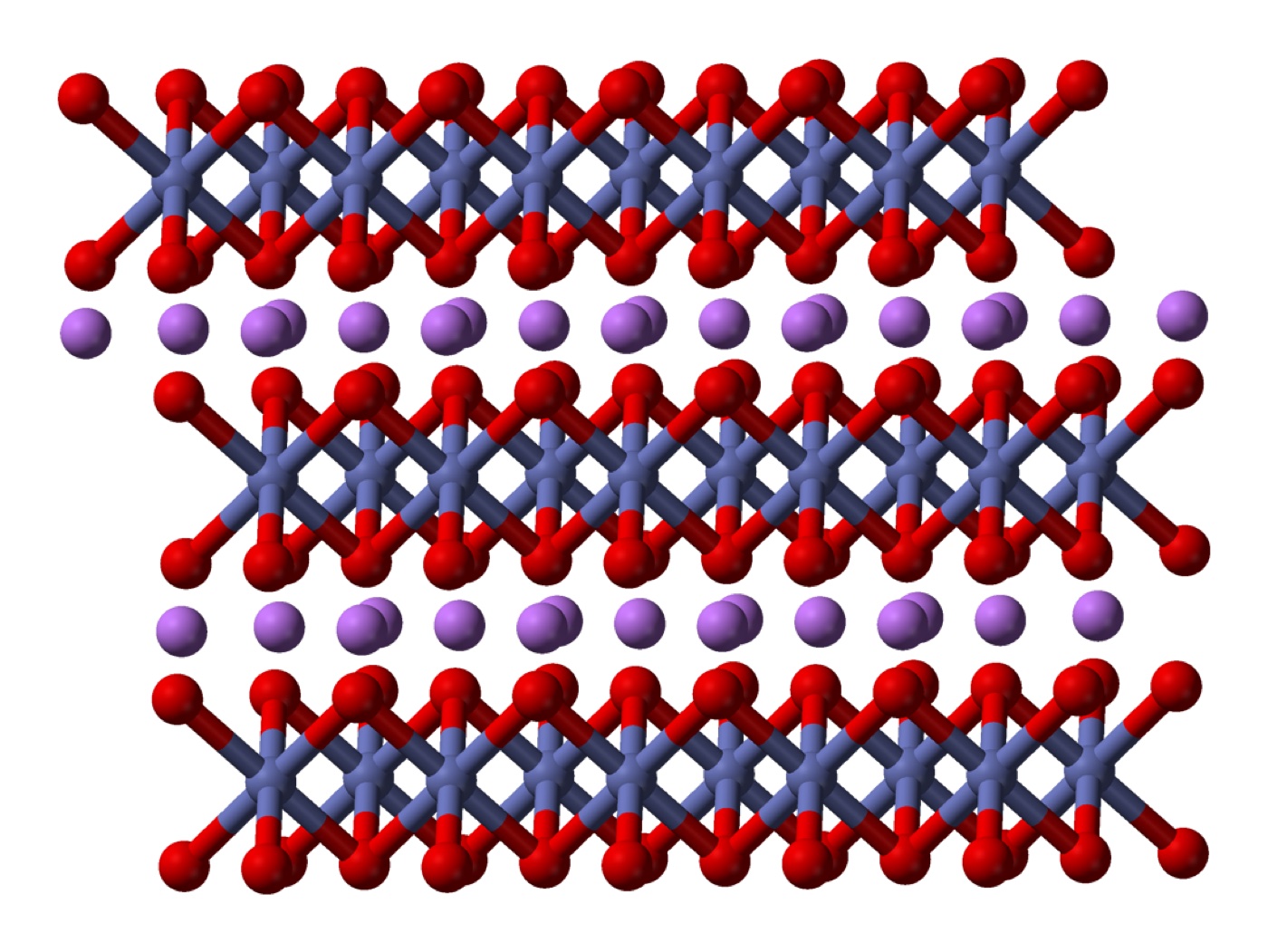
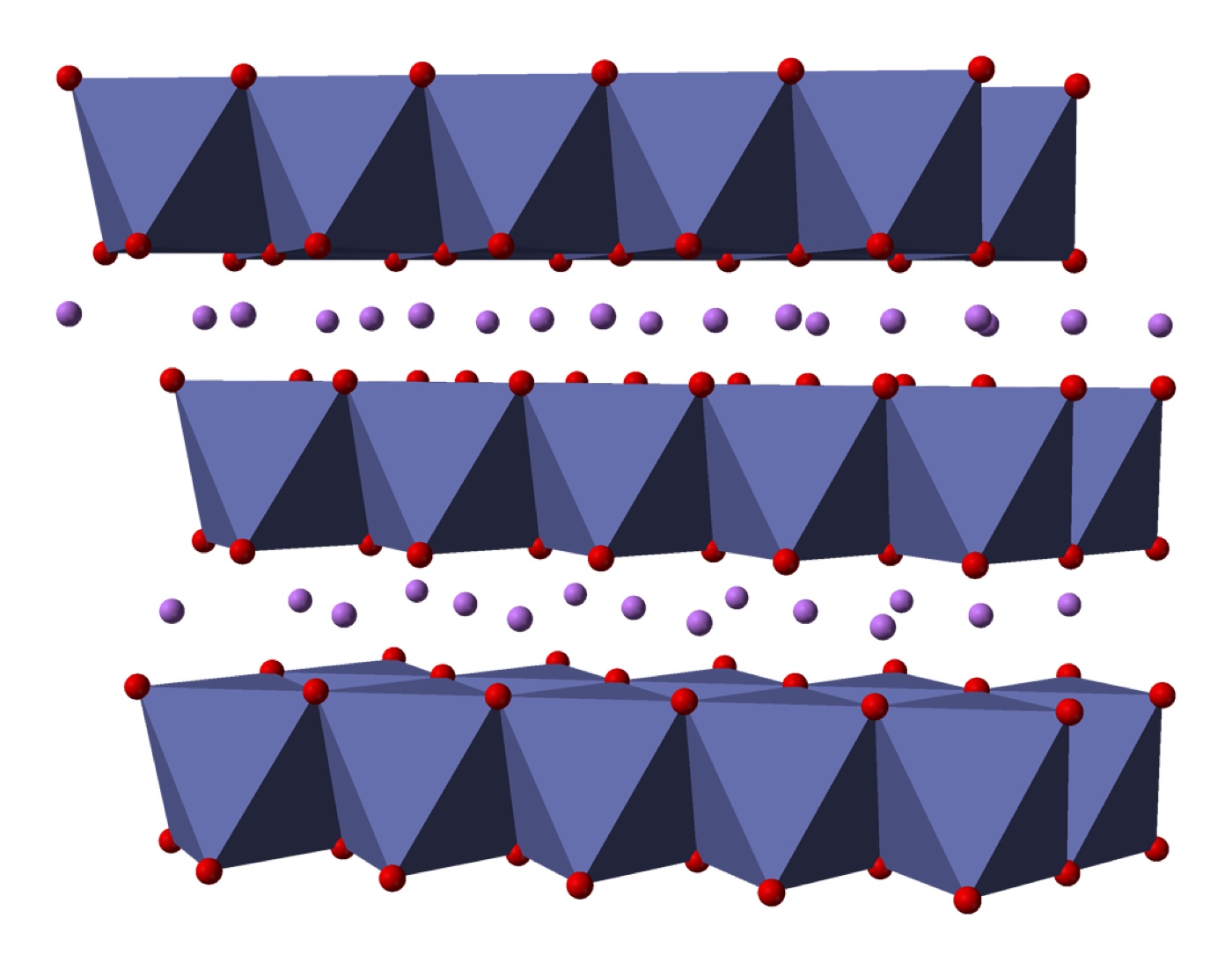
Lithium cobalt oxide (LCO, LiCoO₂) is the layered-oxide cathode of the first commercial lithium-ion cells, which Sony introduced in 1991. It crystallizes in the layered R-3m structure and remains the predominant cathode for portable electronic devices. NASA also lists it in the batteries of many spacecraft, including the lithium-ion batteries of the International Space Station. Its strengths are compact cells with a flat voltage near 3.9 V and a long flight record. Its limits are that ordinary 4.2 V cells use only about half of its theoretical capacity, that charging far above that damages the structure, and that a charged cell releases a great deal of heat when it fails.
Where it's used
International Space Station main power
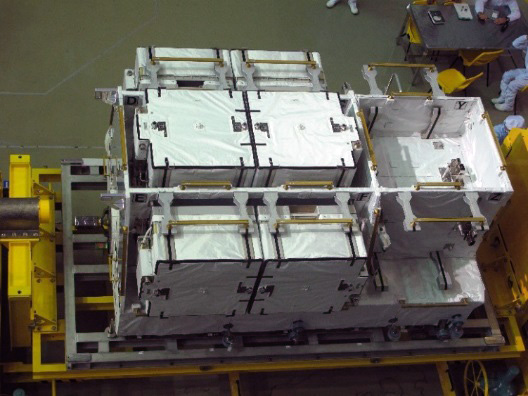
GS Yuasa 134 Ah LCO/graphite cells, 30 in series per battery, replaced two nickel-hydrogen units on the station. The first six batteries launched on HTV-6 on 9 December 2016, and two station power channels have run on lithium-ion batteries alone since January 2017. On orbit, one battery set had accumulated about 16,000 cycles.
NASA science spacecraft
NASA lists LCO lithium-ion batteries on Kepler, the Lunar Reconnaissance Orbiter, LCROSS, LADEE, DSCOVR, MMS, the James Webb Space Telescope and JPSS-2. Small Sony 18650 LCO cells serve in batteries on Kepler, Aquarius and SMAP.
Portable electronics
Sony commercialised lithium-ion cells in 1991, and LCO became the predominant commercial cathode. It dominates the cells of portable electronic devices.
Recipe
LiCoO2
LiCoO₂ is a lithium metal oxide. Each formula unit combines one lithium ion, one cobalt atom and two oxygen atoms in a layered structure.
| Ingredient | Atoms per unit | Share of the weight | What it does |
|---|---|---|---|
| Lithium Li | 1 | 7.1% | The mobile species. Lithium ions leave and re-enter the layers between the cobalt oxide sheets as the cell charges and discharges. |
| Cobalt Co | 1 | 60.2% | The redox center. Cobalt changes oxidation state as lithium leaves and returns, which stores and releases the charge. |
| Oxygen O | 2 | 32.7% | Bonds with cobalt to form the oxide layers that hold the structure together. |
Weight shares are calculated from standard atomic weights.
What it can do
Capacity
About 140 mAh/g
The theoretical specific capacity is 274 mAh/g. A conventional cell charged to 4.2 V delivers about 140 mAh/g, which is 51% of the theoretical value. Charging to a higher voltage gives more capacity but faster degradation.
Voltage
3.9 to 4.2 V
LCO operates between about 3.9 and 4.2 V versus Li/Li⁺. In one nanostructured sol-gel electrode, the first plateau of the charge-discharge curve sat near 3.92 V.
Thermal behavior
Peaked at 545 °C
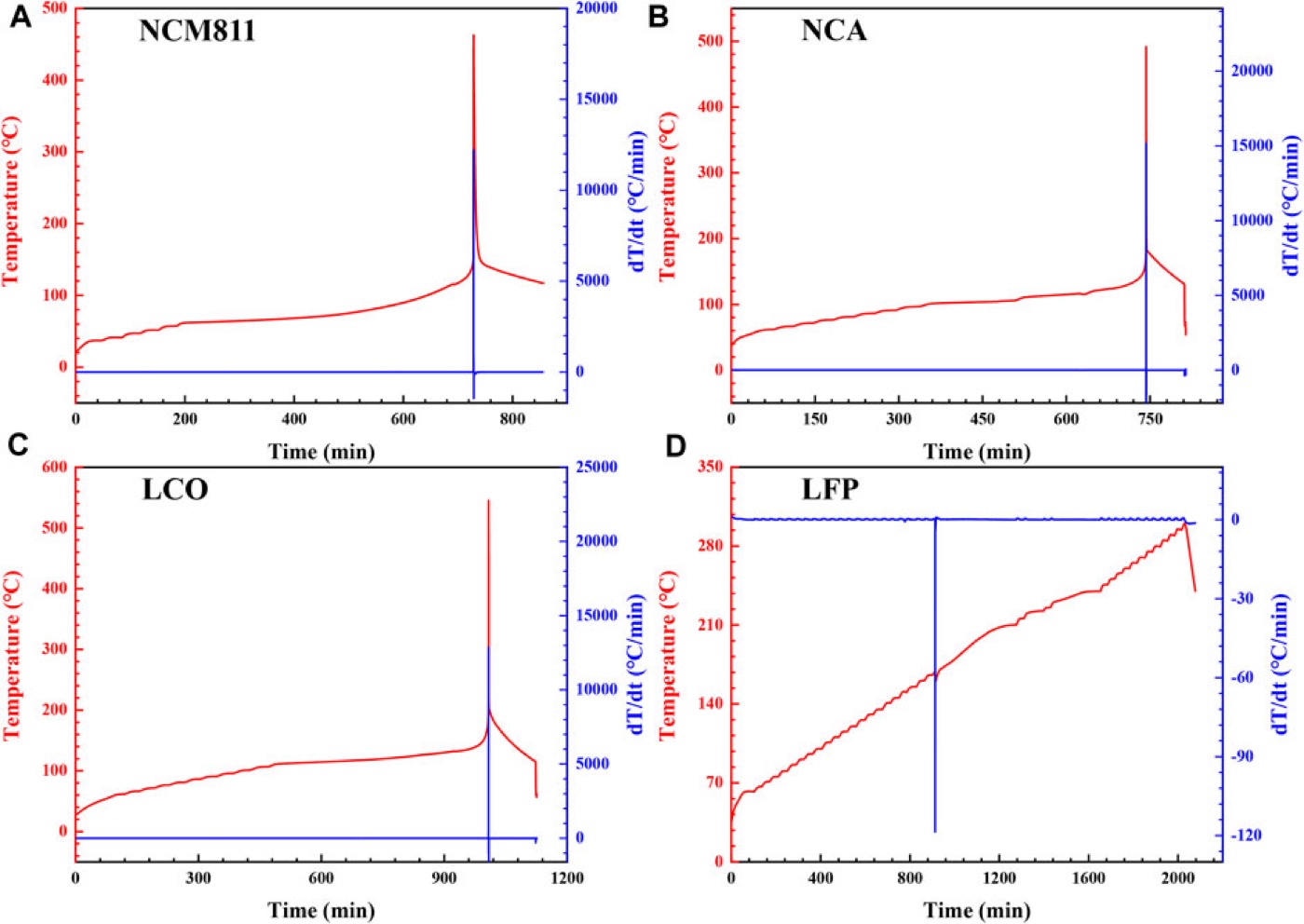
A fully charged 2.2 Ah 18650 LCO/graphite cell began to heat itself at 111.78 °C in an accelerating-rate calorimetry test, ran away at 180.16 °C and reached 545.11 °C. The same paper ranks the runaway danger of the four chemistries it tested as LCO > NCA > NCM811 >> LFP.
Cycle life in orbit
About 16,000 cycles
The ISS batteries had accumulated about 16,000 cycles on orbit at a 3.95 V end-of-charge voltage per cell and were reported as performing well. This counts cycles so far, not cycles to failure.
Conductivity
6 × 10⁻⁸ S/cm
The electronic conductivity of sintered LCO pellets at 20 °C was about 6 × 10⁻⁸ S/cm. Conductivity rises by six orders of magnitude between LiCoO₂ and Li₀.₅CoO₂, as lithium is removed.
How it compares
LCO is the oldest and most proven of the layered oxides and has the longest flight record in this collection. It stores far more per gram than LFP in theory, 274 mAh/g against 170 mAh/g, but in a 4.2 V cell it delivers about half of that. Its thermal behavior is the weakest: in the one four-chemistry test collected here, LCO ranked as the most dangerous in runaway and LFP as the least. The table compares LCO with the other cathodes in the collection.
The same measurements for each material, so you can compare them. Each row names the key condition under the value; the full conditions and methods are in the numbered notes under Technical details. Other materials are shown beside it; each was measured under its own conditions, so open its page before comparing closely. See the full ranking.
| Measurement | LCO | LFP | NMC | NCA | LNO | LMO |
|---|---|---|---|---|---|---|
| Capacity and energy | ||||||
| Theoretical specific capacity | 274 mAh/g1 | 170 mAh/g | 275 mAh/g | 278 mAh/g | 275 mAh/g | 285 mAh/g |
| Reversible specific capacity (measured)Review statement of typical delivered capacity | 140 mAh/g2 | 164.1 mAh/g | no data | 200 mAh/g | no data | 123 mAh/g |
| Voltage and potential | ||||||
| Operating voltage rangeLiterature comparison table | 3.9 to 4.2 V vs Li/Li+ | 3.4 V vs Li/Li+ | no data | 3.6 to 4.3 V vs Li/Li+ | 4 V vs Li/Li+ | no data |
| Charge-discharge plateau voltageCharge-discharge curve (Figure 6a of the review) | 3.92 V vs Li/Li+3 | no data | no data | no data | no data | 4.05 to 4.15 V vs Li/Li+ |
| Physical and electrical | ||||||
| Electronic conductivity | 6×10^-8 S/cm4 | 1×10^-10 to 1×10^-9 S/cm | no data | no data | no data | no data |
| Tap density | 4.2 g/cm³5 | 0.8 to 1.5 g/cm³ | no data | no data | 3.3 g/cm³ | no data |
Why choose it, and why not
Good for
- A proven, compact cell with a flat voltage near 3.9 V.
- A long flight record, including about 16,000 on-orbit cycles for the ISS batteries.
Watch out for
- Normal 4.2 V cells use only about half of the theoretical capacity, and charging beyond 4.6 V damages the structure irreversibly.
- Thermal runaway is severe: 545 °C in an adiabatic test, ranked the most dangerous of LCO, NCA, NCM811 and LFP.
- Cobalt is costly and tied to one dominant supplier country, and cobalt-containing powders carry serious hazard classifications.
LCO is the proven but unforgiving choice. It has the longest record and a flat voltage, and it needs careful charge limits and protection because it fails hot.
Technical details
For scientists and researchers. Everything above comes from the record below: every number with its method, its conditions and its source.
Cell-level benchmarks
Values for finished cells. These vary by manufacturer, so read the conditions in the notes. Other materials are shown beside it; each was measured under its own conditions, so open its page before comparing closely. See the full ranking.
| Measurement | LCO | LFP | NMC | NCA | LNO | LMO |
|---|---|---|---|---|---|---|
| Thermal behavior and safety | ||||||
| Thermal runaway onset | 111.8 °C6 | 116.7 °C | 91 °C | 101.7 °C | no data | no data |
| Maximum temperature in thermal runaway (cell)Accelerating rate calorimetry (ARC) | 545.1 °C7 | no data | no data | 491.8 °C | no data | no data |
| Lifetime and stability | ||||||
| ISS flight battery cycles to dateOn-orbit operation | > 16000 cycles8 | 275 cycles | 300 cycles | 500 to 1500 cycles | 69.2 % retained | no data |
| Ground LEO cycling of a 10 Ah Co-oxide cell batteryLow-Earth-orbit regime cycling on the ground | > 3441 cycles9 | 275 cycles | 300 cycles | 500 to 1500 cycles | 69.2 % retained | no data |
| Sony 18650 LCO battery on Aquarius, cycles to date | > 6500 cycles10 | 275 cycles | 300 cycles | 500 to 1500 cycles | 69.2 % retained | no data |
| Temperature behavior | ||||||
| Operating range of space Li-ion batteries (LCO, Sony 18650)Mission battery table | -10 to 45 °C | no data | no data | no data | -10 to 60 °C | no data |
Notes
The method, full conditions and any caveat for the numbered rows above.
| # | Measurement | Method | Conditions | Caveat |
|---|---|---|---|---|
| 1 | Theoretical specific capacity | Capacity from the formula (value as stated in the review, not recomputed here) | basis figure quoted by the review; the same review says the ~140 mAh/g delivered at 4.2 V is 51% of it | Another review (ijms-nano-2026) gives 274 in one place and 280 in another; 274 is used here. |
| 2 | Reversible specific capacity (measured) | — | upper cutoff 4.2 V vs Li/Li+cell conventional LCO systemsrate not stated in the source | Reported as approximately 140 mAh/g. Charging to higher voltage gives more capacity but faster degradation (see risks). |
| 3 | Charge-discharge plateau voltage | — | window 2.5-4.3 Velectrode nanostructured LiCoO2 made by sol-gel, half cell | The review gives "approximately 3.92 V" for the first plateau; this is a plateau, not a computed average voltage. The text gives a 2.5-4.3 V window, but the Figure 6 caption describes a half-cell cycled between 3.0 and 4.8 V; the paper does not reconcile the two. |
| 4 | Electronic conductivity | Ex situ electrochemical impedance spectroscopy (value reported as ca. 6 x 10^-8 S/cm) | temperature 20 °Csample sintered LCO pellets between ion-blocking electrodesstate not stated for this value in the source | The same paper notes conductivity rises by six orders of magnitude going from LiCoO2 to Li0.5CoO2 (four-electrode AC on pellets). |
| 5 | Tap density | Value stated in a review (measurement method not given) | form large (about 20 um) single-crystal LiCoO2 particles used in phone batteriesbasis tap density, not crystallographic density | — |
| 6 | Thermal runaway onset | Accelerating rate calorimetry (ARC) on commercial cells | cell 18650, LCO/graphite, 2.2 Ah rated, 3.7 V nominalsoc 100%test ARC heat-wait-search, 60 to 300 °C, 5 °C steps, 15 min waitdefinition onset of exothermic reaction, self-heating rate above 0.03 °C/min | The authors attribute this first onset to SEI decomposition on the graphite anode, not to the cathode. Thermal runaway temperature (self-heating above 10 °C/min) was 180.16 °C and the maximum cell temperature 545.11 °C. In the same test NCA, NCM811 and LFP cells reached 491.84, 462.52 and 239.26 °C. |
| 7 | Maximum temperature in thermal runaway (cell) | — | cell 18650, LCO/graphite, 2.2 Ahsoc 100%test ARC, adiabatic | The paper ranks the runaway danger of the four chemistries tested as LCO > NCA > NCM811 >> LFP. |
| 8 | ISS flight battery cycles to date | — | cell GS Yuasa 134 Ah LCO/graphite, 30 in series per batteryorbit ISS low Earth orbitend of charge voltage 3.95 V per celldate approx. 16,000 cycles on batteries 1A/3A as of 9 Oct 2019cell temperature within 5 °C across cells | Cycles accumulated so far, not cycles to failure. The batteries were reported as performing well. Capacity of battery 1A1 went from 113.1 Ah (Jan 2017) to 111.0 Ah (Feb 2018) to 109.9 Ah (Feb 2019). |
| 9 | Ground LEO cycling of a 10 Ah Co-oxide cell battery | — | cell MSA 10 Ah prismatic, Co oxide positive, graphitic carbon negative, 8-cell batterydepth of discharge 40%temperature 20 °C, with some cycling at -10 and 0 °Ccharge battery voltage clamp (30.8 V) with current taper | Cycles completed at the time of the 2001 report, not to failure. The low-temperature cycling started after 2182 cycles at 20 °C. |
| 10 | Sony 18650 LCO battery on Aquarius, cycles to date | Mission battery table (value given as ~6,500 to date) | battery 8s2p ABSL/Enersys, Sony 18650 LCO cellsoperating temperature -10 to 40 °Claunch June 2011 | Listed as cycle life "to date" in the 2017 NASA assessment, not a measured end of life. |
Corrosion and compatibility
What happens when it meets other materials and environments.
| Environment | Concern | What happens |
|---|---|---|
| Electrolyte at normal charge limit (about 4.2 V) | low | At the normal 4.2 V limit, cobalt dissolution and capacity loss were minimal.1 |
| Electrolyte at high voltage (4.5 V and above) | severe | Above 4.5 V, cobalt dissolves into the electrolyte and slows lithium at the anode.2 |
| Surface oxygen loss at high voltage | moderate | Above about 4.3 V the surface begins to lose oxygen, and the structure collapses.3 |
| Aluminium current collector with LiPF6 electrolyte | low | LiPF6 is compatible with aluminium, but collectors can corrode at high voltage and temperature.4 |
| HF from LiPF6 and trace moisture | moderate | Trace water turns LiPF6 into hydrofluoric acid, which damages the electrode surface.5 |
| Humid air or water exposure of the powder | not rated | The powder should be stored dry, but no degradation rate in humid air was found.6 |
| # | Environment | Details | Test conditions |
|---|---|---|---|
| 1 | Electrolyte at normal charge limit (about 4.2 V) | Minimal cobalt dissolution or capacity loss was detected when cycling at 4.2 V. | voltage 4.2 V vs Li/Li+cell carbonate electrolyte with LiPF6 (typical) |
| 2 | Electrolyte at high voltage (4.5 V and above) | Cobalt dissolves into the electrolyte, forms corrosion zones near the particle surface, and the dissolved ions travel to the anode, where they slow lithium transport. Surface Co3+ is rapidly reduced to Co2+ on contact with electrolyte under high voltage. | voltage charged to 4.5 Vtemperature worse above 60 °C |
| 3 | Surface oxygen loss at high voltage | Oxygen evolution switches on above about 4.3 V and the review puts the threshold for significant oxygen release at 4.5 V; surface structure then collapses and electrolyte oxidises faster. | voltage above ~4.3 V (onset) and 4.5 V (significant)temperature faster above 60 °C |
| 4 | Aluminium current collector with LiPF6 electrolyte | LiPF6 is described as compatible with aluminium current collectors. In general lithium-ion cells, corrosion mainly affects the Cu and Al current collectors at high temperature, over-discharge and high voltage. | electrolyte LiPF6 carbonatenote no LCO-specific aluminium corrosion rate found |
| 5 | HF from LiPF6 and trace moisture | With trace water, LiPF6 breaks down to PF5, which hydrolyses to hydrofluoric acid (HF). HF damages the electrode-electrolyte interface and speeds transition-metal dissolution. | trigger LiPF6 above about 60 °C, trace moisturenote general electrolyte statement, not measured on LCO alone |
| 6 | Humid air or water exposure of the powder | The supplier safety data sheet says to store under inert atmosphere and protect from moisture. No measured degradation rate for LCO in humid air was found. | source type supplier SDS storage instruction |
Risks and side effects
Hazards to people, what happens when a cell overheats, and how the material is handled and stored.
For people
LCO powder carries serious hazard classifications, and they vary between notifiers. Check the safety data sheet of the exact powder.
- Database entries
- PubChem aggregates 194 ECHA notifications for lithium cobalt oxide, and the notified classifications differ. The most common are may cause an allergic skin reaction (26.8%), may cause cancer (22.7%), and may damage fertility or the unborn child (12.4%, or 58.8% with suspected unborn-child harm). Other notifications add fatal if inhaled, allergy or asthma symptoms if inhaled, and damage to organs through prolonged exposure.
- A supplier sheet
- A supplier safety data sheet (revision 18 February 2020) classifies it as carcinogenicity category 1B and reproductive toxicity category 2 (suspected of damaging fertility), with the signal word Danger. It lists an ACGIH exposure limit of 0.02 mg/m³, as cobalt, averaged over a work shift.
- Dust
- Avoid dust and store the powder locked up.
If a cell overheats
These results come from laboratory tests and from design requirements for spacecraft batteries.
- A charged 18650 cell
- A fully charged 2.2 Ah LCO/graphite cell in an accelerating-rate calorimeter began to heat itself at 111.78 °C, ran away (over 10 °C/min) at 180.16 °C and reached 545.11 °C. That is above the autoignition temperature of 445 °C the paper quotes for diethyl carbonate. The authors attribute the first onset to decomposition of the film on the graphite anode, not to the cathode.
- Over-charging
- Phase transitions below 4.5 V are reversible with negligible capacity loss. Charging beyond 4.6 V causes irreversible structural damage, with lattice contraction and cracking of particles.
- Oxygen loss
- Oxygen evolution switches on above about 4.3 V, and the review puts the threshold for significant release at 4.5 V. Release at high voltage or above 60 °C is described as a primary trigger of thermal instability.
- One cell next to others
- The ISS design requires that a failure does not propagate beyond the battery unit. Safety features include two independent controls against thermal runaway, radiant barriers between cell pairs, directed vents and a flame trap. A failure of a battery charge and discharge unit in 2018 blew the fuse in one new ISS lithium-ion battery.
- Metals on the anode
- Dissolved cobalt migrates from the cathode to the anode and slows lithium movement there, which adds to impedance and capacity loss.
Handling and storage
- Storage
- The safety data sheet calls for an inert atmosphere, a tightly closed container in a dry place, protection from moisture, and avoiding dust.
- Protection in spacecraft
- The ISS batteries monitor voltage and temperature in all 30 cells, isolate faults cell by cell, and add radiant barriers, controlled vent direction, an overpressure relief and flame trap, and an internal fusible link in each cell.
- Higher voltage
- Doping, surface coating, single-crystal particles and electrolyte additives are the approaches the review lists for keeping LCO stable at higher charge voltage.
Test details
The original wording and numbers from the sources, for readers who want them.
Failure risks
| Failure | Trigger and consequence |
|---|---|
| Thermal runaway of a charged cellcritical severity | Heating a fully charged 18650 LCO cell in an accelerating rate calorimeterSelf-heating started at 111.78 °C, runaway (over 10 °C/min) at 180.16 °C and the cell reached 545.11 °C. This is above the autoignition temperature the paper quotes for diethyl carbonate (445 °C). The same paper ranks LCO the most dangerous of LCO, NCA, NCM811 and LFP. |
| Structural damage from over-charginghigh severity | Charging above 4.5 V; above 4.6 V the damage is irreversiblePhase transitions below 4.5 V are reversible with negligible capacity loss; charging beyond 4.6 V causes irreversible structural degradation. A monoclinic phase forms near 4.2 V and an H1-3 phase near 4.55 V, with lattice contraction and cracking of particles. |
| Loss of oxygen from the surfacehigh severity | High voltage (above about 4.3 V) and temperature above 60 °COxygen release is described as a primary trigger of thermal instability of cathode materials and speeds electrolyte oxidation and capacity fade. |
| Failure of a large cell next to others in a batteryhigh severity | One cell failing in the ISS batteryDesign requires non-propagation beyond the battery unit. Safety features include two independent controls against thermal runaway, radiant barriers between cell pairs, directed vents and a flame trap on the unit. A BCDU failure in 2018 blew the fuse in one new ISS Li-ion battery. |
Side effects on surrounding parts
| Affects | Effect |
|---|---|
| Graphite anode and SEI of the same cell | Dissolved cobalt migrates from the cathode to the anode and slows lithium movement there, adding to impedance and capacity loss. |
| Spacecraft power system and its battery management hardware | Cells need electronic charge control for long life and safe operation, and are less tolerant of electrical and thermal abuse than aqueous nickel batteries. |
Handling and storage
- Store under an inert atmosphere, keep the container tightly closed in a dry place, protect from moisture, avoid dust, and store locked up.
Mitigations
- ISS Li-ion batteries: voltage and temperature monitoring of all 30 cells, cell-level fault isolation, thermal radiant barriers between cell pairs, controlled vent direction, an overpressure relief and flame trap on the unit, micrometeoroid and debris shielding, and an internal fusible link in each cell.
- Doping, surface coating, single-crystal particles and electrolyte additives are the approaches the review lists for keeping LCO stable at higher charge voltage.
Supply and geography
How common the raw materials are and where they come from.
Cobalt
No crustal abundance figure was read from a source for this profile. USGS gives identified world terrestrial cobalt resources as about 25 million tons and world reserves as 12,000,000 tons.
- Top producers (2025)
- Congo (Kinshasa) 73%, Indonesia 14%
- Critical mineral lists
- US: listed, EU: listed
- Recycling
- In 2025, cobalt content of purchased scrap in the United States represented 25% of estimated cobalt consumption. China is the leading producer of refined cobalt and the leading consumer, mainly for lithium-ion batteries.
- Substitutes
- The cobalt content of lithium-ion batteries was being decreased; cobalt-free cathodes using iron and phosphorus held significant market share in China.
Lithium
USGS gives world lithium reserves of 37,000,000 tons and measured and indicated resources of about 150 million tons. No crustal abundance figure was read.
- Top producers (2025)
- Australia 31.7%, China 21.4%, Chile 19.3%
- Critical mineral lists
- US: listed, EU: listed
- Recycling
- Construction of lithium battery recycling plants continued throughout 2025; automakers and recyclers partnered to supply battery materials. Batteries were 88% of global lithium end use.
- Substitutes
- USGS: substitution for lithium compounds is possible in batteries, ceramics, greases and glass, but its examples are for primary-battery anodes (calcium, magnesium, mercury, zinc), not lithium-ion cathodes.
Gallery
Documents
Datasheets, safety data sheets, papers and standards you can open.
Full record
The complete spore, as stored. Free to reuse under CC-BY-4.0. Images keep the licence shown with each one.
Show the full YAML
spore: profile
id: lithium-cobalt-oxide
spore_version: 0.2
family: lithium
name: Lithium cobalt oxide
abbreviation: LCO
role: cathode
category: energy
type: li-ion-cathodes
summary: |
  Lithium cobalt oxide (LiCoO2) is the layered cathode used in the first commercial lithium-ion cells. It is still the main cathode for portable electronics, and NASA lists it in the batteries of many spacecraft, including the International Space Station's lithium-ion batteries. Normal 4.2 V cells use only about half of its theoretical capacity, and its cobalt content is costly and tied to one dominant supplier country.
best_for: Compact, proven cells with a flat voltage near 3.9 V and a long flight record
weakest_at: Using more than half its lithium, and thermal runaway heat once a cell is abused
identity:
  formula: LiCoO2
  cas: 12190-79-3
  crystal_system: trigonal (layered, often described on hexagonal axes)
  space_group: R-3m
  source: ijms-nano-2026
  where: Section 3.1.1 (CAS from PubChem and the SDS)
tags:
  environments:
    - low-earth-orbit
    - cislunar
    - deep-space
  stresses:
    - extreme-cold
    - extreme-heat
    - micrometeoroids-and-debris
  applications:
    - batteries
properties:
  - benchmark: theoretical_capacity
    value: 274
    unit: mAh/g
    scope: material
    conditions:
      basis: figure quoted by the review; the same review says the ~140 mAh/g delivered at 4.2 V is 51% of it
    method: Capacity from the formula (value as stated in the review, not recomputed here)
    status: calculated
    note: Another review (ijms-nano-2026) gives 274 in one place and 280 in another; 274 is used here.
    source: adv-mater-lco-2026
    where: Introduction, section 1
  - benchmark: practical_capacity
    value: 140
    unit: mAh/g
    scope: material
    conditions:
      upper_cutoff: 4.2 V vs Li/Li+
      cell: conventional LCO systems
      rate: not stated in the source
    method: Review statement of typical delivered capacity
    status: ground
    note: Reported as approximately 140 mAh/g. Charging to higher voltage gives more capacity but faster degradation (see risks).
    source: adv-mater-lco-2026
    where: Introduction, section 1
  - benchmark: avg_voltage
    label: Operating voltage range
    value: 3.9
    value_high: 4.2
    bound: range
    unit: V vs Li/Li+
    scope: material
    conditions:
      basis: operating voltage range listed for LiCoO2 in a comparison table
    method: Literature comparison table
    status: ground
    source: ijms-nano-2026
    where: Table 4
  - benchmark: plateau_voltage
    label: Charge-discharge plateau voltage
    value: 3.92
    unit: V vs Li/Li+
    scope: material
    conditions:
      window: 2.5-4.3 V
      electrode: nanostructured LiCoO2 made by sol-gel, half cell
    method: Charge-discharge curve (Figure 6a of the review)
    status: ground
    note: The review gives "approximately 3.92 V" for the first plateau; this is a plateau, not a computed average voltage. The text gives a 2.5-4.3 V window, but the Figure 6 caption describes a half-cell cycled between 3.0 and 4.8 V; the paper does not reconcile the two.
    source: ijms-nano-2026
    where: Section 3.1.1, Figure 6
  - benchmark: electronic_conductivity
    value: 6.e-8
    unit: S/cm
    scope: material
    conditions:
      temperature: 20 °C
      sample: sintered LCO pellets between ion-blocking electrodes
      state: not stated for this value in the source
    method: Ex situ electrochemical impedance spectroscopy (value reported as ca. 6 x 10^-8 S/cm)
    status: ground
    note: The same paper notes conductivity rises by six orders of magnitude going from LiCoO2 to Li0.5CoO2 (four-electrode AC on pellets).
    source: iscience-lco-2025
    where: Introduction (paragraph on LCO pellets)
  - benchmark: density
    label: Tap density
    value: 4.2
    unit: g/cm3
    scope: material
    conditions:
      form: large (about 20 um) single-crystal LiCoO2 particles used in phone batteries
      basis: tap density, not crystallographic density
    method: Value stated in a review (measurement method not given)
    status: ground
    source: chemrev-single-crystal-2025
    where: Section 1.1, Single Crystal History and Trend
  - benchmark: thermal_runaway_onset
    value: 111.78
    unit: °C
    scope: cell
    conditions:
      cell: 18650, LCO/graphite, 2.2 Ah rated, 3.7 V nominal
      soc: 100%
      test: ARC heat-wait-search, 60 to 300 °C, 5 °C steps, 15 min wait
      definition: onset of exothermic reaction, self-heating rate above 0.03 °C/min
    method: Accelerating rate calorimetry (ARC) on commercial cells
    status: ground
    note: The authors attribute this first onset to SEI decomposition on the graphite anode, not to the cathode. Thermal runaway temperature (self-heating above 10 °C/min) was 180.16 °C and the maximum cell temperature 545.11 °C. In the same test NCA, NCM811 and LFP cells reached 491.84, 462.52 and 239.26 °C.
    source: yuan-2024
    where: Table 1, Table 2, section 3.1
  - benchmark: thermal_runaway_tmax
    label: Maximum temperature in thermal runaway (cell)
    value: 545.11
    unit: °C
    scope: cell
    conditions:
      cell: 18650, LCO/graphite, 2.2 Ah
      soc: 100%
      test: ARC, adiabatic
    method: Accelerating rate calorimetry (ARC)
    status: ground
    note: The paper ranks the runaway danger of the four chemistries tested as LCO > NCA > NCM811 >> LFP.
    source: yuan-2024
    where: Table 2
  - benchmark: cycle_life
    label: ISS flight battery cycles to date
    value: 16000
    bound: lower
    unit: cycles
    scope: cell
    conditions:
      cell: GS Yuasa 134 Ah LCO/graphite, 30 in series per battery
      orbit: ISS low Earth orbit
      end_of_charge_voltage: 3.95 V per cell
      date: approx. 16,000 cycles on batteries 1A/3A as of 9 Oct 2019
      cell_temperature: within 5 °C across cells
    method: On-orbit operation
    status: flight
    note: Cycles accumulated so far, not cycles to failure. The batteries were reported as performing well. Capacity of battery 1A1 went from 113.1 Ah (Jan 2017) to 111.0 Ah (Feb 2018) to 109.9 Ah (Feb 2019).
    source: nasa-iss-2019
    where: Slides 8 and 12
  - benchmark: cycle_life
    label: Ground LEO cycling of a 10 Ah Co-oxide cell battery
    value: 3441
    bound: lower
    unit: cycles
    scope: cell
    conditions:
      cell: MSA 10 Ah prismatic, Co oxide positive, graphitic carbon negative, 8-cell battery
      depth_of_discharge: 40%
      temperature: 20 °C, with some cycling at -10 and 0 °C
      charge: battery voltage clamp (30.8 V) with current taper
    method: Low-Earth-orbit regime cycling on the ground
    status: ground
    note: Cycles completed at the time of the 2001 report, not to failure. The low-temperature cycling started after 2182 cycles at 20 °C.
    source: nasa-rao-2001
    where: Summary of results (MSA cells)
  - benchmark: cycle_life
    label: Sony 18650 LCO battery on Aquarius, cycles to date
    value: 6500
    bound: lower
    unit: cycles
    scope: cell
    conditions:
      battery: 8s2p ABSL/Enersys, Sony 18650 LCO cells
      operating_temperature: '-10 to 40 °C'
      launch: June 2011
    method: Mission battery table (value given as ~6,500 to date)
    status: flight
    note: Listed as cycle life "to date" in the 2017 NASA assessment, not a measured end of life.
    source: nasa-jpl-estorage
    where: Table 3-5
  - benchmark: operating_temperature_range
    label: Operating range of space Li-ion batteries (LCO, Sony 18650)
    value: -10
    value_high: 45
    bound: range
    unit: °C
    scope: cell
    conditions:
      battery: Kepler 8s2p ABSL Sony 18650 LCO battery (Aquarius is -10 to 40 °C, SMAP 10 to 25 °C)
    method: Mission battery table
    status: flight
    source: nasa-jpl-estorage
    where: Table 3-5
corrosion:
  - environment: Electrolyte at normal charge limit (about 4.2 V)
    headline: At the normal 4.2 V limit, cobalt dissolution and capacity loss were minimal.
    effect: Minimal cobalt dissolution or capacity loss was detected when cycling at 4.2 V.
    rating: low
    conditions:
      voltage: 4.2 V vs Li/Li+
      cell: carbonate electrolyte with LiPF6 (typical)
    source: adv-mater-lco-2026
    where: Section 3.2 (Co dissolution)
  - environment: Electrolyte at high voltage (4.5 V and above)
    headline: Above 4.5 V, cobalt dissolves into the electrolyte and slows lithium at the anode.
    effect: Cobalt dissolves into the electrolyte, forms corrosion zones near the particle surface, and the dissolved ions travel to the anode, where they slow lithium transport. Surface Co3+ is rapidly reduced to Co2+ on contact with electrolyte under high voltage.
    rating: severe
    conditions:
      voltage: charged to 4.5 V
      temperature: worse above 60 °C
    source: adv-mater-lco-2026
    where: Section 3.2, Figure 6
  - environment: Surface oxygen loss at high voltage
    headline: Above about 4.3 V the surface begins to lose oxygen, and the structure collapses.
    effect: Oxygen evolution switches on above about 4.3 V and the review puts the threshold for significant oxygen release at 4.5 V; surface structure then collapses and electrolyte oxidises faster.
    rating: moderate
    conditions:
      voltage: above ~4.3 V (onset) and 4.5 V (significant)
      temperature: faster above 60 °C
    source: adv-mater-lco-2026
    where: Section 3.2
  - environment: Aluminium current collector with LiPF6 electrolyte
    headline: LiPF6 is compatible with aluminium, but collectors can corrode at high voltage and temperature.
    effect: LiPF6 is described as compatible with aluminium current collectors. In general lithium-ion cells, corrosion mainly affects the Cu and Al current collectors at high temperature, over-discharge and high voltage.
    rating: low
    conditions:
      electrolyte: LiPF6 carbonate
      note: no LCO-specific aluminium corrosion rate found
    source: yang-2026
    where: Section on electrolyte salts (LiPF6 compatibility with Al collectors)
  - environment: HF from LiPF6 and trace moisture
    headline: Trace water turns LiPF6 into hydrofluoric acid, which damages the electrode surface.
    effect: With trace water, LiPF6 breaks down to PF5, which hydrolyses to hydrofluoric acid (HF). HF damages the electrode-electrolyte interface and speeds transition-metal dissolution.
    rating: moderate
    conditions:
      trigger: LiPF6 above about 60 °C, trace moisture
      note: general electrolyte statement, not measured on LCO alone
    source: yang-2026
    where: Section 3 (electrolyte decomposition) and electrolyte salt section
  - environment: Humid air or water exposure of the powder
    headline: The powder should be stored dry, but no degradation rate in humid air was found.
    effect: The supplier safety data sheet says to store under inert atmosphere and protect from moisture. No measured degradation rate for LCO in humid air was found.
    rating: unknown
    conditions:
      source_type: supplier SDS storage instruction
    source: sds-lco-sam
    where: Section 7
risks:
  hazards:
    - text: 'PubChem aggregates 194 ECHA notifications for lithium cobalt oxide; notified classifications differ. The most common are: may cause an allergic skin reaction (26.8%), may cause cancer (22.7%), may damage fertility or the unborn child (12.4% and 58.8% with suspected unborn-child harm). Other notifications add fatal if inhaled, may cause allergy or asthma symptoms if inhaled, and damage to organs through prolonged exposure.'
      ghs:
        - H317
        - H350
        - H360
        - H360Fd
        - H330
        - H334
        - H372
      source: pubchem-lco
      where: GHS Classification section
    - text: 'A supplier SDS (revision 18 Feb 2020) classifies it as carcinogenicity category 1B and reproductive toxicity category 2 (suspected of damaging fertility), signal word Danger. Workplace limit listed: ACGIH TLV 0.02 mg/m3 (time-weighted average, as cobalt).'
      ghs: []
      source: sds-lco-sam
      where: Sections 2 and 8
  failure_risks:
    - mode: Thermal runaway of a charged cell
      trigger: Heating a fully charged 18650 LCO cell in an accelerating rate calorimeter
      consequence: Self-heating started at 111.78 °C, runaway (over 10 °C/min) at 180.16 °C and the cell reached 545.11 °C. This is above the autoignition temperature the paper quotes for diethyl carbonate (445 °C). The same paper ranks LCO the most dangerous of LCO, NCA, NCM811 and LFP.
      severity: critical
      source: yuan-2024
      where: Table 2, section 3.1
    - mode: Structural damage from over-charging
      trigger: Charging above 4.5 V; above 4.6 V the damage is irreversible
      consequence: Phase transitions below 4.5 V are reversible with negligible capacity loss; charging beyond 4.6 V causes irreversible structural degradation. A monoclinic phase forms near 4.2 V and an H1-3 phase near 4.55 V, with lattice contraction and cracking of particles.
      severity: high
      source: adv-mater-lco-2026
      where: Section 3.1 (structural changes)
    - mode: Loss of oxygen from the surface
      trigger: High voltage (above about 4.3 V) and temperature above 60 °C
      consequence: Oxygen release is described as a primary trigger of thermal instability of cathode materials and speeds electrolyte oxidation and capacity fade.
      severity: high
      source: adv-mater-lco-2026
      where: Section 3.2
    - mode: Failure of a large cell next to others in a battery
      trigger: One cell failing in the ISS battery
      consequence: Design requires non-propagation beyond the battery unit. Safety features include two independent controls against thermal runaway, radiant barriers between cell pairs, directed vents and a flame trap on the unit. A BCDU failure in 2018 blew the fuse in one new ISS Li-ion battery.
      severity: high
      source: nasa-iss-2016
      where: Slides 11-14 (and nasa-iss-2019 slide 7 for the fuse event)
  side_effects:
    - text: Dissolved cobalt migrates from the cathode to the anode and slows lithium movement there, adding to impedance and capacity loss.
      affects: Graphite anode and SEI of the same cell
      source: adv-mater-lco-2026
      where: Section 3.2
    - text: Cells need electronic charge control for long life and safe operation, and are less tolerant of electrical and thermal abuse than aqueous nickel batteries.
      affects: Spacecraft power system and its battery management hardware
      source: nasa-jpl-estorage
      where: Section 3.3.2, text after Table 3-5
  handling:
    - text: Store under an inert atmosphere, keep the container tightly closed in a dry place, protect from moisture, avoid dust, and store locked up.
      source: sds-lco-sam
      where: Sections 2 and 7
  mitigations:
    - text: 'ISS Li-ion batteries: voltage and temperature monitoring of all 30 cells, cell-level fault isolation, thermal radiant barriers between cell pairs, controlled vent direction, an overpressure relief and flame trap on the unit, micrometeoroid and debris shielding, and an internal fusible link in each cell.'
      source: nasa-iss-2016
      where: Slides 10-14
    - text: Doping, surface coating, single-crystal particles and electrolyte additives are the approaches the review lists for keeping LCO stable at higher charge voltage.
      source: adv-mater-lco-2026
      where: Sections on foreign-ion doping, surface modification and electrolyte design
uses:
  - application: batteries
    device: International Space Station main power battery
    example: GS Yuasa 134 Ah lithium cobalt oxide / graphite cells, 30 in series per battery, replacing two nickel-hydrogen units. The first six batteries launched on HTV-6 on 9 Dec 2016; two ISS channels ran on Li-ion only from January 2017.
    source: nasa-iss-2016
    where: Slides 6-10, 19; nasa-iss-2019 slides 4-8
  - application: batteries
    device: NASA science spacecraft batteries (large and small cells)
    example: Table 3-3 lists lithium-ion (LCO) batteries on Kepler (2009), Lunar Reconnaissance Orbiter (2009), LCROSS (2009), LADEE (2013), DSCOVR (2015), MMS (2015), James Webb Space Telescope (listed 2018) and JPSS-2 (listed 2021).
    source: nasa-jpl-estorage
    where: Table 3-3
  - application: batteries
    device: Small-cell 18650 spacecraft battery
    example: Sony LiCoO2 18650 cells in ABSL/Enersys batteries on Kepler, Aquarius and SMAP; ESA's Mars Express (2003) is described as the first Li-ion battery to orbit Mars, from the same maker.
    source: nasa-jpl-estorage
    where: Section 3.3.2, Table 3-5
  - application: batteries
    device: Portable electronics cells
    example: Sony commercialised lithium-ion cells in 1991 and LCO became the predominant commercial cathode; it dominates cells for portable electronic devices.
    source: adv-mater-lco-2026
    where: Introduction
supply:
  - subject: Cobalt
    abundance: No crustal abundance figure was read from a source for this profile. USGS gives identified world terrestrial cobalt resources as about 25 million tons and world reserves as 12,000,000 tons.
    producers:
      - country: Congo (Kinshasa)
        share_percent: 73
        year: 2025
      - country: Indonesia
        share_percent: 14
        year: 2025
    critical_lists:
      - list: USGS 2025 List of Critical Minerals (final, 7 Nov 2025)
        listed: true
      - list: EU Critical Raw Materials Act, Annex II (Regulation 2024/1252)
        listed: true
    recycling: In 2025, cobalt content of purchased scrap in the United States represented 25% of estimated cobalt consumption. China is the leading producer of refined cobalt and the leading consumer, mainly for lithium-ion batteries.
    substitutes:
      - The cobalt content of lithium-ion batteries was being decreased; cobalt-free cathodes using iron and phosphorus held significant market share in China.
    source: usgs-cobalt-2026
    where: Events, Trends, and Issues; World Mine Production and Reserves; Substitutes Critical-list status from crs-usgs-list-2026 (aluminum, cobalt, lithium and nickel are all on the USGS list) and eu-crma-2024 (cobalt, lithium, nickel battery grade, bauxite/alumina/aluminium).
  - subject: Lithium
    abundance: USGS gives world lithium reserves of 37,000,000 tons and measured and indicated resources of about 150 million tons. No crustal abundance figure was read.
    producers:
      - country: Australia
        share_percent: 31.7
        year: 2025
      - country: China
        share_percent: 21.4
        year: 2025
      - country: Chile
        share_percent: 19.3
        year: 2025
    critical_lists:
      - list: USGS 2025 List of Critical Minerals (final, 7 Nov 2025)
        listed: true
      - list: EU Critical Raw Materials Act, Annex II (Regulation 2024/1252)
        listed: true
    recycling: Construction of lithium battery recycling plants continued throughout 2025; automakers and recyclers partnered to supply battery materials. Batteries were 88% of global lithium end use.
    substitutes:
      - 'USGS: substitution for lithium compounds is possible in batteries, ceramics, greases and glass, but its examples are for primary-battery anodes (calcium, magnesium, mercury, zinc), not lithium-ion cathodes.'
    source: usgs-lithium-2026
    where: Domestic Production and Use; World Mine Production and Reserves (shares computed here from 2025 mine production over the 290,000-ton world total, which excludes withheld U.S. data) Critical-list status from crs-usgs-list-2026 (aluminum, cobalt, lithium and nickel are all on the USGS list) and eu-crma-2024 (cobalt, lithium, nickel battery grade, bauxite/alumina/aluminium).
media:
  - file: /media/lithium/lithium-cobalt-oxide-1.jpg
    caption: 'Layered crystal structure of lithium cobalt oxide: lithium ions between sheets of CoO6 octahedra.'
    shows: Ball-and-stick model of part of the LiCoO2 crystal structure; lithium (violet) sits between cobalt-oxygen layers (cobalt blue-grey, oxygen red).
    conditions: Computer rendering from published structural data
    alt: Ball-and-stick drawing of three cobalt-oxide layers with rows of lithium atoms between them.
    credit: Ben Mills (Wikimedia Commons)
    license: Public domain
    license_url: https://commons.wikimedia.org/wiki/File:Lithium-cobalt-oxide-3D-balls.png
    source_url: https://commons.wikimedia.org/wiki/File:Lithium-cobalt-oxide-3D-balls.png
  - file: /media/lithium/lithium-cobalt-oxide-2.jpg
    caption: The same structure drawn as CoO6 polyhedra.
    shows: Polyhedral model of part of the LiCoO2 crystal structure, showing the edge-sharing CoO6 octahedra that form the layers lithium moves between.
    conditions: Computer rendering from published structural data
    alt: Polyhedral drawing of LiCoO2 with cobalt-oxygen octahedra layers and lithium atoms in between.
    credit: Ben Mills (Wikimedia Commons)
    license: Public domain
    license_url: https://commons.wikimedia.org/wiki/File:Lithium-cobalt-oxide-3D-polyhedra.png
    source_url: https://commons.wikimedia.org/wiki/File:Lithium-cobalt-oxide-3D-polyhedra.png
  - file: /media/lithium/lithium-cobalt-oxide-3.jpg
    caption: ISS lithium-ion battery orbital replacement units (ORUs) on their flight support equipment before launch.
    shows: Li-ion battery units for the International Space Station, whose cells are lithium cobalt oxide / graphite.
    conditions: Ground photograph from a NASA presentation, pre-launch
    alt: Overhead view of white-wrapped battery boxes on a yellow frame in a processing hall.
    credit: NASA
    license: Public domain
    license_url: https://commons.wikimedia.org/wiki/File:Li-ion_batteries_as_ISS-ORUs.jpg
    source_url: https://commons.wikimedia.org/wiki/File:Li-ion_batteries_as_ISS-ORUs.jpg
  - file: /media/lithium/lithium-cobalt-oxide-4.jpg
    caption: Temperature and self-heating rate of four 18650 cells in an accelerating rate calorimeter; panel C is the LCO cell.
    shows: Cell temperature (red) and rate of temperature rise (blue) against time for NCM811 (A), NCA (B), LCO (C) and LFP (D) cells at 100% state of charge. The LCO cell peaks near 545 °C.
    conditions: ARC heat-wait-search from 60 to 300 °C, commercial 18650 cells, 100% SOC
    alt: Four line charts of temperature and heating rate over time; each lithium-ion cell shows a sudden spike at thermal runaway, except the LFP cell.
    credit: Yuan Y. et al., Frontiers in Chemistry 12 (2024), Figure 3
    license: CC BY
    license_url: https://creativecommons.org/licenses/by/4.0/
    source_url: https://doi.org/10.3389/fchem.2024.1324840
documents:
  - title: Lithium cobalt (III) oxide safety data sheet (Stanford Advanced Materials)
    type: sds
    url: https://samaterials.com/tds/1690966028-19-lithium-cobalt-iii-oxide-powder-lco-powder.pdf
    year: 2020
  - title: 'NASA: International Space Station Lithium-Ion Battery Status (Nov 2019)'
    type: report
    url: https://ntrs.nasa.gov/citations/20200000004
    year: 2019
  - title: 'NASA JPL: Energy Storage Technologies for Future Planetary Science Missions'
    type: report
    url: https://solarsystem.nasa.gov/system/downloadable_items/716_Energy_Storage_Tech_Report_FINAL.PDF
    year: 2017
  - title: 'Decoding high-voltage LiCoO2: from degradation to stabilization (open access review)'
    type: paper
    url: https://doi.org/10.1002/adma.202523570
    year: 2026
  - title: Influence of cathode materials on thermal characteristics of lithium-ion batteries (open access)
    type: paper
    url: https://doi.org/10.3389/fchem.2024.1324840
    year: 2024
gaps:
  - 'Crystallographic (true) density of LCO: not found; only a tap density is given.'
  - 'Volume change on cycling: no sourced percentage read. Sources only say the c-axis and volume change cause cracking and a monoclinic phase forms near 4.2 V.'
  - 'Material-level thermal data for charged LCO powder (DSC onset and heat): not found; only the whole-cell ARC value is given.'
  - 'Cold-temperature capacity as % of room-temperature capacity: not found. NASA notes MSA Co-oxide cells cycled at -10 and 0 °C only after raising the charge voltage limit to 4.5 V per cell, and YTP Co/Ni cells could not charge well at low temperature.'
  - 'Measured practical capacity rate: the 140 mAh/g value does not state the C-rate.'
  - 'Crustal abundance of cobalt and lithium: no source opened.'
  - 'Radiation, vacuum or thermal-vacuum test results specific to LCO: none found. Flight evidence is battery-level (ISS and listed NASA missions).'
  - 'Humid-air stability of LCO powder: no measured data found.'
sources:
  adv-mater-lco-2026:
    title: 'Decoding High-voltage LiCoO2: From Degradation to Stabilization Toward Durable Li-ion Batteries'
    id: doi:10.1002/adma.202523570
    url: https://doi.org/10.1002/adma.202523570
    year: 2026
    kind: paper
    license: CC BY 4.0
  ijms-nano-2026:
    title: 'Nanostructured Cathode Materials for Rechargeable Lithium-Ion Batteries: Synthesis, Morphology, and Performances'
    id: doi:10.3390/ijms27156797
    url: https://doi.org/10.3390/ijms27156797
    year: 2026
    kind: paper
    license: CC BY 4.0
  iscience-lco-2025:
    title: Electronic transport properties in lithium cobalt oxide battery electrode material studied in ion-gated transistor configuration
    id: doi:10.1016/j.isci.2025.112657
    url: https://doi.org/10.1016/j.isci.2025.112657
    year: 2025
    kind: paper
    license: CC BY-NC-ND 4.0
  yuan-2024:
    title: Influence of cathode materials on thermal characteristics of lithium-ion batteries
    id: doi:10.3389/fchem.2024.1324840
    url: https://doi.org/10.3389/fchem.2024.1324840
    year: 2024
    kind: paper
    license: CC BY
  yang-2026:
    title: A Review of Failure Modes and Safety Strategies of Lithium-Ion Batteries from Materials to Systems
    id: doi:10.1002/advs.76228
    url: https://doi.org/10.1002/advs.76228
    year: 2026
    kind: paper
    license: CC BY 4.0
  nasa-jpl-estorage:
    title: Energy Storage Technologies for Future Planetary Science Missions
    id: JPL D-101146
    url: https://solarsystem.nasa.gov/system/downloadable_items/716_Energy_Storage_Tech_Report_FINAL.PDF
    year: 2017
    kind: report
    license: public domain
  nasa-iss-2016:
    title: International Space Station Lithium-Ion Battery (NASA Aerospace Battery Workshop, 15 Nov 2016)
    id: NTRS 20170004112
    url: https://ntrs.nasa.gov/citations/20170004112
    year: 2016
    kind: report
    license: public domain
  nasa-iss-2019:
    title: International Space Station Lithium-Ion Battery Status (NASA Aerospace Battery Workshop, 19 Nov 2019)
    id: NTRS 20200000004
    url: https://ntrs.nasa.gov/citations/20200000004
    year: 2019
    kind: report
    license: public domain
  nasa-rao-2001:
    title: Performance of Li-Ion Cells Under Battery Voltage Charge Control
    id: NTRS 20020043395
    url: https://ntrs.nasa.gov/citations/20020043395
    year: 2001
    kind: report
    license: public domain
  pubchem-lco:
    title: 'PubChem: Lithium cobalt oxide (CID 23670860), GHS classification'
    id: CID 23670860
    url: https://pubchem.ncbi.nlm.nih.gov/compound/23670860
    year: 2026
    kind: database
    license: public domain
  sds-lco-sam:
    title: 'Safety Data Sheet: Lithium cobalt (III) oxide, Stanford Advanced Materials, revision 18 Feb 2020'
    id: CAS 12190-79-3
    url: https://samaterials.com/tds/1690966028-19-lithium-cobalt-iii-oxide-powder-lco-powder.pdf
    year: 2020
    kind: datasheet
    license: supplier document, cited for facts only
  usgs-cobalt-2026:
    title: 'Mineral Commodity Summaries 2026: Cobalt'
    id: USGS MCS 2026
    url: https://pubs.usgs.gov/periodicals/mcs2026/mcs2026-cobalt.pdf
    year: 2026
    kind: report
    license: public domain
  usgs-lithium-2026:
    title: 'Mineral Commodity Summaries 2026: Lithium'
    id: USGS MCS 2026
    url: https://pubs.usgs.gov/periodicals/mcs2026/mcs2026-lithium.pdf
    year: 2026
    kind: report
    license: public domain
  chemrev-single-crystal-2025:
    title: 'Single Crystal Cathode Materials for Lithium-Based Batteries: Synthesis, Scaleup, and Manufacturing'
    id: doi:10.1021/acs.chemrev.5c00485
    url: https://doi.org/10.1021/acs.chemrev.5c00485
    year: 2025
    kind: paper
    license: CC BY-NC-ND 4.0
  crs-usgs-list-2026:
    title: U.S. Geological Survey's Critical Minerals List (CRS In Focus IF13145, 7 Jan 2026), summarising the Final 2025 List of Critical Minerals
    id: CRS IF13145
    url: https://www.everycrsreport.com/reports/IF13145.html
    year: 2026
    kind: report
    license: public domain (Congressional Research Service)
  eu-crma-2024:
    title: Regulation (EU) 2024/1252, Annex II, list of critical raw materials (EUR-Lex text)
    id: Regulation (EU) 2024/1252
    url: https://eur-lex.europa.eu/eli/reg/2024/1252/oj
    year: 2024
    kind: standard
    license: EU legislation, reuse permitted
license: CC-BY-4.0
updated: '2026-10-16'
review:
  status: draft
  method: assistant
  checked_values: 12
  unreachable: 0
  caveats: 2
  note: 'Re-read by an AI assistant on 2026-10-16: 12 of 12 benchmark values match their cited source; 0 could not be opened; 0 did not match.'
story:
  recipe:
    line: LiCoO₂ is a lithium metal oxide. Each formula unit combines one lithium ion, one cobalt atom and two oxygen atoms in a layered structure.
    parts:
      - name: Lithium
        symbol: Li
        atoms: 1
        atomic_weight: 6.94
        role: The mobile species. Lithium ions leave and re-enter the layers between the cobalt oxide sheets as the cell charges and discharges.
      - name: Cobalt
        symbol: Co
        atoms: 1
        atomic_weight: 58.933
        role: The redox center. Cobalt changes oxidation state as lithium leaves and returns, which stores and releases the charge.
      - name: Oxygen
        symbol: O
        atoms: 2
        atomic_weight: 15.999
        role: Bonds with cobalt to form the oxide layers that hold the structure together.
  why: Lithium cobalt oxide (LCO, LiCoO₂) is the layered-oxide cathode of the first commercial lithium-ion cells, which Sony introduced in 1991. It crystallizes in the layered R-3m structure and remains the predominant cathode for portable electronic devices. NASA also lists it in the batteries of many spacecraft, including the lithium-ion batteries of the International Space Station. Its strengths are compact cells with a flat voltage near 3.9 V and a long flight record. Its limits are that ordinary 4.2 V cells use only about half of its theoretical capacity, that charging far above that damages the structure, and that a charged cell releases a great deal of heat when it fails.
  uses:
    - where: International Space Station main power
      line: GS Yuasa 134 Ah LCO/graphite cells, 30 in series per battery, replaced two nickel-hydrogen units on the station. The first six batteries launched on HTV-6 on 9 December 2016, and two station power channels have run on lithium-ion batteries alone since January 2017. On orbit, one battery set had accumulated about 16,000 cycles.
    - where: NASA science spacecraft
      line: NASA lists LCO lithium-ion batteries on Kepler, the Lunar Reconnaissance Orbiter, LCROSS, LADEE, DSCOVR, MMS, the James Webb Space Telescope and JPSS-2. Small Sony 18650 LCO cells serve in batteries on Kepler, Aquarius and SMAP.
    - where: Portable electronics
      line: Sony commercialised lithium-ion cells in 1991, and LCO became the predominant commercial cathode. It dominates the cells of portable electronic devices.
  can_do:
    - label: Capacity
      value: About 140 mAh/g
      line: The theoretical specific capacity is 274 mAh/g. A conventional cell charged to 4.2 V delivers about 140 mAh/g, which is 51% of the theoretical value. Charging to a higher voltage gives more capacity but faster degradation.
    - label: Voltage
      value: 3.9 to 4.2 V
      line: LCO operates between about 3.9 and 4.2 V versus Li/Li⁺. In one nanostructured sol-gel electrode, the first plateau of the charge-discharge curve sat near 3.92 V.
    - label: Thermal behavior
      value: Peaked at 545 °C
      line: A fully charged 2.2 Ah 18650 LCO/graphite cell began to heat itself at 111.78 °C in an accelerating-rate calorimetry test, ran away at 180.16 °C and reached 545.11 °C. The same paper ranks the runaway danger of the four chemistries it tested as LCO > NCA > NCM811 >> LFP.
    - label: Cycle life in orbit
      value: About 16,000 cycles
      line: The ISS batteries had accumulated about 16,000 cycles on orbit at a 3.95 V end-of-charge voltage per cell and were reported as performing well. This counts cycles so far, not cycles to failure.
    - label: Conductivity
      value: 6 × 10⁻⁸ S/cm
      line: The electronic conductivity of sintered LCO pellets at 20 °C was about 6 × 10⁻⁸ S/cm. Conductivity rises by six orders of magnitude between LiCoO₂ and Li₀.₅CoO₂, as lithium is removed.
  compare: 'LCO is the oldest and most proven of the layered oxides and has the longest flight record in this collection. It stores far more per gram than LFP in theory, 274 mAh/g against 170 mAh/g, but in a 4.2 V cell it delivers about half of that. Its thermal behavior is the weakest: in the one four-chemistry test collected here, LCO ranked as the most dangerous in runaway and LFP as the least. The table compares LCO with the other cathodes in the collection.'
  good_for:
    - A proven, compact cell with a flat voltage near 3.9 V.
    - A long flight record, including about 16,000 on-orbit cycles for the ISS batteries.
  watch_out:
    - Normal 4.2 V cells use only about half of the theoretical capacity, and charging beyond 4.6 V damages the structure irreversibly.
    - 'Thermal runaway is severe: 545 °C in an adiabatic test, ranked the most dangerous of LCO, NCA, NCM811 and LFP.'
    - Cobalt is costly and tied to one dominant supplier country, and cobalt-containing powders carry serious hazard classifications.
  verdict: LCO is the proven but unforgiving choice. It has the longest record and a flat voltage, and it needs careful charge limits and protection because it fails hot.
  risk_groups:
    - title: For people
      level: 3
      verdict: Serious hazard classifications
      lead: LCO powder carries serious hazard classifications, and they vary between notifiers. Check the safety data sheet of the exact powder.
      points:
        - label: Database entries
          line: PubChem aggregates 194 ECHA notifications for lithium cobalt oxide, and the notified classifications differ. The most common are may cause an allergic skin reaction (26.8%), may cause cancer (22.7%), and may damage fertility or the unborn child (12.4%, or 58.8% with suspected unborn-child harm). Other notifications add fatal if inhaled, allergy or asthma symptoms if inhaled, and damage to organs through prolonged exposure.
        - label: A supplier sheet
          line: A supplier safety data sheet (revision 18 February 2020) classifies it as carcinogenicity category 1B and reproductive toxicity category 2 (suspected of damaging fertility), with the signal word Danger. It lists an ACGIH exposure limit of 0.02 mg/m³, as cobalt, averaged over a work shift.
        - label: Dust
          line: Avoid dust and store the powder locked up.
    - title: If a cell overheats
      lead: These results come from laboratory tests and from design requirements for spacecraft batteries.
      points:
        - label: A charged 18650 cell
          line: A fully charged 2.2 Ah LCO/graphite cell in an accelerating-rate calorimeter began to heat itself at 111.78 °C, ran away (over 10 °C/min) at 180.16 °C and reached 545.11 °C. That is above the autoignition temperature of 445 °C the paper quotes for diethyl carbonate. The authors attribute the first onset to decomposition of the film on the graphite anode, not to the cathode.
        - label: Over-charging
          line: Phase transitions below 4.5 V are reversible with negligible capacity loss. Charging beyond 4.6 V causes irreversible structural damage, with lattice contraction and cracking of particles.
        - label: Oxygen loss
          line: Oxygen evolution switches on above about 4.3 V, and the review puts the threshold for significant release at 4.5 V. Release at high voltage or above 60 °C is described as a primary trigger of thermal instability.
        - label: One cell next to others
          line: The ISS design requires that a failure does not propagate beyond the battery unit. Safety features include two independent controls against thermal runaway, radiant barriers between cell pairs, directed vents and a flame trap. A failure of a battery charge and discharge unit in 2018 blew the fuse in one new ISS lithium-ion battery.
        - label: Metals on the anode
          line: Dissolved cobalt migrates from the cathode to the anode and slows lithium movement there, which adds to impedance and capacity loss.
    - title: Handling and storage
      points:
        - label: Storage
          line: The safety data sheet calls for an inert atmosphere, a tightly closed container in a dry place, protection from moisture, and avoiding dust.
        - label: Protection in spacecraft
          line: The ISS batteries monitor voltage and temperature in all 30 cells, isolate faults cell by cell, and add radiant barriers, controlled vent direction, an overpressure relief and flame trap, and an internal fusible link in each cell.
        - label: Higher voltage
          line: Doping, surface coating, single-crystal particles and electrolyte additives are the approaches the review lists for keeping LCO stable at higher charge voltage.
  compare_rows:
    - label: Density
      benchmark: density
      scope: material
    - label: Practical capacity
      benchmark: practical_capacity
      scope: material
    - label: Avg voltage
      benchmark: avg_voltage
      scope: material
References
Every number above carries a reference number. Click one to see the source and where in it the value comes from.