Lithium nickel cobalt aluminium oxide NCA
LiNi0.8Co0.15Al0.05O2 · CAS 193214-24-3 · trigonal, R-3m
NCA is a nickel-rich layered cathode, usually written LiNi0.8Co0.15Al0.05O2 (the composition every number below refers to unless it says otherwise).
Evidence level
2 of 5
Lab-measured
- 0Predicted only. No one has made it, or no measurement exists.
- 1Calculated. Only calculated or predicted values from sources.
- 2Lab-measured. Measured properties with their conditions stated.
- 3Space-relevant tests. Measured in conditions relevant to space, such as vacuum or atomic oxygen.
- 4Ground-qualified. Qualified for an application on the ground.
- 5Flown or field-proven. Flight or field results exist.
Capacity
About 200 mAh/g
Thermal behavior of the cathode
Onset at 250 °C
Thermal behavior of a cell
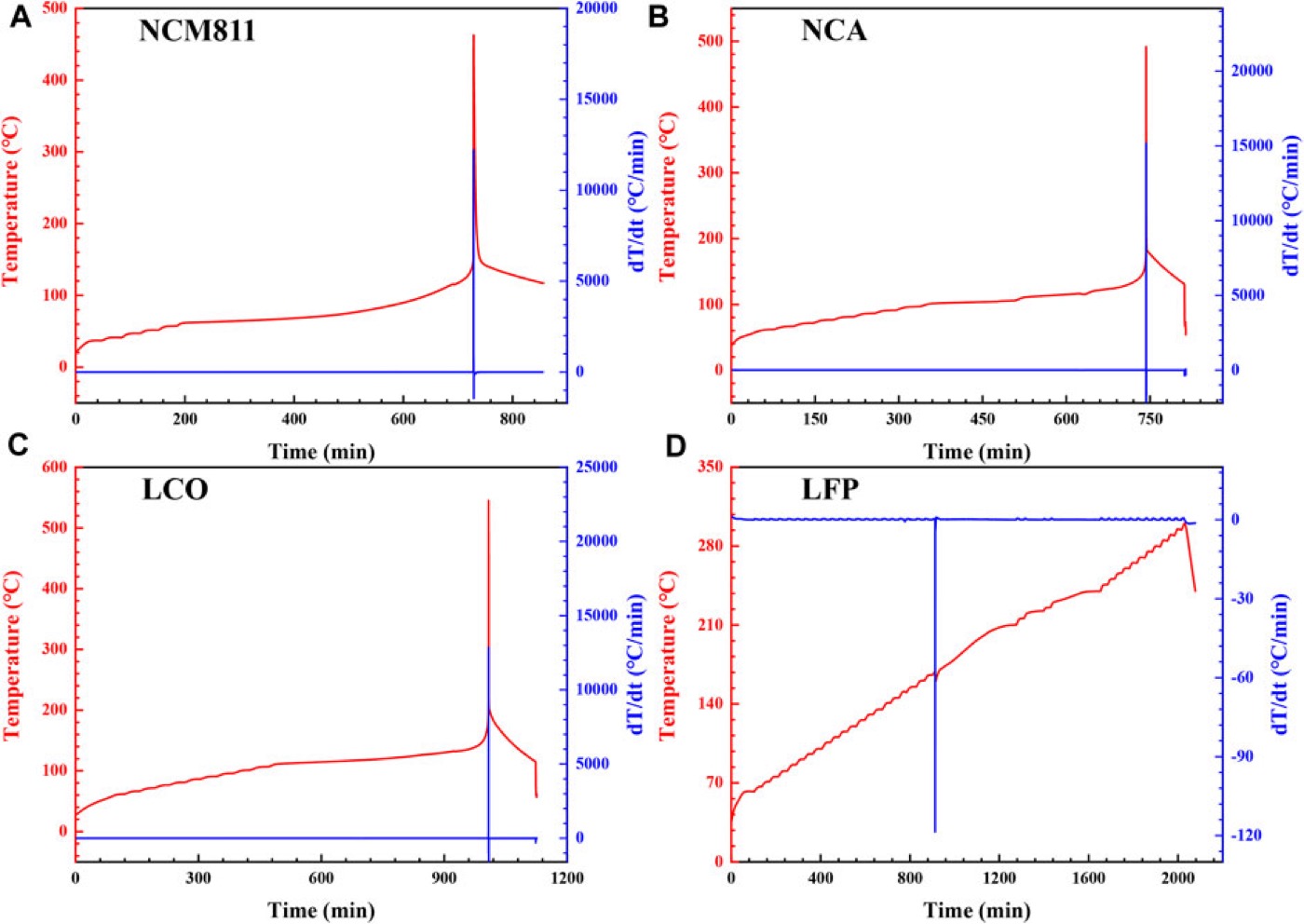
Peaked at 492 °C
Cycle life
500 to 1,500 cycles
Cracking
5% of the cross-section
Recipe, share of the weight
- Li 7.2%Lithium
- Ni 48.9%Nickel
- Co 9.2%Cobalt
- Al 1.4%Aluminium
- O 33.3%Oxygen
Best for
High specific capacity and energy from a layered oxide with less cobalt than LCO
Weakest at
Thermal stability of the charged cathode, moisture sensitivity and cycle life at high nickel content
Risk at a glance
- People Moderate. Skin sensitiser, suspected carcinogen
- If it fails Severe. Oxygen release and thermal runaway of a charged cathode
- Corrosion Moderate. In air, NCA reacts with moisture and CO₂ and forms surface residues that cost capacity.
Why it exists
NCA (lithium nickel cobalt aluminium oxide, usually LiNi₀.₈Co₀.₁₅Al₀.₀₅O₂) is a nickel-rich layered cathode with the same R-3m layered structure as LiCoO₂. It stores more charge than lithium cobalt oxide while using less cobalt, which is why it is used in electric-vehicle cells. NASA lists it for the InSight and Mars 2020 battery systems. Its weak points are thermal stability of the charged cathode, sensitivity to moisture and CO₂ in air, and a shorter cycle life than some rivals, all of which grow as the nickel fraction rises.
Where it's used
Electric-vehicle cells
A 2023 review reports that Tesla Model S, X and 3 batteries use NCA, and a 2026 review says Tesla has historically used NCA for its long-range vehicles.
Mars landers and rovers
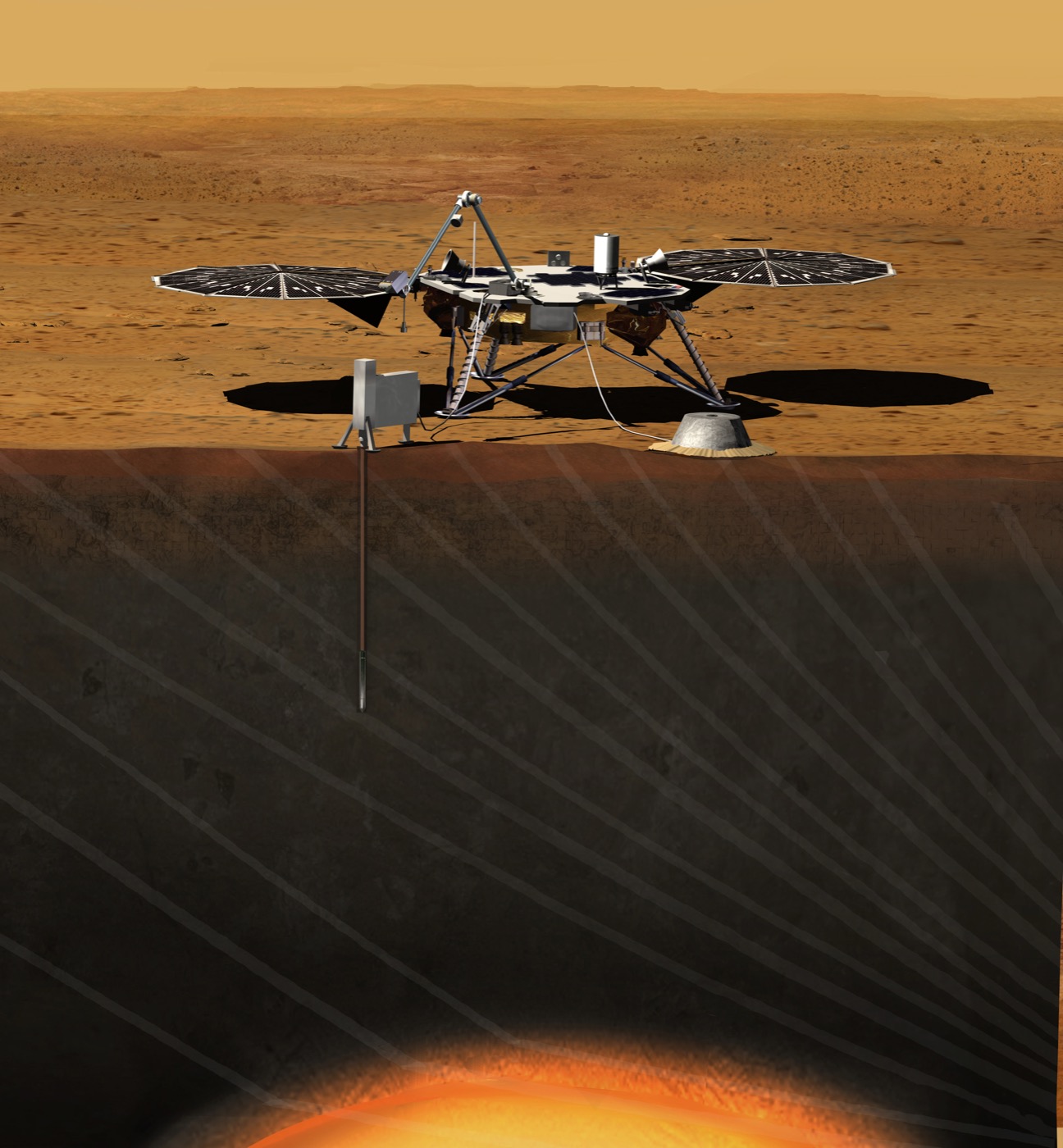
NASA's 2017 assessment lists the InSight lander (launch May 2018) and the Mars 2020 rover (launch listed as summer 2020) as using lithium-ion NCA batteries. The table was written before these launches. Earlier Mars rovers and landers are listed with NCO, a nickel-cobalt oxide without aluminium, not NCA.
Recipe
LiNi0.8Co0.15Al0.05O2
The composition every number on this page refers to is LiNi₀.₈Co₀.₁₅Al₀.₀₅O₂. For each lithium atom, 0.8 of the metal sites hold nickel, 0.15 hold cobalt and 0.05 hold aluminium, with two oxygen atoms.
| Ingredient | Atoms per unit | Share of the weight | What it does |
|---|---|---|---|
| Lithium Li | 1 | 7.2% | The mobile species. Lithium ions leave and re-enter the layers as the cell charges and discharges. |
| Nickel Ni | 0.8 | 48.9% | The main redox center. Nickel supplies most of the capacity, and more nickel means more capacity per gram. |
| Cobalt Co | 0.15 | 9.2% | Stabilizes the layered structure. NCA uses less cobalt than LCO. |
| Aluminium Al | 0.05 | 1.4% | Described by the review as a structural stabiliser that improves durability. |
| Oxygen O | 2 | 33.3% | Bonds with the metals to form the oxide layers. |
Weight shares are calculated from standard atomic weights.
What it can do
Capacity
About 200 mAh/g
The theoretical specific capacity is quoted as 278 mAh/g for the general LiNiₓCo_yAl_zO₂ family. A literature comparison table gives about 200 mAh/g for LiNi₀.₈Co₀.₁₅Al₀.₀₅O₂, at an operating range of 3.6 to 4.3 V versus Li/Li⁺.
Thermal behavior of the cathode
Onset at 250 °C
In differential scanning calorimetry with electrolyte, delithiated NCA released 1,460 J/g with onset at 250 °C, against 790 J/g for NMC111. By 600 °C it had lost 11 wt% as oxygen, against 6% for NMC111. These are second-hand figures from a review.
Thermal behavior of a cell
Peaked at 492 °C
A fully charged 3.0 Ah NCA/graphite 18650 cell began to heat itself at 101.71 °C, ran away at 165.44 °C and reached 491.84 °C. The paper rates NCA the second most hazardous of the four chemistries it tested, after LCO.
Cycle life
500 to 1,500 cycles
A review states a general range of 500 to 1,500 cycles for NCA, against 1,500 to 2,000 for NMC, without giving the depth of discharge, rate or end-of-life criterion, so the range is indicative only. NASA's assessment ranks cathode cycle life as LiFePO₄ > NMC > NCA > Mn spinel > LCO.
Cracking
5% of the cross-section
After charging to 4.3 V, microcracks covered 5% of the particle cross-section for NCA80, against 14.0% for NCA88 and 25.7% for NCA95. Cracking is linked to the abrupt shrinkage along the c-axis at the H2 to H3 phase transition.
How it compares
NCA offers more capacity per gram than LFP, about 200 mAh/g in a cell against 164 mAh/g, and more than LCO with less cobalt. Like NMC, it pays for that in heat. Charged NCA releases oxygen on heating, and the one four-chemistry test collected here ranks it second most hazardous, after LCO and far above LFP. The table compares NCA with the other cathodes in the collection.
The same measurements for each material, so you can compare them. Each row names the key condition under the value; the full conditions and methods are in the numbered notes under Technical details. Other materials are shown beside it; each was measured under its own conditions, so open its page before comparing closely. See the full ranking.
| Measurement | NCA | LFP | NMC | LCO | LNO | LMO |
|---|---|---|---|---|---|---|
| Capacity and energy | ||||||
| Theoretical specific capacityReview statement | 278 mAh/g1 | 170 mAh/g | 275 mAh/g | 274 mAh/g | 275 mAh/g | 285 mAh/g |
| Reversible specific capacity (measured) | 200 mAh/g2 | 164.1 mAh/g | no data | 140 mAh/g | no data | 123 mAh/g |
| Voltage and potential | ||||||
| Operating voltage rangeLiterature comparison table | 3.6 to 4.3 V vs Li/Li+ | 3.4 V vs Li/Li+ | no data | 3.9 to 4.2 V vs Li/Li+ | 4 V vs Li/Li+ | no data |
| Thermal behavior and safety | ||||||
| DSC exotherm onset, delithiated NCA with electrolyte | 250 °C3 | 210 to 250 °C | no data | no data | no data | no data |
| Lifetime and stability | ||||||
| Microcrack area after charging (NCA80) | 5 % (areal fraction)5 | no data | no data | no data | no data | no data |
| Other measurements | ||||||
| Oxygen mass loss on heating, delithiated NCA | 11 wt%4 | no data | no data | no data | no data | no data |
Why choose it, and why not
Good for
- High specific capacity and energy from a layered oxide that uses less cobalt than LCO.
- Established use in electric-vehicle cells and in NASA's Mars battery systems.
Watch out for
- A charged cathode releases oxygen on heating, with a high-heat exotherm that can burn the electrolyte.
- Surface compounds form readily in air because the material reacts with moisture and CO₂, which costs capacity at high voltage.
- Cycle life is shorter than for some rivals, and microcracking from the H2 to H3 transition grows as the nickel fraction rises.
NCA is the high-capacity, low-cobalt choice. It needs a strong battery management system and cooling, because a charged cell releases oxygen and fails hot.
Technical details
For scientists and researchers. Everything above comes from the record below: every number with its method, its conditions and its source.
Cell-level benchmarks
Values for finished cells. These vary by manufacturer, so read the conditions in the notes. Other materials are shown beside it; each was measured under its own conditions, so open its page before comparing closely. See the full ranking.
| Measurement | NCA | LFP | NMC | LCO | LNO | LMO |
|---|---|---|---|---|---|---|
| Thermal behavior and safety | ||||||
| Cell self-heating onset (ARC), NCA 18650 | 101.7 °C6 | 116.7 °C | 91 °C | 111.8 °C | no data | no data |
| Maximum temperature in thermal runaway (cell)Accelerating rate calorimetry (ARC) | 491.8 °C7 | no data | no data | 545.1 °C | no data | no data |
| Lifetime and stability | ||||||
| Typical cycle life range quoted for NCA cellsReview statement | 500 to 1500 cycles8 | 275 cycles | 300 cycles | > 16000 cycles | 69.2 % retained | no data |
Notes
The method, full conditions and any caveat for the numbered rows above.
| # | Measurement | Method | Conditions | Caveat |
|---|---|---|---|---|
| 1 | Theoretical specific capacity | — | composition general LiNixCoyAlzO2; the source does not say which Ni:Co:Al ratio the figure is forbasis described as hypothetical capacity | The review gives the general formula, not LiNi0.8Co0.15Al0.05O2 specifically. |
| 2 | Reversible specific capacity (measured) | Literature comparison table (approximate value, "~200") | composition LiNi0.8Co0.15Al0.05O2voltage range 3.6-4.3 V vs Li/Li+ (as listed in the table)rate not stated in the source | — |
| 3 | DSC exotherm onset, delithiated NCA with electrolyte | Differential scanning calorimetry, as summarised in a review of Belharouak et al. (2006) | sample Li0.45(Ni0.8Co0.15Al0.05)O2 powder, delithiatedelectrolyte 1.2 M LiPF6 in EC:EMC (3:7 wt)compared with Li0.55(Ni1/3Co1/3Mn1/3)O2 at above 300 °C and 790 J/g | Heat released was 1460 J/g for NCA against 790 J/g for the NMC111 powder. This is a secondhand figure; the original paper was not opened. |
| 4 | Oxygen mass loss on heating, delithiated NCA | Thermogravimetric analysis, as summarised in a review | sample Li0.45(Ni0.8Co0.15Al0.05)O2, delithiatedatmosphere TGA in purified air as shown in the review's figureend temperature 600 °Crelease starts about 190 °C for NCA vs 250 °C for NMC111, read from the review's figure; not stated in the text | NMC111 lost 6% in the same comparison. Secondhand figure from a review. |
| 5 | Microcrack area after charging (NCA80) | Cross-section SEM, as summarised in a review of Nam et al. | sample LiNi0.8Co0.15Al0.05O2 (NCA80)state charged to 4.3 Vcompared with 14.0% for NCA88 and 25.7% for NCA95 | A proxy for the abrupt c-axis shrinkage at the H2 to H3 phase transition. The review also says NCA80 still held a substantial fraction of H2 at 4.3 V. The review says only "areal fraction". No volume-change percentage was found. |
| 6 | Cell self-heating onset (ARC), NCA 18650 | Accelerating rate calorimetry (ARC) on commercial cells | cell 18650, NCA/graphite, 3.0 Ah rated, 3.7 V nominalsoc 100%test ARC heat-wait-search, 60 to 300 °C, 5 °C stepsdefinition self-heating rate above 0.03 °C/min | The authors attribute this first onset to SEI decomposition on the anode. Thermal runaway (above 10 °C/min) began at 165.44 °C and the maximum cell temperature was 491.84 °C. In the same test LCO reached 545.11 °C and NCM811 462.52 °C. |
| 7 | Maximum temperature in thermal runaway (cell) | — | cell 18650, NCA/graphite, 3.0 Ahsoc 100%test ARC, adiabatic | The authors note that for the non-LFP cells Tmax is above the autoignition temperature of diethyl carbonate (445 °C) and rank hazard LCO > NCA > NCM811 >> LFP. |
| 8 | Typical cycle life range quoted for NCA cells | — | basis general range stated in a review; depth of discharge, rate, temperature and end-of-life criterion are not givencompared with 1500 to 2000 cycles for NMC | Treat as indicative only. NASA's JPL assessment ranks cathode cycle life as LiFePO4 > NMC > NCA > Mn spinel > LCO > LiNiCoO2. |
Corrosion and compatibility
What happens when it meets other materials and environments.
| Environment | Concern | What happens |
|---|---|---|
| Air with moisture and CO2 | moderate | In air, NCA reacts with moisture and CO₂ and forms surface residues that cost capacity.1 |
| Electrolyte, charged to 4.3 V and above | moderate | Above 4.3 V, surface nickel attacks the electrolyte and metals leach out toward the anode.2 |
| HF from LiPF6 and trace moisture | moderate | Trace water turns LiPF6 into hydrofluoric acid, which speeds metal dissolution.3 |
| Aluminium current collector with LiPF6 electrolyte | low | LiPF6 is compatible with aluminium collectors, though some other salts corrode them.4 |
| # | Environment | Details | Test conditions |
|---|---|---|---|
| 1 | Air with moisture and CO2 | Surface lithium compounds (LiOH, Li2CO3) form easily on nickel-rich oxides during preparation and storage, and Li(NiCoAl)O2 is described as prone to react with CO2 and moisture in air. These residues cause side reactions and capacity loss at high voltage. One review table lists moisture sensitivity as a main challenge for NCA. | exposure ambient air; no humidity or time given for NCA in the sources |
| 2 | Electrolyte, charged to 4.3 V and above | Surface Ni4+ attacks the electrolyte and forms a NiO-like rock-salt layer; transition metals (Ni most of all) leach out, deposit on the graphite anode and add impedance. Leaching figures quoted are for NCM-type cathodes, not NCA. | voltage 4.3 V vs Li/Li+ and abovenote NCA surface degradation described in Molecules 2023; leaching ppm values are from an NCM523/graphite study |
| 3 | HF from LiPF6 and trace moisture | With trace water LiPF6 breaks down to PF5 and HF. HF accelerates transition-metal dissolution and attacks the electrode-electrolyte interface. | trigger LiPF6 above about 60 °C, trace moisturenote general statement for Li-ion cells, not measured on NCA alone |
| 4 | Aluminium current collector with LiPF6 electrolyte | LiPF6 is described as compatible with aluminium collectors, while some alternative salts (LiTFSI, LiBF4) cause Al corrosion at low concentrations. In Li-ion cells in general, corrosion mainly affects Cu and Al collectors at high temperature, over-discharge and high voltage. | electrolyte LiPF6 carbonatenote no NCA-specific aluminium corrosion rate found |
Risks and side effects
Hazards to people, what happens when a cell overheats, and how the material is handled and stored.
For people
NCA powder is classified as a skin sensitiser and a suspected carcinogen. Check the safety data sheet of the exact powder.
- A supplier sheet
- A supplier safety data sheet (MSE Supplies, revision 12 February 2019) classifies it as skin sensitisation category 1 (may cause an allergic skin reaction) and carcinogenicity category 2 (suspected of causing cancer), with the signal word Danger. It lists no occupational exposure limit.
- Database entries
- PubChem, from 49 ECHA notifications, reports H317 (skin sensitisation) in 98% and H351 (suspected carcinogen) in 95.9% of reports, with the signal word Warning.
- Dust
- Avoid dust formation. The safety data sheet calls for gloves, a face shield and a particle respirator (N100 or P3), and for the powder to be stored locked up.
If a cell overheats
These results come from laboratory tests, not from incidents in the field.
- A charged 18650 cell
- A 3.0 Ah NCA/graphite cell at 100% state of charge, heated adiabatically, began to heat itself at 101.71 °C, ran away at 165.44 °C and peaked at 491.84 °C. The authors attribute the first onset to decomposition of the film on the anode. They note that for the non-LFP cells the peak is above the autoignition temperature of diethyl carbonate (445 °C).
- Oxygen release
- The layered oxide loses lattice oxygen when heated, and the resulting high-heat exotherm burns the electrolyte. An overcharged NCA changes from layered to spinel to rock salt above about 200 °C.
- Gas and pressure
- Nickel-rich oxides give off reactive oxygen, CO and CO₂ when charged. The gas raises the internal pressure and can crack the electrode.
- Cracking
- Above about 4.15 V, abrupt shrinkage along the c-axis cracks the secondary particles. Fresh surfaces meet the electrolyte, a resistive layer grows and capacity fades. The effect appears strongly only at 80% nickel or more.
Handling and storage
- Storage
- Keep the container tightly closed in a dry, well-ventilated place, and avoid dust formation.
- Air exposure
- NCA is prone to react with CO₂ and moisture in air, forming LiOH and Li₂CO₃ on the surface during preparation and storage. These residues cause side reactions and capacity loss at high voltage.
- Battery design
- A review table notes that NCA cells need a strong battery management system and cooling because of their lower thermal stability.
- Stabilizing the material
- Aluminium in the lattice acts as a structural stabiliser. Concentration-gradient particles and Mg/Al co-doping are reported to suppress the H2 to H3 transition. One doped composition kept 95.6% capacity retention in the cited study.
Test details
The original wording and numbers from the sources, for readers who want them.
Failure risks
| Failure | Trigger and consequence |
|---|---|
| Oxygen release and thermal runaway of a charged cathodecritical severity | Heating a delithiated (charged) cathode; an overcharged NCA goes from layered to spinel to rock salt above about 200 °CLayered oxide loses lattice oxygen and gives a high-heat exotherm that burns the electrolyte. In DSC with electrolyte NCA gave 1460 J/g with onset at 250 °C, and lost 11 wt% as oxygen by 600 °C. |
| Whole-cell thermal runawaycritical severity | 100% state of charge, heated adiabatically (ARC)An 18650 NCA cell began self-heating at 101.71 °C, reached runaway at 165.44 °C and peaked at 491.84 °C. The paper rates NCA the second most hazardous of the four chemistries tested, after LCO. |
| Microcracking from the H2 to H3 phase changemoderate severity | Charging above about 4.15 V (higher nickel makes it earlier and sharper)Abrupt shrinkage along the c-axis cracks the secondary particles; electrolyte then reaches fresh surfaces and the resistive interphase grows, so capacity fades. The effect only appears strongly at 80% nickel or more and gets worse as nickel rises. |
Side effects on surrounding parts
| Affects | Effect |
|---|---|
| Cell internals and neighbouring cells in a pack (gas, heat) | Nickel-rich oxides give off reactive oxygen, CO and CO2 when charged; the gas raises internal pressure and can crack the electrode. |
| Spacecraft power system | The 2017 NASA assessment notes Li-ion cells in general are less tolerant of electrical and thermal abuse than aqueous nickel batteries and need electronic charge control. |
| Pack design (mass and complexity of thermal control) | Review table says NCA cells need a strong battery management system and cooling because of their lower thermal stability. |
Handling and storage
- Keep container tightly closed in a dry, well-ventilated place; avoid dust formation; wear gloves, face shield and a particle respirator (N100/P3); store locked up.
Mitigations
- Aluminium in the lattice is described as a structural stabiliser for NCA; the review credits it with improving structural durability compared with higher-cobalt-free compositions.
- Concentration-gradient particles and Mg/Al co-doping are reported to suppress the H2 to H3 transition (LiNi0.95Co0.03Al0.01Mg0.01O2 kept a capacity retention of 95.6% in the cited study).
Supply and geography
How common the raw materials are and where they come from.
Nickel
No crustal abundance figure was read. USGS gives identified nickel resources of more than 350 million tons (54% in laterites) and world reserves above 140,000,000 tons.
- Top producers (2025)
- Indonesia 66.7%, Philippines 6.9%, Russia 5.1%
- Critical mineral lists
- US: listed, EU: listed
- Recycling
- In 2025, nickel recovered from scrap was about 60% of U.S. apparent consumption, mostly stainless-steel scrap used again for alloys and stainless.
- Substitutes
- USGS substitutes listed are for stainless steel and alloy uses (low-nickel and duplex stainless steels, titanium alloys); none is given for battery cathodes.
Cobalt
No crustal abundance figure was read. USGS gives identified world terrestrial cobalt resources of about 25 million tons and reserves of 12,000,000 tons.
- Top producers (2025)
- Congo (Kinshasa) 73%, Indonesia 14%
- Critical mineral lists
- US: listed, EU: listed
- Recycling
- In 2025, cobalt content of purchased scrap in the United States represented 25% of estimated cobalt consumption.
- Substitutes
- The cobalt content of lithium-ion batteries was being decreased; cobalt-free iron-phosphorus cathodes held significant market share in China.
Lithium
USGS gives world lithium reserves of 37,000,000 tons and measured and indicated resources of about 150 million tons. No crustal abundance figure was read.
- Top producers (2025)
- Australia 31.7%, China 21.4%, Chile 19.3%
- Critical mineral lists
- US: listed, EU: listed
- Recycling
- Construction of lithium battery recycling plants continued throughout 2025.
- Substitutes
- USGS examples of lithium substitution are for primary batteries, ceramics, greases and glass, not lithium-ion cathodes.
Aluminium (as bauxite)
USGS gives bauxite resources of 55 billion to 75 billion tons and world bauxite reserves of 29,000,000 thousand tons. Aluminium makes up only 5 of the 100 atom-percent of the metal sites in NCA.
- Top producers (2025)
- Guinea 34.1%, Australia 22%, China 19.8%
- Critical mineral lists
- US: listed, EU: listed
- Recycling
- In 2025, aluminium recovered from old (discarded) scrap in the U.S. was equal to about 28% of apparent consumption. This is aluminium metal in general, not recovery from batteries.
- Substitutes
- USGS: bauxite is the only commercial raw material for alumina in the U.S.; clay and other raw materials are technically possible but not competitive.
Gallery
Documents
Datasheets, safety data sheets, papers and standards you can open.
Full record
The complete spore, as stored. Free to reuse under CC-BY-4.0. Images keep the licence shown with each one.
Show the full YAML
spore: profile
id: nca
spore_version: 0.2
family: lithium
name: Lithium nickel cobalt aluminium oxide
abbreviation: NCA
role: cathode
category: energy
type: li-ion-cathodes
summary: |
  NCA is a nickel-rich layered cathode, usually written LiNi0.8Co0.15Al0.05O2 (the composition every number below refers to unless it says otherwise). It stores more charge than lithium cobalt oxide and uses less cobalt. NASA lists it for the InSight and Mars 2020 battery systems, and it is used in electric-vehicle cells. Its weak points are heat (a charged NCA cathode releases oxygen on heating), sensitivity to moisture and CO2 in air, and a shorter cycle life than some rivals.
best_for: High specific capacity and energy from a layered oxide with less cobalt than LCO
weakest_at: Thermal stability of the charged cathode, moisture sensitivity and cycle life at high nickel content
identity:
  formula: LiNi0.8Co0.15Al0.05O2
  cas: 193214-24-3
  crystal_system: trigonal (layered O3 type, same structure as LiCoO2)
  space_group: R-3m
  source: ijms-nano-2026
  where: Section 3.1.5 (structure); CAS and formula from the MSE Supplies SDS section 1 and 3
tags:
  environments:
    - mars-surface
  stresses:
    - extreme-heat
  applications:
    - batteries
    - rovers-and-surface-systems
properties:
  - benchmark: theoretical_capacity
    value: 278
    unit: mAh/g
    scope: material
    conditions:
      composition: general LiNixCoyAlzO2; the source does not say which Ni:Co:Al ratio the figure is for
      basis: described as hypothetical capacity
    method: Review statement
    status: calculated
    note: The review gives the general formula, not LiNi0.8Co0.15Al0.05O2 specifically.
    source: molecules-2023
    where: Section 3.3 (NCA paragraph)
  - benchmark: practical_capacity
    value: 200
    unit: mAh/g
    scope: material
    conditions:
      composition: LiNi0.8Co0.15Al0.05O2
      voltage_range: 3.6-4.3 V vs Li/Li+ (as listed in the table)
      rate: not stated in the source
    method: Literature comparison table (approximate value, "~200")
    status: ground
    source: ijms-nano-2026
    where: Table 4
  - benchmark: avg_voltage
    label: Operating voltage range
    value: 3.6
    value_high: 4.3
    bound: range
    unit: V vs Li/Li+
    scope: material
    conditions:
      composition: LiNi0.8Co0.15Al0.05O2
      basis: operating voltage range listed in a comparison table
    method: Literature comparison table
    status: ground
    source: ijms-nano-2026
    where: Table 4
  - benchmark: thermal_runaway_onset
    label: DSC exotherm onset, delithiated NCA with electrolyte
    value: 250
    unit: °C
    scope: material
    conditions:
      sample: Li0.45(Ni0.8Co0.15Al0.05)O2 powder, delithiated
      electrolyte: 1.2 M LiPF6 in EC:EMC (3:7 wt)
      compared_with: Li0.55(Ni1/3Co1/3Mn1/3)O2 at above 300 °C and 790 J/g
    method: Differential scanning calorimetry, as summarised in a review of Belharouak et al. (2006)
    status: ground
    note: Heat released was 1460 J/g for NCA against 790 J/g for the NMC111 powder. This is a secondhand figure; the original paper was not opened.
    source: ahangari-2024
    where: Section 2.2 (thermal stability), Figure 11a,b
  - benchmark: oxygen_loss_600c
    label: Oxygen mass loss on heating, delithiated NCA
    value: 11
    unit: wt%
    scope: material
    conditions:
      sample: Li0.45(Ni0.8Co0.15Al0.05)O2, delithiated
      atmosphere: TGA in purified air as shown in the review's figure
      end_temperature: 600 °C
      release_starts: about 190 °C for NCA vs 250 °C for NMC111, read from the review's figure; not stated in the text
    method: Thermogravimetric analysis, as summarised in a review
    status: ground
    note: NMC111 lost 6% in the same comparison. Secondhand figure from a review.
    source: ahangari-2024
    where: Section 2.2, Figure 11c
  - benchmark: thermal_runaway_onset
    label: Cell self-heating onset (ARC), NCA 18650
    value: 101.71
    unit: °C
    scope: cell
    conditions:
      cell: 18650, NCA/graphite, 3.0 Ah rated, 3.7 V nominal
      soc: 100%
      test: ARC heat-wait-search, 60 to 300 °C, 5 °C steps
      definition: self-heating rate above 0.03 °C/min
    method: Accelerating rate calorimetry (ARC) on commercial cells
    status: ground
    note: The authors attribute this first onset to SEI decomposition on the anode. Thermal runaway (above 10 °C/min) began at 165.44 °C and the maximum cell temperature was 491.84 °C. In the same test LCO reached 545.11 °C and NCM811 462.52 °C.
    source: yuan-2024
    where: Table 1, Table 2
  - benchmark: thermal_runaway_tmax
    label: Maximum temperature in thermal runaway (cell)
    value: 491.84
    unit: °C
    scope: cell
    conditions:
      cell: 18650, NCA/graphite, 3.0 Ah
      soc: 100%
      test: ARC, adiabatic
    method: Accelerating rate calorimetry (ARC)
    status: ground
    note: The authors note that for the non-LFP cells Tmax is above the autoignition temperature of diethyl carbonate (445 °C) and rank hazard LCO > NCA > NCM811 >> LFP.
    source: yuan-2024
    where: Table 2
  - benchmark: cycle_life
    label: Typical cycle life range quoted for NCA cells
    value: 500
    value_high: 1500
    bound: range
    unit: cycles
    scope: cell
    conditions:
      basis: general range stated in a review; depth of discharge, rate, temperature and end-of-life criterion are not given
      compared_with: 1500 to 2000 cycles for NMC
    method: Review statement
    status: ground
    note: Treat as indicative only. NASA's JPL assessment ranks cathode cycle life as LiFePO4 > NMC > NCA > Mn spinel > LCO > LiNiCoO2.
    source: ijms-nano-2026
    where: Section 6.1 (NASA ranking in nasa-jpl-estorage section 4.2.1, p. 35)
  - benchmark: microcrack_area_fraction
    label: Microcrack area after charging (NCA80)
    value: 5
    unit: '% (areal fraction)'
    scope: material
    conditions:
      sample: LiNi0.8Co0.15Al0.05O2 (NCA80)
      state: charged to 4.3 V
      compared_with: 14.0% for NCA88 and 25.7% for NCA95
    method: Cross-section SEM, as summarised in a review of Nam et al.
    status: ground
    note: A proxy for the abrupt c-axis shrinkage at the H2 to H3 phase transition. The review also says NCA80 still held a substantial fraction of H2 at 4.3 V. The review says only "areal fraction". No volume-change percentage was found.
    source: ahangari-2024
    where: Section 2.1 (structural degradation)
corrosion:
  - environment: Air with moisture and CO2
    headline: In air, NCA reacts with moisture and CO₂ and forms surface residues that cost capacity.
    effect: Surface lithium compounds (LiOH, Li2CO3) form easily on nickel-rich oxides during preparation and storage, and Li(NiCoAl)O2 is described as prone to react with CO2 and moisture in air. These residues cause side reactions and capacity loss at high voltage. One review table lists moisture sensitivity as a main challenge for NCA.
    rating: moderate
    conditions:
      exposure: ambient air; no humidity or time given for NCA in the sources
    source: ahangari-2024
    where: Section 2.2 (residual lithium) and ijms-nano-2026 Table 4
  - environment: Electrolyte, charged to 4.3 V and above
    headline: Above 4.3 V, surface nickel attacks the electrolyte and metals leach out toward the anode.
    effect: Surface Ni4+ attacks the electrolyte and forms a NiO-like rock-salt layer; transition metals (Ni most of all) leach out, deposit on the graphite anode and add impedance. Leaching figures quoted are for NCM-type cathodes, not NCA.
    rating: moderate
    conditions:
      voltage: 4.3 V vs Li/Li+ and above
      note: NCA surface degradation described in Molecules 2023; leaching ppm values are from an NCM523/graphite study
    source: molecules-2023
    where: Section 2.3 (NCA paragraph)
  - environment: HF from LiPF6 and trace moisture
    headline: Trace water turns LiPF6 into hydrofluoric acid, which speeds metal dissolution.
    effect: With trace water LiPF6 breaks down to PF5 and HF. HF accelerates transition-metal dissolution and attacks the electrode-electrolyte interface.
    rating: moderate
    conditions:
      trigger: LiPF6 above about 60 °C, trace moisture
      note: general statement for Li-ion cells, not measured on NCA alone
    source: yang-2026
    where: Electrolyte decomposition and salt sections
  - environment: Aluminium current collector with LiPF6 electrolyte
    headline: LiPF6 is compatible with aluminium collectors, though some other salts corrode them.
    effect: LiPF6 is described as compatible with aluminium collectors, while some alternative salts (LiTFSI, LiBF4) cause Al corrosion at low concentrations. In Li-ion cells in general, corrosion mainly affects Cu and Al collectors at high temperature, over-discharge and high voltage.
    rating: low
    conditions:
      electrolyte: LiPF6 carbonate
      note: no NCA-specific aluminium corrosion rate found
    source: yang-2026
    where: Electrolyte salt section
risks:
  hazards:
    - text: 'Supplier SDS (MSE Supplies, revision 12 Feb 2019 as printed 12-2-2019): skin sensitisation category 1 (may cause an allergic skin reaction) and carcinogenicity category 2 (suspected of causing cancer), signal word Danger. No occupational exposure limit listed.'
      ghs:
        - H317
        - H351
      source: sds-nca-mse
      where: Section 2 and Section 8
    - text: 'PubChem, from 49 ECHA notifications: H317 in 98% and H351 in 95.9% of reports, signal word Warning.'
      ghs:
        - H317
        - H351
      source: pubchem-nca
      where: GHS Classification
  failure_risks:
    - mode: Oxygen release and thermal runaway of a charged cathode
      trigger: Heating a delithiated (charged) cathode; an overcharged NCA goes from layered to spinel to rock salt above about 200 °C
      consequence: Layered oxide loses lattice oxygen and gives a high-heat exotherm that burns the electrolyte. In DSC with electrolyte NCA gave 1460 J/g with onset at 250 °C, and lost 11 wt% as oxygen by 600 °C.
      severity: critical
      source: ahangari-2024
      where: Section 2.3 and Figure 11; yang-2026 thermal runaway section for the 200 °C statement
    - mode: Whole-cell thermal runaway
      trigger: 100% state of charge, heated adiabatically (ARC)
      consequence: An 18650 NCA cell began self-heating at 101.71 °C, reached runaway at 165.44 °C and peaked at 491.84 °C. The paper rates NCA the second most hazardous of the four chemistries tested, after LCO.
      severity: critical
      source: yuan-2024
      where: Table 2
    - mode: Microcracking from the H2 to H3 phase change
      trigger: Charging above about 4.15 V (higher nickel makes it earlier and sharper)
      consequence: Abrupt shrinkage along the c-axis cracks the secondary particles; electrolyte then reaches fresh surfaces and the resistive interphase grows, so capacity fades. The effect only appears strongly at 80% nickel or more and gets worse as nickel rises.
      severity: moderate
      source: molecules-2023
      where: Section 2.3; ijms-nano-2026 section 3.1.5
  side_effects:
    - text: Nickel-rich oxides give off reactive oxygen, CO and CO2 when charged; the gas raises internal pressure and can crack the electrode.
      affects: Cell internals and neighbouring cells in a pack (gas, heat)
      source: ahangari-2024
      where: Section 2.3 (gas evolution)
    - text: The 2017 NASA assessment notes Li-ion cells in general are less tolerant of electrical and thermal abuse than aqueous nickel batteries and need electronic charge control.
      affects: Spacecraft power system
      source: nasa-jpl-estorage
      where: Section 3.3.2
    - text: Review table says NCA cells need a strong battery management system and cooling because of their lower thermal stability.
      affects: Pack design (mass and complexity of thermal control)
      source: ijms-nano-2026
      where: Table 3
  handling:
    - text: Keep container tightly closed in a dry, well-ventilated place; avoid dust formation; wear gloves, face shield and a particle respirator (N100/P3); store locked up.
      source: sds-nca-mse
      where: Sections 2, 7 and 8
  mitigations:
    - text: Aluminium in the lattice is described as a structural stabiliser for NCA; the review credits it with improving structural durability compared with higher-cobalt-free compositions.
      source: ijms-nano-2026
      where: Section 3.1.5
    - text: Concentration-gradient particles and Mg/Al co-doping are reported to suppress the H2 to H3 transition (LiNi0.95Co0.03Al0.01Mg0.01O2 kept a capacity retention of 95.6% in the cited study).
      source: ijms-nano-2026
      where: Section 3.1.7
uses:
  - application: batteries
    device: Mars lander and rover batteries (NASA)
    example: NASA's 2017 JPL assessment lists the InSight (launch May 2018, Mars) and Mars 2020 (launch listed as summer 2020, Mars) battery systems as Li-ion (NCA). The table was written before these launches.
    source: nasa-jpl-estorage
    where: Table 3-3
  - application: rovers-and-surface-systems
    device: Rover and lander power
    example: Same table entry (InSight lander, Mars 2020 rover). The earlier Mars rovers and landers (MER, Phoenix, MSL, MAVEN and others) are listed in the same table as Li-ion (NCO), a nickel-cobalt oxide without aluminium, not NCA.
    source: nasa-jpl-estorage
    where: Table 3-3
  - application: batteries
    device: Electric-vehicle cells
    example: Tesla Model S, X and 3 batteries use NCA, per a 2023 review; another 2026 review says Tesla has historically used NCA for its long-range EVs.
    source: molecules-2023
    where: Section 2.3 (NCA paragraph); ijms-nano-2026 section 3.4
supply:
  - subject: Nickel
    abundance: No crustal abundance figure was read. USGS gives identified nickel resources of more than 350 million tons (54% in laterites) and world reserves above 140,000,000 tons.
    producers:
      - country: Indonesia
        share_percent: 66.7
        year: 2025
      - country: Philippines
        share_percent: 6.9
        year: 2025
      - country: Russia
        share_percent: 5.1
        year: 2025
    critical_lists:
      - list: USGS 2025 List of Critical Minerals (final, 7 Nov 2025)
        listed: true
      - list: EU Critical Raw Materials Act, Annex II (Regulation 2024/1252)
        listed: true
    recycling: In 2025, nickel recovered from scrap was about 60% of U.S. apparent consumption, mostly stainless-steel scrap used again for alloys and stainless.
    substitutes:
      - USGS substitutes listed are for stainless steel and alloy uses (low-nickel and duplex stainless steels, titanium alloys); none is given for battery cathodes.
    source: usgs-nickel-2026
    where: World Mine Production and Reserves (shares computed here from 2025e mine production over the 3,900,000-ton world total); Recycling; Substitutes Critical-list status from crs-usgs-list-2026 (aluminum, cobalt, lithium and nickel are all on the USGS list) and eu-crma-2024 (cobalt, lithium, nickel battery grade, bauxite/alumina/aluminium).
  - subject: Cobalt
    abundance: No crustal abundance figure was read. USGS gives identified world terrestrial cobalt resources of about 25 million tons and reserves of 12,000,000 tons.
    producers:
      - country: Congo (Kinshasa)
        share_percent: 73
        year: 2025
      - country: Indonesia
        share_percent: 14
        year: 2025
    critical_lists:
      - list: USGS 2025 List of Critical Minerals (final, 7 Nov 2025)
        listed: true
      - list: EU Critical Raw Materials Act, Annex II (Regulation 2024/1252)
        listed: true
    recycling: In 2025, cobalt content of purchased scrap in the United States represented 25% of estimated cobalt consumption.
    substitutes:
      - The cobalt content of lithium-ion batteries was being decreased; cobalt-free iron-phosphorus cathodes held significant market share in China.
    source: usgs-cobalt-2026
    where: 'Events, Trends, and Issues; Recycling; Substitutes Critical-list status from crs-usgs-list-2026 (aluminum, cobalt, lithium and nickel are all on the USGS list) and eu-crma-2024 (cobalt, lithium, nickel battery grade, bauxite/alumina/aluminium). Congo (Kinshasa) share: the USGS text states 73%, while its table gives 230,000 of 310,000 t, which is 74.2%.'
  - subject: Lithium
    abundance: USGS gives world lithium reserves of 37,000,000 tons and measured and indicated resources of about 150 million tons. No crustal abundance figure was read.
    producers:
      - country: Australia
        share_percent: 31.7
        year: 2025
      - country: China
        share_percent: 21.4
        year: 2025
      - country: Chile
        share_percent: 19.3
        year: 2025
    critical_lists:
      - list: USGS 2025 List of Critical Minerals (final, 7 Nov 2025)
        listed: true
      - list: EU Critical Raw Materials Act, Annex II (Regulation 2024/1252)
        listed: true
    recycling: Construction of lithium battery recycling plants continued throughout 2025.
    substitutes:
      - USGS examples of lithium substitution are for primary batteries, ceramics, greases and glass, not lithium-ion cathodes.
    source: usgs-lithium-2026
    where: World Mine Production and Reserves (shares computed here from 2025 mine production over the 290,000-ton world total, which excludes withheld U.S. data) Critical-list status from crs-usgs-list-2026 (aluminum, cobalt, lithium and nickel are all on the USGS list) and eu-crma-2024 (cobalt, lithium, nickel battery grade, bauxite/alumina/aluminium).
  - subject: Aluminium (as bauxite)
    abundance: USGS gives bauxite resources of 55 billion to 75 billion tons and world bauxite reserves of 29,000,000 thousand tons. Aluminium makes up only 5 of the 100 atom-percent of the metal sites in NCA.
    producers:
      - country: Guinea
        share_percent: 34.1
        year: 2025
      - country: Australia
        share_percent: 22
        year: 2025
      - country: China
        share_percent: 19.8
        year: 2025
    critical_lists:
      - list: USGS 2025 List of Critical Minerals (final, 7 Nov 2025)
        listed: true
      - list: EU Critical Raw Materials Act, Annex II (Regulation 2024/1252)
        listed: true
    recycling: In 2025, aluminium recovered from old (discarded) scrap in the U.S. was equal to about 28% of apparent consumption. This is aluminium metal in general, not recovery from batteries.
    substitutes:
      - 'USGS: bauxite is the only commercial raw material for alumina in the U.S.; clay and other raw materials are technically possible but not competitive.'
    source: usgs-bauxite-2026
    where: Bauxite production table, 2025e (shares computed here over the 440,000 thousand-ton world total); World Resources; Substitutes. Recycling from the USGS aluminum chapter (source usgs-aluminum-2026). Critical-list status from crs-usgs-list-2026 (aluminum, cobalt, lithium and nickel are all on the USGS list) and eu-crma-2024 (cobalt, lithium, nickel battery grade, bauxite/alumina/aluminium).
media:
  - file: /media/lithium/nca-1.jpg
    caption: Temperature and self-heating rate of four 18650 cells in an accelerating rate calorimeter; panel B is the NCA cell.
    shows: Cell temperature (red) and rate of temperature rise (blue) against time for NCM811 (A), NCA (B), LCO (C) and LFP (D) cells at 100% state of charge. The NCA cell peaks near 490 °C.
    conditions: ARC heat-wait-search from 60 to 300 °C, commercial 18650 cells, 100% SOC
    alt: Four line charts of temperature and heating rate over time; each lithium-ion cell shows a sudden spike at thermal runaway, except the LFP cell.
    credit: Yuan Y. et al., Frontiers in Chemistry 12 (2024), Figure 3
    license: CC BY
    license_url: https://creativecommons.org/licenses/by/4.0/
    source_url: https://doi.org/10.3389/fchem.2024.1324840
  - file: /media/lithium/nca-2.jpg
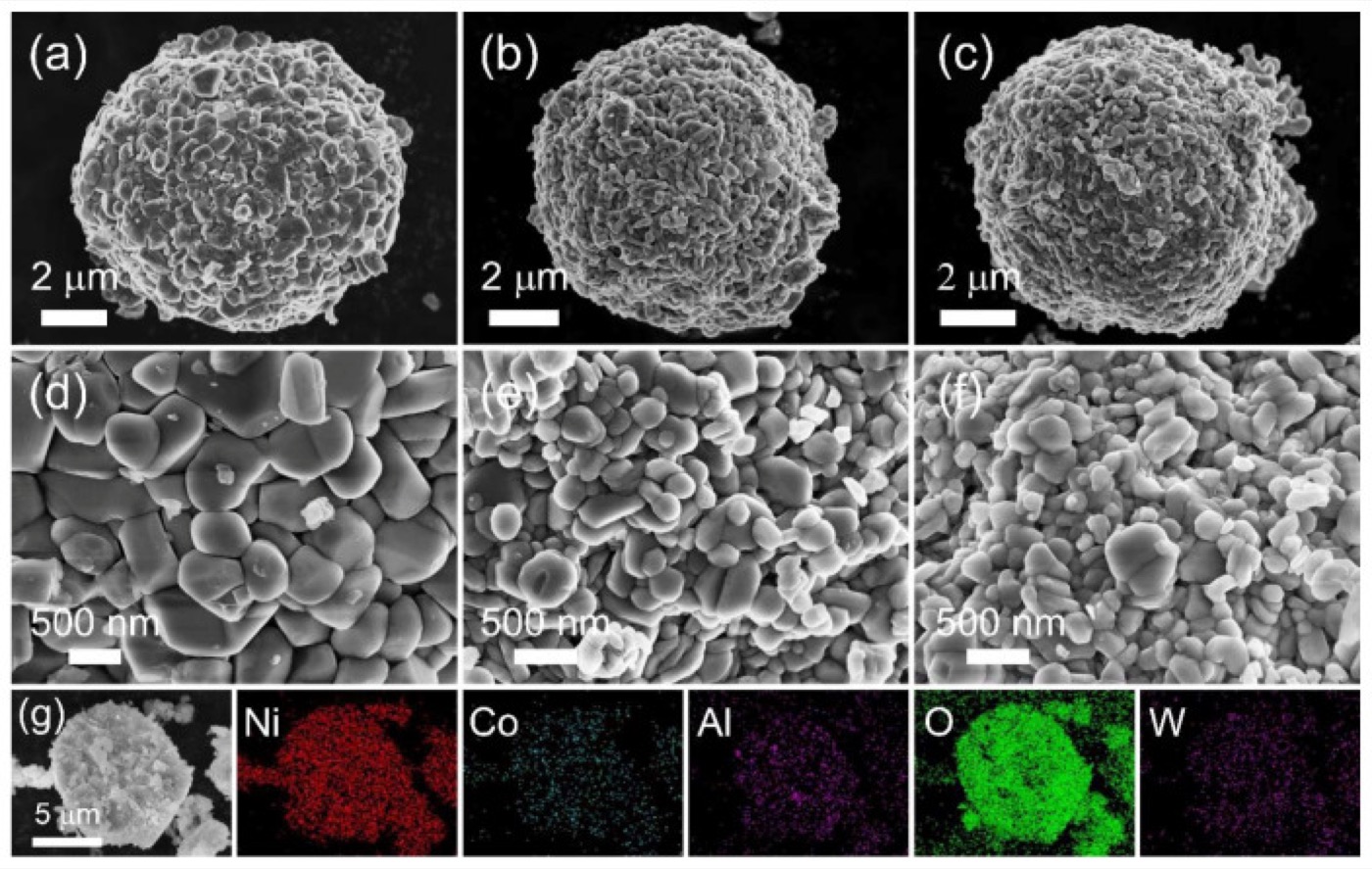
    caption: 'SEM of Ni-rich NCA powder: a spherical secondary particle made of many small crystals (panels a and d, undoped sample).'
    shows: Scanning electron micrographs of LiNi0.88Co0.09Al0.03O2 (NCA88, higher nickel than the 0.8 profile composition), undoped in panels a and d and tungsten-doped in the others, plus element maps of Ni, Co, Al, O and W.
    conditions: SEM, as-synthesised powder; scale bars 2 um, 500 nm and 5 um. The composition is NCA88, not LiNi0.8Co0.15Al0.05O2.
    alt: Electron microscope images of a round cathode particle about 10 micrometres across, built from many faceted crystals, with colour element maps below.
    credit: Zhang R. et al., Nanomaterials 12 (2022), Figure 2
    license: CC BY 4.0
    license_url: https://creativecommons.org/licenses/by/4.0/
    source_url: https://doi.org/10.3390/nano12050729
  - file: /media/lithium/nca-3.jpg
    caption: Artist's view of the InSight lander on Mars, one of the two missions NASA's 2017 assessment lists with NCA batteries.
    shows: Rendering of the InSight lander with its solar arrays, seismometer and heat probe. It shows the vehicle, not the battery.
    conditions: NASA/JPL artist rendition
    alt: Illustration of a lander with two round solar arrays standing on orange Martian ground, with a cutaway showing instruments below the surface.
    credit: NASA/JPL
    license: Public domain
    license_url: https://commons.wikimedia.org/wiki/File:InSight_Lander.jpg
    source_url: https://commons.wikimedia.org/wiki/File:InSight_Lander.jpg
documents:
  - title: Lithium nickel cobalt aluminum oxide safety data sheet (MSE Supplies)
    type: sds
    url: https://cdn.shopify.com/s/files/1/0722/7785/files/MSE-NCA-SDS.pdf
    year: 2019
  - title: 'NASA JPL: Energy Storage Technologies for Future Planetary Science Missions'
    type: report
    url: https://solarsystem.nasa.gov/system/downloadable_items/716_Energy_Storage_Tech_Report_FINAL.PDF
    year: 2017
  - title: Influence of cathode materials on thermal characteristics of lithium-ion batteries (open access)
    type: paper
    url: https://doi.org/10.3389/fchem.2024.1324840
    year: 2024
  - title: Advancements and challenges in high-capacity Ni-rich cathode materials (open access)
    type: paper
    url: https://doi.org/10.3390/ma17040801
    year: 2024
gaps:
  - 'Density (g/cm3): no source opened yet.'
  - 'Electronic conductivity: a 2015 paper (Amin, Ravnsbaek, Chiang, J. Electrochem. Soc. 162, A1163) measured it versus lithium content; its numbers were not read.'
  - 'Volume change on cycling: no percentage found; only a microcrack area fraction.'
  - 'Cold-temperature capacity retention of NCA: no sourced value found.'
  - 'NCA in Saft VES16 and other space cells: only a distributor listing says so; not used. Which cell and cathode NASA''s InSight and Mars 2020 batteries use is not stated beyond the table entry.'
  - 'Moisture sensitivity: no humidity, time or capacity-loss number found for NCA itself.'
  - Material-level DSC for charged NCA is secondhand (a review of Belharouak 2006); the original was not opened.
  - 'Radiation, vacuum or thermal-vacuum test results specific to NCA: none found.'
sources:
  molecules-2023:
    title: 'Layered-Oxide Cathode Materials for Fast-Charging Lithium-Ion Batteries: A Review'
    id: doi:10.3390/molecules28104007
    url: https://doi.org/10.3390/molecules28104007
    year: 2023
    kind: paper
    license: CC BY 4.0
  ijms-nano-2026:
    title: 'Nanostructured Cathode Materials for Rechargeable Lithium-Ion Batteries: Synthesis, Morphology, and Performances'
    id: doi:10.3390/ijms27156797
    url: https://doi.org/10.3390/ijms27156797
    year: 2026
    kind: paper
    license: CC BY 4.0
  ahangari-2024:
    title: Advancements and Challenges in High-Capacity Ni-Rich Cathode Materials for Lithium-Ion Batteries
    id: doi:10.3390/ma17040801
    url: https://doi.org/10.3390/ma17040801
    year: 2024
    kind: paper
    license: CC BY 4.0
  yuan-2024:
    title: Influence of cathode materials on thermal characteristics of lithium-ion batteries
    id: doi:10.3389/fchem.2024.1324840
    url: https://doi.org/10.3389/fchem.2024.1324840
    year: 2024
    kind: paper
    license: CC BY
  yang-2026:
    title: A Review of Failure Modes and Safety Strategies of Lithium-Ion Batteries from Materials to Systems
    id: doi:10.1002/advs.76228
    url: https://doi.org/10.1002/advs.76228
    year: 2026
    kind: paper
    license: CC BY 4.0
  nasa-jpl-estorage:
    title: Energy Storage Technologies for Future Planetary Science Missions
    id: JPL D-101146
    url: https://solarsystem.nasa.gov/system/downloadable_items/716_Energy_Storage_Tech_Report_FINAL.PDF
    year: 2017
    kind: report
    license: public domain
  sds-nca-mse:
    title: 'Safety Data Sheet: Lithium nickel cobalt aluminum oxide (PO0180), MSE Supplies LLC, version 3.1'
    id: CAS 193214-24-3
    url: https://cdn.shopify.com/s/files/1/0722/7785/files/MSE-NCA-SDS.pdf
    year: 2019
    kind: datasheet
    license: supplier document, cited for facts only
  pubchem-nca:
    title: 'PubChem: Lithium Nickel Cobalt Aluminium Oxide (CID 22610795), GHS classification'
    id: CID 22610795
    url: https://pubchem.ncbi.nlm.nih.gov/compound/22610795
    year: 2026
    kind: database
    license: public domain
  usgs-nickel-2026:
    title: 'Mineral Commodity Summaries 2026: Nickel'
    id: USGS MCS 2026
    url: https://pubs.usgs.gov/periodicals/mcs2026/mcs2026-nickel.pdf
    year: 2026
    kind: report
    license: public domain
  usgs-cobalt-2026:
    title: 'Mineral Commodity Summaries 2026: Cobalt'
    id: USGS MCS 2026
    url: https://pubs.usgs.gov/periodicals/mcs2026/mcs2026-cobalt.pdf
    year: 2026
    kind: report
    license: public domain
  usgs-lithium-2026:
    title: 'Mineral Commodity Summaries 2026: Lithium'
    id: USGS MCS 2026
    url: https://pubs.usgs.gov/periodicals/mcs2026/mcs2026-lithium.pdf
    year: 2026
    kind: report
    license: public domain
  usgs-aluminum-2026:
    title: 'Mineral Commodity Summaries 2026: Aluminum'
    id: USGS MCS, February 2026
    url: https://pubs.usgs.gov/periodicals/mcs2026/mcs2026-aluminum.pdf
    year: 2026
    kind: report
    license: public domain
  usgs-bauxite-2026:
    title: 'Mineral Commodity Summaries 2026: Bauxite and Alumina (recycling figure from the Aluminum chapter)'
    id: USGS MCS 2026
    url: https://pubs.usgs.gov/periodicals/mcs2026/mcs2026-bauxite-alumina.pdf
    year: 2026
    kind: report
    license: public domain
  crs-usgs-list-2026:
    title: U.S. Geological Survey's Critical Minerals List (CRS In Focus IF13145, 7 Jan 2026), summarising the Final 2025 List of Critical Minerals
    id: CRS IF13145
    url: https://www.everycrsreport.com/reports/IF13145.html
    year: 2026
    kind: report
    license: public domain (Congressional Research Service)
  eu-crma-2024:
    title: Regulation (EU) 2024/1252, Annex II, list of critical raw materials (EUR-Lex text)
    id: Regulation (EU) 2024/1252
    url: https://eur-lex.europa.eu/eli/reg/2024/1252/oj
    year: 2024
    kind: standard
    license: EU legislation, reuse permitted
license: CC-BY-4.0
updated: '2026-10-16'
review:
  status: draft
  method: assistant
  checked_values: 9
  unreachable: 0
  caveats: 5
  note: 'Re-read by an AI assistant on 2026-10-16: 9 of 9 benchmark values match their cited source; 0 could not be opened; 0 did not match.'
story:
  recipe:
    line: The composition every number on this page refers to is LiNi₀.₈Co₀.₁₅Al₀.₀₅O₂. For each lithium atom, 0.8 of the metal sites hold nickel, 0.15 hold cobalt and 0.05 hold aluminium, with two oxygen atoms.
    parts:
      - name: Lithium
        symbol: Li
        atoms: 1
        atomic_weight: 6.94
        role: The mobile species. Lithium ions leave and re-enter the layers as the cell charges and discharges.
      - name: Nickel
        symbol: Ni
        atoms: 0.8
        atomic_weight: 58.693
        role: The main redox center. Nickel supplies most of the capacity, and more nickel means more capacity per gram.
      - name: Cobalt
        symbol: Co
        atoms: 0.15
        atomic_weight: 58.933
        role: Stabilizes the layered structure. NCA uses less cobalt than LCO.
      - name: Aluminium
        symbol: Al
        atoms: 0.05
        atomic_weight: 26.982
        role: Described by the review as a structural stabiliser that improves durability.
      - name: Oxygen
        symbol: O
        atoms: 2
        atomic_weight: 15.999
        role: Bonds with the metals to form the oxide layers.
  why: NCA (lithium nickel cobalt aluminium oxide, usually LiNi₀.₈Co₀.₁₅Al₀.₀₅O₂) is a nickel-rich layered cathode with the same R-3m layered structure as LiCoO₂. It stores more charge than lithium cobalt oxide while using less cobalt, which is why it is used in electric-vehicle cells. NASA lists it for the InSight and Mars 2020 battery systems. Its weak points are thermal stability of the charged cathode, sensitivity to moisture and CO₂ in air, and a shorter cycle life than some rivals, all of which grow as the nickel fraction rises.
  uses:
    - where: Electric-vehicle cells
      line: A 2023 review reports that Tesla Model S, X and 3 batteries use NCA, and a 2026 review says Tesla has historically used NCA for its long-range vehicles.
    - where: Mars landers and rovers
      line: NASA's 2017 assessment lists the InSight lander (launch May 2018) and the Mars 2020 rover (launch listed as summer 2020) as using lithium-ion NCA batteries. The table was written before these launches. Earlier Mars rovers and landers are listed with NCO, a nickel-cobalt oxide without aluminium, not NCA.
  can_do:
    - label: Capacity
      value: About 200 mAh/g
      line: The theoretical specific capacity is quoted as 278 mAh/g for the general LiNiₓCo_yAl_zO₂ family. A literature comparison table gives about 200 mAh/g for LiNi₀.₈Co₀.₁₅Al₀.₀₅O₂, at an operating range of 3.6 to 4.3 V versus Li/Li⁺.
    - label: Thermal behavior of the cathode
      value: Onset at 250 °C
      line: In differential scanning calorimetry with electrolyte, delithiated NCA released 1,460 J/g with onset at 250 °C, against 790 J/g for NMC111. By 600 °C it had lost 11 wt% as oxygen, against 6% for NMC111. These are second-hand figures from a review.
    - label: Thermal behavior of a cell
      value: Peaked at 492 °C
      line: A fully charged 3.0 Ah NCA/graphite 18650 cell began to heat itself at 101.71 °C, ran away at 165.44 °C and reached 491.84 °C. The paper rates NCA the second most hazardous of the four chemistries it tested, after LCO.
    - label: Cycle life
      value: 500 to 1,500 cycles
      line: A review states a general range of 500 to 1,500 cycles for NCA, against 1,500 to 2,000 for NMC, without giving the depth of discharge, rate or end-of-life criterion, so the range is indicative only. NASA's assessment ranks cathode cycle life as LiFePO₄ > NMC > NCA > Mn spinel > LCO.
    - label: Cracking
      value: 5% of the cross-section
      line: After charging to 4.3 V, microcracks covered 5% of the particle cross-section for NCA80, against 14.0% for NCA88 and 25.7% for NCA95. Cracking is linked to the abrupt shrinkage along the c-axis at the H2 to H3 phase transition.
  compare: NCA offers more capacity per gram than LFP, about 200 mAh/g in a cell against 164 mAh/g, and more than LCO with less cobalt. Like NMC, it pays for that in heat. Charged NCA releases oxygen on heating, and the one four-chemistry test collected here ranks it second most hazardous, after LCO and far above LFP. The table compares NCA with the other cathodes in the collection.
  good_for:
    - High specific capacity and energy from a layered oxide that uses less cobalt than LCO.
    - Established use in electric-vehicle cells and in NASA's Mars battery systems.
  watch_out:
    - A charged cathode releases oxygen on heating, with a high-heat exotherm that can burn the electrolyte.
    - Surface compounds form readily in air because the material reacts with moisture and CO₂, which costs capacity at high voltage.
    - Cycle life is shorter than for some rivals, and microcracking from the H2 to H3 transition grows as the nickel fraction rises.
  verdict: NCA is the high-capacity, low-cobalt choice. It needs a strong battery management system and cooling, because a charged cell releases oxygen and fails hot.
  risk_groups:
    - title: For people
      level: 2
      verdict: Skin sensitiser, suspected carcinogen
      lead: NCA powder is classified as a skin sensitiser and a suspected carcinogen. Check the safety data sheet of the exact powder.
      points:
        - label: A supplier sheet
          line: A supplier safety data sheet (MSE Supplies, revision 12 February 2019) classifies it as skin sensitisation category 1 (may cause an allergic skin reaction) and carcinogenicity category 2 (suspected of causing cancer), with the signal word Danger. It lists no occupational exposure limit.
        - label: Database entries
          line: PubChem, from 49 ECHA notifications, reports H317 (skin sensitisation) in 98% and H351 (suspected carcinogen) in 95.9% of reports, with the signal word Warning.
        - label: Dust
          line: Avoid dust formation. The safety data sheet calls for gloves, a face shield and a particle respirator (N100 or P3), and for the powder to be stored locked up.
    - title: If a cell overheats
      lead: These results come from laboratory tests, not from incidents in the field.
      points:
        - label: A charged 18650 cell
          line: A 3.0 Ah NCA/graphite cell at 100% state of charge, heated adiabatically, began to heat itself at 101.71 °C, ran away at 165.44 °C and peaked at 491.84 °C. The authors attribute the first onset to decomposition of the film on the anode. They note that for the non-LFP cells the peak is above the autoignition temperature of diethyl carbonate (445 °C).
        - label: Oxygen release
          line: The layered oxide loses lattice oxygen when heated, and the resulting high-heat exotherm burns the electrolyte. An overcharged NCA changes from layered to spinel to rock salt above about 200 °C.
        - label: Gas and pressure
          line: Nickel-rich oxides give off reactive oxygen, CO and CO₂ when charged. The gas raises the internal pressure and can crack the electrode.
        - label: Cracking
          line: Above about 4.15 V, abrupt shrinkage along the c-axis cracks the secondary particles. Fresh surfaces meet the electrolyte, a resistive layer grows and capacity fades. The effect appears strongly only at 80% nickel or more.
    - title: Handling and storage
      points:
        - label: Storage
          line: Keep the container tightly closed in a dry, well-ventilated place, and avoid dust formation.
        - label: Air exposure
          line: NCA is prone to react with CO₂ and moisture in air, forming LiOH and Li₂CO₃ on the surface during preparation and storage. These residues cause side reactions and capacity loss at high voltage.
        - label: Battery design
          line: A review table notes that NCA cells need a strong battery management system and cooling because of their lower thermal stability.
        - label: Stabilizing the material
          line: Aluminium in the lattice acts as a structural stabiliser. Concentration-gradient particles and Mg/Al co-doping are reported to suppress the H2 to H3 transition. One doped composition kept 95.6% capacity retention in the cited study.
  compare_rows:
    - label: Practical capacity
      benchmark: practical_capacity
      scope: material
    - label: Avg voltage
      benchmark: avg_voltage
      scope: material
    - label: Theoretical capacity
      benchmark: theoretical_capacity
      scope: material
References
Every number above carries a reference number. Click one to see the source and where in it the value comes from.