Lithium titanate LTO
Li4Ti5O12 · CAS 12031-95-7 · cubic, Fd-3m
Lithium titanate (Li4Ti5O12) is a spinel oxide used as a lithium-ion anode.
Evidence level
2 of 5
Lab-measured
- 0Predicted only. No one has made it, or no measurement exists.
- 1Calculated. Only calculated or predicted values from sources.
- 2Lab-measured. Measured properties with their conditions stated.
- 3Space-relevant tests. Measured in conditions relevant to space, such as vacuum or atomic oxygen.
- 4Ground-qualified. Qualified for an application on the ground.
- 5Flown or field-proven. Flight or field results exist.
Capacity
175 mAh/g in theory
Voltage
1.55 V
Size change
About 0.2%
Cycle life
20,000 to 30,000 cycles
Heat
383 J/g
Recipe, share of the weight
- Li 6.0%Lithium
- Ti 52.1%Titanium
- O 41.8%Oxygen
Best for
Very long cycle life and fast charge, with no lithium plating and almost no size change.
Weakest at
Lower cell energy (high voltage, low capacity per gram) and gas generation with swelling in cells.
Risk at a glance
- People None found. Not classified hazardous
- If it fails High. Gassing and swelling
- Corrosion Severe. LTO reacts with the carbonate solvents and makes gas that swells soft-pack cells.
Why it exists
Lithium titanate (LTO, Li₄Ti₅O₁₂) is a spinel oxide (cubic, space group Fd-3m) used as a lithium-ion anode. It works at a much higher voltage than graphite, near 1.55 V versus Li/Li⁺, and its structure barely changes size when lithium enters, a property called zero strain. Together these avoid lithium plating and allow very long cycle life, at the cost of lower cell energy. Its known weak point is that it reacts with carbonate electrolytes and generates gas, which swells soft-pack cells.
Where it's used
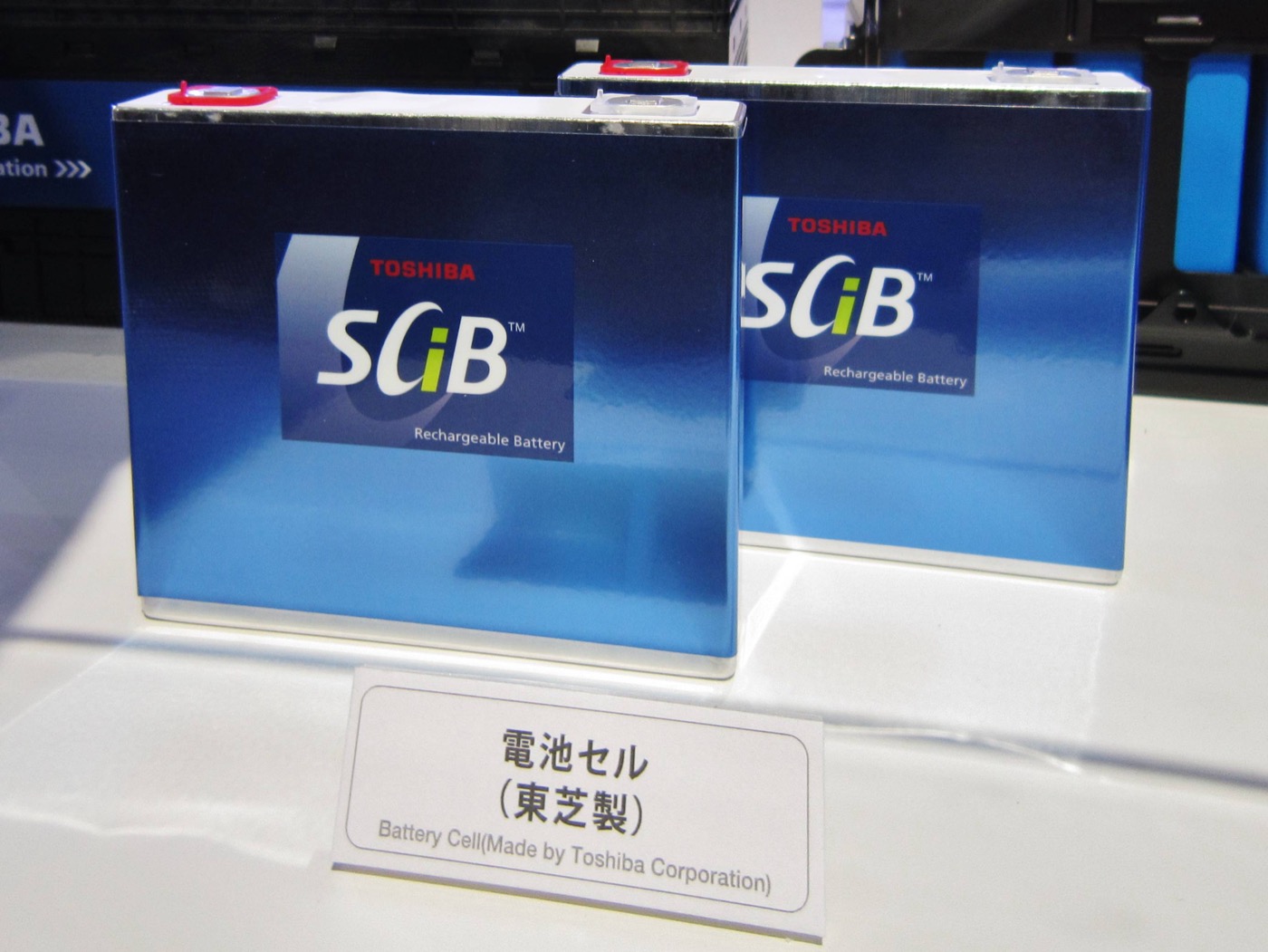
Toshiba SCiB cells
Toshiba says its SCiB cells use lithium titanium oxide in the anode. It names mild hybrid and hybrid cars, electric buses, trucks, factory vehicles, grid storage, trains, ships and substations as uses. It does not mention space.
A fast-charging car cell
A review reports that a Li₄Ti₅O₁₂ and LiFePO₄ 18650 cell type was used in a real car with the charge time cut to 5 minutes using a three-level charger. The car and maker are not named.
Recipe
Li4Ti5O12
Li₄Ti₅O₁₂ is a spinel oxide. Each formula unit combines four lithium atoms, five titanium atoms and twelve oxygen atoms.
| Ingredient | Atoms per unit | Share of the weight | What it does |
|---|---|---|---|
| Lithium Li | 4 | 6.0% | The mobile species. Lithium ions enter and leave the spinel as the cell charges and discharges. |
| Titanium Ti | 5 | 52.1% | The redox center. Titanium changes oxidation state as lithium enters, near 1.55 V versus Li/Li⁺. |
| Oxygen O | 12 | 41.8% | Bonds with lithium and titanium to form the spinel framework, which barely changes size as lithium moves. |
Weight shares are calculated from standard atomic weights.
What it can do
Capacity
175 mAh/g in theory
The theoretical specific capacity of the spinel is 175 mAh/g over a voltage window of 2.5 to 1.0 V versus Li/Li⁺. In a soft-pack full cell at a 0.5 C rate and 25 °C, the measured capacity of the LTO was 148.7 mAh/g, and 151.2 mAh/g for carbon-coated LTO. In a half-cell at 10 C discharge, porous crystallites delivered 140 mAh/g, and at 100 C about 70 mAh/g.
Voltage
1.55 V
The flat plateau of the two-phase Li₄Ti₅O₁₂ to Li₇Ti₅O₁₂ reaction sits at 1.55 V versus Li/Li⁺. That is about 1.2 V above a carbon anode, which lowers cell voltage and energy density.
Size change
About 0.2%
Inserting and removing lithium changes the volume by only around 0.2%, which is why the material is called zero strain. Graphite swells by around 10%.
Cycle life
20,000 to 30,000 cycles
An 800 mAh 18650 cell charged at 10C and discharged at 5C completed 20,000 cycles. A similar cell charged at 15C and discharged at 5C retained 95% after 30,000 cycles. These are test results reported in a review.
Heat
383 J/g
Electrochemically lithiated Li₄Ti₅O₁₂ released a total of 383 J/g in differential scanning calorimetry, with onset at 125 °C. The comparison value for fully lithiated graphite is 2,700 J/g, with onset at 100 °C.
In the cold
55% at -40 °C
In a coin half-cell with a ternary carbonate electrolyte, LTO delivered 55.48% of its room-temperature capacity at -40 °C. The binary EC+DMC electrolyte almost failed to charge and discharge below -30 °C in the same study, so the electrolyte sets the limit.
How it compares
Lithium titanate is one of two anodes in this collection, and the other is graphite. It stores less charge per gram, 175 mAh/g in theory against 372 mAh/g for graphite, and it works at a higher voltage, which lowers cell energy. In exchange it avoids lithium plating, barely changes size, and lasts through tens of thousands of cycles in the tests collected here. The table compares lithium titanate with the other anodes in the collection.
The same measurements for each material, so you can compare them. Each row names the key condition under the value; the full conditions and methods are in the numbered notes under Technical details. Other materials are shown beside it; each was measured under its own conditions, so open its page before comparing closely. See the full ranking.
| Measurement | LTO | Gr |
|---|---|---|
| Capacity and energy | ||
| Theoretical specific capacity | 175 mAh/g1 | 372 mAh/g |
| Porous nanocrystalline LTO at 10CHalf-cell result reported in a review | 140 mAh/g3 | no data |
| Porous nanocrystalline LTO at 100CHalf-cell result reported in a review | 70 mAh/g | no data |
| Discharge capacity of LTO at -40 C relative to room temperature | 55.48 % of room-temperature capacity6 | no data |
| Voltage and potential | ||
| Working voltage plateau | 1.55 V vs Li/Li+2 | no data |
| Thermal behavior and safety | ||
| DSC onset, fully lithiated Li4Ti5O12 with electrolyteDSC | 125 °C7 | 80 to 160 °C |
| Lifetime and stability | ||
| Volume change on cyclingValue quoted in a review | 0.2 %4 | 10 % |
| Physical and electrical | ||
| Electronic conductivityValue quoted in the body text of a review | 1×10^-8 to 1×10^-7 S/cm5 | no data |
| Electronic conductivity as given in the abstractValue quoted in the abstract of a review | 1×10^-13 S/cm | no data |
Why choose it, and why not
Good for
- Very long cycle life and fast charging, with no lithium plating and almost no change in size.
- Established in commercial cells and named for vehicles, buses, trains, ships and grid storage by one manufacturer.
Watch out for
- Lower cell energy, because of the high voltage and low capacity per gram.
- Gas generation (hydrogen, carbon dioxide and carbon monoxide) swells soft-pack cells. The authors call gassing a grave safety concern and a main obstacle to wide use.
- Poor performance in the cold with the wrong electrolyte.
LTO is the long-life, fast-charging anode. It gives up cell energy and has to be managed for gas, and in exchange it avoids lithium plating and barely changes size.
Technical details
For scientists and researchers. Everything above comes from the record below: every number with its method, its conditions and its source.
Cell-level benchmarks
Values for finished cells. These vary by manufacturer, so read the conditions in the notes. Other materials are shown beside it; each was measured under its own conditions, so open its page before comparing closely. See the full ranking.
| Measurement | LTO | Gr |
|---|---|---|
| Capacity and energy | ||
| Capacity of LTO in a NCM/LTO soft-pack cell, cycle 1 | 148.7 mAh/g8 | no data |
| Capacity of LTO in a NCM/LTO soft-pack cell, cycle 400 | 138.5 mAh/g9 | no data |
| Lifetime and stability | ||
| LTO//LiFePO4 18650 cell, stable capacityCycling test reported in a review | 20000 cycles10 | no data |
| LTO//LiFePO4 18650 cell, 95% capacity retentionCycling test reported in a review | 30000 cycles11 | no data |
| Hydrogen share of gas from charged NCM/LTO soft-pack cells stored 3 monthsGas chromatography of gas from the cells | 55.65 wt%12 | no data |
Notes
The method, full conditions and any caveat for the numbered rows above.
| # | Measurement | Method | Conditions | Caveat |
|---|---|---|---|---|
| 1 | Theoretical specific capacity | Value quoted by the paper as the theoretical capacity of the spinel | voltage window 2.5 to 1.0 V vs Li/Li+reaction lithium insertion into the Li4Ti5O12 spinel (the source does not give the lithium count) | — |
| 2 | Working voltage plateau | Half-cell galvanostatic discharge, as summarized in a review | reaction two-phase Li4Ti5O12 to Li7Ti5O12 plateaunote flat plateau, not an average over a sloping curve | — |
| 3 | Porous nanocrystalline LTO at 10C | — | rate 10C dischargeparticles porous crystallites 20 to 50 nm, 12 m2/gnote close to 175 mAh/g at C/2 per the same review | — |
| 4 | Volume change on cycling | — | event lithium insertion and extractionstated as around 0.2%attributed to Ohzuku et al. (zero-strain) | — |
| 5 | Electronic conductivity | — | material intrinsic Li4Ti5O12reason given empty Ti 3d state | The abstract of the same paper states 1e-13 S/cm, so published figures disagree. |
| 6 | Discharge capacity of LTO at -40 C relative to room temperature | Galvanostatic cycling after 4 h temperature equilibration | temperature C -40rate 0.5Cvoltage window 1 to 2.5 V vs Li/Li+cell CR2025 coin half-cell vs lithium, 1 M LiPF6 in EC+EMC+DMC 1:1:1capacity at minus40 mAh g 86 | The binary EC+DMC electrolyte almost failed to charge and discharge below -30 C in the same study, so the electrolyte sets the limit. |
| 7 | DSC onset, fully lithiated Li4Ti5O12 with electrolyte | — | material electrochemically lithiated Li4Ti5O12 from a Li-metal half-cell, with electrolytetest differential scanning calorimetrynote onset did not change noticeably with the amount of lithium inserted | Total heat of fully lithiated Li4Ti5O12 was 383 J/g, against 2700 J/g with onset 100 C for fully lithiated graphite (unit printed as "Jg" on the page, read as J/g). LTO's advantage here is mainly less heat, not a much later onset. |
| 8 | Capacity of LTO in a NCM/LTO soft-pack cell, cycle 1 | Specific capacity of the LTO measured in the full cell | rate 0.5C charge and dischargetemperature C 25cell soft-pack, Li(Ni1/3Co1/3Mn1/3)O2 cathode, 1 M LiPF6 in EC+DMC+EMC | — |
| 9 | Capacity of LTO in a NCM/LTO soft-pack cell, cycle 400 | Specific capacity of the LTO measured in the full cell | rate 0.5C charge and dischargetemperature C 25cell soft-pack, Li(Ni1/3Co1/3Mn1/3)O2 cathode, 1 M LiPF6 in EC+DMC+EMC | The same cell type with carbon-coated LTO gave 151.2 mAh/g at cycle 1 and 151.3 mAh/g at cycle 400. |
| 10 | LTO//LiFePO4 18650 cell, stable capacity | — | charge 10Cdischarge 5Ccell 18650, 800 mAh, nanostructured carbon-coated electrodes, flat 1.85 V | Section 1 describes carbon-coated electrodes for this cell, while later text in the same paper calls the LTO anode carbon-free; the paper does not reconcile the two. |
| 11 | LTO//LiFePO4 18650 cell, 95% capacity retention | — | charge 15Cdischarge 5Cretention 95%cell 18650, 800 mAh | — |
| 12 | Hydrogen share of gas from charged NCM/LTO soft-pack cells stored 3 months | — | storage fully charged, 25 C, 3 monthselectrolyte 1 M LiPF6 in EC+DMC+EMCother gases CO2 30.41 wt%, CO 10.00 wt% | — |
Corrosion and compatibility
What happens when it meets other materials and environments.
| Environment | Concern | What happens |
|---|---|---|
| Carbonate electrolyte with LiPF6, stored or cycled | severe | LTO reacts with the carbonate solvents and makes gas that swells soft-pack cells.1 |
| Water and PF5 / HF from LiPF6 | not rated | The gas comes from LTO reacting with the solvent, not from water or HF.2 |
| Deep discharge below about 1 V vs Li/Li+ | moderate | Discharging below about 1 V inserts extra lithium and builds a thick surface film.3 |
| Normal working window (above 1 V vs Li/Li+) | low | In its normal window above 1 V, no surface film forms on LTO.4 |
| Water during aqueous electrode processing, with an aluminium current collector | moderate | Water raises the slurry pH, which corrodes the aluminium current collector.5 |
| Low-temperature carbonate electrolyte | moderate | In the cold the electrolyte thickens and the capacity falls.6 |
| # | Environment | Details | Test conditions |
|---|---|---|---|
| 1 | Carbonate electrolyte with LiPF6, stored or cycled | LTO reacts with the carbonate solvents at its surface and makes H2, CO2 and CO, which swell soft-pack cells. The reaction happens in a thin outer layer of the (111) plane, which changes toward anatase TiO2. It occurs even in solvent with no LiPF6. | storage 25 and 50 C, up to 3 monthscells soft-pack NCM/LTO, also 400 cycles at 0.5C and 25 Cworse at higher temperature (50 C reacts more than 25 C) |
| 2 | Water and PF5 / HF from LiPF6 | The paper concludes the gas comes from the interaction of LTO with the solvent rather than from PF5 or water. In electrolyte, HF reacts with LTO to form Li2TiF6 and LiF on the surface. | electrolyte 1 M LiPF6 in EC+DMC+EMC, 50 C soak |
| 3 | Deep discharge below about 1 V vs Li/Li+ | Taking LTO down to 0.01 V inserts one extra lithium and also reduces electrolyte on the surface to form a thick SEI. | voltage 0.01 V vs Li/Li+ |
| 4 | Normal working window (above 1 V vs Li/Li+) | The reaction at 1.55 V means no SEI is formed at the LTO surface, according to the review, which avoids SEI-related safety problems and allows other electrolytes than ethylene carbonate based ones. | voltage 1.55 V plateau |
| 5 | Water during aqueous electrode processing, with an aluminium current collector | LTO reacts with water, leaching lithium and raising the slurry pH (stabilizing above 11 when LTO is simply exposed to water, per the paper's citation). The high pH causes pitting corrosion of the aluminium current collector with hydrogen evolution, cracked coatings, poor adhesion and higher charge-transfer resistance. | process water-based electrode slurry cast on battery-grade aluminium foilscope manufacturing step, not in-cell use |
| 6 | Low-temperature carbonate electrolyte | At low temperature the electrolyte gets more viscous and less conductive, charge transfer and lithium diffusion in LTO slow down and capacity falls. | temperature C -40electrolyte EC+EMC+DMC ternary vs EC+DMC binary |
Risks and side effects
Hazards to people, what happens when a cell overheats, and how the material is handled and stored.
For people
Lithium titanate powder is not classified as hazardous by the supplier sheet we found, but toxicology data are mostly missing.
- A supplier sheet
- An MSE Supplies safety data sheet (revision 2020) for lithium titanate anode powder says it is not a hazardous substance or mixture under the OSHA hazard communication standard. Many toxicology and physical properties are listed as no data available.
- Dust
- Further processing of the solid may form combustible dusts, so this should be considered before processing.
- In a fire
- Fire products are titanium oxides and lithium oxides, and the powder is incompatible with strong oxidizing agents.
If a cell overheats
The evidence here is limited to one cell pairing and one test.
- A cell with an LTO anode
- In an accelerating-rate calorimetry test of 18650 cells with a Li₄Ti₅O₁₂ anode and a LiMn₂O₄ cathode, the authors report no thermal runaway, explosion or fire. This is one cathode pairing, and other cathodes and abuse modes were not covered.
- Heat released
- Fully lithiated Li₄Ti₅O₁₂ released 383 J/g in differential scanning calorimetry, against 2,700 J/g for fully lithiated graphite.
- Gassing
- LTO reacts with the carbonate solvents at its surface and makes hydrogen, carbon dioxide and carbon monoxide, which swell soft-pack cells. In one test the gas from fully charged cells stored for 3 months at 25 °C was 55.65 wt% hydrogen, 30.41 wt% carbon dioxide and 10.00 wt% carbon monoxide. The reaction is faster at high temperature.
Handling and storage
- Storage
- Keep the container tightly closed in a dry, well-ventilated place, and avoid dust formation.
- Controlling gas
- A nanoscale carbon coating of about 5 nm, together with a stable surface film on the LTO, stopped visible swelling after 3 months of storage and 400 cycles in soft-pack cells. A 2 to 3 nm carbon layer applied by spray granulation of sucrose was reported to give a more stable film and suppress gas.
- Water processing
- LTO reacts with water and raises the slurry pH, which corrodes an aluminium current collector. Adding phosphoric acid to the aqueous slurry, tested up to 2.68 wt% of the LTO mass, buffers the pH and suppresses the corrosion.
- In the cold
- A ternary carbonate electrolyte (EC, EMC and DMC) gave better performance below 0 °C than a binary one.
Test details
The original wording and numbers from the sources, for readers who want them.
Failure risks
| Failure | Trigger and consequence |
|---|---|
| Gassing and swellinghigh severity | Interfacial reaction of LTO with carbonate electrolyte, during storage and cycling, faster at high temperatureCell swelling; the authors call gassing a grave safety concern and a main obstacle to wide use of LTO batteries. |
| Thermal runaway of LTO/LiMn2O4 18650 cellslow severity | Accelerated rate calorimetry test of 18650 cells with Li4Ti5O12 anode and LiMn2O4 cathodeThe authors report no thermal runaway, explosion or fire in that test. This is one cathode pairing; other cathodes and abuse modes were not covered. |
| Poor performance in the cold with the wrong electrolytemoderate severity | Cycling at or below -30 C with an EC+DMC binary electrolyteCells almost failed to charge and discharge below -30 C. |
Side effects on surrounding parts
| Affects | Effect |
|---|---|
| Pouch cells and packs | Gas from LTO surface reactions (H2, CO2, CO) is the main source of swelling in soft-pack batteries. |
| Cell energy | LTO works about 1.2 V above a carbon anode, which lowers cell voltage and energy density. |
Handling and storage
- Keep the container tightly closed in a dry, well-ventilated place; avoid dust formation.
Mitigations
- A nanoscale carbon coating (about 5 nm) plus a stable SEI film on LTO stopped visible swelling after 3 months of storage and 400 cycles in the soft-pack cells.
- A 2 to 3 nm carbon layer applied by spray granulation of sucrose was reported to give a more stable SEI and suppress gas.
- Adding phosphoric acid to the aqueous slurry (tested up to 2.68 wt% of the LTO mass) buffers the pH and suppresses the aluminium corrosion; the corrosion-free electrodes outperformed the acid-free ones.
- Use of a ternary carbonate electrolyte (EC+EMC+DMC) gave better LTO performance below 0 C than a binary one.
Supply and geography
How common the raw materials are and where they come from.
Lithium
World mine production 290,000 t in 2025 (excluding the US, which is withheld), up from 222,000 t in 2024; reserves 37,000,000 t; identified resources about 150 million tons. Batteries were 88% of world lithium end use. Shares below are computed from the USGS table (country production / 290,000).
- Top producers (2025)
- Australia 31.7%, China 21.4%, Chile 19.3%, Zimbabwe 9.7%, Argentina 7.9%
- Recycling
- USGS: construction of lithium battery recycling plants continued throughout 2025; automotive firms and recyclers partnered.
- Substitutes
- Possible in batteries, ceramics, greases and glass; for primary battery anodes: calcium, magnesium, mercury, zinc
Titanium (sponge metal) and titanium dioxide pigment capacity
2025e world titanium sponge production 370,000 t (rounded), world pigment capacity 9,900,000 t. China 260,000 t of sponge and 6,000,000 t of pigment capacity. LTO is made from a titanium dioxide (anatase) precursor with a lithium compound, so pigment-grade TiO2 supply is the closer link than sponge metal. China's share of pigment capacity is 60.6% (6,000,000 of 9,900,000 t), computed here from the figures above; the producer shares listed below are for sponge metal. Shares computed from the USGS table.
- Top producers (2025)
- China 70.3%, Japan 14.3%, Russia 6.8%
- Recycling
- USGS: scrap data withheld; U.S. produced titanium powder from scrap metal from late 2024.
- Substitutes
- Aluminum, composites, steel and superalloys compete with titanium metal; calcium carbonate, kaolin and talc compete with TiO2 as pigment
Gallery
Documents
Datasheets, safety data sheets, papers and standards you can open.
Full record
The complete spore, as stored. Free to reuse under CC-BY-4.0. Images keep the licence shown with each one.
Show the full YAML
spore: profile
id: lithium-titanate
spore_version: 0.2
family: lithium
name: Lithium titanate
abbreviation: LTO
role: anode
category: energy
type: li-ion-anodes
summary: |
  Lithium titanate (Li4Ti5O12) is a spinel oxide used as a lithium-ion anode. It works at a much higher voltage than graphite and barely changes size when lithium enters, so it avoids lithium plating and lasts through very many cycles, at the cost of lower cell energy. Its known weak point is gas generation that swells soft-pack cells.
best_for: Very long cycle life and fast charge, with no lithium plating and almost no size change.
weakest_at: Lower cell energy (high voltage, low capacity per gram) and gas generation with swelling in cells.
identity:
  formula: Li4Ti5O12
  cas: 12031-95-7
  crystal_system: cubic (spinel)
  space_group: Fd-3m
  source: julien-2024
  where: Section 1 (structure) and SDS section 1 for CAS (sds-mse-lto)
tags:
  environments:
    - low-earth-orbit
  stresses:
    - extreme-cold
  applications:
    - batteries
properties:
  - benchmark: theoretical_capacity
    value: 175
    unit: mAh/g
    scope: material
    conditions:
      voltage_window: 2.5 to 1.0 V vs Li/Li+
      reaction: lithium insertion into the Li4Ti5O12 spinel (the source does not give the lithium count)
    method: Value quoted by the paper as the theoretical capacity of the spinel
    status: calculated
    source: he-2012
    where: Introduction
  - benchmark: avg_voltage
    label: Working voltage plateau
    value: 1.55
    unit: V vs Li/Li+
    scope: material
    conditions:
      reaction: two-phase Li4Ti5O12 to Li7Ti5O12 plateau
      note: flat plateau, not an average over a sloping curve
    method: Half-cell galvanostatic discharge, as summarized in a review
    status: ground
    source: julien-2024
    where: Section 1
  - benchmark: practical_capacity
    label: Capacity of LTO in a NCM/LTO soft-pack cell, cycle 1
    value: 148.7
    unit: mAh/g
    scope: cell
    conditions:
      rate: 0.5C charge and discharge
      temperature_C: 25
      cell: soft-pack, Li(Ni1/3Co1/3Mn1/3)O2 cathode, 1 M LiPF6 in EC+DMC+EMC
    method: Specific capacity of the LTO measured in the full cell
    status: ground
    source: he-2012
    where: Results (Figure 1a)
  - benchmark: practical_capacity
    label: Capacity of LTO in a NCM/LTO soft-pack cell, cycle 400
    value: 138.5
    unit: mAh/g
    scope: cell
    conditions:
      rate: 0.5C charge and discharge
      temperature_C: 25
      cell: soft-pack, Li(Ni1/3Co1/3Mn1/3)O2 cathode, 1 M LiPF6 in EC+DMC+EMC
    method: Specific capacity of the LTO measured in the full cell
    status: ground
    note: The same cell type with carbon-coated LTO gave 151.2 mAh/g at cycle 1 and 151.3 mAh/g at cycle 400.
    source: he-2012
    where: Results (Figure 1a, 1b)
  - benchmark: practical_capacity
    label: Porous nanocrystalline LTO at 10C
    value: 140
    unit: mAh/g
    scope: material
    conditions:
      rate: 10C discharge
      particles: porous crystallites 20 to 50 nm, 12 m2/g
      note: close to 175 mAh/g at C/2 per the same review
    method: Half-cell result reported in a review
    status: ground
    source: mauger-2015
    where: Section 4
  - benchmark: practical_capacity
    label: Porous nanocrystalline LTO at 100C
    value: 70
    unit: mAh/g
    scope: material
    conditions:
      rate: 100C discharge
      particles: porous crystallites 20 to 50 nm, 12 m2/g
    method: Half-cell result reported in a review
    status: ground
    source: mauger-2015
    where: Section 4
  - benchmark: volume_change
    value: 0.2
    unit: '%'
    scope: material
    conditions:
      event: lithium insertion and extraction
      stated_as: around 0.2%
      attributed_to: Ohzuku et al. (zero-strain)
    method: Value quoted in a review
    status: ground
    source: apostolopoulou-2024
    where: Section 2
  - benchmark: electronic_conductivity
    value: 1.e-8
    value_high: 1.e-7
    bound: range
    unit: S/cm
    scope: material
    conditions:
      material: intrinsic Li4Ti5O12
      reason_given: empty Ti 3d state
    method: Value quoted in the body text of a review
    status: ground
    note: The abstract of the same paper states 1e-13 S/cm, so published figures disagree.
    source: julien-2024
    where: Section 1
  - benchmark: electronic_conductivity
    label: Electronic conductivity as given in the abstract
    value: 1.e-13
    unit: S/cm
    scope: material
    conditions:
      material: Li4Ti5O12
      stated_in: abstract
    method: Value quoted in the abstract of a review
    status: ground
    source: julien-2024
    where: Abstract
  - benchmark: cycle_life
    label: LTO//LiFePO4 18650 cell, stable capacity
    value: 20000
    unit: cycles
    scope: cell
    conditions:
      charge: 10C
      discharge: 5C
      cell: 18650, 800 mAh, nanostructured carbon-coated electrodes, flat 1.85 V
    method: Cycling test reported in a review
    status: ground
    note: Section 1 describes carbon-coated electrodes for this cell, while later text in the same paper calls the LTO anode carbon-free; the paper does not reconcile the two.
    source: julien-2024
    where: Section 1
  - benchmark: cycle_life
    label: LTO//LiFePO4 18650 cell, 95% capacity retention
    value: 30000
    unit: cycles
    scope: cell
    conditions:
      charge: 15C
      discharge: 5C
      retention: 95%
      cell: 18650, 800 mAh
    method: Cycling test reported in a review
    status: ground
    source: julien-2024
    where: Section 1
  - benchmark: cold_capacity
    label: Discharge capacity of LTO at -40 C relative to room temperature
    value: 55.48
    unit: '% of room-temperature capacity'
    scope: material
    conditions:
      temperature_C: -40
      rate: 0.5C
      voltage_window: 1 to 2.5 V vs Li/Li+
      cell: CR2025 coin half-cell vs lithium, 1 M LiPF6 in EC+EMC+DMC 1:1:1
      capacity_at_minus40_mAh_g: 86
    method: Galvanostatic cycling after 4 h temperature equilibration
    status: ground
    note: The binary EC+DMC electrolyte almost failed to charge and discharge below -30 C in the same study, so the electrolyte sets the limit.
    source: huang-2017
    where: Low-temperature electrochemical performance
  - benchmark: thermal_runaway_onset
    label: DSC onset, fully lithiated Li4Ti5O12 with electrolyte
    value: 125
    unit: °C
    scope: material
    conditions:
      material: electrochemically lithiated Li4Ti5O12 from a Li-metal half-cell, with electrolyte
      test: differential scanning calorimetry
      note: onset did not change noticeably with the amount of lithium inserted
    method: DSC
    status: ground
    note: Total heat of fully lithiated Li4Ti5O12 was 383 J/g, against 2700 J/g with onset 100 C for fully lithiated graphite (unit printed as "Jg" on the page, read as J/g). LTO's advantage here is mainly less heat, not a much later onset.
    source: belharouak-2007
    where: Abstract
  - benchmark: gas_composition_h2
    label: Hydrogen share of gas from charged NCM/LTO soft-pack cells stored 3 months
    value: 55.65
    unit: wt%
    scope: cell
    conditions:
      storage: fully charged, 25 C, 3 months
      electrolyte: 1 M LiPF6 in EC+DMC+EMC
      other_gases: CO2 30.41 wt%, CO 10.00 wt%
    method: Gas chromatography of gas from the cells
    status: ground
    source: he-2012
    where: Table 2, Condition D
corrosion:
  - environment: Carbonate electrolyte with LiPF6, stored or cycled
    headline: LTO reacts with the carbonate solvents and makes gas that swells soft-pack cells.
    effect: |
      LTO reacts with the carbonate solvents at its surface and makes H2, CO2 and CO, which swell soft-pack cells. The reaction happens in a thin outer layer of the (111) plane, which changes toward anatase TiO2. It occurs even in solvent with no LiPF6.
    rating: severe
    conditions:
      storage: 25 and 50 C, up to 3 months
      cells: soft-pack NCM/LTO, also 400 cycles at 0.5C and 25 C
      worse_at: higher temperature (50 C reacts more than 25 C)
    source: he-2012
    where: Abstract, Results, Table 2
  - environment: Water and PF5 / HF from LiPF6
    headline: The gas comes from LTO reacting with the solvent, not from water or HF.
    effect: |
      The paper concludes the gas comes from the interaction of LTO with the solvent rather than from PF5 or water. In electrolyte, HF reacts with LTO to form Li2TiF6 and LiF on the surface.
    rating: unknown
    conditions:
      electrolyte: 1 M LiPF6 in EC+DMC+EMC, 50 C soak
    source: he-2012
    where: Results, Condition B discussion
  - environment: Deep discharge below about 1 V vs Li/Li+
    headline: Discharging below about 1 V inserts extra lithium and builds a thick surface film.
    effect: Taking LTO down to 0.01 V inserts one extra lithium and also reduces electrolyte on the surface to form a thick SEI.
    rating: moderate
    conditions:
      voltage: 0.01 V vs Li/Li+
    source: julien-2024
    where: Section 1
  - environment: Normal working window (above 1 V vs Li/Li+)
    headline: In its normal window above 1 V, no surface film forms on LTO.
    effect: The reaction at 1.55 V means no SEI is formed at the LTO surface, according to the review, which avoids SEI-related safety problems and allows other electrolytes than ethylene carbonate based ones.
    rating: low
    conditions:
      voltage: 1.55 V plateau
    source: mauger-2015
    where: Section 4
  - environment: Water during aqueous electrode processing, with an aluminium current collector
    headline: Water raises the slurry pH, which corrodes the aluminium current collector.
    effect: |
      LTO reacts with water, leaching lithium and raising the slurry pH (stabilizing above 11 when LTO is simply exposed to water, per the paper's citation). The high pH causes pitting corrosion of the aluminium current collector with hydrogen evolution, cracked coatings, poor adhesion and higher charge-transfer resistance.
    rating: moderate
    conditions:
      process: water-based electrode slurry cast on battery-grade aluminium foil
      scope: manufacturing step, not in-cell use
    source: xu-2022
    where: Abstract and Introduction
  - environment: Low-temperature carbonate electrolyte
    headline: In the cold the electrolyte thickens and the capacity falls.
    effect: At low temperature the electrolyte gets more viscous and less conductive, charge transfer and lithium diffusion in LTO slow down and capacity falls.
    rating: moderate
    conditions:
      temperature_C: -40
      electrolyte: EC+EMC+DMC ternary vs EC+DMC binary
    source: huang-2017
    where: Effect of electrolyte; impedance table
risks:
  hazards:
    - text: |
        MSE Supplies safety data sheet (revision 2020) for lithium titanate anode powder: not a hazardous substance or mixture under OSHA HCS. Fire products are titanium oxides and lithium oxides; incompatible with strong oxidizing agents; many toxicology and physical properties are listed as no data available.
      ghs: []
      source: sds-mse-lto
      where: Sections 2, 5, 9, 10, 11
    - text: Further processing of the solid may form combustible dusts; consider this before processing.
      ghs: []
      source: sds-mse-lto
      where: Section 7.1
  failure_risks:
    - mode: Gassing and swelling
      trigger: Interfacial reaction of LTO with carbonate electrolyte, during storage and cycling, faster at high temperature
      consequence: Cell swelling; the authors call gassing a grave safety concern and a main obstacle to wide use of LTO batteries.
      severity: high
      source: he-2012
      where: Introduction and Abstract
    - mode: Thermal runaway of LTO/LiMn2O4 18650 cells
      trigger: Accelerated rate calorimetry test of 18650 cells with Li4Ti5O12 anode and LiMn2O4 cathode
      consequence: The authors report no thermal runaway, explosion or fire in that test. This is one cathode pairing; other cathodes and abuse modes were not covered.
      severity: low
      source: belharouak-2007
      where: Abstract
    - mode: Poor performance in the cold with the wrong electrolyte
      trigger: Cycling at or below -30 C with an EC+DMC binary electrolyte
      consequence: Cells almost failed to charge and discharge below -30 C.
      severity: moderate
      source: huang-2017
      where: Effect of electrolyte
  side_effects:
    - text: Gas from LTO surface reactions (H2, CO2, CO) is the main source of swelling in soft-pack batteries.
      affects: Pouch cells and packs
      source: he-2012
      where: Summary
    - text: LTO works about 1.2 V above a carbon anode, which lowers cell voltage and energy density.
      affects: Cell energy
      source: mauger-2015
      where: Section 4
  handling:
    - text: Keep the container tightly closed in a dry, well-ventilated place; avoid dust formation.
      source: sds-mse-lto
      where: Sections 6.1 and 7.2
  mitigations:
    - text: A nanoscale carbon coating (about 5 nm) plus a stable SEI film on LTO stopped visible swelling after 3 months of storage and 400 cycles in the soft-pack cells.
      source: he-2012
      where: Results (Figure 1g-j)
    - text: A 2 to 3 nm carbon layer applied by spray granulation of sucrose was reported to give a more stable SEI and suppress gas.
      source: rsc-adv-lto-2025
      where: Abstract
    - text: Adding phosphoric acid to the aqueous slurry (tested up to 2.68 wt% of the LTO mass) buffers the pH and suppresses the aluminium corrosion; the corrosion-free electrodes outperformed the acid-free ones.
      source: xu-2022
      where: Abstract
    - text: Use of a ternary carbonate electrolyte (EC+EMC+DMC) gave better LTO performance below 0 C than a binary one.
      source: huang-2017
      where: Effect of electrolyte
uses:
  - application: batteries
    device: Toshiba SCiB cells (LTO anode)
    example: Toshiba says SCiB uses lithium titanium oxide in its anode and names mild hybrid and hybrid cars, electric buses, trucks, factory vehicles, grid storage, trains, ships and substations as uses. It does not mention space.
    source: toshiba-scib
    where: Article body (28 Apr 2021)
  - application: batteries
    device: LTO//LiFePO4 18650 cell
    example: The review reports that this cell type was used in a real car with charge time cut to 5 min using a three-level charger; the car and maker are not named.
    source: julien-2024
    where: Section 1
supply:
  - subject: Lithium
    abundance: |
      World mine production 290,000 t in 2025 (excluding the US, which is withheld), up from 222,000 t in 2024; reserves 37,000,000 t; identified resources about 150 million tons. Batteries were 88% of world lithium end use. Shares below are computed from the USGS table (country production / 290,000).
    producers:
      - country: Australia
        share_percent: 31.7
        year: 2025
      - country: China
        share_percent: 21.4
        year: 2025
      - country: Chile
        share_percent: 19.3
        year: 2025
      - country: Zimbabwe
        share_percent: 9.7
        year: 2025
      - country: Argentina
        share_percent: 7.9
        year: 2025
    critical_lists: []
    recycling: 'USGS: construction of lithium battery recycling plants continued throughout 2025; automotive firms and recyclers partnered.'
    substitutes:
      - 'Possible in batteries, ceramics, greases and glass; for primary battery anodes: calcium, magnesium, mercury, zinc'
    source: usgs-lithium-2026
    where: Lithium, Domestic Production and Use; World Mine Production and Reserves; Substitutes
  - subject: Titanium (sponge metal) and titanium dioxide pigment capacity
    abundance: |
      2025e world titanium sponge production 370,000 t (rounded), world pigment capacity 9,900,000 t. China 260,000 t of sponge and 6,000,000 t of pigment capacity. LTO is made from a titanium dioxide (anatase) precursor with a lithium compound, so pigment-grade TiO2 supply is the closer link than sponge metal. China's share of pigment capacity is 60.6% (6,000,000 of 9,900,000 t), computed here from the figures above; the producer shares listed below are for sponge metal. Shares computed from the USGS table.
    producers:
      - country: China
        share_percent: 70.3
        year: 2025
      - country: Japan
        share_percent: 14.3
        year: 2025
      - country: Russia
        share_percent: 6.8
        year: 2025
    critical_lists: []
    recycling: 'USGS: scrap data withheld; U.S. produced titanium powder from scrap metal from late 2024.'
    substitutes:
      - Aluminum, composites, steel and superalloys compete with titanium metal; calcium carbonate, kaolin and talc compete with TiO2 as pigment
    source: usgs-titanium-2026
    where: Titanium and Titanium Dioxide, World Sponge Metal Production and Sponge and Pigment Capacity; Substitutes
media:
  - file: /media/lithium/lithium-titanate-1.jpg
    caption: Toshiba SCiB cells on show at the Tokyo Motor Show 2011.
    shows: Two prismatic SCiB battery cells; Toshiba describes SCiB as a lithium-ion battery with a lithium titanium oxide (LTO) anode.
    conditions: Photograph of finished cells at a trade show, not of the material
    alt: Two blue rectangular battery cells with the Toshiba SCiB logo on a white display table.
    credit: Qurren (Wikimedia Commons)
    license: CC BY-SA 3.0
    license_url: https://creativecommons.org/licenses/by-sa/3.0/
    source_url: https://commons.wikimedia.org/wiki/File:Toshiba_SCiB_cell_in_Tokyo_Motor_Show_2011.jpg
  - file: /media/lithium/lithium-titanate-2.jpg
    caption: Dried nanoparticulate lithium titanate powder.
    shows: A small heap of white lithium titanate powder on a dark background, as made in the cited study.
    conditions: Photograph of laboratory-purified powder
    alt: A small pile of fine white powder on a black surface.
    credit: Mateusz Odziomek et al., Nature Communications 8, 15636 (2017), via Wikimedia Commons
    license: CC BY 4.0
    license_url: https://creativecommons.org/licenses/by/4.0/
    source_url: https://commons.wikimedia.org/wiki/File:Lithium_titanate_powder.jpg
  - file: /media/lithium/lithium-titanate-3.jpg
    caption: 'Hierarchical lithium titanate: nanoparticles, spherical aggregates and porous secondary particles.'
    shows: TEM images of well-crystallized nanoparticles (a, scale bar 10 nm), a spherical aggregate (b, 20 nm), a sponge-like porous structure (c, 500 nm) and an SEM image of the arranged spheres (d, 1 micrometre), with drawings of each level.
    conditions: TEM (a to c) and SEM (d); scale bars as given in the figure caption
    alt: 'Four-panel figure: electron micrographs of lithium titanate nanoparticles and porous aggregates, interleaved with green drawings of cubes clustering into spheres.'
    credit: Mateusz Odziomek et al., Nature Communications 8, 15636 (2017)
    license: CC BY 4.0
    license_url: https://creativecommons.org/licenses/by/4.0/
    source_url: https://www.nature.com/articles/ncomms15636
documents:
  - title: MSE Supplies safety data sheet, lithium titanate anode powder (revision 2020)
    type: sds
    url: https://cdn.shopify.com/s/files/1/0722/7785/files/MSE-Li4Ti5O12_Anode_Powder-SDS.pdf
    year: 2020
  - title: Gassing in Li4Ti5O12-based batteries and its remedy (Scientific Reports 2012)
    type: paper
    url: https://doi.org/10.1038/srep00913
    year: 2012
  - title: Mechanisms of the decrease in low-temperature electrochemical performance of Li4Ti5O12-based anode materials (Scientific Reports 2017)
    type: paper
    url: https://doi.org/10.1038/s41598-017-15504-4
    year: 2017
  - title: Fabrication of Li4Ti5O12 (LTO) as Anode Material for Li-Ion Batteries (Micromachines 2024)
    type: paper
    url: https://doi.org/10.3390/mi15030310
    year: 2024
  - title: USGS Mineral Commodity Summaries 2026, Lithium
    type: report
    url: https://pubs.usgs.gov/periodicals/mcs2026/mcs2026-lithium.pdf
    year: 2026
gaps:
  - 'Density of Li4Ti5O12: no source opened.'
  - 'Thermal behaviour of LTO beyond one 2007 DSC and ARC study (LTO/LiMn2O4 only): no other sourced data.'
  - 'Why aluminium (not copper) can be the LTO current collector, e.g. no lithium-aluminium alloying at LTO potentials: not stated in any text opened. Only the use of aluminium foil in a study is sourced.'
  - 'Moisture effects on dry LTO powder in storage: not sourced; only water-based slurry behaviour is.'
  - 'Any named spacecraft or satellite using LTO: none found; vendor claims seen but not opened.'
  - 'Flight, vacuum, radiation or lunar-cold test of LTO cells: none found.'
  - Titanium mineral concentrates (ilmenite, rutile) chapter of USGS MCS 2026 was unreachable when attempted.
  - 'Critical minerals list status of lithium and titanium: not read in the sources opened.'
sources:
  xu-2022:
    title: Effect of phosphoric acid as slurry additive on Li4Ti5O12 lithium-ion anodes (Xu et al., Helmholtz Institute Ulm / KIT, Electrochimica Acta)
    id: doi 10.1016/j.electacta.2022.140970
    url: https://doi.org/10.1016/j.electacta.2022.140970
    year: 2022
    kind: paper
  belharouak-2007:
    title: On the safety of the Li4Ti5O12/LiMn2O4 lithium-ion battery system (Belharouak, Sun, Lu, Amine; J. Electrochem. Soc. 154(12) A1083-A1087), abstract page at Oak Ridge National Laboratory
    id: doi 10.1149/1.2783770
    url: https://doi.org/10.1149/1.2783770
    year: 2007
    kind: paper
  toshiba-scib:
    title: Toshiba's Lithium-Ion Batteries, driving the future of a decarbonized society
    url: https://asia.toshiba.com/highlights/english/toshibas-lithium-ion-batteries-driving-the-future-of-a-decarbonized-society/
    year: 2021
    kind: web
  usgs-lithium-2026:
    title: Mineral Commodity Summaries 2026, Lithium
    id: USGS MCS 2026
    url: https://pubs.usgs.gov/periodicals/mcs2026/mcs2026-lithium.pdf
    year: 2026
    kind: report
    license: public domain
  usgs-titanium-2026:
    title: Mineral Commodity Summaries 2026, Titanium and Titanium Dioxide
    id: USGS MCS 2026
    url: https://pubs.usgs.gov/periodicals/mcs2026/mcs2026-titanium.pdf
    year: 2026
    kind: report
    license: public domain
  sds-mse-lto:
    title: MSE Supplies Safety Data Sheet, Lithium titanate Anode Powder, version 2.1
    id: PO0196, PO0124
    url: https://cdn.shopify.com/s/files/1/0722/7785/files/MSE-Li4Ti5O12_Anode_Powder-SDS.pdf
    year: 2020
    kind: datasheet
  he-2012:
    title: Gassing in Li4Ti5O12-based batteries and its remedy
    id: Sci. Rep. 2:913, doi 10.1038/srep00913
    url: https://doi.org/10.1038/srep00913
    year: 2012
    kind: paper
    license: CC BY-NC-ND 3.0
  huang-2017:
    title: Mechanisms of the decrease in low-temperature electrochemical performance of Li4Ti5O12-based anode materials (Huang et al.)
    id: Sci. Rep. 7:15292, doi 10.1038/s41598-017-15504-4
    url: https://doi.org/10.1038/s41598-017-15504-4
    year: 2017
    kind: paper
    license: CC BY 4.0
  julien-2024:
    title: Fabrication of Li4Ti5O12 (LTO) as Anode Material for Li-Ion Batteries (Julien, Micromachines)
    id: doi 10.3390/mi15030310
    url: https://doi.org/10.3390/mi15030310
    year: 2024
    kind: paper
    license: CC BY 4.0
  mauger-2015:
    title: Nanoscience Supporting the Research on the Negative Electrodes of Li-Ion Batteries (Mauger and Julien, Nanomaterials)
    id: doi 10.3390/nano5042279
    url: https://doi.org/10.3390/nano5042279
    year: 2015
    kind: paper
    license: CC BY 4.0
  apostolopoulou-2024:
    title: Optimization Strategies of Hybrid Lithium Titanate Oxide/Carbon Anodes for Lithium-Ion Batteries (Nanomaterials)
    id: doi 10.3390/nano14221799
    url: https://doi.org/10.3390/nano14221799
    year: 2024
    kind: paper
    license: CC BY
  rsc-adv-lto-2025:
    title: Mitigating interfacial reactions in Li4Ti5O12 anodes through carbon shells synthesized by spray granulation (RSC Advances)
    id: doi 10.1039/d5ra00150a
    url: https://doi.org/10.1039/d5ra00150a
    year: 2025
    kind: paper
license: CC-BY-4.0
updated: '2026-10-16'
review:
  status: draft
  method: assistant
  checked_values: 14
  unreachable: 0
  caveats: 4
  note: 'Re-read by an AI assistant on 2026-10-16: 14 of 14 benchmark values match their cited source; 0 could not be opened; 0 did not match.'
story:
  recipe:
    line: Li₄Ti₅O₁₂ is a spinel oxide. Each formula unit combines four lithium atoms, five titanium atoms and twelve oxygen atoms.
    parts:
      - name: Lithium
        symbol: Li
        atoms: 4
        atomic_weight: 6.94
        role: The mobile species. Lithium ions enter and leave the spinel as the cell charges and discharges.
      - name: Titanium
        symbol: Ti
        atoms: 5
        atomic_weight: 47.867
        role: The redox center. Titanium changes oxidation state as lithium enters, near 1.55 V versus Li/Li⁺.
      - name: Oxygen
        symbol: O
        atoms: 12
        atomic_weight: 15.999
        role: Bonds with lithium and titanium to form the spinel framework, which barely changes size as lithium moves.
  why: Lithium titanate (LTO, Li₄Ti₅O₁₂) is a spinel oxide (cubic, space group Fd-3m) used as a lithium-ion anode. It works at a much higher voltage than graphite, near 1.55 V versus Li/Li⁺, and its structure barely changes size when lithium enters, a property called zero strain. Together these avoid lithium plating and allow very long cycle life, at the cost of lower cell energy. Its known weak point is that it reacts with carbonate electrolytes and generates gas, which swells soft-pack cells.
  uses:
    - where: Toshiba SCiB cells
      line: Toshiba says its SCiB cells use lithium titanium oxide in the anode. It names mild hybrid and hybrid cars, electric buses, trucks, factory vehicles, grid storage, trains, ships and substations as uses. It does not mention space.
    - where: A fast-charging car cell
      line: A review reports that a Li₄Ti₅O₁₂ and LiFePO₄ 18650 cell type was used in a real car with the charge time cut to 5 minutes using a three-level charger. The car and maker are not named.
  can_do:
    - label: Capacity
      value: 175 mAh/g in theory
      line: The theoretical specific capacity of the spinel is 175 mAh/g over a voltage window of 2.5 to 1.0 V versus Li/Li⁺. In a soft-pack full cell at a 0.5 C rate and 25 °C, the measured capacity of the LTO was 148.7 mAh/g, and 151.2 mAh/g for carbon-coated LTO. In a half-cell at 10 C discharge, porous crystallites delivered 140 mAh/g, and at 100 C about 70 mAh/g.
    - label: Voltage
      value: 1.55 V
      line: The flat plateau of the two-phase Li₄Ti₅O₁₂ to Li₇Ti₅O₁₂ reaction sits at 1.55 V versus Li/Li⁺. That is about 1.2 V above a carbon anode, which lowers cell voltage and energy density.
    - label: Size change
      value: About 0.2%
      line: Inserting and removing lithium changes the volume by only around 0.2%, which is why the material is called zero strain. Graphite swells by around 10%.
    - label: Cycle life
      value: 20,000 to 30,000 cycles
      line: An 800 mAh 18650 cell charged at 10C and discharged at 5C completed 20,000 cycles. A similar cell charged at 15C and discharged at 5C retained 95% after 30,000 cycles. These are test results reported in a review.
    - label: Heat
      value: 383 J/g
      line: Electrochemically lithiated Li₄Ti₅O₁₂ released a total of 383 J/g in differential scanning calorimetry, with onset at 125 °C. The comparison value for fully lithiated graphite is 2,700 J/g, with onset at 100 °C.
    - label: In the cold
      value: 55% at -40 °C
      line: In a coin half-cell with a ternary carbonate electrolyte, LTO delivered 55.48% of its room-temperature capacity at -40 °C. The binary EC+DMC electrolyte almost failed to charge and discharge below -30 °C in the same study, so the electrolyte sets the limit.
  compare: Lithium titanate is one of two anodes in this collection, and the other is graphite. It stores less charge per gram, 175 mAh/g in theory against 372 mAh/g for graphite, and it works at a higher voltage, which lowers cell energy. In exchange it avoids lithium plating, barely changes size, and lasts through tens of thousands of cycles in the tests collected here. The table compares lithium titanate with the other anodes in the collection.
  good_for:
    - Very long cycle life and fast charging, with no lithium plating and almost no change in size.
    - Established in commercial cells and named for vehicles, buses, trains, ships and grid storage by one manufacturer.
  watch_out:
    - Lower cell energy, because of the high voltage and low capacity per gram.
    - Gas generation (hydrogen, carbon dioxide and carbon monoxide) swells soft-pack cells. The authors call gassing a grave safety concern and a main obstacle to wide use.
    - Poor performance in the cold with the wrong electrolyte.
  verdict: LTO is the long-life, fast-charging anode. It gives up cell energy and has to be managed for gas, and in exchange it avoids lithium plating and barely changes size.
  risk_groups:
    - title: For people
      level: 0
      verdict: Not classified hazardous
      lead: Lithium titanate powder is not classified as hazardous by the supplier sheet we found, but toxicology data are mostly missing.
      points:
        - label: A supplier sheet
          line: An MSE Supplies safety data sheet (revision 2020) for lithium titanate anode powder says it is not a hazardous substance or mixture under the OSHA hazard communication standard. Many toxicology and physical properties are listed as no data available.
        - label: Dust
          line: Further processing of the solid may form combustible dusts, so this should be considered before processing.
        - label: In a fire
          line: Fire products are titanium oxides and lithium oxides, and the powder is incompatible with strong oxidizing agents.
    - title: If a cell overheats
      lead: The evidence here is limited to one cell pairing and one test.
      points:
        - label: A cell with an LTO anode
          line: In an accelerating-rate calorimetry test of 18650 cells with a Li₄Ti₅O₁₂ anode and a LiMn₂O₄ cathode, the authors report no thermal runaway, explosion or fire. This is one cathode pairing, and other cathodes and abuse modes were not covered.
        - label: Heat released
          line: Fully lithiated Li₄Ti₅O₁₂ released 383 J/g in differential scanning calorimetry, against 2,700 J/g for fully lithiated graphite.
        - label: Gassing
          line: LTO reacts with the carbonate solvents at its surface and makes hydrogen, carbon dioxide and carbon monoxide, which swell soft-pack cells. In one test the gas from fully charged cells stored for 3 months at 25 °C was 55.65 wt% hydrogen, 30.41 wt% carbon dioxide and 10.00 wt% carbon monoxide. The reaction is faster at high temperature.
    - title: Handling and storage
      points:
        - label: Storage
          line: Keep the container tightly closed in a dry, well-ventilated place, and avoid dust formation.
        - label: Controlling gas
          line: A nanoscale carbon coating of about 5 nm, together with a stable surface film on the LTO, stopped visible swelling after 3 months of storage and 400 cycles in soft-pack cells. A 2 to 3 nm carbon layer applied by spray granulation of sucrose was reported to give a more stable film and suppress gas.
        - label: Water processing
          line: LTO reacts with water and raises the slurry pH, which corrodes an aluminium current collector. Adding phosphoric acid to the aqueous slurry, tested up to 2.68 wt% of the LTO mass, buffers the pH and suppresses the corrosion.
        - label: In the cold
          line: A ternary carbonate electrolyte (EC, EMC and DMC) gave better performance below 0 °C than a binary one.
  compare_rows:
    - label: Practical capacity
      benchmark: practical_capacity
      scope: material
    - label: Avg voltage
      benchmark: avg_voltage
      scope: material
    - label: Theoretical capacity
      benchmark: theoretical_capacity
      scope: material
References
Every number above carries a reference number. Click one to see the source and where in it the value comes from.