Lithium metal Li
Li · CAS 7439-93-2
Lithium metal is the lightest metal and, used as a battery anode, holds more charge per gram than any other anode material (3860 mAh/g).
Evidence level
2 of 5
Lab-measured
- 0Predicted only. No one has made it, or no measurement exists.
- 1Calculated. Only calculated or predicted values from sources.
- 2Lab-measured. Measured properties with their conditions stated.
- 3Space-relevant tests. Measured in conditions relevant to space, such as vacuum or atomic oxygen.
- 4Ground-qualified. Qualified for an application on the ground.
- 5Flown or field-proven. Flight or field results exist.
Capacity
3,860 mAh/g
Energy in primary cells
420 to 730 Wh/kg
Melting
180.5 °C
A rechargeable cell
More than 350 cycles
Radiation
Up to 10 Mrad
Recipe, share of the weight
- Li 100.0%Lithium
Best for
Highest charge per gram and lowest potential of any anode; primary cells that sit dormant for years before use.
Weakest at
Safe recharging (dendrites, short circuits, thermal runaway) and any contact with water or humid air.
Risk at a glance
- People Severe. Corrosive and water-reactive
- If it fails Severe. Thermal runaway of a charged lithium-metal pouch cell
- Corrosion Severe. Water reacts violently with lithium, giving off hydrogen and caustic lithium hydroxide, and usually ignites.
Quick facts: Li
| Property | Value | Basis |
|---|---|---|
| Density | 0.53 g/cm³ | 1 sourced value |
| Melting point | 181 °C | 1 sourced value |
| Electrical resistivity | 9.4e-8 Ω·m | 1 sourced value |
What is the density of Lithium metal?
Lithium metal has a density of 0.53 g/cm³. The source and test conditions are listed in the properties table on this page.
What is the melting point of Lithium metal?
Lithium metal has a melting point of 181 °C. The source and test conditions are listed in the properties table on this page.
What is Lithium metal used for?
Uses recorded in the sources include Primary Li/SO2 battery of an atmospheric entry probe; Primary Li/SO2 batteries of a lander; Primary lithium-thionyl chloride battery of a Mars rover.
Why it exists
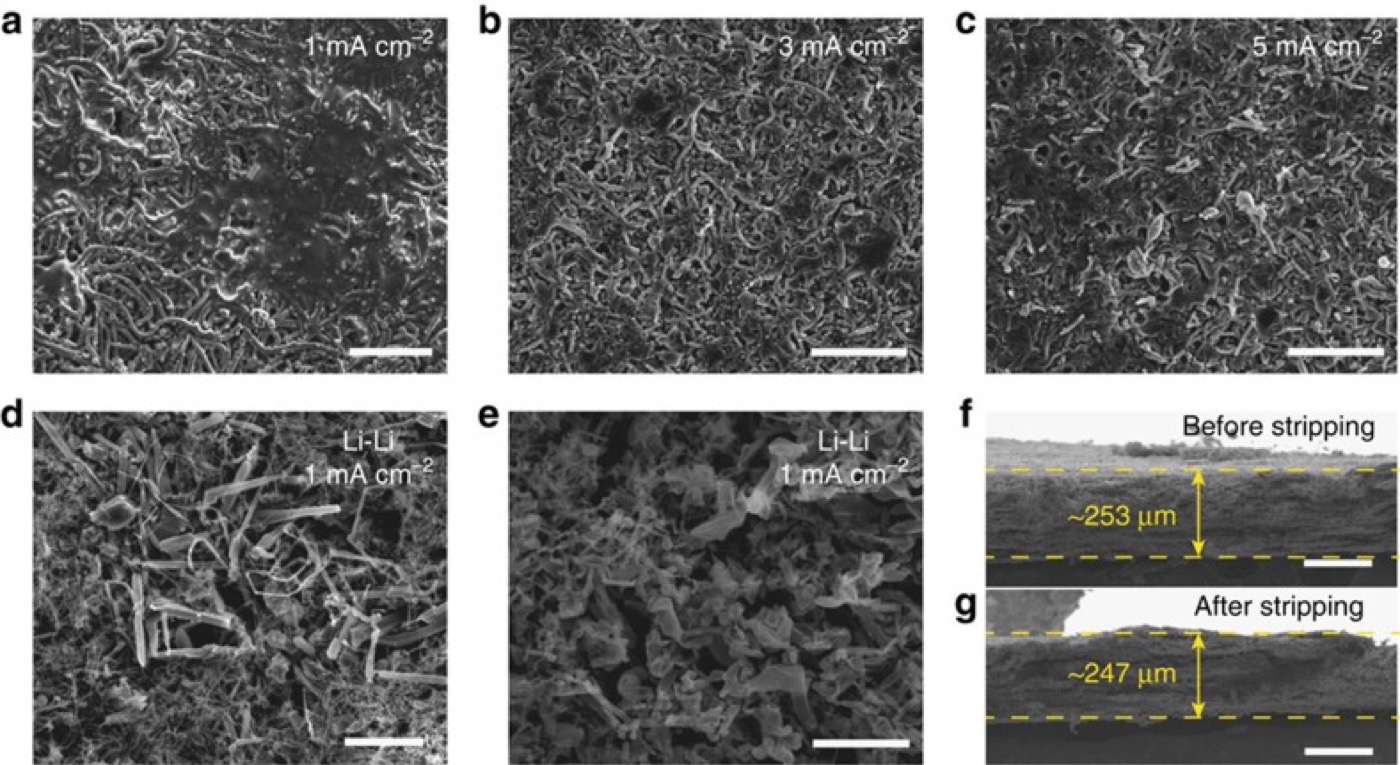
Lithium metal is the lightest metal, and as a battery anode it holds more charge per gram than any other anode material, 3,860 mAh/g. It is the anode in single-use (primary) lithium cells that have powered planetary probes, military radios and pacemakers, and it is the target anode for future high-energy rechargeable cells such as lithium-sulfur and solid-state batteries. Its difficulties are chemical. It reacts with water and air, it grows needle-like dendrites when recharged, and it melts at 180.5 °C, which is within the range a failing cell can reach.
Where it's used
Planetary probes
The Galileo probe to Jupiter carried three battery modules with 39 D-size lithium/sulfur dioxide cells, designed to keep their capacity for over 50 months and then deliver 3 to 4 amperes for 48 minutes. The Huygens probe used non-rechargeable lithium sulfur dioxide batteries that sat inactive during a seven-year trip to Saturn and still had enough capacity for the Titan landing.
Mars landers and penetrators
The Mars Pathfinder microrover used lithium-thionyl chloride batteries. The Deep Space 2 microprobes used a lithium-thionyl chloride primary battery of four D-size cells, rated at 600 mAh at -80 °C according to JPL.
Launch vehicles and orbital experiments
The Space Shuttle solid rocket booster and external tank range-safety batteries, and the orbital IECM contamination monitor, used lithium carbon monofluoride batteries rated 18 ampere-hours with 13 cells per housing. JPL has developed Li/CFx cells above 700 Wh/kg for the Europa Lander concept, at technology readiness level 4 in 2022.
Military radios and pacemakers
The Saft BA 5590 B/U lithium/sulfur dioxide pack powers radios and other military equipment from -40 °C to +71 °C. Lithium-iodine cells replaced mercury-zinc cells in pacemakers, with a life of 10 years against 2 years.
Rechargeable cells, still under development
NASA Glenn is working on a solid-state lithium/sulfur-selenium cell. NASA targets above 400 Wh/kg for spacesuit power and above 500 Wh/kg with more than 100 cycles for landers, rovers and habitats. A 1995 JPL study planned the first flight of a rechargeable lithium battery in space, and this profile found no flight result.
Recipe
Li
Lithium metal is the pure element, Li, with one atom per formula unit. It is not a compound or alloy in this profile.
| Ingredient | Atoms per unit | Share of the weight | What it does |
|---|---|---|---|
| Lithium Li | 1 | 100.0% | The only element in the anode. NIST gives a range for natural abundance; 6.94 is the rounded value used in the LFP profile. |
Weight shares are calculated from standard atomic weights.
What it can do
Capacity
3,860 mAh/g
The theoretical specific capacity of 3,860 mAh/g comes from the reaction of lithium to Li⁺ with one electron per atom. At a density of 0.534 g/cm³ this gives 2,061 mAh/cm³. The standard electrode potential is -3.04 V versus the standard hydrogen electrode, the lowest of any anode.
Energy in primary cells
420 to 730 Wh/kg
In a JPL comparison of D-size primary cells at 20 °C and 50 mA, commercial lithium cells delivered 420 and 421 Wh/kg, and another primary cell type delivered 730 Wh/kg. The theoretical specific energy of a lithium-sulfur cell, from a NASA slide, is 2,680 Wh/kg.
Melting
180.5 °C
Lithium melts at 180.5 °C, and the heat of fusion is 432 J/g. Above this temperature it is liquid and ignites easily. In calorimetry of lithium deposited on copper with a carbonate electrolyte, a strong exotherm from molten lithium reacting with the electrolyte appeared near 180 °C after 1 cycle and near 140 °C after 20 cycles.
A rechargeable cell
More than 350 cycles
A lithium foil anode with an NMC622 cathode in a pouch cell reached more than 350 cycles at 350 Wh/kg in a DOE Battery500 test, up from about 10 cycles, using thin lithium against a thick cathode, new electrolytes and applied pressure. The page gives no retention limit, rate or temperature, so the figure is indicative only.
Radiation
Up to 10 Mrad
JPL reports high radiation tolerance for lithium/carbon monofluoride D cells up to total ionizing doses of 10 Mrad, tested with Sandia National Laboratories.
How it compares
Lithium metal is not a cathode, so the table cannot compare it with LFP, NMC, LCO or NCA. It is the anode of the collection with the highest charge per gram, 3,860 mAh/g against 372 mAh/g for graphite and 175 mAh/g for lithium titanate, and the one that is hardest to use safely.
The same measurements for each material, so you can compare them. Each row names the key condition under the value; the full conditions and methods are in the numbered notes under Technical details. Compare every grade in the family.
| Measurement | Li |
|---|---|
| Capacity and energy | |
| Theoretical specific capacity | 3860 mAh/g1 |
| Theoretical volumetric capacity | 2061 mAh/cm³2 |
| Lithium thickness plated per mAh/cm2 | 4.85 µm per mAh/cm²11 |
| Voltage and potential | |
| Electrode potential versus standard hydrogen electrode | -3.04 V vs SHE4 |
| Thermal behavior and safety | |
| Melting pointHandbook value | 180.5 °C5 |
| Enthalpy of fusion | 432 J/g6 |
| Vapor pressureSupplier safety data sheet value | 1 hPa9 |
| Lithium-electrolyte reaction peak, 1 charge cycleDifferential scanning calorimetry | 180 °C12 |
| Lithium-electrolyte reaction peak, 20 charge cyclesDifferential scanning calorimetry | 140 °C13 |
| Physical and electrical | |
| Density | 0.534 g/cm³3 |
| Electrical resistivity | 9.446 µΩ·cm7 |
| Electronic conductivity | 1.06×10^5 S/cm8 |
| Mohs hardness | 0.6 Mohs10 |
Why choose it, and why not
Good for
- The highest charge per gram and the lowest potential of any anode.
- Primary cells that sit dormant for years before use, which is why they power probes, military radios and pacemakers.
Watch out for
- Safe recharging is unsolved. Dendrites can pierce the separator and short the cell, which can lead to thermal runaway.
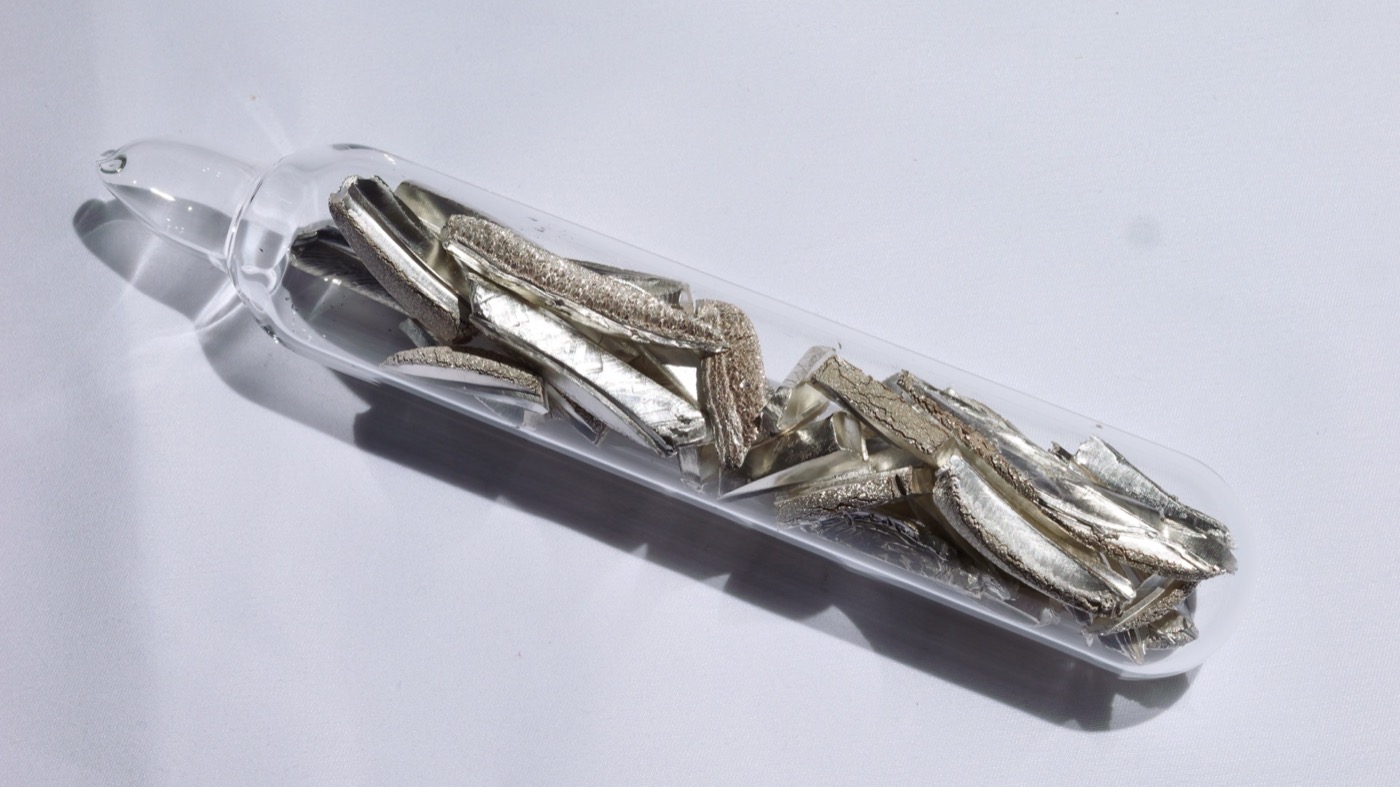
- It reacts violently with water and keeps reacting with air, so it must be handled under argon or mineral oil.
- It melts at 180.5 °C, and molten lithium reacts directly with the electrolyte and releases heat.
Lithium metal is the highest-capacity anode and the most demanding one. It is proven in single-use cells and not yet in rechargeable ones.
Technical details
For scientists and researchers. Everything above comes from the record below: every number with its method, its conditions and its source.
Cell-level benchmarks
Values for finished cells. These vary by manufacturer, so read the conditions in the notes. Compare every grade in the family.
| Measurement | Li |
|---|---|
| Capacity and energy | |
| Cell specific energy, Li/SO2 D cell (Saft LO 26 SXC)JPL comparison table of commercial primary cells | 420 Wh/kg17 |
| Cell specific energy, Li/SOCl2 D cell (Saft LSH 20)JPL comparison table of commercial primary cells | 421 Wh/kg18 |
| Cell specific energy, Li/CFx D cell (Rayovac, Europa Lander development)JPL comparison table of primary cells | 730 Wh/kg19 |
| Theoretical specific energy of a lithium-sulfur battery | 2680 Wh/kg21 |
| Thermal behavior and safety | |
| Self-heating onset (T1) in an anode-free lithium-metal pouch cellAccelerating rate calorimetry (ARC) | 61.5 °C14 |
| Temperature where self-heating reached 10 C/min (T2) in the same cellAccelerating rate calorimetry (ARC) | 162.5 °C15 |
| Lifetime and stability | |
| Cycles of a 350 Wh/kg Li/NMC622 pouch cell | > 350 cycles16 |
| Other measurements | |
| Total ionizing dose tolerated by Li/CFx primary cellsRadiation testing reported by JPL | > 10 Mrad20 |
Notes
The method, full conditions and any caveat for the numbered rows above.
| # | Measurement | Method | Conditions | Caveat |
|---|---|---|---|---|
| 1 | Theoretical specific capacity | Value stated by the source (the source gives the number but shows no calculation) | reaction Li to Li+, one electron per lithium atomelectrode lithium metal anode | — |
| 2 | Theoretical volumetric capacity | Calculation as stated by the source (3860 mAh/g times the density of lithium) | reaction Li to Li+electrode lithium metal anode | This source's abstract quotes a density of 0.59 g/cm3; this profile uses the 0.534 g/cm3 from PubChem. 3860 x 0.534 = 2061. |
| 3 | Density | Handbook value (HSDB entry reproduced in PubChem) | temperature 25 C | — |
| 4 | Electrode potential versus standard hydrogen electrode | Standard electrochemical potential as stated by the source | electrode lithium metal | — |
| 5 | Melting point | — | pressure ambient | PubChem lists 453.65 K (180.50 C) in the element record. Above this temperature lithium is liquid and ignites easily. |
| 6 | Enthalpy of fusion | Handbook value (HSDB entry reproduced in PubChem) | temperature at the melting point | — |
| 7 | Electrical resistivity | Handbook value (HSDB entry reproduced in PubChem) | temperature 20 C | — |
| 8 | Electronic conductivity | Reciprocal of the handbook resistivity of 9.446 microohm cm | temperature 20 C | Converted by the Space Mushroom editors, 1 / (9.446e-6 ohm cm). The source states resistivity only. |
| 9 | Vapor pressure | — | temperature 723 C | The sheet gives 1 hPa (1 mmHg) at 723 C. It gives no vapor pressure near room temperature. |
| 10 | Mohs hardness | Handbook value (HSDB entry reproduced in PubChem) | temperature room temperature, not stated by source | Soft enough to be cut with a knife; the source calls it the hardest of the alkali metals. |
| 11 | Lithium thickness plated per mAh/cm2 | Thickness of lithium for 1 mAh/cm2, from the source's supplementary method | basis bare lithium foil, fully dense | The source states "for bare Li foil, 1 mAh cm-2 capacity represents about 4.85 um thickness of Li". It also calls the relative volume change of hostless lithium "virtually infinite" (no percentage exists). The same figure follows from 1 mAh/cm2 divided by 2061 mAh/cm3. |
| 12 | Lithium-electrolyte reaction peak, 1 charge cycle | — | sample lithium deposited on copper foil with LP40 electrolytecycles 1charge rate C/10test DSC | The source says "around 180 C" and ties this peak to molten lithium reacting with the electrolyte. |
| 13 | Lithium-electrolyte reaction peak, 20 charge cycles | — | sample lithium deposited on copper foil with LP40 electrolytecycles 20charge rate C/10test DSC | The source says the lithium-electrolyte reaction occurs earlier, "around 140 C", after 20 cycles. |
| 14 | Self-heating onset (T1) in an anode-free lithium-metal pouch cell | — | cell NCM811 / copper anode-free pouch, 2 Ahstate of charge 100 %electrolyte 1 M LiPF6 EC-DEC 1/1 by volume (LP40)test accelerating rate calorimetry, heat-wait-seek | Lithium is deposited on the copper foil during charging, so this is a lithium-metal cell without a pre-built lithium foil. The temperature rate reached 10 C/min at 162.5 C (T2), maximum temperature 437.9 C (T3), peak rate about 13700 C/min. |
| 15 | Temperature where self-heating reached 10 C/min (T2) in the same cell | — | cell NCM811 / copper anode-free pouch, 2 Ahstate of charge 100 %electrolyte LP40 | — |
| 16 | Cycles of a 350 Wh/kg Li/NMC622 pouch cell | Cycling test reported by DOE Battery500 consortium | cell lithium foil anode, NMC622 cathode, pouch formatspecific energy 350 Wh/kgenablers new electrolytes, thick cathode against thin lithium foil, applied cell-stack pressure | The page says "more than 350 cycles". It does not give capacity-retention limit, rate or temperature, so it is not comparable with other cycle-life numbers. |
| 17 | Cell specific energy, Li/SO2 D cell (Saft LO 26 SXC) | — | temperature 20 Ccurrent 50 mAformat D cell | — |
| 18 | Cell specific energy, Li/SOCl2 D cell (Saft LSH 20) | — | temperature 20 Ccurrent 50 mAformat D cell | — |
| 19 | Cell specific energy, Li/CFx D cell (Rayovac, Europa Lander development) | — | temperature 20 Ccurrent 50 mAformat D cell | — |
| 20 | Total ionizing dose tolerated by Li/CFx primary cells | — | cell Li/CFx D cells from Rayovac and EaglePichertesting radiation testing with Sandia National Laboratories | The abstract says "high radiation tolerance up to 10 Mrad total ionizing doses". The abstract does not state the capacity retained, the dose rate or the radiation source. |
| 21 | Theoretical specific energy of a lithium-sulfur battery | Value stated on a NASA slide (the slide gives the result without showing the working) | anode lithium metal, 3860 mAh/gcathode sulfur, 1670 mAh/g | — |
Corrosion and compatibility
What happens when it meets other materials and environments.
| Environment | Concern | What happens |
|---|---|---|
| Liquid water | severe | Water reacts violently with lithium, giving off hydrogen and caustic lithium hydroxide, and usually ignites.1 |
| Ambient room air (mass gain of bulk lithium) | severe | In room air lithium keeps taking up gas from the air.2 |
| Room air at about 50 percent moisture (surface film growth) | severe | In humid air a surface film of oxides and carbonates grows at about 24 nm per minute.3 |
| Dry synthetic air | moderate | In dry air lithium still reacts, though about 30 times more slowly at first.4 |
| Dry air or oxygen when heated | severe | Heated to 100 °C or more in air or oxygen, lithium forms lithium oxide and can ignite.5 |
| Nitrogen gas at room temperature | low | Whether lithium reacts with pure nitrogen at room temperature is disputed in the literature.6 |
| Nitrogen, oxygen, hydrogen or carbon dioxide at high temperature | severe | At high temperature lithium burns in air, oxygen, nitrogen, hydrogen and carbon dioxide.7 |
| Argon glovebox | low | An argon glovebox is the standard handling atmosphere, though a thin surface layer remains.8 |
| Dry mineral oil | low | Dry mineral oil is a recommended liquid for storing lithium if it is free of oxygen and water.9 |
| Carbonate liquid electrolyte, at room temperature | moderate | Lithium reacts with carbonate electrolyte on contact and forms a surface film that cracks as the volume changes.10 |
| Carbonate electrolyte (1 M LiPF6 in EC-DEC) when heated | severe | When heated, molten lithium reacts strongly with the electrolyte near 180 °C, and near 140 °C after 20 cycles.11 |
| Copper current collector | low | Copper is the most suitable current collector because it does not alloy with lithium.12 |
| Aluminium current collector | moderate | Aluminium alloys with lithium at low potentials, so it is not used for lithium-metal anodes.13 |
| Molten lithium in contact with copper, zinc, tin or platinum | severe | Molten lithium dissolves copper, zinc and tin and reacts violently with platinum.14 |
| Carbon dioxide, halogenated extinguishers, sand, concrete, wood | severe | Burning lithium reacts with water, carbon dioxide, sand and concrete, and only dry Class D agents are suitable.15 |
| Residual gases (H2O, CO, CO2) in a vacuum vessel | not rated | Lithium reacts with residual gases in a vacuum vessel, though no rate is given.16 |
| # | Environment | Details | Test conditions |
|---|---|---|---|
| 1 | Liquid water | Reacts violently, giving off hydrogen gas and a strong caustic solution (lithium hydroxide). Ignition usually occurs. | form bulk metal; foil, ribbon and wire react relatively slowly on skin contact, powder reacts explosively |
| 2 | Ambient room air (mass gain of bulk lithium) | Lithium takes up gas from the air at several mg/h on a 1 cm2 surface at first, below 1 mg/h after one hour, about ten times slower after 24 h. A 9 mg sample had gained mass equal to complete conversion to lithium carbonate after 5 days. | atmosphere ambient airsurface about 1 cm2sample bulk lithium on a microbalance |
| 3 | Room air at about 50 percent moisture (surface film growth) | A surface layer of oxides and carbonates grows at roughly 24 nm per minute. Even after cleaning and polishing inside a glovebox, a layer a few tens of nanometres thick remains. | atmosphere room air, about 50 % moisturemethod optical ellipsometry, real time |
| 4 | Dry synthetic air | The initial mass-gain rate is 30 times lower than in ambient air, but lithium still reacts. HSDB states lithium stays untarnished in dry air and does not react with oxygen at room temperature. | atmosphere dry synthetic airtemperature room temperature |
| 5 | Dry air or oxygen when heated | Forms lithium oxide (Li2O) when heated to 100 C or above. Clean lithium is spontaneously flammable in air if heated to 180 C. Finely divided metal may ignite in air at ambient temperature. | temperature 100 C and above; ignition at 180 C for clean surface |
| 6 | Nitrogen gas at room temperature | The literature disagrees on whether lithium nitrides on contact with pure N2. In one X-ray photoelectron study no lithium nitride (Li3N) was detected at 10 mTorr or below; at 100 to 800 mTorr Li3N formed on the surface, and nitrogen stayed below 2 atomic percent because trace gases oxidize lithium first. | temperature room temperaturepressure 0.1 to 800 mTorr N2method ambient-pressure XPS |
| 7 | Nitrogen, oxygen, hydrogen or carbon dioxide at high temperature | Lithium burns in air, oxygen, nitrogen, hydrogen and carbon dioxide. Reactions become extremely violent at higher temperatures, and molten lithium ignites more easily when oxides and nitrides are present on the surface. | temperature molten lithium and above, no single temperature given |
| 8 | Argon glovebox | Standard handling atmosphere (the SDS says store and handle under argon). A thin native layer of oxides and carbonates still exists on lithium prepared inside a glovebox. | atmosphere argonnote layer a few tens of nm thick after chemical cleaning and mechanical polishing |
| 9 | Dry mineral oil | Recommended liquid for storing lithium, if free of oxygen and water. | liquid mineral oil or other liquid free of oxygen or water |
| 10 | Carbonate liquid electrolyte, at room temperature | Lithium reacts spontaneously with the solvent molecules and salt anions to form an insoluble surface layer (solid electrolyte interphase, SEI). Volume change cracks this layer, so fresh lithium is exposed and more electrolyte is consumed. | electrolyte carbonate-based liquid electrolytetemperature cell operating temperature, not stated |
| 11 | Carbonate electrolyte (1 M LiPF6 in EC-DEC) when heated | A strong exotherm from molten lithium reacting with the electrolyte appears near 180 C after 1 cycle and near 140 C after 20 cycles. A denser, inorganic-rich SEI from a localized high-concentration electrolyte pushed the reaction to a higher temperature. | electrolyte 1 M LiPF6 EC-DEC 1/1 (LP40)sample lithium deposited on coppertest DSCheating see source |
| 12 | Copper current collector | Copper is the most suitable current collector for lithium-metal anodes because it does not alloy with lithium at low potentials. Plain copper foil does not wet well with lithium (lithiophobic). | state in a cell, at lithium plating potentials |
| 13 | Aluminium current collector | Aluminium has a tendency to form alloys with lithium at low potentials, so it is not used for lithium-metal anodes. | state in a cell, at lithium plating potentials |
| 14 | Molten lithium in contact with copper, zinc, tin or platinum | Liquid lithium dissolves copper, zinc, tin and their alloys. Platinum and molten lithium react violently at 540 C plus or minus 20 C, forming an intermetallic compound. | temperature above 180.5 C; platinum reaction at 540 C |
| 15 | Carbon dioxide, halogenated extinguishers, sand, concrete, wood | Hot or burning lithium reacts with most extinguishing agents, including water, carbon dioxide and carbon tetrachloride, and reacts violently with concrete, wood, asphalt, sand and asbestos. Only dry Class D agents are suitable. | state hot, molten or burning lithium |
| 16 | Residual gases (H2O, CO, CO2) in a vacuum vessel | Elemental lithium reacts with these residual gases in a vacuum vessel. The paper gives no rate for vacuum conditions. | setting fusion-device vacuum vessel, as described in the abstract |
Risks and side effects
Hazards to people, what happens when a cell overheats, and how the material is handled and stored.
For people
Lithium metal is classified Danger. It is water-reactive and corrosive.
- Hazard classification
- In contact with water it releases flammable gases that may ignite spontaneously (water-reactive category 1, in 100% of ECHA notifications). It causes severe skin burns and eye damage (skin corrosion 1B, in 100%). Serious eye damage category 1 is notified by 20.8% of companies.
- Dust and powder
- Finely divided lithium may ignite spontaneously in air, and the powder reacts explosively with water.
- Corrosive effects
- It is corrosive to the eyes, skin and respiratory tract, and corrosive if swallowed. Inhalation may cause lung oedema.
- Fire
- Molten lithium is easily ignited and difficult to extinguish. Burning lithium gives off strong alkali fumes, and spontaneous ignition is likely if the metal is heated to its melting point. Only dry Class D agents are suitable. Water, foam and carbon dioxide must not be used, and sand and concrete can also react.
- Protection
- The safety data sheet calls for gloves, a face shield and fire-retardant clothing. A German occupational limit of 0.2 mg/m³ (inhalable fraction, as Li) is listed.
If a cell overheats
These results come from laboratory tests, not from incidents in the field.
- A charged lithium-metal cell
- A fully charged 2 Ah NCM811/copper pouch cell, heated in an adiabatic calorimeter, began to heat itself at 61.5 °C and reached 10 °C/min at 162.5 °C. The peak was 437.9 °C, at a rate near 13,700 °C/min. Cells at 0% and 50% charge stayed below 10 °C/min. Severity rises with charge, charge rate and cycling.
- Dendrites
- Uneven lithium deposition when a cell is recharged forms dendrites that pierce the separator and short the cell. NASA Glenn states that this can lead to thermal runaway and that reliable rechargeable lithium-metal use has not yet been achieved.
- Melting
- Near 180 °C, or near 140 °C after 20 cycles with the carbonate electrolyte tested, molten lithium reacts directly with the electrolyte and releases heat.
- Heat from the cell
- Lithium-CFx cells give off about 1 W of heat for every 1 W of electrical power delivered. This heat can keep a battery module warm, but it must be removed in a warm environment.
Handling and storage
- Storage
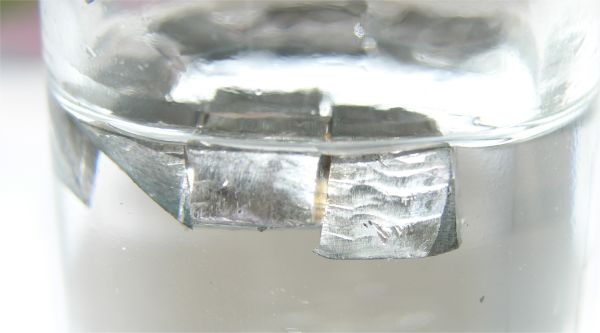
- Store and handle under argon in a tightly closed container in a dry, well-ventilated place. Mineral oil or another liquid free of oxygen and water is an alternative. Never let it contact water.
- Spills
- Isolate at least 25 m (75 ft) for solids, keep water away, and cover with dry earth, dry sand or another non-combustible material.
- Shipping
- The metal ships as UN1415, class 4.3, packing group I. Under US rules a cell may contain no more than 1 g of lithium and a battery 2 g to use the small-cell exception, and cells must pass UN Manual of Tests and Criteria section 38.3.
- In cells
- Pack-level protection in a fielded primary battery is a fuse in each series group, a thermal fuse that opens on overheating, and a diode that blocks charging current. Keeping cells at a low state of charge when abuse is possible greatly reduces the severity of runaway.
- Safer designs
- A nonflammable solid electrolyte lets lithium cycle more safely, although low ionic conductivity and high interfacial impedance are unsolved. A localized high-concentration electrolyte forms a dense, LiF-rich surface film that postpones exotherms.
Test details
The original wording and numbers from the sources, for readers who want them.
Failure risks
| Failure | Trigger and consequence |
|---|---|
| Dendrite growth and internal short circuithigh severity | Uneven lithium deposition when a cell is rechargedDendrites pierce the separator and short the cell; this can lead to thermal runaway. |
| Dendrite-driven thermal runaway in space-class cellshigh severity | Dendrite growth during lithium plating and charge-discharge cyclingNASA Glenn states that dendrites can cause thermal runaway and short circuits and that reliable rechargeable lithium-metal use has not yet been achieved. |
| Thermal runaway of a charged lithium-metal pouch cellcritical severity | Heating a fully charged anode-free NCM811/Cu cell in an adiabatic calorimeterSelf-heating from 61.5 C, 10 C/min at 162.5 C, a peak of 437.9 C and a rate near 13700 C/min. Cells at 0 % and 50 % charge stayed below 10 C/min. Severity rises with charge, charge rate and cycling. |
| Melting of lithium and fast reaction with electrolytehigh severity | Cell temperature near 180 C (near 140 C after 20 cycles with the carbonate electrolyte tested)Molten lithium reacts directly with the electrolyte and releases heat. |
| Cracking of the SEI and loss of lithiummoderate severity | Repeated stripping and plating of hostless lithium (virtually infinite relative volume change)Mechanical instability of the SEI, fresh lithium exposed to electrolyte, lower efficiency and shorter life. |
| Thick surface film from air exposure during cell buildingmoderate severity | Exposure to room air at about 50 % moisture (24 nm/min film growth)The starting interface of a fabricated cell can differ from an ideal lithium/electrolyte contact. |
Side effects on surrounding parts
| Affects | Effect |
|---|---|
| Separator and cell | Dendrites pierce the separator and short-circuit the cell. |
| Fire surroundings, nearby metal parts | Molten or burning lithium reacts with concrete, wood, asphalt and sand, and dissolves copper, zinc and tin and their alloys. |
| Nearby equipment, people, optics and surfaces exposed to the fumes | Burning lithium produces strong alkali (corrosive) fumes; reaction with water leaves caustic lithium hydroxide. |
| Battery module thermal design | Lithium-CFx cells give off about 1 W of heat for every 1 W of electrical power delivered. This heat can keep a battery module warm, but it must be removed in a warm environment. |
| Cell safety margin | A higher charge rate tends to form a more reactive lithium anode in anode-free lithium-metal cells. |
Handling and storage
- Store and handle under argon, keep the container tightly closed in a dry, well-ventilated place, and never let it contact water.
- Alternative storage: keep under mineral oil or another liquid free of oxygen or water; store cool and dry, separate from water.
- Fire: use a Class D extinguisher or smother with dry sand, dry ground limestone or dry clay. Do not use water, foam or carbon dioxide.
- Spill: isolate at least 25 m (75 ft) for solids; keep water away; cover with dry earth, dry sand or other non-combustible material.
- Shipping the metal: UN1415, class 4.3, packing group I.
- Shipping cells and batteries: in US rules, a lithium metal cell may contain no more than 1 g of lithium and a battery 2 g of lithium to use the small-cell exception (5 g and 25 g for highway or rail only); UN3090 is marked on such packages, and cells and batteries must pass UN Manual of Tests and Criteria section 38.3.
- Example of what a military lithium primary battery contains: the Saft BA 5590 B/U holds 24.0 g of lithium metal in a 1,000 g pack, with recommended maximum storage at +35 C.
- Personal protection: gloves, face shield, fire-retardant clothing; a German occupational limit (MAK) of 0.2 mg/m3 (inhalable fraction, as Li) is listed.
Mitigations
- Replace the flammable liquid electrolyte with a nonflammable solid electrolyte (garnet/ceramic or solid polymer nanocomposite) so lithium can cycle more safely. Low ionic conductivity and high interfacial impedance are the unsolved obstacles.
- A nonflammable solid polymer composite electrolyte film tolerated current densities up to 15 mA/cm2 in lithium/lithium symmetric cells with low polarization, which indicates a stabilized lithium/polymer interface (lab result, not a flight cell).
- A localized high-concentration electrolyte forms a dense, LiF-rich SEI that postpones exotherms and lowers the maximum heating rate compared with the LP40 carbonate electrolyte.
- Electrolyte additives that form a protective coating on the lithium were developed to improve cycle life and safety (NASA Tech Brief).
- Thin lithium foil against a thick cathode, new lithium-stable electrolytes, and applied stack pressure raised a lithium pouch cell from about 10 cycles to more than 350 cycles at 350 Wh/kg.
- Keep cells at a low state of charge when abuse is possible: 0 % and 50 % charged anode-free cells showed dT/dt below 10 C/min versus a violent runaway at 100 %.
- Pack-level protection in a fielded primary lithium battery: a fuse in each series group, a thermal fuse that opens on overheating, and a diode that blocks charging current.
Supply and geography
How common the raw materials are and where they come from.
Lithium
Estimated crustal abundance 2.0x10^1 mg/kg (about 20 parts per million) and oceanic abundance 1.8x10^-1 mg/L (PubChem). World reserves 37,000,000 t of lithium content; largest: Chile 9,200,000 t, Australia 8,400,000 t, China 4,600,000 t, Argentina 4,400,000 t, United States 4,400,000 t. Measured and indicated resources about 150 million tons (USGS, 2026). Estimated world end use: batteries 88 %, ceramics and glass 4 %, lubricating greases 2 %.
- Top producers (2025)
- Australia 31.7%, China 21.4%, Chile 19.3%, Zimbabwe 9.7%, Argentina 7.9%, Brazil 4.1%, Mali 3.2%, Canada 1.9%, Portugal 0.1%
- Critical mineral lists
- US: listed, EU: listed, EU: listed
- Recycling
- USGS 2026: construction of lithium battery recycling plants continued throughout 2025, and automobile companies partnered with battery recyclers to supply battery materials. No recycled-share figure is given.
- Substitutes
- Calcium, magnesium, mercury and zinc as anode material in primary batteries (USGS); Calcium and aluminum soaps for stearates in greases; Sodic and potassic fluxes in ceramics and glass
Gallery
Documents
Datasheets, safety data sheets, papers and standards you can open.
Full record
The complete spore, as stored. Free to reuse under CC-BY-4.0. Images keep the licence shown with each one.
Show the full YAML
spore: profile
id: lithium-metal
spore_version: 0.2
family: lithium
name: Lithium metal
abbreviation: Li
role: anode
category: energy
type: lithium-metal
summary: |
  Lithium metal is the lightest metal and, used as a battery anode, holds more charge per gram than any other anode material (3860 mAh/g). It is the anode in single-use (primary) lithium cells that have powered planetary probes, military radios and pacemakers, and it is the target anode for future high-energy rechargeable cells such as lithium-sulfur and solid-state batteries. Its problems are chemical: it reacts with water and air, grows needle-like dendrites when recharged, and melts at 180.5 C.
best_for: Highest charge per gram and lowest potential of any anode; primary cells that sit dormant for years before use.
weakest_at: Safe recharging (dendrites, short circuits, thermal runaway) and any contact with water or humid air.
identity:
  formula: Li
  cas: 7439-93-2
  source: pubchem-lithium
  where: Names and Identifiers > Other Identifiers > CAS
tags:
  environments:
    - low-earth-orbit
    - deep-space
    - mars-surface
    - launch
    - lunar-night
  stresses:
    - extreme-cold
    - total-radiation-dose
    - vacuum-and-outgassing
  applications:
    - batteries
    - rovers-and-surface-systems
properties:
  - benchmark: theoretical_capacity
    value: 3860
    unit: mAh/g
    scope: material
    conditions:
      reaction: Li to Li+, one electron per lithium atom
      electrode: lithium metal anode
    method: Value stated by the source (the source gives the number but shows no calculation)
    status: calculated
    source: liu-2016-ncomms
    where: Introduction, paragraph 1
  - benchmark: volumetric_capacity
    label: Theoretical volumetric capacity
    value: 2061
    unit: mAh/cm3
    scope: material
    conditions:
      reaction: Li to Li+
      electrode: lithium metal anode
    method: Calculation as stated by the source (3860 mAh/g times the density of lithium)
    status: calculated
    note: This source's abstract quotes a density of 0.59 g/cm3; this profile uses the 0.534 g/cm3 from PubChem. 3860 x 0.534 = 2061.
    source: liu-2019-frontiers
    where: Introduction, paragraph 1
  - benchmark: density
    value: 0.534
    unit: g/cm3
    scope: material
    conditions:
      temperature: 25 C
    method: Handbook value (HSDB entry reproduced in PubChem)
    status: ground
    source: pubchem-lithium
    where: Chemical and Physical Properties > Experimental Properties > Density (HSDB)
  - benchmark: electrode_potential_she
    label: Electrode potential versus standard hydrogen electrode
    value: -3.04
    unit: V vs SHE
    scope: material
    conditions:
      electrode: lithium metal
    method: Standard electrochemical potential as stated by the source
    status: ground
    source: liu-2016-ncomms
    where: Introduction, paragraph 1
  - benchmark: melting_point
    label: Melting point
    value: 180.5
    unit: C
    scope: material
    conditions:
      pressure: ambient
    method: Handbook value
    status: ground
    note: PubChem lists 453.65 K (180.50 C) in the element record. Above this temperature lithium is liquid and ignites easily.
    source: pubchem-element-lithium
    where: Properties > Melting Point
  - benchmark: enthalpy_of_fusion
    label: Enthalpy of fusion
    value: 432
    unit: J/g
    scope: material
    conditions:
      temperature: at the melting point
    method: Handbook value (HSDB entry reproduced in PubChem)
    status: ground
    source: pubchem-lithium
    where: Chemical and Physical Properties > Experimental Properties > Melting Point (HSDB)
  - benchmark: electrical_resistivity
    label: Electrical resistivity
    value: 9.446
    unit: microohm cm
    scope: material
    conditions:
      temperature: 20 C
    method: Handbook value (HSDB entry reproduced in PubChem)
    status: ground
    source: pubchem-lithium
    where: Chemical and Physical Properties > Experimental Properties > Other Experimental Properties (HSDB)
  - benchmark: electronic_conductivity
    value: 105865
    unit: S/cm
    scope: material
    conditions:
      temperature: 20 C
    method: Reciprocal of the handbook resistivity of 9.446 microohm cm
    status: calculated
    note: Converted by the Space Mushroom editors, 1 / (9.446e-6 ohm cm). The source states resistivity only.
    source: pubchem-lithium
    where: Chemical and Physical Properties > Experimental Properties > Other Experimental Properties (HSDB)
  - benchmark: vapor_pressure
    label: Vapor pressure
    value: 1
    unit: hPa
    scope: material
    conditions:
      temperature: 723 C
    method: Supplier safety data sheet value
    status: ground
    note: The sheet gives 1 hPa (1 mmHg) at 723 C. It gives no vapor pressure near room temperature.
    source: trace-sds-2025
    where: Section 9, Physical and Chemical Properties
  - benchmark: hardness_mohs
    label: Mohs hardness
    value: 0.6
    unit: Mohs
    scope: material
    conditions:
      temperature: room temperature, not stated by source
    method: Handbook value (HSDB entry reproduced in PubChem)
    status: ground
    note: Soft enough to be cut with a knife; the source calls it the hardest of the alkali metals.
    source: pubchem-lithium
    where: Chemical and Physical Properties > Experimental Properties > Other Experimental Properties (HSDB)
  - benchmark: lithium_thickness_per_areal_capacity
    label: Lithium thickness plated per mAh/cm2
    value: 4.85
    unit: micrometre per mAh/cm2
    scope: material
    conditions:
      basis: bare lithium foil, fully dense
    method: Thickness of lithium for 1 mAh/cm2, from the source's supplementary method
    status: calculated
    note: The source states "for bare Li foil, 1 mAh cm-2 capacity represents about 4.85 um thickness of Li". It also calls the relative volume change of hostless lithium "virtually infinite" (no percentage exists). The same figure follows from 1 mAh/cm2 divided by 2061 mAh/cm3.
    source: liu-2016-ncomms
    where: Results, "Dendrite-free cycling with minimum volume change" (text after Fig. 4)
  - benchmark: thermal_runaway_onset
    label: Self-heating onset (T1) in an anode-free lithium-metal pouch cell
    value: 61.5
    unit: C
    scope: cell
    conditions:
      cell: NCM811 / copper anode-free pouch, 2 Ah
      state_of_charge: 100 %
      electrolyte: 1 M LiPF6 EC-DEC 1/1 by volume (LP40)
      test: accelerating rate calorimetry, heat-wait-seek
    method: Accelerating rate calorimetry (ARC)
    status: ground
    note: Lithium is deposited on the copper foil during charging, so this is a lithium-metal cell without a pre-built lithium foil. The temperature rate reached 10 C/min at 162.5 C (T2), maximum temperature 437.9 C (T3), peak rate about 13700 C/min.
    source: psu-2026-jps
    where: Section 2.2, Fig. 2a-c
  - benchmark: thermal_runaway_trigger
    label: Temperature where self-heating reached 10 C/min (T2) in the same cell
    value: 162.5
    unit: C
    scope: cell
    conditions:
      cell: NCM811 / copper anode-free pouch, 2 Ah
      state_of_charge: 100 %
      electrolyte: LP40
    method: Accelerating rate calorimetry (ARC)
    status: ground
    source: psu-2026-jps
    where: Section 2.2, Fig. 2a-c
  - benchmark: li_electrolyte_exotherm_dsc
    label: Lithium-electrolyte reaction peak, 1 charge cycle
    value: 180
    unit: C
    scope: material
    conditions:
      sample: lithium deposited on copper foil with LP40 electrolyte
      cycles: 1
      charge_rate: C/10
      test: DSC
    method: Differential scanning calorimetry
    status: ground
    note: The source says "around 180 C" and ties this peak to molten lithium reacting with the electrolyte.
    source: psu-2026-jps
    where: Section 2.3, Fig. 3a
  - benchmark: li_electrolyte_exotherm_dsc
    label: Lithium-electrolyte reaction peak, 20 charge cycles
    value: 140
    unit: C
    scope: material
    conditions:
      sample: lithium deposited on copper foil with LP40 electrolyte
      cycles: 20
      charge_rate: C/10
      test: DSC
    method: Differential scanning calorimetry
    status: ground
    note: The source says the lithium-electrolyte reaction occurs earlier, "around 140 C", after 20 cycles.
    source: psu-2026-jps
    where: Section 2.3, Fig. 3b
  - benchmark: cycle_life
    label: Cycles of a 350 Wh/kg Li/NMC622 pouch cell
    value: 350
    bound: lower
    unit: cycles
    scope: cell
    conditions:
      cell: lithium foil anode, NMC622 cathode, pouch format
      specific_energy: 350 Wh/kg
      enablers: new electrolytes, thick cathode against thin lithium foil, applied cell-stack pressure
    method: Cycling test reported by DOE Battery500 consortium
    status: ground
    note: The page says "more than 350 cycles". It does not give capacity-retention limit, rate or temperature, so it is not comparable with other cycle-life numbers.
    source: doe-battery500-2020
    where: Progress update, Figure 2 and text
  - benchmark: cell_specific_energy
    label: Cell specific energy, Li/SO2 D cell (Saft LO 26 SXC)
    value: 420
    unit: Wh/kg
    scope: cell
    conditions:
      temperature: 20 C
      current: 50 mA
      format: D cell
    method: JPL comparison table of commercial primary cells
    status: ground
    source: brandon-licfx-slides
    where: Comparison of SOA vs. Advanced Cells table
  - benchmark: cell_specific_energy
    label: Cell specific energy, Li/SOCl2 D cell (Saft LSH 20)
    value: 421
    unit: Wh/kg
    scope: cell
    conditions:
      temperature: 20 C
      current: 50 mA
      format: D cell
    method: JPL comparison table of commercial primary cells
    status: ground
    source: brandon-licfx-slides
    where: Comparison of SOA vs. Advanced Cells table
  - benchmark: cell_specific_energy
    label: Cell specific energy, Li/CFx D cell (Rayovac, Europa Lander development)
    value: 730
    unit: Wh/kg
    scope: cell
    conditions:
      temperature: 20 C
      current: 50 mA
      format: D cell
    method: JPL comparison table of primary cells
    status: ground
    source: brandon-licfx-slides
    where: Comparison of SOA vs. Advanced Cells table
  - benchmark: li_cfx_total_ionizing_dose
    label: Total ionizing dose tolerated by Li/CFx primary cells
    value: 10
    bound: lower
    unit: Mrad
    scope: cell
    conditions:
      cell: Li/CFx D cells from Rayovac and EaglePicher
      testing: radiation testing with Sandia National Laboratories
    method: Radiation testing reported by JPL
    status: ground
    note: The abstract says "high radiation tolerance up to 10 Mrad total ionizing doses". The abstract does not state the capacity retained, the dose rate or the radiation source.
    source: brandon-2022-abstract
    where: Abstract, paragraph 2
  - benchmark: li_s_theoretical_specific_energy
    label: Theoretical specific energy of a lithium-sulfur battery
    value: 2680
    unit: Wh/kg
    scope: cell
    conditions:
      anode: lithium metal, 3860 mAh/g
      cathode: sulfur, 1670 mAh/g
    method: Value stated on a NASA slide (the slide gives the result without showing the working)
    status: calculated
    source: wu-2020-nasa
    where: Slide "Li/S - Potential High Energy Battery Chemistry"
corrosion:
  - environment: Liquid water
    headline: Water reacts violently with lithium, giving off hydrogen and caustic lithium hydroxide, and usually ignites.
    effect: Reacts violently, giving off hydrogen gas and a strong caustic solution (lithium hydroxide). Ignition usually occurs.
    rating: severe
    conditions:
      form: bulk metal; foil, ribbon and wire react relatively slowly on skin contact, powder reacts explosively
    source: pubchem-lithium
    where: Chemical and Physical Properties > Physical Description (CAMEO/USCG 1999); Stability and Reactivity > Hazardous Reactivities (HSDB)
  - environment: Ambient room air (mass gain of bulk lithium)
    headline: In room air lithium keeps taking up gas from the air.
    effect: Lithium takes up gas from the air at several mg/h on a 1 cm2 surface at first, below 1 mg/h after one hour, about ten times slower after 24 h. A 9 mg sample had gained mass equal to complete conversion to lithium carbonate after 5 days.
    rating: severe
    conditions:
      atmosphere: ambient air
      surface: about 1 cm2
      sample: bulk lithium on a microbalance
    source: hart-2016-pppl
    where: Abstract
  - environment: Room air at about 50 percent moisture (surface film growth)
    headline: In humid air a surface film of oxides and carbonates grows at about 24 nm per minute.
    effect: A surface layer of oxides and carbonates grows at roughly 24 nm per minute. Even after cleaning and polishing inside a glovebox, a layer a few tens of nanometres thick remains.
    rating: severe
    conditions:
      atmosphere: room air, about 50 % moisture
      method: optical ellipsometry, real time
    source: seo-2022-arxiv
    where: Abstract
  - environment: Dry synthetic air
    headline: In dry air lithium still reacts, though about 30 times more slowly at first.
    effect: The initial mass-gain rate is 30 times lower than in ambient air, but lithium still reacts. HSDB states lithium stays untarnished in dry air and does not react with oxygen at room temperature.
    rating: moderate
    conditions:
      atmosphere: dry synthetic air
      temperature: room temperature
    source: hart-2016-pppl
    where: Abstract (30 times lower initial rate); PubChem HSDB excerpt for the untarnished statement
  - environment: Dry air or oxygen when heated
    headline: Heated to 100 °C or more in air or oxygen, lithium forms lithium oxide and can ignite.
    effect: Forms lithium oxide (Li2O) when heated to 100 C or above. Clean lithium is spontaneously flammable in air if heated to 180 C. Finely divided metal may ignite in air at ambient temperature.
    rating: severe
    conditions:
      temperature: 100 C and above; ignition at 180 C for clean surface
    source: pubchem-lithium
    where: Chemical and Physical Properties > Other Experimental Properties; Safety and Hazards > Fire Potential (HSDB)
  - environment: Nitrogen gas at room temperature
    headline: Whether lithium reacts with pure nitrogen at room temperature is disputed in the literature.
    effect: The literature disagrees on whether lithium nitrides on contact with pure N2. In one X-ray photoelectron study no lithium nitride (Li3N) was detected at 10 mTorr or below; at 100 to 800 mTorr Li3N formed on the surface, and nitrogen stayed below 2 atomic percent because trace gases oxidize lithium first.
    rating: low
    conditions:
      temperature: room temperature
      pressure: 0.1 to 800 mTorr N2
      method: ambient-pressure XPS
    source: etxebarria-2025-jacs
    where: Abstract
  - environment: Nitrogen, oxygen, hydrogen or carbon dioxide at high temperature
    headline: At high temperature lithium burns in air, oxygen, nitrogen, hydrogen and carbon dioxide.
    effect: Lithium burns in air, oxygen, nitrogen, hydrogen and carbon dioxide. Reactions become extremely violent at higher temperatures, and molten lithium ignites more easily when oxides and nitrides are present on the surface.
    rating: severe
    conditions:
      temperature: molten lithium and above, no single temperature given
    source: pubchem-lithium
    where: Safety and Hazards > Stability and Reactivity > Reactivity Profile (CAMEO)
  - environment: Argon glovebox
    headline: An argon glovebox is the standard handling atmosphere, though a thin surface layer remains.
    effect: Standard handling atmosphere (the SDS says store and handle under argon). A thin native layer of oxides and carbonates still exists on lithium prepared inside a glovebox.
    rating: low
    conditions:
      atmosphere: argon
      note: layer a few tens of nm thick after chemical cleaning and mechanical polishing
    source: seo-2022-arxiv
    where: Abstract
  - environment: Dry mineral oil
    headline: Dry mineral oil is a recommended liquid for storing lithium if it is free of oxygen and water.
    effect: Recommended liquid for storing lithium, if free of oxygen and water.
    rating: low
    conditions:
      liquid: mineral oil or other liquid free of oxygen or water
    source: pubchem-lithium
    where: Safety and Hazards > Handling and Storage > Storage Conditions (HSDB)
  - environment: Carbonate liquid electrolyte, at room temperature
    headline: Lithium reacts with carbonate electrolyte on contact and forms a surface film that cracks as the volume changes.
    effect: Lithium reacts spontaneously with the solvent molecules and salt anions to form an insoluble surface layer (solid electrolyte interphase, SEI). Volume change cracks this layer, so fresh lithium is exposed and more electrolyte is consumed.
    rating: moderate
    conditions:
      electrolyte: carbonate-based liquid electrolyte
      temperature: cell operating temperature, not stated
    source: liu-2016-ncomms
    where: Introduction, paragraph 2
  - environment: Carbonate electrolyte (1 M LiPF6 in EC-DEC) when heated
    headline: When heated, molten lithium reacts strongly with the electrolyte near 180 °C, and near 140 °C after 20 cycles.
    effect: A strong exotherm from molten lithium reacting with the electrolyte appears near 180 C after 1 cycle and near 140 C after 20 cycles. A denser, inorganic-rich SEI from a localized high-concentration electrolyte pushed the reaction to a higher temperature.
    rating: severe
    conditions:
      electrolyte: 1 M LiPF6 EC-DEC 1/1 (LP40)
      sample: lithium deposited on copper
      test: DSC
      heating: see source
    source: psu-2026-jps
    where: Section 2.3, Fig. 3a-b
  - environment: Copper current collector
    headline: Copper is the most suitable current collector because it does not alloy with lithium.
    effect: Copper is the most suitable current collector for lithium-metal anodes because it does not alloy with lithium at low potentials. Plain copper foil does not wet well with lithium (lithiophobic).
    rating: low
    conditions:
      state: in a cell, at lithium plating potentials
    source: yang-2025-cu
    where: Section 1, Introduction
  - environment: Aluminium current collector
    headline: Aluminium alloys with lithium at low potentials, so it is not used for lithium-metal anodes.
    effect: Aluminium has a tendency to form alloys with lithium at low potentials, so it is not used for lithium-metal anodes.
    rating: moderate
    conditions:
      state: in a cell, at lithium plating potentials
    source: yang-2025-cu
    where: Section 1, Introduction
  - environment: Molten lithium in contact with copper, zinc, tin or platinum
    headline: Molten lithium dissolves copper, zinc and tin and reacts violently with platinum.
    effect: Liquid lithium dissolves copper, zinc, tin and their alloys. Platinum and molten lithium react violently at 540 C plus or minus 20 C, forming an intermetallic compound.
    rating: severe
    conditions:
      temperature: above 180.5 C; platinum reaction at 540 C
    source: pubchem-lithium
    where: Chemical and Physical Properties > Melting Point (HSDB); Stability and Reactivity > Hazardous Reactivities and Incompatibilities (HSDB)
  - environment: Carbon dioxide, halogenated extinguishers, sand, concrete, wood
    headline: Burning lithium reacts with water, carbon dioxide, sand and concrete, and only dry Class D agents are suitable.
    effect: Hot or burning lithium reacts with most extinguishing agents, including water, carbon dioxide and carbon tetrachloride, and reacts violently with concrete, wood, asphalt, sand and asbestos. Only dry Class D agents are suitable.
    rating: severe
    conditions:
      state: hot, molten or burning lithium
    source: pubchem-lithium
    where: Safety and Hazards > Hazards Identification > Fire Hazards (CAMEO); Fire Fighting (HSDB, ERG 2024 Guide 138)
  - environment: Residual gases (H2O, CO, CO2) in a vacuum vessel
    headline: Lithium reacts with residual gases in a vacuum vessel, though no rate is given.
    effect: Elemental lithium reacts with these residual gases in a vacuum vessel. The paper gives no rate for vacuum conditions.
    rating: unknown
    conditions:
      setting: fusion-device vacuum vessel, as described in the abstract
    source: hart-2016-pppl
    where: Abstract
risks:
  hazards:
    - text: Classified Danger. In contact with water releases flammable gases which may ignite spontaneously (water-reactive, category 1; 100 % of ECHA notifications). Causes severe skin burns and eye damage (skin corrosion 1B; 100 %).
      ghs:
        - H260
        - H314
      source: pubchem-lithium
      where: Safety and Hazards > GHS Classification (ECHA C&L, 549 reports from 7 notifications)
    - text: Serious eye damage (eye damage category 1) is notified by 20.8 % of companies in ECHA C&L; the Trace Sciences SDS also lists it.
      ghs:
        - H318
      source: pubchem-lithium
      where: Safety and Hazards > GHS Classification (ECHA C&L)
    - text: 'Transport class: UN1415, Division 4.3 (dangerous when wet), packing group I, label Dangerous When Wet.'
      ghs: []
      source: pubchem-lithium
      where: Safety and Hazards > Hazards Identification > DOT Hazard Classification (49 CFR 172.101)
    - text: 'Fire: molten lithium is easily ignited and difficult to extinguish. Burning lithium gives off strong alkali fumes. If lithium metal is heated to its melting point, spontaneous ignition is likely.'
      ghs: []
      source: pubchem-lithium
      where: Safety and Hazards > Fire Hazards (CAMEO); Fire Potential (HSDB)
    - text: Finely divided lithium may ignite spontaneously in air, and powder reacts explosively with water.
      ghs: []
      source: pubchem-lithium
      where: Safety and Hazards > Chemical Dangers (ICSC); Explosive Limits and Potential (HSDB)
    - text: Corrosive to eyes, skin and respiratory tract; corrosive if swallowed; inhalation may cause lung oedema.
      ghs: []
      source: pubchem-lithium
      where: Safety and Hazards > Effects of Short Term Exposure (ICSC 0710)
  failure_risks:
    - mode: Dendrite growth and internal short circuit
      trigger: Uneven lithium deposition when a cell is recharged
      consequence: Dendrites pierce the separator and short the cell; this can lead to thermal runaway.
      severity: high
      source: liu-2016-ncomms
      where: Introduction, paragraph 2
    - mode: Dendrite-driven thermal runaway in space-class cells
      trigger: Dendrite growth during lithium plating and charge-discharge cycling
      consequence: NASA Glenn states that dendrites can cause thermal runaway and short circuits and that reliable rechargeable lithium-metal use has not yet been achieved.
      severity: high
      source: wu-2019-nasa
      where: Abstract
    - mode: Thermal runaway of a charged lithium-metal pouch cell
      trigger: Heating a fully charged anode-free NCM811/Cu cell in an adiabatic calorimeter
      consequence: Self-heating from 61.5 C, 10 C/min at 162.5 C, a peak of 437.9 C and a rate near 13700 C/min. Cells at 0 % and 50 % charge stayed below 10 C/min. Severity rises with charge, charge rate and cycling.
      severity: critical
      source: psu-2026-jps
      where: Section 2.2 and Section 2.3, Fig. 2-3
    - mode: Melting of lithium and fast reaction with electrolyte
      trigger: Cell temperature near 180 C (near 140 C after 20 cycles with the carbonate electrolyte tested)
      consequence: Molten lithium reacts directly with the electrolyte and releases heat.
      severity: high
      source: psu-2026-jps
      where: Section 2.3, Fig. 3a-b
    - mode: Cracking of the SEI and loss of lithium
      trigger: Repeated stripping and plating of hostless lithium (virtually infinite relative volume change)
      consequence: Mechanical instability of the SEI, fresh lithium exposed to electrolyte, lower efficiency and shorter life.
      severity: moderate
      source: liu-2016-ncomms
      where: Introduction, paragraph 2
    - mode: Thick surface film from air exposure during cell building
      trigger: Exposure to room air at about 50 % moisture (24 nm/min film growth)
      consequence: The starting interface of a fabricated cell can differ from an ideal lithium/electrolyte contact.
      severity: moderate
      source: seo-2022-arxiv
      where: Abstract
  side_effects:
    - text: Dendrites pierce the separator and short-circuit the cell.
      affects: Separator and cell
      source: liu-2019-frontiers
      where: The Formation Mechanism of Li Dendrites
    - text: Molten or burning lithium reacts with concrete, wood, asphalt and sand, and dissolves copper, zinc and tin and their alloys.
      affects: Fire surroundings, nearby metal parts
      source: pubchem-lithium
      where: Safety and Hazards > Fire Hazards (CAMEO); Melting Point (HSDB)
    - text: Burning lithium produces strong alkali (corrosive) fumes; reaction with water leaves caustic lithium hydroxide.
      affects: Nearby equipment, people, optics and surfaces exposed to the fumes
      source: pubchem-lithium
      where: Safety and Hazards > Hazards Identification > Fire Hazards (CAMEO)
    - text: Lithium-CFx cells give off about 1 W of heat for every 1 W of electrical power delivered. This heat can keep a battery module warm, but it must be removed in a warm environment.
      affects: Battery module thermal design
      source: brandon-2022-abstract
      where: Abstract
    - text: A higher charge rate tends to form a more reactive lithium anode in anode-free lithium-metal cells.
      affects: Cell safety margin
      source: psu-2026-jps
      where: Abstract
  handling:
    - text: Store and handle under argon, keep the container tightly closed in a dry, well-ventilated place, and never let it contact water.
      source: trace-sds-2025
      where: Section 7.2
    - text: 'Alternative storage: keep under mineral oil or another liquid free of oxygen or water; store cool and dry, separate from water.'
      source: pubchem-lithium
      where: Safety and Hazards > Handling and Storage (HSDB, ICSC)
    - text: 'Fire: use a Class D extinguisher or smother with dry sand, dry ground limestone or dry clay. Do not use water, foam or carbon dioxide.'
      source: trace-sds-2025
      where: Section 5.2; PubChem ERG 2024 Guide 138 and HSDB
    - text: 'Spill: isolate at least 25 m (75 ft) for solids; keep water away; cover with dry earth, dry sand or other non-combustible material.'
      source: pubchem-lithium
      where: Safety and Hazards > Accidental Release Measures (ERG 2024 Guide 138)
    - text: 'Shipping the metal: UN1415, class 4.3, packing group I.'
      source: trace-sds-2025
      where: Section 14
    - text: 'Shipping cells and batteries: in US rules, a lithium metal cell may contain no more than 1 g of lithium and a battery 2 g of lithium to use the small-cell exception (5 g and 25 g for highway or rail only); UN3090 is marked on such packages, and cells and batteries must pass UN Manual of Tests and Criteria section 38.3.'
      source: cfr-173-185
      where: 49 CFR 173.185 (a)(1), (c)(1)(ii), (c)(1)(iv), (c)(3)(i)
    - text: 'Example of what a military lithium primary battery contains: the Saft BA 5590 B/U holds 24.0 g of lithium metal in a 1,000 g pack, with recommended maximum storage at +35 C.'
      source: saft-ba5590
      where: Datasheet
      physical and electrical tables: null
    - text: 'Personal protection: gloves, face shield, fire-retardant clothing; a German occupational limit (MAK) of 0.2 mg/m3 (inhalable fraction, as Li) is listed.'
      source: pubchem-lithium
      where: Safety and Hazards > Exposure Control and Personal Protection (Haz-Map/DFG; HSDB)
  mitigations:
    - text: Replace the flammable liquid electrolyte with a nonflammable solid electrolyte (garnet/ceramic or solid polymer nanocomposite) so lithium can cycle more safely. Low ionic conductivity and high interfacial impedance are the unsolved obstacles.
      source: wu-2019-nasa
      where: Abstract
    - text: A nonflammable solid polymer composite electrolyte film tolerated current densities up to 15 mA/cm2 in lithium/lithium symmetric cells with low polarization, which indicates a stabilized lithium/polymer interface (lab result, not a flight cell).
      source: wu-2020-nasa
      where: Slides "Solid Polymer Composite Electrolyte"
    - text: A localized high-concentration electrolyte forms a dense, LiF-rich SEI that postpones exotherms and lowers the maximum heating rate compared with the LP40 carbonate electrolyte.
      source: psu-2026-jps
      where: Highlights; Section 2.3
    - text: Electrolyte additives that form a protective coating on the lithium were developed to improve cycle life and safety (NASA Tech Brief).
      source: chen-2011-techbrief
      where: Abstract
    - text: Thin lithium foil against a thick cathode, new lithium-stable electrolytes, and applied stack pressure raised a lithium pouch cell from about 10 cycles to more than 350 cycles at 350 Wh/kg.
      source: doe-battery500-2020
      where: Progress update text
    - text: 'Keep cells at a low state of charge when abuse is possible: 0 % and 50 % charged anode-free cells showed dT/dt below 10 C/min versus a violent runaway at 100 %.'
      source: psu-2026-jps
      where: Section 2.2
    - text: 'Pack-level protection in a fielded primary lithium battery: a fuse in each series group, a thermal fuse that opens on overheating, and a diode that blocks charging current.'
      source: saft-ba5590
      where: Datasheet
      key features: null
uses:
  - application: batteries
    device: Primary Li/SO2 battery of an atmospheric entry probe
    example: 'Galileo probe to Jupiter: three battery modules with 39 D-size Li/SO2 cells, designed to keep capacity for over 50 months and then give 3 to 4 amperes for 48 minutes.'
    source: marcoux-1983
    where: Abstract
  - application: batteries
    device: Primary Li/SO2 batteries of a lander
    example: 'ESA Huygens probe: non-rechargeable lithium sulphur dioxide batteries that could stay inactive during the seven-year trip to Saturn and still had enough capacity for the Titan landing. JPL names Galileo and Huygens as heritage LiSO2 battery missions.'
    source: esa-2009-batteries
    where: Page text
  - application: rovers-and-surface-systems
    device: Primary lithium-thionyl chloride battery of a Mars rover
    example: 'Mars Pathfinder microrover: a 1996 JPL report covers requirements, cell design, battery design and test results for its Li-SOCl2 batteries.'
    source: staniewicz-1996
    where: Abstract
  - application: rovers-and-surface-systems
    device: Primary lithium-thionyl chloride battery of a Mars penetrator probe
    example: 'Deep Space 2 microprobes: a lithium-thionyl chloride primary battery of four D-size cells, two batteries wired in parallel, 600 milliamp-hours at -80 C according to the JPL page.'
    source: jpl-ds2-1999
    where: Page text
  - application: batteries
    device: Primary Li/CFx batteries for launch-vehicle range safety and an orbital experiment
    example: Space Shuttle solid rocket booster and external tank range-safety batteries and the orbital IECM contamination monitor used lithium carbon monofluoride batteries rated 18 ampere-hours with 13 cells per housing.
    source: paschal-1980
    where: Figures 1-38 and 1-43 text
  - application: batteries
    device: Primary Li/CFx battery modules for outer-planet probes and landers
    example: JPL developed Li/CFx cells above 700 Wh/kg for the Europa Lander concept; applications named include atmospheric probes, Mars and ocean-world landers and lunar night survival. Technology readiness level 4 in 2022.
    source: brandon-2022-abstract
    where: Abstract
  - application: batteries
    device: Primary lithium-sulphur-chloride battery for a returnable microgravity capsule
    example: 'ESA Foton M3 missions used lithium batteries (page wording: lithium-sulphuride chloride) to support microgravity experiments for more than 10 days before re-entry.'
    source: esa-2009-batteries
    where: Page text
  - application: batteries
    device: Planned rechargeable lithium flight experiment
    example: 'Lithium Battery Space Experiment (1995 Phase A study at JPL): intended as the first flight of a rechargeable lithium battery in space, to test lithium deposition and dissolution in microgravity. The paper describes the plan; this profile found no flight result.'
    source: mueller-1995
    where: Abstract
  - application: batteries
    device: Solid-state lithium/sulfur-selenium cell under development
    example: NASA Glenn work on a solid-state Li/S-Se battery for safe, high-capacity missions; NASA targets above 400 Wh/kg for spacesuit power and above 500 Wh/kg with more than 100 cycles for landers, rovers and habitats.
    source: wu-2020-nasa
    where: Slide "NASA Demands Very High Specific Energy Batteries"
  - application: batteries
    device: Military radio battery (Li/SO2)
    example: Saft BA 5590 B/U 12 V/24 V pack for AN/PRC-104, -113, -117 and -119 radios and other military equipment, operating from -40 C to +71 C.
    source: saft-ba5590
    where: Datasheet, typical applications
  - application: batteries
    device: Implantable pacemaker cell (lithium/iodine)
    example: Lithium-iodide batteries replaced mercury-zinc cells in pacemakers; the new cell had a life of 10 years compared with 2 years.
    source: barold-2011
    where: Pages 718-719
supply:
  - subject: Lithium
    abundance: 'Estimated crustal abundance 2.0x10^1 mg/kg (about 20 parts per million) and oceanic abundance 1.8x10^-1 mg/L (PubChem). World reserves 37,000,000 t of lithium content; largest: Chile 9,200,000 t, Australia 8,400,000 t, China 4,600,000 t, Argentina 4,400,000 t, United States 4,400,000 t. Measured and indicated resources about 150 million tons (USGS, 2026). Estimated world end use: batteries 88 %, ceramics and glass 4 %, lubricating greases 2 %.'
    producers:
      - country: Australia
        share_percent: 31.7
        year: 2025
      - country: China
        share_percent: 21.4
        year: 2025
      - country: Chile
        share_percent: 19.3
        year: 2025
      - country: Zimbabwe
        share_percent: 9.7
        year: 2025
      - country: Argentina
        share_percent: 7.9
        year: 2025
      - country: Brazil
        share_percent: 4.1
        year: 2025
      - country: Mali
        share_percent: 3.2
        year: 2025
      - country: Canada
        share_percent: 1.9
        year: 2025
      - country: Portugal
        share_percent: 0.1
        year: 2025
    critical_lists:
      - list: USGS 2025 final list of critical minerals (60 minerals)
        listed: true
      - list: EU critical raw materials list (CRMA, 34 materials)
        listed: true
      - list: EU strategic raw materials list (CRMA), entry 'Lithium - battery grade'
        listed: true
    recycling: 'USGS 2026: construction of lithium battery recycling plants continued throughout 2025, and automobile companies partnered with battery recyclers to supply battery materials. No recycled-share figure is given.'
    substitutes:
      - Calcium, magnesium, mercury and zinc as anode material in primary batteries (USGS)
      - Calcium and aluminum soaps for stearates in greases
      - Sodic and potassic fluxes in ceramics and glass
    source: usgs-mcs-2026
    where: 'Critical lists: USGS final 2025 list (usgs.gov news item of Nov 14 2025, lithium named as used in rechargeable batteries) and EU JRC RMIS page rmis.jrc.ec.europa.eu/eu-critical-raw-materials (lithium on the 34-item critical list; ''Lithium - battery grade'' on the 16-item strategic list). Lithium chapter, World Mine Production and Reserves table; Substitutes; Recycling. Shares computed by the editors from 2025 mine production (e) divided by the 290,000 t world total (which excludes U.S. production).'
media:
  - file: /media/lithium/lithium-metal-1.jpg
    caption: Purified lithium metal sealed in a glass ampoule under argon.
    shows: Silvery lithium pieces, some with a dull crust, in a sealed glass ampoule. Lithium is stored under argon or under oil because it reacts with air and water.
    conditions: Lithium purified by distillation under high vacuum, then sealed under argon (uploader's description); photo at room temperature
    alt: A clear glass ampoule on a white surface holding shiny silver-grey chunks and flakes of lithium metal.
    credit: AdvancedTinkering
    license: CC BY-SA 4.0
    license_url: https://creativecommons.org/licenses/by-sa/4.0/
    source_url: https://commons.wikimedia.org/wiki/File:Purified_lithium_in_an_ampoule_under_argon.png
  - file: /media/lithium/lithium-metal-2.jpg
    caption: Scanning electron micrographs of cycled lithium electrodes; the bare lithium electrode (panels d and e) is covered in mossy dendrites.
    shows: 'Figure 4 of Liu et al. 2016. Panels a-c: a lithium-coated polymer matrix after 10 cycles at 1, 3 and 5 mA/cm2 (the uniform fibres are the host matrix, not dendrites). Panels d-e: a bare lithium electrode after 10 cycles at 1 mA/cm2 with large amounts of mossy dendrites. Panels f-g: cross-sections of the matrix electrode before and after stripping.'
    conditions: SEM, top view; 10 stripping/plating cycles in EC/DEC electrolyte; scale bars 10 um (a-d), 5 um (e), 200 um (f-g)
    alt: 'Seven grey scanning electron microscope images in a grid. Top row: fibrous matrix surfaces at three current densities. Bottom row: tangled mossy lithium dendrites on bare lithium, and two cross-sections of an electrode about 250 micrometres thick.'
    credit: Yayuan Liu, Dingchang Lin, Zheng Liang, Jie Zhao, Kai Yan and Yi Cui, Nature Communications 7:10992 (2016)
    license: CC BY 4.0
    license_url: https://creativecommons.org/licenses/by/4.0/
    source_url: https://pmc.ncbi.nlm.nih.gov/articles/PMC4802050/
  - file: /media/lithium/lithium-metal-3.jpg
    caption: Lithium metal stored in paraffin oil.
    shows: Cut pieces of lithium with bright metallic faces submerged in clear oil, the traditional way to keep lithium away from air and moisture.
    conditions: Photograph, room temperature, lithium in paraffin oil (uploader's description)
    alt: Several rectangular silver-grey pieces of lithium metal sitting in a glass jar filled with clear oil.
    credit: Tomihahndorf (German Wikipedia)
    license: Public domain
    license_url: https://commons.wikimedia.org/wiki/File:Lithium_paraffin.jpg
    source_url: https://commons.wikimedia.org/wiki/File:Lithium_paraffin.jpg
documents:
  - title: Lithium safety data sheet (Trace Sciences International)
    type: sds
    url: https://tracesciences.com/wp-content/uploads/2025/04/Lithium-SDS.pdf
    year: 2025
  - title: 'PubChem: Lithium (CID 3028194), hazard and safety record'
    type: database
    url: https://pubchem.ncbi.nlm.nih.gov/compound/3028194
  - title: 'USGS Mineral Commodity Summaries 2026: Lithium'
    type: report
    url: https://pubs.usgs.gov/periodicals/mcs2026/mcs2026-lithium.pdf
    year: 2026
  - title: Lithium-coated polymeric matrix as a minimum volume-change and dendrite-free lithium metal anode (Nature Communications, open access)
    type: paper
    url: https://pmc.ncbi.nlm.nih.gov/articles/PMC4802050
    year: 2016
  - title: 'NASA Glenn: Development of Solid-State Li/Sulfur-Selenium as Safe and High Capacity Battery'
    type: report
    url: https://ntrs.nasa.gov/citations/20200001446
    year: 2020
  - title: 'JPL: High Specific Energy Primary Batteries for NASA Missions'
    type: report
    url: https://science.nasa.gov/wp-content/uploads/2023/11/nasa-smd-tech-showcase-abstract-high-performance-primary-batteries-11-17-22.pdf
    year: 2022
  - title: "NIST Atomic Weights and Isotopic Compositions for All Elements"
    type: database
    url: https://physics.nist.gov/cgi-bin/Compositions/stand_alone.pl
    year: 2026
gaps:
  - 'Crystal system and space group of lithium: no source opened for this profile, so left out.'
  - 'Volume change on stripping and plating as a percentage: sources only say ''virtually infinite'' (hostless anode); only the calculated 4.85 micrometres per mAh/cm2 is given.'
  - 'Practical (measured) reversible capacity of a lithium-metal anode and average voltage versus Li/Li+: no source read; lithium is the Li/Li+ reference by definition.'
  - 'Gas evolution from lithium metal in cells: no open source with numbers found (a preprint reports methane in ether electrolytes; not used).'
  - 'Corrosion of lithium by nickel, stainless steel and other current-collector metals, and by dry air at stated dew points: no sourced data found.'
  - 'Vacuum behaviour of lithium metal at room temperature (sublimation, outgassing): only a vapor pressure at 723 C was found; the PPPL paper mentions residual gases in a vacuum vessel but gives no vacuum rate.'
  - 'Rechargeable lithium-metal cell flight data: the 1995 Lithium Battery Space Experiment is a plan in the abstract; no result was found. No lithium-metal rechargeable cell flight record found.'
  - Radiation, cold and thermal-vacuum data exist only for primary cells (Li/CFx up to 10 Mrad; DS2 600 mAh at -80 C; Li/CFx batteries tested at 1e-6 torr); none for lithium-metal secondary cells.
  - 'Lithium-iodine pacemaker cell and Li/SOCl2 cells: only abstracts and short pages opened; no cell-level performance numbers recorded.'
  - 'Recycled share of lithium supply and primary-source text of EU Regulation 2024/1252 Annexes: not read directly (EU lists confirmed through the JRC RMIS page).'
sources:
  usgs-mcs-2026:
    title: Mineral Commodity Summaries 2026, Lithium (Brian W. Jaskula; contact Andrew A. Stewart)
    id: USGS MCS, February 2026
    url: https://pubs.usgs.gov/periodicals/mcs2026/mcs2026-lithium.pdf
    year: 2026
    kind: report
    license: public domain
  pubchem-element-lithium:
    title: PubChem Periodic Table element record, Lithium
    id: PubChem element 3
    url: https://pubchem.ncbi.nlm.nih.gov/element/Lithium
    year: 2026
    kind: database
    license: public domain (NCBI)
  pubchem-lithium:
    title: PubChem compound record, Lithium (CID 3028194), with HSDB, CAMEO, ICSC, ECHA C&L and ERG 2024 excerpts
    id: PubChem CID 3028194
    url: https://pubchem.ncbi.nlm.nih.gov/compound/3028194
    year: 2026
    kind: database
    license: public domain (NCBI); contributed data keep their own terms
  trace-sds-2025:
    title: Lithium Safety Data Sheet, Trace Sciences International
    id: SDS Lithium (7 sections, CAS 7439-93-2, EC 231-102-5)
    url: https://tracesciences.com/wp-content/uploads/2025/04/Lithium-SDS.pdf
    year: 2025
    kind: datasheet
    license: supplier document
  liu-2016-ncomms:
    title: Lithium-coated polymeric matrix as a minimum volume-change and dendrite-free lithium metal anode
    id: doi:10.1038/ncomms10992
    url: https://pmc.ncbi.nlm.nih.gov/articles/PMC4802050
    year: 2016
    kind: paper
    license: CC BY 4.0
  liu-2019-frontiers:
    title: A Review of Carbon-Based Materials for Safe Lithium Metal Anodes
    id: doi:10.3389/fchem.2019.00721
    url: https://www.frontiersin.org/journals/chemistry/articles/10.3389/fchem.2019.00721/full
    year: 2019
    kind: paper
    license: CC BY 4.0
  yang-2025-cu:
    title: 'Engineering 3D copper foam current collectors: modification strategies and challenges toward stable lithium metal batteries'
    id: doi:10.1080/14686996.2025.2525064
    url: https://pmc.ncbi.nlm.nih.gov/articles/PMC12444963/
    year: 2025
    kind: paper
    license: CC BY 4.0
  psu-2026-jps:
    title: 'Impact of electrolyte and SEI passivity on thermal runaway: A comparative DSC and ARC analysis of anode-free lithium metal batteries'
    id: doi:10.1016/j.jpowsour.2026.239261
    url: https://doi.org/10.1016/j.jpowsour.2026.239261
    year: 2026
    kind: paper
    license: all rights reserved (numbers cited only)
  hart-2016-pppl:
    title: Sorption of Atmospheric Gases by Bulk Lithium Metal
    id: PPPL-5215 (submitted to Journal of Nuclear Materials)
    url: https://bp-pub.pppl.gov/pub_report/2016/PPPL-5215-abs.html
    year: 2016
    kind: report
    license: abstract page, numbers cited only
  seo-2022-arxiv:
    title: Observation of the Surface Layer of Lithium Metal using In Situ Spectroscopy
    id: arXiv:2209.10138
    url: https://arxiv.org/abs/2209.10138
    year: 2022
    kind: paper
    license: arXiv preprint
  etxebarria-2025-jacs:
    title: Probing the Surface Chemistry of Lithium Nitridation
    id: doi:10.1021/jacs.5c11781
    url: https://escholarship.org/uc/item/52n5g81d
    year: 2025
    kind: paper
    license: CC BY 4.0
  wu-2019-nasa:
    title: Development of Solid State Electrolytes for Li-Metal Based High Capacity Battery (NASA Glenn, ECS Meeting presentation abstract)
    id: NTRS 20190033929, GRC-E-DAA-TN74072
    url: https://ntrs.nasa.gov/citations/20190033929
    year: 2019
    kind: report
    license: public domain (US Government work)
  wu-2020-nasa:
    title: Development of Solid-State Li/Sulfur-Selenium as Safe and High Capacity Battery (TMS 2020 invited presentation)
    id: NTRS 20200001446
    url: https://ntrs.nasa.gov/citations/20200001446
    year: 2020
    kind: report
    license: public domain (US Government work)
  chen-2011-techbrief:
    title: Li Anode Technology for Improved Performance (NASA Tech Briefs)
    id: NTRS 20120006642, LEW-18715-1
    url: https://ntrs.nasa.gov/citations/20120006642
    year: 2011
    kind: report
    license: public domain (US Government work)
  doe-battery500-2020:
    title: 'Battery500: Progress Update'
    id: US DOE, May 19, 2020
    url: https://www.energy.gov/cmei/articles/battery500-progress-update
    year: 2020
    kind: web
    license: public domain (US Government work)
  marcoux-1983:
    title: The Galileo probe Li/SO2 battery
    id: NTRS 19840047388 (accession 84A30175)
    url: https://ntrs.nasa.gov/citations/19840047388
    year: 1983
    kind: paper
    license: abstract page
  esa-2009-batteries:
    title: Batteries at the heart of ESA space missions
    id: ESA, 07/09/2009
    url: https://www.esa.int/Enabling_Support/Space_Engineering_Technology/Batteries_at_the_heart_of_ESA_space_missions
    year: 2009
    kind: web
    license: ESA web content
  staniewicz-1996:
    title: Lithium-Thionyl Chloride Batteries for the Mars Pathfinder Microrover
    id: NASA report 96N24120
    url: https://repository.exst.jaxa.jp/dspace/handle/a-is/543092
    year: 1996
    kind: report
    license: abstract page
  jpl-ds2-1999:
    title: Deep Space 2 lithium battery technology page (JPL, last updated October 29, 1999)
    url: https://www.jpl.nasa.gov/nmp/ds2/tech/lithium.html
    year: 1999
    kind: web
    license: public domain (NASA)
  paschal-1980:
    title: NASA/Marshall's lithium battery applications (The 1979 Goddard Space Flight Center Battery Workshop)
    id: NTRS 19800012341
    url: https://ntrs.nasa.gov/citations/19800012341
    year: 1980
    kind: report
    license: public domain (US Government work)
  brandon-2022-abstract:
    title: High Specific Energy Primary Batteries for NASA Missions (NASA SMD Tech Showcase abstract, E. J. Brandon, JPL)
    url: https://science.nasa.gov/wp-content/uploads/2023/11/nasa-smd-tech-showcase-abstract-high-performance-primary-batteries-11-17-22.pdf
    year: 2022
    kind: report
    license: public domain (NASA)
  brandon-licfx-slides:
    title: High Specific Energy Primary Batteries for NASA Missions (JPL one-page chart with cell comparison table)
    url: https://smd-cms.nasa.gov/wp-content/uploads/2023/11/brandon-jpl-licfx-primary-batteries.pdf
    year: 2022
    kind: report
    license: public domain (NASA)
  mueller-1995:
    title: Lithium Battery Space Experiment
    id: NTRS 20210001375
    url: https://ntrs.nasa.gov/citations/20210001375
    year: 1995
    kind: report
    license: public domain (US Government work)
  saft-ba5590:
    title: Primary lithium battery system BA 5590 B/U, 12 V/24 V Li/SO2 (Saft datasheet)
    url: https://files.batteryjunction.com/frontend/files/SAFT-BA-5590B-U-DataSheet.pdf
    kind: datasheet
    license: manufacturer datasheet
  barold-2011:
    title: Wilson Greatbatch (1919-2011), History of Cardiology, Cardiology Journal 18(6), 718-719
    id: doi:10.5603/CJ.2011.0043
    url: https://journals.viamedica.pl/cardiology_journal/article/download/21189/16793
    year: 2011
    kind: paper
    license: Via Medica journal
  cfr-173-185:
    title: 49 CFR 173.185, Lithium cells and batteries
    url: https://www.law.cornell.edu/cfr/text/49/173.185
    kind: standard
    license: public domain (US regulation)
  nist-atomic-weights:
    title: "NIST Atomic Weights and Isotopic Compositions for All Elements (standard atomic weight table)"
    url: https://physics.nist.gov/cgi-bin/Compositions/stand_alone.pl
    year: 2026
    kind: database
    license: public domain (US government work)
license: CC-BY-4.0
updated: '2026-10-16'
review:
  status: draft
  method: assistant
  checked_values: 17
  unreachable: 4
  caveats: 2
  note: 'Re-read by an AI assistant on 2026-10-16: 17 of 21 benchmark values match their cited source; 4 could not be opened; 0 did not match.'
story:
  recipe:
    line: "Lithium metal is the pure element, Li, with one atom per formula unit. It is not a compound or alloy in this profile."
    parts:
      - {name: Lithium, symbol: Li, atoms: 1, atomic_weight: 6.94, role: "The only element in the anode. NIST gives a range for natural abundance; 6.94 is the rounded value used in the LFP profile."}
  why: Lithium metal is the lightest metal, and as a battery anode it holds more charge per gram than any other anode material, 3,860 mAh/g. It is the anode in single-use (primary) lithium cells that have powered planetary probes, military radios and pacemakers, and it is the target anode for future high-energy rechargeable cells such as lithium-sulfur and solid-state batteries. Its difficulties are chemical. It reacts with water and air, it grows needle-like dendrites when recharged, and it melts at 180.5 °C, which is within the range a failing cell can reach.
  uses:
    - where: Planetary probes
      line: The Galileo probe to Jupiter carried three battery modules with 39 D-size lithium/sulfur dioxide cells, designed to keep their capacity for over 50 months and then deliver 3 to 4 amperes for 48 minutes. The Huygens probe used non-rechargeable lithium sulfur dioxide batteries that sat inactive during a seven-year trip to Saturn and still had enough capacity for the Titan landing.
    - where: Mars landers and penetrators
      line: The Mars Pathfinder microrover used lithium-thionyl chloride batteries. The Deep Space 2 microprobes used a lithium-thionyl chloride primary battery of four D-size cells, rated at 600 mAh at -80 °C according to JPL.
    - where: Launch vehicles and orbital experiments
      line: The Space Shuttle solid rocket booster and external tank range-safety batteries, and the orbital IECM contamination monitor, used lithium carbon monofluoride batteries rated 18 ampere-hours with 13 cells per housing. JPL has developed Li/CFx cells above 700 Wh/kg for the Europa Lander concept, at technology readiness level 4 in 2022.
    - where: Military radios and pacemakers
      line: The Saft BA 5590 B/U lithium/sulfur dioxide pack powers radios and other military equipment from -40 °C to +71 °C. Lithium-iodine cells replaced mercury-zinc cells in pacemakers, with a life of 10 years against 2 years.
    - where: Rechargeable cells, still under development
      line: NASA Glenn is working on a solid-state lithium/sulfur-selenium cell. NASA targets above 400 Wh/kg for spacesuit power and above 500 Wh/kg with more than 100 cycles for landers, rovers and habitats. A 1995 JPL study planned the first flight of a rechargeable lithium battery in space, and this profile found no flight result.
  can_do:
    - label: Capacity
      value: 3,860 mAh/g
      line: The theoretical specific capacity of 3,860 mAh/g comes from the reaction of lithium to Li⁺ with one electron per atom. At a density of 0.534 g/cm³ this gives 2,061 mAh/cm³. The standard electrode potential is -3.04 V versus the standard hydrogen electrode, the lowest of any anode.
    - label: Energy in primary cells
      value: 420 to 730 Wh/kg
      line: In a JPL comparison of D-size primary cells at 20 °C and 50 mA, commercial lithium cells delivered 420 and 421 Wh/kg, and another primary cell type delivered 730 Wh/kg. The theoretical specific energy of a lithium-sulfur cell, from a NASA slide, is 2,680 Wh/kg.
    - label: Melting
      value: 180.5 °C
      line: Lithium melts at 180.5 °C, and the heat of fusion is 432 J/g. Above this temperature it is liquid and ignites easily. In calorimetry of lithium deposited on copper with a carbonate electrolyte, a strong exotherm from molten lithium reacting with the electrolyte appeared near 180 °C after 1 cycle and near 140 °C after 20 cycles.
    - label: A rechargeable cell
      value: More than 350 cycles
      line: A lithium foil anode with an NMC622 cathode in a pouch cell reached more than 350 cycles at 350 Wh/kg in a DOE Battery500 test, up from about 10 cycles, using thin lithium against a thick cathode, new electrolytes and applied pressure. The page gives no retention limit, rate or temperature, so the figure is indicative only.
    - label: Radiation
      value: Up to 10 Mrad
      line: JPL reports high radiation tolerance for lithium/carbon monofluoride D cells up to total ionizing doses of 10 Mrad, tested with Sandia National Laboratories.
  compare: Lithium metal is not a cathode, so the table cannot compare it with LFP, NMC, LCO or NCA. It is the anode of the collection with the highest charge per gram, 3,860 mAh/g against 372 mAh/g for graphite and 175 mAh/g for lithium titanate, and the one that is hardest to use safely.
  good_for:
    - The highest charge per gram and the lowest potential of any anode.
    - Primary cells that sit dormant for years before use, which is why they power probes, military radios and pacemakers.
  watch_out:
    - Safe recharging is unsolved. Dendrites can pierce the separator and short the cell, which can lead to thermal runaway.
    - It reacts violently with water and keeps reacting with air, so it must be handled under argon or mineral oil.
    - It melts at 180.5 °C, and molten lithium reacts directly with the electrolyte and releases heat.
  verdict: Lithium metal is the highest-capacity anode and the most demanding one. It is proven in single-use cells and not yet in rechargeable ones.
  risk_groups:
    - title: For people
      level: 4
      verdict: Corrosive and water-reactive
      lead: Lithium metal is classified Danger. It is water-reactive and corrosive.
      points:
        - label: Hazard classification
          line: In contact with water it releases flammable gases that may ignite spontaneously (water-reactive category 1, in 100% of ECHA notifications). It causes severe skin burns and eye damage (skin corrosion 1B, in 100%). Serious eye damage category 1 is notified by 20.8% of companies.
        - label: Dust and powder
          line: Finely divided lithium may ignite spontaneously in air, and the powder reacts explosively with water.
        - label: Corrosive effects
          line: It is corrosive to the eyes, skin and respiratory tract, and corrosive if swallowed. Inhalation may cause lung oedema.
        - label: Fire
          line: Molten lithium is easily ignited and difficult to extinguish. Burning lithium gives off strong alkali fumes, and spontaneous ignition is likely if the metal is heated to its melting point. Only dry Class D agents are suitable. Water, foam and carbon dioxide must not be used, and sand and concrete can also react.
        - label: Protection
          line: The safety data sheet calls for gloves, a face shield and fire-retardant clothing. A German occupational limit of 0.2 mg/m³ (inhalable fraction, as Li) is listed.
    - title: If a cell overheats
      lead: These results come from laboratory tests, not from incidents in the field.
      points:
        - label: A charged lithium-metal cell
          line: A fully charged 2 Ah NCM811/copper pouch cell, heated in an adiabatic calorimeter, began to heat itself at 61.5 °C and reached 10 °C/min at 162.5 °C. The peak was 437.9 °C, at a rate near 13,700 °C/min. Cells at 0% and 50% charge stayed below 10 °C/min. Severity rises with charge, charge rate and cycling.
        - label: Dendrites
          line: Uneven lithium deposition when a cell is recharged forms dendrites that pierce the separator and short the cell. NASA Glenn states that this can lead to thermal runaway and that reliable rechargeable lithium-metal use has not yet been achieved.
        - label: Melting
          line: Near 180 °C, or near 140 °C after 20 cycles with the carbonate electrolyte tested, molten lithium reacts directly with the electrolyte and releases heat.
        - label: Heat from the cell
          line: Lithium-CFx cells give off about 1 W of heat for every 1 W of electrical power delivered. This heat can keep a battery module warm, but it must be removed in a warm environment.
    - title: Handling and storage
      points:
        - label: Storage
          line: Store and handle under argon in a tightly closed container in a dry, well-ventilated place. Mineral oil or another liquid free of oxygen and water is an alternative. Never let it contact water.
        - label: Spills
          line: Isolate at least 25 m (75 ft) for solids, keep water away, and cover with dry earth, dry sand or another non-combustible material.
        - label: Shipping
          line: The metal ships as UN1415, class 4.3, packing group I. Under US rules a cell may contain no more than 1 g of lithium and a battery 2 g to use the small-cell exception, and cells must pass UN Manual of Tests and Criteria section 38.3.
        - label: In cells
          line: Pack-level protection in a fielded primary battery is a fuse in each series group, a thermal fuse that opens on overheating, and a diode that blocks charging current. Keeping cells at a low state of charge when abuse is possible greatly reduces the severity of runaway.
        - label: Safer designs
          line: A nonflammable solid electrolyte lets lithium cycle more safely, although low ionic conductivity and high interfacial impedance are unsolved. A localized high-concentration electrolyte forms a dense, LiF-rich surface film that postpones exotherms.
  compare_rows:
    - label: Density
      benchmark: density
      scope: material
    - label: Melting point
      benchmark: melting_point
      scope: material
    - label: Electrical resistivity
      benchmark: electrical_resistivity
      scope: material
References
Every number above carries a reference number. Click one to see the source and where in it the value comes from.