SR-1 Freedom nuclear spacecraft gets a shorter boom
Published
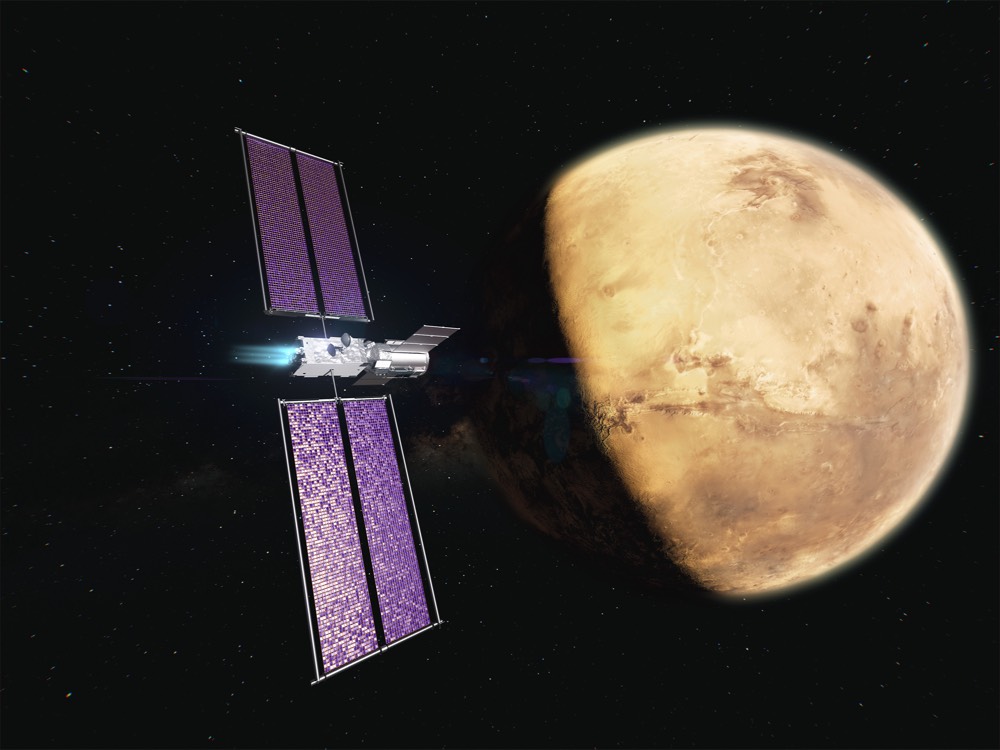
NASA's Space Reactor-1 (SR-1) Freedom, the first spacecraft meant to run a fission reactor beyond Earth orbit, will have a shorter boom and a reactor mounted closer to the rest of the vehicle than first drawn. NASA said so on 24 November 2026, after an October design review at its Glenn Research Center in Cleveland. Launch is targeted for late 2028. Three things are still open: how many radiator panels the ship carries, how much power the reactor delivers, and how long it runs.
Key facts
Mission: SR-1 Freedom, NASA's first fission-powered interplanetary spacecraft, introduced in March 2026 at the agency's Ignition event. Schedule: launch in late 2028 (a March fact sheet said December 2028), a Mars flyby in 2029, and release of the SkyFall payload on a second Mars approach in autumn 2030. Mass: about 12,000 kilograms. Reactor: designed by the Department of Energy's Idaho National Laboratory, fuelled with high-assay low-enriched uranium, with closed Brayton-cycle conversion producing 20 kilowatts of electricity. Propulsion: three 12-kilowatt Hall-effect thrusters, plus roll-out solar arrays. Payload: SkyFall, three helicopters of 2.7 kilograms each, evolved from Ingenuity. Heat rejection: a $39.3 million contract to the Johns Hopkins Applied Physics Laboratory, with heat pipes and composite radiators from Advanced Cooling Technologies. Undecided: radiator panel count, reactor power levels and reactor run time.
What the October review changed
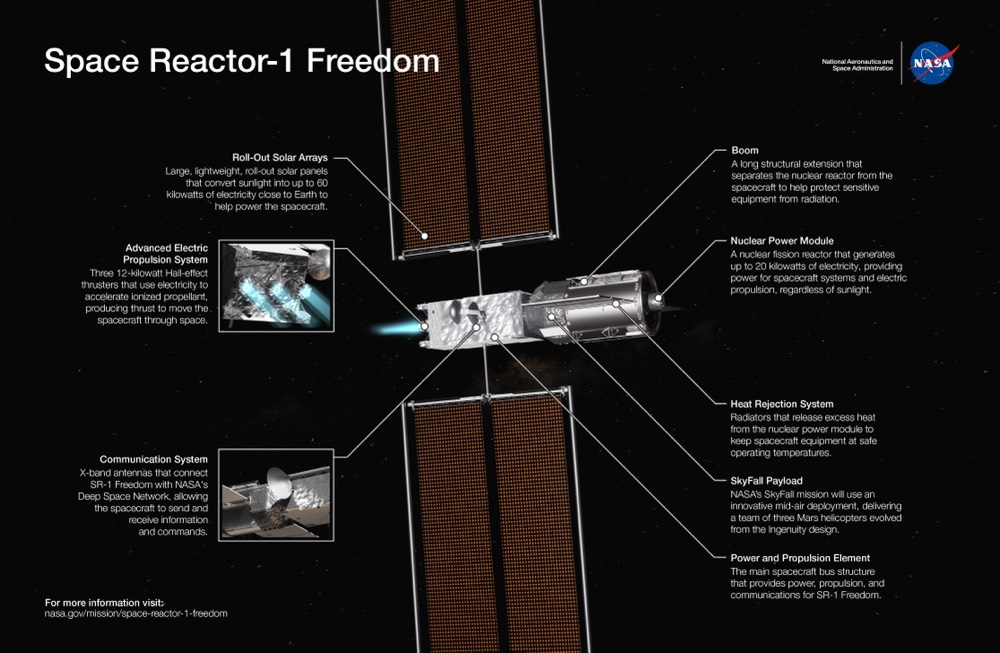
Experts from NASA, the Department of Energy and industry met in Cleveland and settled the main outline of the vehicle. The boom, which holds the reactor away from the main body (the Power and Propulsion Element), is shorter than in the early illustrations, and NASA says that cuts weight and simplifies assembly. Shielding makes that possible: NASA says better shielding and vehicle design let the reactor operate closer to the electronics and the SkyFall payload while still protecting them from radiation.
The third change is the radio. SR-1 will carry larger X-band dishes for the link to the Deep Space Network, which NASA says are for sending data across deep space on the journey to Mars.
Steve Sinacore, the SR-1 program director, called the mission "the first freight run on the railroad of the solar system". The pace is the other fact worth noting: NASA Administrator Jared Isaacman introduced the concept in March, and eight months later the agency has a reviewed architecture and named suppliers for the reactor, the power converter and the radiators.
The power budget: a 20-kilowatt reactor beside big solar arrays
NASA's pages give several power figures, and two of them do not match. The nuclear power module makes 20 kilowatts of electricity (the March fact sheet says "more than 20"). The mission page lists the Power and Propulsion Element at 48 kilowatts, while NASA's infographic shows the roll-out solar arrays at up to 60 kilowatts close to Earth. The pages do not reconcile 48 and 60. The three Hall-effect thrusters add up to 36 kilowatts when all are running.
Sunlight at Mars's average distance, about 1.52 times Earth's, is roughly 43 percent as strong as at Earth. Scaling the array figures by that factor, our own arithmetic, gives about 21 to 26 kilowatts at Mars, before cell ageing. So by the time SR-1 reaches Mars the arrays and the reactor offer similar power, and that matches the profile NASA describes: the reactor runs for an initial period after the ship leaves Earth orbit and then shuts down, solar arrays carry the cruise, and the reactor restarts once SkyFall has been delivered.
NASA lists "reactor extended performance" among six mission objectives, next to operating a nuclear electric propulsion system in space and using the 2028 launch window. The aim is performance data from a flying reactor, not a faster trip.
Who builds what, and the heat problem
The reactor comes from DOE's Idaho National Laboratory. Sierra Lobo supplies the closed Brayton-cycle converter, which turns the reactor's heat into electricity, under NASA's Space Flight Systems Development and Operations Contract III, awarded in 2024. The Applied Physics Laboratory's $39.3 million award covers the heat rejection system under the Aerospace Research, Development, and Engineering Support II contract: design, build, test, and flight hardware. NASA says the reactor stays inactive until the spacecraft leaves Earth orbit, and a NASA chief safety officer oversees the design.
Every converter throws away most of the heat it takes in, and in vacuum the only way to lose it is radiation. NASA names heat pipes and composite radiators but not the working fluid or the radiator temperature, and the choice shapes the radiator count that is still open. Two of our profiles mark the range. Ammonia, the usual spacecraft heat-pipe fluid and the coolant in the ISS radiator loop, has a critical temperature of 405.4 kelvin (132 °C), the ceiling for a liquid-vapour loop. Potassium melts at 63.5 °C and boils at 759 °C, and its sodium mixture NaK-78 stays liquid down to -12.6 °C; that mixture served as a coolant in earlier space fission reactors.
The stakes follow from physics: an ideal black surface radiates in proportion to the fourth power of its temperature, about 1.5 kilowatts per square metre at 405 kelvin and about 7.3 kilowatts at 600 kelvin (an example temperature, not a NASA figure). A hotter radiator needs far less area, which is why the panel count and the fluid decision belong together.
One reactor, two burns, then a descent
The mission page gives the launch trajectory as Earth escape. Once the ship is clear of Earth orbit the reactor starts, and the March fact sheet said the reactor and thrusters would be running within 48 hours of escape. After an initial run the reactor shuts down and the solar arrays take over. NASA's 24 November account has the reactor restarting after the ship delivers SkyFall to Mars, to collect more performance data.
SkyFall's three helicopters are far smaller than the carrier: each is 68 centimetres tall, with two counter-rotating blades 1.4 metres across, and each carries a ground-penetrating radar for depths from 0.5 to 3 metres plus 13-megapixel colour cameras. They are released in the air during descent, after a parachute and braking rockets slow the descent stage, and each flies off and lands on its own. The helicopters transmit to orbiters directly, with no rover as relay, and the landing site is not yet chosen.
Why NASA wants the reactor flown first, and what is still open
NASA's case is in its fact sheet. In six decades the United States spent more than $20 billion on dozens of space nuclear programs and flew exactly one reactor, SNAP-10A in 1965, which never left orbit. A fixed Mars window, NASA argues, forces decisions that decades of study did not, and the ship reuses a nearly built spacecraft bus, the Power and Propulsion Element, instead of starting from scratch.
SR-1 also sits at the front of a sequence. NASA says flying a reactor before landing one retires nuclear flight risk for Lunar Reactor-1, the 20-kilowatt lunar surface system that the fact sheet shows landing in 2030 and for which proposals are due on 21 December. The same reactor-and-converter class, 20 kilowatts of electricity, shows up in both programs. SR-1 would also stimulate the supply chain and build the workforce for later flights, and the contracts named so far show who is in it: one national laboratory for the reactor, one company for the converter, and one laboratory and one company for the radiators.
NASA has not published the mission's cost, named the launch vehicle, or said whether the December 2028 window still holds. The radiator count, the reactor's power levels and its run time are all still being evaluated. The three are linked: reactor power sets how much heat the radiators must shed, and run time sets how long they must shed it.