A 5.5-Micron Liquid Crystal Solar Sail Design
Published
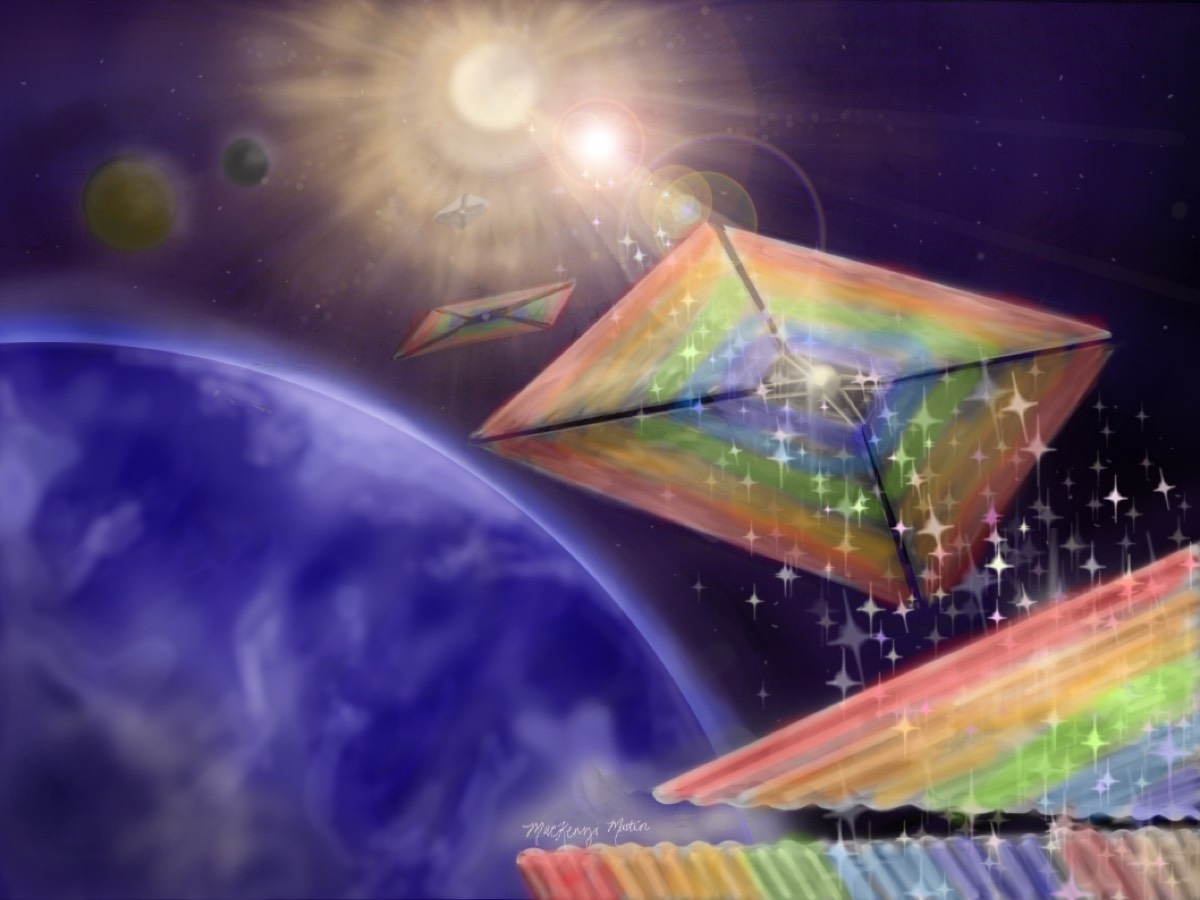
A three-layer film of liquid crystal polymer just 5.5 micrometres thick, roughly a tenth of the width of a human hair, could push a solar sail sideways with 25.6 percent efficiency while the sail keeps facing the Sun, a simulation by researchers at the Rochester Institute of Technology shows. Stack a second film for the other polarization of light and the transverse efficiency reaches 51.2 percent. The design is described in a preprint (arXiv:2610.28942, 20 October 2026) by Sai Keshav Sasanapuri, Xiulian (Nicole) Shan and Grover Swartzlander Jr. It has not been peer reviewed, and no film has been built.
Key facts
Design: three stacked Bragg gratings made from a chiral (cholesteric) liquid crystal polymer, held facing the Sun. Thickness: 5.5 micrometres in total, in layers of 1.5, 2.0 and 2.0 micrometres. Light band: 0.47 to 1.67 micrometres, which carries 69.6 percent of the Sun's energy at Earth's distance (1,367 watts per square metre). Efficiency: 25.6 percent of the light's momentum goes sideways for one polarization state, 51.2 percent for two stacked films; the along-the-Sun-line figure is 99.9 percent. Assumed material: birefringence of 0.5 (ordinary index 1.7, extraordinary index 1.2). Method: rigorous coupled-wave analysis, optimized with a differential evolution algorithm. Funding: DARPA, through BEAM Engineering for Advanced Measurements Co., and NASA, through the Johns Hopkins Applied Physics Laboratory.
Why a sail wants to steer without tilting
Sunlight bouncing off a mirror sail pushes along the surface normal. To get a sideways component, which is what a sail needs to change its orbit, the whole sail must tilt away from the Sun, and the tilt shrinks the area catching light and makes a large structure harder to control. A diffractive sail bends the reflected light sideways while the film stays square to the Sun, so a simple roll of the spacecraft changes the direction of the sideways push.
The same trick matters for a sunshade. One use the authors describe is a film parked at the Sun-Earth L1 point that scatters part of the sunlight away from Earth; a tilting mirror would lose shade area every time it corrected its position, while a sun-facing diffractive film would not.
What the three layers do
A single liquid crystal Bragg layer reflects only a narrow band of colours. Bandwidth grows in proportion to birefringence, about 220 terahertz for every 1.0 of it in the authors' model, so the team stacked three layers, each tuned to a different slice of the solar spectrum, with the light reaching each layer already thinned by the one above.
Layer 1 is 1.5 micrometres thick with a slant angle of 17.0 degrees, a Bragg period of 0.201 micrometres and a design wavelength of 0.60 micrometres. Layer 2 is 2.0 micrometres, 17.5 degrees, 0.296 micrometres and 0.87 micrometres. Layer 3 is 2.0 micrometres, 17.5 degrees, 0.437 micrometres and 1.29 micrometres. In a chiral liquid crystal polymer the rod-shaped molecules twist into a helix, which builds the repeating layers of different refractive index that the light reflects from.
The authors say the design can be adapted to let through the bands that plants (600 to 680 nanometres) and solar panels (700 to 900 nanometres) use, for example by dropping layer 2.
A check on the printed force numbers
For a 100-square-metre sail and a single polarization state, the preprint prints a sideways force of 0.012 newtons and a force along the Sun line of 0.023 newtons. Those do not match the preprint's own formula, force equals solar constant times area times efficiency divided by the speed of light. With 1,367 watts per square metre, 100 square metres and efficiencies of 25.6 and 99.9 percent, the formula gives about 0.00012 newtons sideways and 0.00046 newtons along the Sun line, 100 and 50 times smaller than printed. The printed forces look like an error, so this post uses the efficiency percentages and not the forces until the authors correct them.
How the film compares with sail materials we have profiled
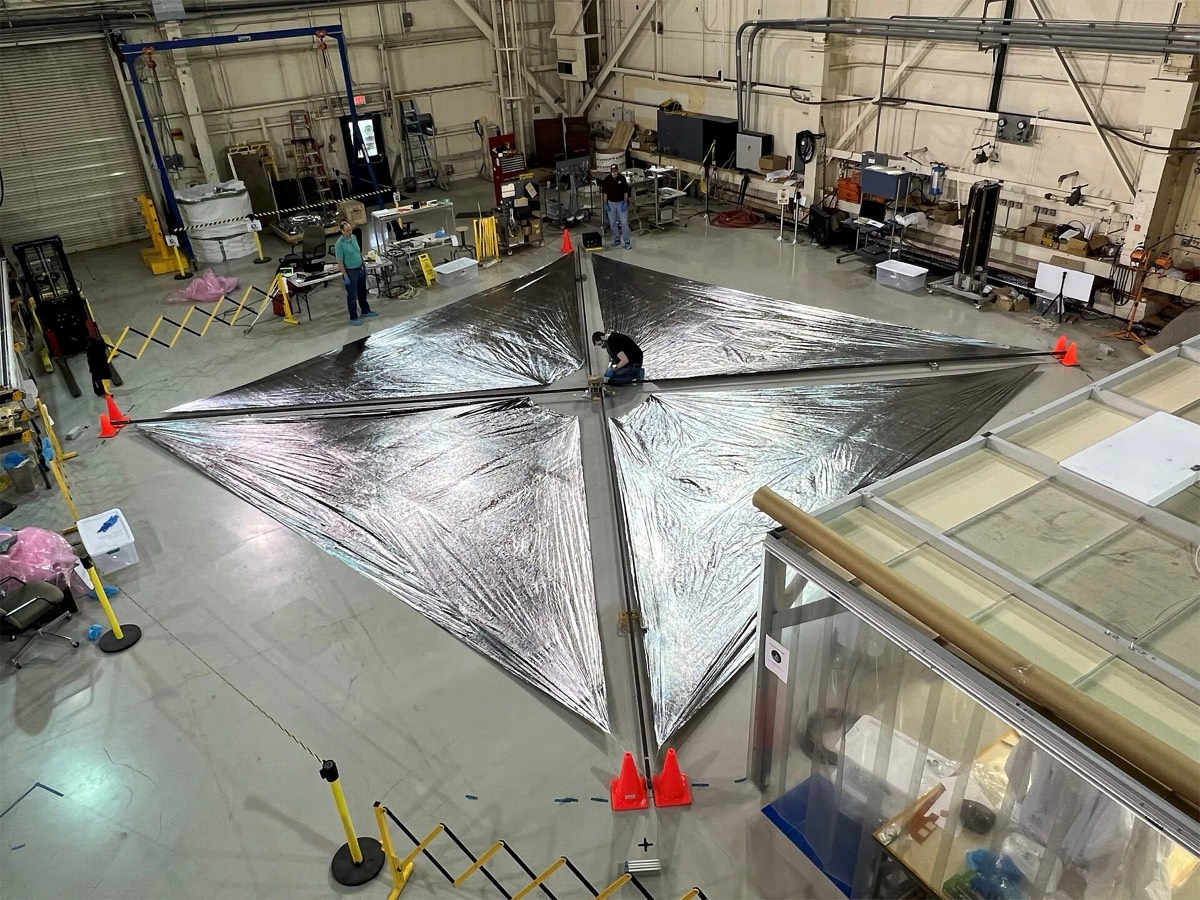
Two sail films we have profiled are both thinner than this design. Aluminised PET film (Mylar) was the sail of the LightSail spacecraft: 4.5 micrometres thick and 32 square metres in area. Our PET profile lists a tensile strength of 190 to 210 megapascals, a density of 1.35 to 1.39 grams per cubic centimetre and an atomic-oxygen erosion yield of 3.01 × 10⁻²⁴ cubic centimetres per atom, measured on the MISSE 2 experiment. Colourless polyimide CP1, described in our CP1 profile, was used as 2-micrometre film with vapour-deposited aluminium for a 20-square-metre sail deployed in vacuum at NASA's Plum Brook facility in 2005, a test that led to NanoSail-D2. CP1 has a tensile strength of 87 megapascals, a density of 1.42 to 1.54 grams per cubic centimetre, an erosion yield of 1.91 × 10⁻²⁴ cubic centimetres per atom, and in simulation its solar absorptance rose by more than 0.3 under ultraviolet and particle radiation.
The liquid crystal film has no such numbers. The preprint reports no strength, density, mass or radiation data, and says sail mass and orbit optimization are for future work. Atomic oxygen, the main hazard for polymer films in low Earth orbit, is not an issue at L1, but ultraviolet and particle darkening are, and the preprint reports no test for them. For scale, NASA's Advanced Composite Solar Sail System demonstrator launched on 23 April 2024 with a sail about 9 metres on a side.
Where the idea comes from and what is missing
Swartzlander developed the diffractive sail idea with support from NASA's Innovative Advanced Concepts (NIAC) program, and the Johns Hopkins Applied Physics Laboratory's Amber Dubill was selected for a 2022 NIAC study to circle the Sun with a constellation of diffractive sails and measure the solar corona and surface magnetic fields from all latitudes. Earlier diffractive designs relied on metal-coated gratings. The authors favour liquid crystal polymers because they are thin, flexible and, they say, easy to make over large areas; the preprint supports that with citations, not tests.
Open questions are practical. The film works on one polarization state, so a useful sail needs two stacks. The preprint does not address folding for launch, long exposure to sunlight or the thermal conditions at L1. The authors say sail mass and orbit optimization studies come next.