Roman Space Telescope: Instruments Aligned in Orbit
Published
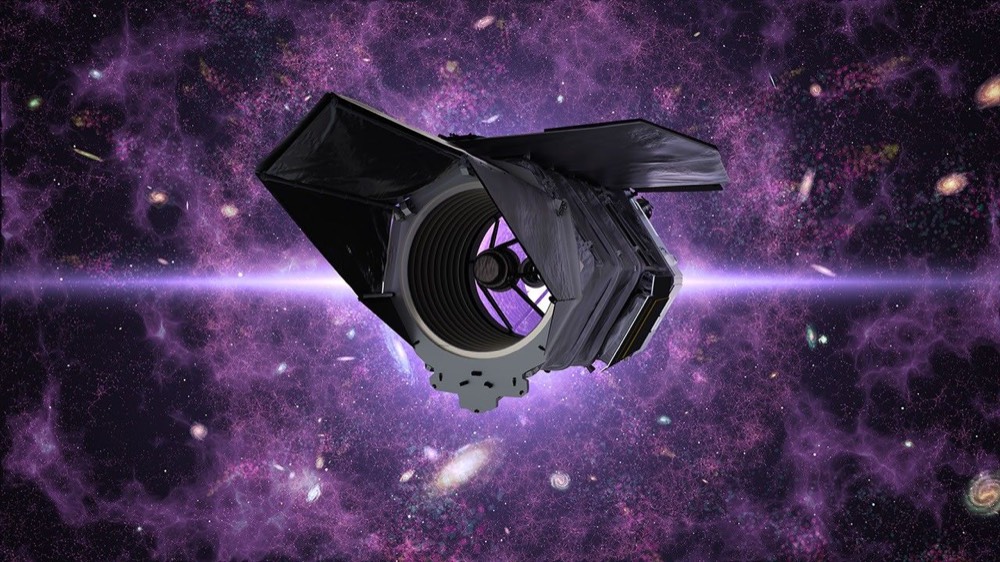
NASA's Nancy Grace Roman Space Telescope has finished lining up its instruments in space, which the agency calls a key milestone on the way to science operations. According to NASA, the observatory is now aligned "to within a tiny fraction of a hair's breadth of perfection."
This is not a flashy result. There is no new picture of a galaxy. But it is the kind of step that decides whether the pictures that come later are any good, so it is worth understanding.
What NASA announced
On 13 November NASA's Roman blog reported that the mission team had brought the telescope's instruments into precise alignment. The team had already lined up the optics and instruments on the ground before launch. In orbit, they went back and checked.
The reason is simple. Launch shakes a spacecraft hard, temperatures change once it is in space, and there is no gravity to hold parts where they sat on Earth. Any of these can move things by tiny amounts. NASA says scientists have been running a series of test observations to measure those shifts and update what it calls Roman's "internal map."
Dominic Benford, Roman's program scientist at NASA Headquarters, put the bar plainly. He said Roman has to be at least ten times more stable than the Hubble or Webb space telescopes to do the science it is meant to do. That is NASA's own comparison, and the blog does not say which measure of stability it means.
How they checked it
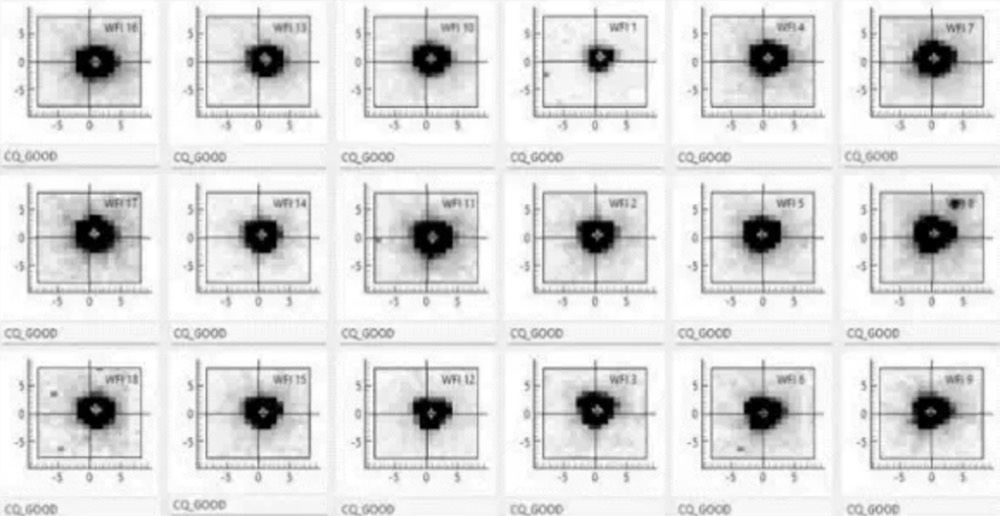
The method is easy to picture. The team pointed Roman at star fields, looked at where the stars landed on the detectors, and compared that with where their map said the stars should be. The gap between the two tells them how to correct future pointing.
The Wide Field Instrument has 18 detectors. Tyler Desjardins, an astrophysicist at the Space Telescope Science Institute in Baltimore, explained why that matters. The detectors work together when the telescope locks onto guide stars. If the map says one star should land on one detector and another star on a second detector, and one of those positions is wrong, guiding becomes a problem. The team needs very precise positions for the guide stars so it can aim and correct tiny drifts.
NASA shared an animation showing stars that were first off-center in Roman's guide windows and then lined up after small adjustments. The picture in this post shows the kind of detector-by-detector plots involved. NASA's image labels each of the 18 detectors, and the stars sit close to the center of each window.
Tony Sohn, an astronomer working on Roman at the Space Telescope Science Institute, said the telescope is now internally aligned to within a fraction of a hair's breadth. He said this precision is needed both for pointing at the right place and for holding extremely still during each observation.
One instrument that points and guides
The Wide Field Instrument does two jobs. It is Roman's main camera, and it is also its guider. It tracks stars to help the telescope point and stay steady during observations.
That has a useful side effect. NASA says that while the Coronagraph Instrument is staring at a nearby star, the Wide Field Instrument will watch stars in a neighboring patch of sky to keep the observatory steady. Benford said this will give scientists a random sampling of "bonus" deep fields alongside those observations for free, in places where there have never been deep surveys.
I like that detail. A tool built to keep the telescope still also ends up collecting extra data. It is a good reminder that in a mission like this the support systems and the science are not cleanly separate.
The coronagraph is the hard part
The Coronagraph Instrument is built to block a star's glare so that faint planets and dusty disks next to it can be seen. NASA's blog describes it as using a series of masks and other components to do this.
Brian Kern, an optical engineer on Roman at NASA's Jet Propulsion Laboratory in Southern California, explained the problem. Because light behaves like a wave, starlight spills out when an image forms, flowing into the area around the star where planets might be. A coronagraph uses carefully chosen masks to absorb and redirect that spilled light, and remove enough of it to uncover the planets.
If the masks are put in the wrong place, the instrument cannot block as much starlight as it is designed to. Kern said the team has precise alignment tolerances for positioning the masks individually, and that this is only a first step. It lets the next, more complex step finish what alignment alone cannot.
The team adjusted the position of the secondary mirror, a smaller mirror that connects the telescope to the Coronagraph Instrument, and all the masks and optics inside the instrument, to make its vision as clear as possible.
What comes next
The next step is the deformable mirrors. According to NASA, the team will now exercise more than 3,000 of the small moving parts that make those mirrors move. Kern said the mirrors use the wave nature of light to redirect starlight while leaving planet light alone, rejecting more and more starlight step by step.
He said this has been shown in a lab with an artificial space environment. The second stage of active starlight control, in space, with real starlight and real planets, would be a record-breaking first, in his words. That is a goal and a claim by the mission team, not a result yet.
What is not known
The NASA blog does not give a date for the start of science operations, and it does not say how long the remaining coronagraph steps will take. It also does not give the alignment numbers beyond the hair's-breadth comparison. So we cannot say yet how the real-world accuracy compares with the design target in exact figures.
The test results for the deformable mirrors have not been reported. Until they are, the claim about the coronagraph reaching its goal remains a hope backed by lab work.
Why I think it matters
Large space telescopes are judged by what they see, but they are really judged by how still and how well aligned they are. A small error in where a star lands on a detector becomes a blurry survey or a failed planet search. Getting the "internal map" right early means every later observation starts from a better place.
It also shows how much work happens after launch. The spacecraft is not finished when the rocket lets go of it. A team on the ground spends weeks checking, measuring and adjusting, step by step, and the milestones that come out of that are quiet ones.
What would you most like Roman to find first: faint exoplanets near bright stars, or the deep fields it collects along the way?
Sources: NASA Roman blog.