Chandra finds hidden partner of an erupting star
Published
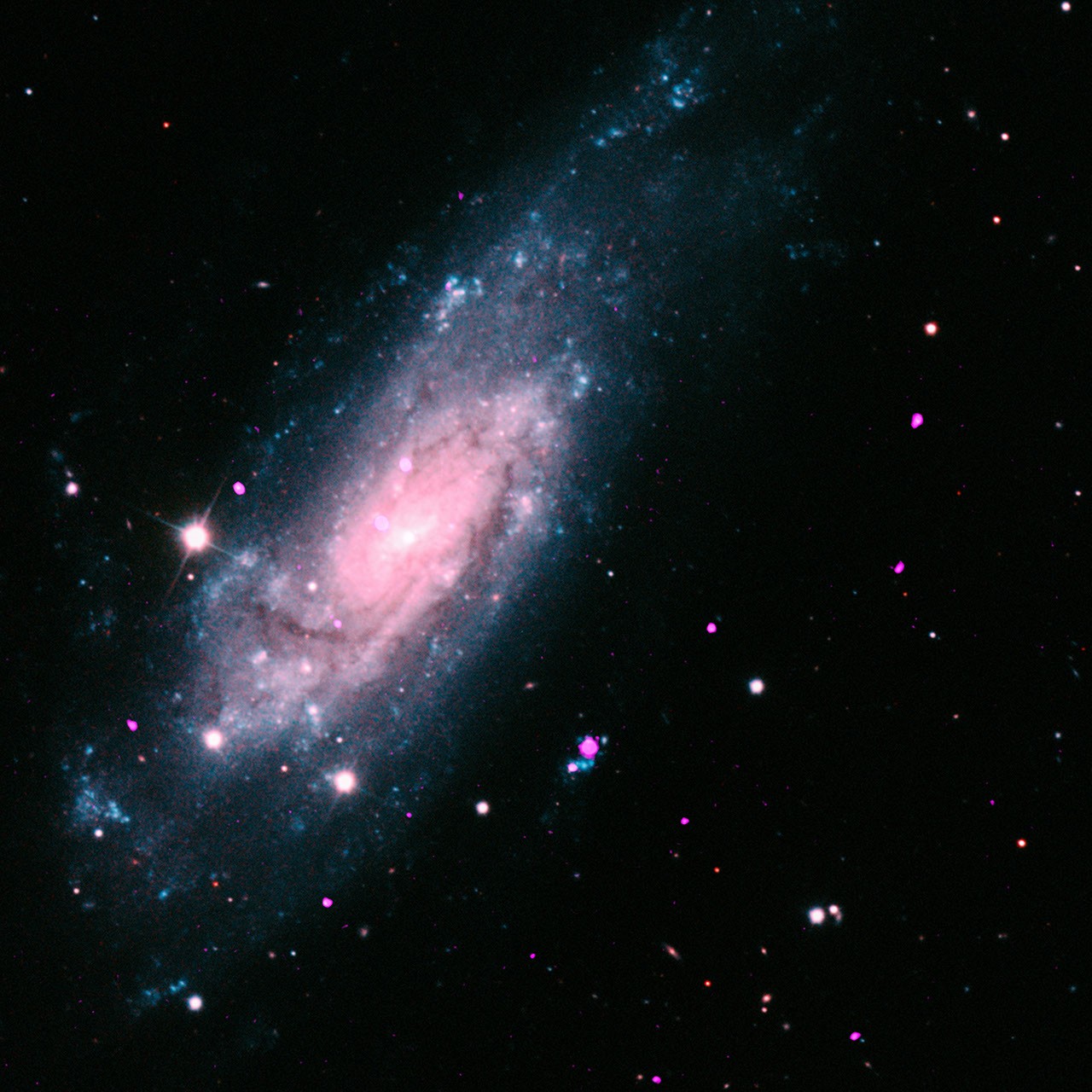
NASA's Chandra X-ray Observatory has found what drives the repeating outbursts of a giant, unstable star about 30 million light-years away. According to NASA, the star, called AT 2016blu, has a hidden companion that is either a black hole or a neutron star, and the two circle each other every 113 days.
The study was published on Monday in The Astrophysical Journal and led by Mojgan Aghakhanloo of the University of Virginia.
What astronomers had been watching
AT 2016blu sits in the spiral galaxy NGC 4559. NASA says astronomers estimate its mass at no less than 33 times that of the Sun. It belongs to a class called luminous blue variables: hot, massive stars whose brightness changes a lot. Eta Carinae is the best-known example.
This one is unusual because it brightens in rapid, repeated spikes. They look so extreme that they can pass for a supernova. A supernova destroys the star, but this star survives each time, which is why it is nicknamed a "supernova impostor". NASA reports that between 2012 and 2026 astronomers recorded at least 27 bursts of visible light, roughly every 113 days.
"For 15 years, astronomers have been watching this star get really bright and then dim again on a regular basis," Aghakhanloo said in NASA's release. Until Chandra data arrived, nobody could say why.
How Chandra caught it
The team suspected the visible flashes were powered by bursts of X-rays. Co-author Nathan Smith of the University of Arizona explained that dense gas around the system is heated by X-rays and then glows in visible light. So the X-ray observation had to be timed to land during an outburst.
Chandra was the right tool because, NASA says, it is the only X-ray telescope sharp enough to separate AT 2016blu from another bright X-ray source close to it. Ground-based telescopes and more than 30 amateur astronomers reporting through the American Association of Variable Star Observers watched the star's brightness. When it flared in early 2026, a Chandra "Target of Opportunity" observation was triggered, and the data were taken in March 2026.
What the X-rays showed
In March 2026 the star was at least 100 times brighter in X-rays than in Chandra data from 2001 to 2002, before the outbursts began. NASA says the best explanation is that material thrown off by the star falls onto a compact companion when the two are closest in their oval orbit. That material moves at very high speed, close to the speed of light, and gets hot enough to shine in X-rays.
The companion has not been seen directly. The evidence is the timing and the X-ray brightness, so whether it is a black hole or a neutron star is still open. That is worth keeping in mind: this is the best explanation the team has, not a picture of the object.
Why it matters
NASA says this is the first X-ray detection of a star of this type, and the first one found with a black hole or neutron star companion.
AT 2016blu is also bright enough in X-rays to count as a candidate ultra-luminous X-ray source. These are rare, very bright sources that astronomers do not yet fully understand, and many of them change a lot in brightness. NASA says the result hints at a link between those sources and violent stellar eruptions like this one.
The finding may also help with stars that flare up before they explode. Astronomers suspect that much of that behaviour could come from a massive star paired with a compact object or another massive star.
I like this one because it is a case where patience and timing solved the puzzle. The star was watched for 15 years, and the answer came from pointing the right telescope at the right moment. It also shows how useful amateur observers are for catching a star mid-outburst.
NASA's Marshall Space Flight Center manages the Chandra programme, and the Smithsonian Astrophysical Observatory runs its science and flight operations.
Do you think more "supernova impostors" will turn out to have a hidden partner?
Sources: NASA, Chandra release and NASA image article.