Why Uranus and Neptune's magnetic fields are odd
Published
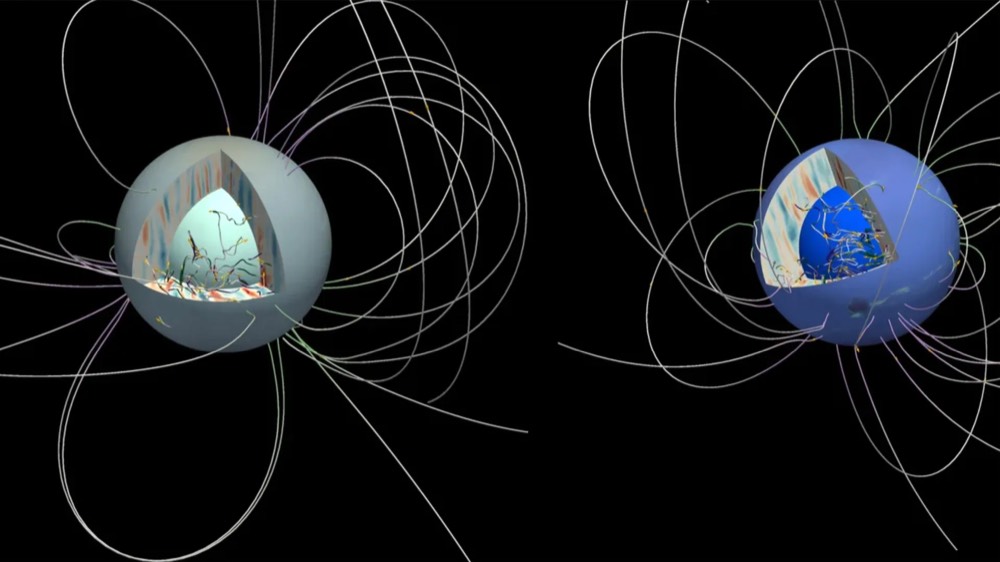
The strange magnetic fields of Uranus and Neptune may finally have an explanation, according to ScienceDaily, which reports on a study in Communications Physics. The answer may lie in how well the planets' deep interiors conduct electricity.
The study was led by Chi Yan at the University of Texas at Austin, with researchers from UCLA, Imperial College London and Northumbria University. Their models assume the material inside these ice giants becomes more conductive with depth, because water breaks apart into ions under extreme pressure.
The fields are strongly tilted. Uranus has a magnetic dipole tilted by 59 degrees and Neptune's is tilted by 47 degrees. Earth's is about 11 degrees. The simulations suggest the poles can shift by tens of degrees within a few decades. Yan says Earth's tilt drifts by about a degree over 50 years.
Why it matters: these fields were measured once, by Voyager 2 in the 1980s. If they change quickly, the picture from that flyby may already be out of date.
Easy question: would you want a new probe to fly past Uranus or Neptune to measure these fields again?
Sources: ScienceDaily