Network-Inspired Metamaterials Resist Impacts Better
Published
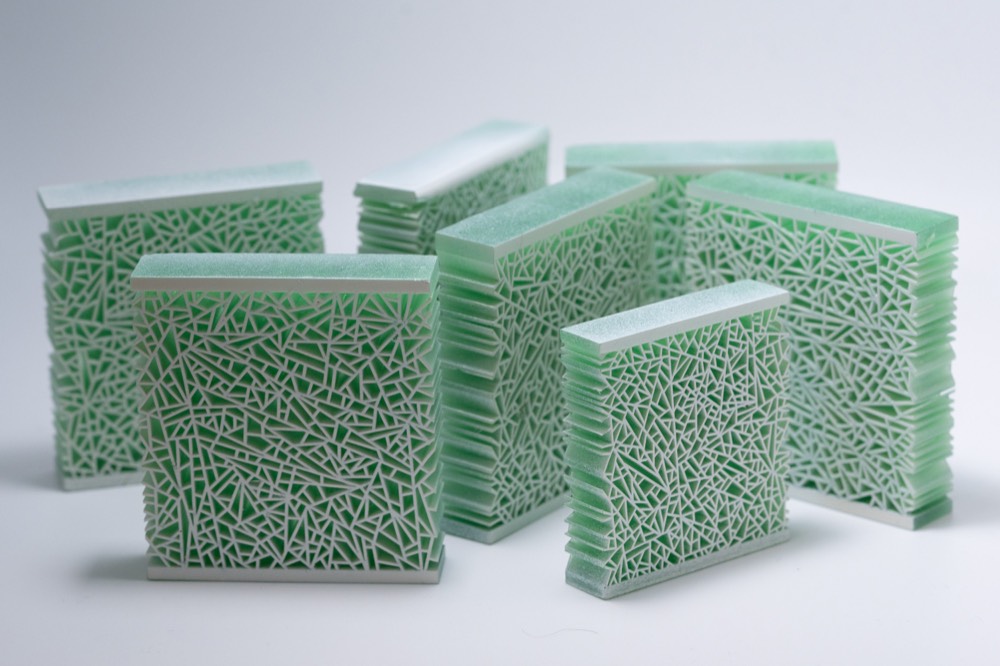
Researchers at MIT and Northeastern University say a little disorder can make an engineered material tougher. They published the work in the journal Nature, and MIT News describes it today as a new way to design "metamaterials."
Instead of repeating one small building block, the team built materials from networks of beams in many sizes. In tests, MIT says, these held up against sudden impacts better than conventional ordered designs.
What is a metamaterial
A metamaterial gets its properties from its internal structure, not only from what it is made of. MIT's release says these structures give the whole material exceptional properties not found in nature.
The usual way to design one is to pick a single building block, called a unit cell, and copy and paste it many times over. The result is a precise, repeating microstructure. Square lattices and honeycombs are common examples, and Carlos Portela, an associate professor of mechanical engineering at MIT, has built metamaterials this way.
The problem with perfect order
Portela says ordered patterns often do improve strength and resilience. But when such a material is punctured or cracked, the rest can buckle and fail quickly. He says this happens because the internal structure is the same everywhere. If one region deforms, the similar cells around it respond and deform in the same way.
"We've spent years looking at periodic and ordered microstructures," Portela says, and learned that there are limits and non-ideal responses, such as this localization effect. The team wanted to get away from that idea.
The new idea: scale-rich metamaterials
The team worked with Albert-László Barabási, a physics professor at Northeastern University and a leader in network science. That field studies nodes and connections in networks, from food webs and neurons to financial markets and the internet. Most of Barabási's work has treated networks as concepts mapped onto existing systems. He wondered whether network science could be used to build a physical material.
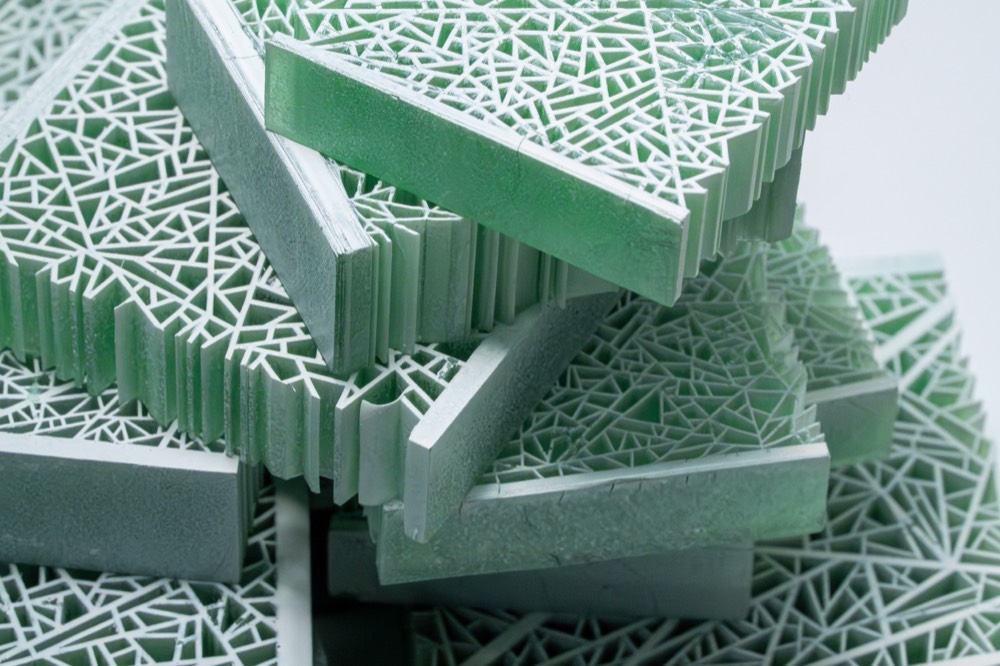
The result is what the researchers call "scale-rich metamaterials." Their structures contain beams of many sizes, sprawling and connecting into a physical network. MIT compares the inspiration to the veins in a leaf, the veins in a dragonfly's wing, and the links in a social network. The work appears in an open-access study in Nature.
How the design is generated
A physical network has limits that an internet map does not. The number, thickness and spacing of beams all matter, and beams cannot pass through each other freely. So the team wrote an algorithm that builds a network with those limits built in.
According to MIT, the program starts by placing a point at a random position in the space that will become the material. It draws a line through that point at a random angle, across the whole space. It then picks a second random point and draws another line at another random angle, stopping when the line reaches a boundary or the first line. The process repeats, with each line shorter and thinner than the last. The outcome is a dense network of crossing beams of many sizes.
Two settings control the result: how thick the starting line is, and how fast the thickness drops with each new line. By changing just those two parameters, the team could generate a wide range of networks. Simulations predicted how each change would affect stiffness and other properties. "We can really tune the stiffness of a material just by changing these two parameters," Portela says.
What they built and tested
The team then made physical samples. They used 3D-printing methods to deposit polymer in patterns of thin, interconnecting beams. Each sample was a square about the size of a credit card, with internal beams ranging from microns to centimeters.
They dropped a large weight on the samples and squeezed them with increasing force. They compared the results with conventional lattice and honeycomb metamaterials. The network-inspired samples were more resilient to compression and impacts, MIT says.
Portela's explanation is that with so many length scales, a failure in one part is surrounded by a strong web of structure that stops the whole material from failing badly. He says it is more efficient at spreading damage and absorbing energy.
In a second demonstration, the researchers copied the idea of a pomelo's thick rind, which is denser toward the outside. They designed a material with a denser network of beams at the edges and showed it could cushion a fragile object embedded at the center.
What it could be used for
MIT lists helmets, packaging and armor as possible uses for impact absorption. The same design procedure could also make acoustic lenses, which are materials whose microstructure focuses sound or vibrations.
Tian "Tim" Chen, an associate professor of aeronautics at Imperial College London who was not involved, called the work a design framework for materials whose features vary over a very wide range. He said it may lead to a next generation of materials for any structure that must carry load, absorb energy or control vibration.
What is not known
The release does not give impact-energy numbers, so we cannot say how much better the network samples performed, only that they did better. The samples were polymer, printed at roughly credit-card size. Whether the idea works in metals or ceramics, or at larger scales, is not covered in the release. Nor does it say how the designs would be made in volume or what they would cost.
The work was supported in part by the US National Science Foundation's DMREF program. The other authors are Andrew Yen-Jong Chen, Mohammad Charara and Jayna Wadhwa at MIT, Csaba Both and Ting-Ting Gao at Northeastern, and Niek Mooij at Utrecht University.
Why I think it matters
Engineers often assume that neat, repeating patterns are the best way to design a structure. This work suggests that controlled messiness can be better at one important thing: failing gently. A part that cracks slowly and spreads the load is usually safer than one that gives way all at once.
That idea is useful well beyond helmets. Lightweight structures for aircraft and spacecraft also have to survive impacts and vibration, though the release does not mention them, and a polymer test is a long way from flight hardware.
Would you trust a material designed by a random-line algorithm more, or less, than a perfect honeycomb?
Sources: MIT News.