BepiColombo Mercury Orbit: Burn Cut Short by Software
Published
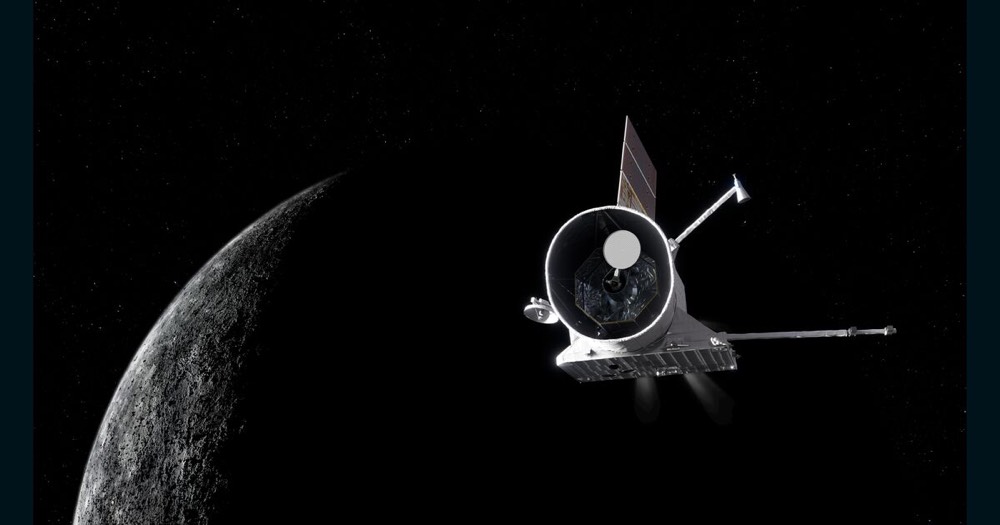
BepiColombo is in orbit around Mercury, but not the orbit it planned. On 21 November 2026 a software fault ended the spacecraft's 37-minute braking burn early. The thrusters delivered about 77 percent of the planned change in velocity, and the spacecraft settled into a 75-hour orbit instead of a 58-hour one. ESA and Airbus have traced the fault to software handling attitude guidance and thruster control, and the investigation continues. The remaining manoeuvres have been re-planned without extra burns, and the 9 December separation of the two science orbiters is unchanged.
Key facts
Event: Mercury orbit insertion of the BepiColombo composite spacecraft, 21 November 2026. The spacecraft turned for the burn at 16:51 UTC, and the four axial thrusters began firing at 18:24 UTC as it passed 635 kilometres above the surface. Result: the burn, planned for 37 minutes, ended early with about 77 percent of the planned velocity change, and the spacecraft entered safe mode. It is in a 75-hour orbit, not the planned 58-hour one. Cause: a software issue involving attitude guidance and thruster control, under investigation by ESA's operations centre in Darmstadt and Airbus. Unchanged: Mio separation on 9 December (10 December in Japan), sunshield ejection on 16 December, arrival in the final orbit in March 2027, science from April 2027. First: orbit insertion at another planet by weak stability capture, a technique previously used only by some Moon missions. Mission: ESA and JAXA, launched on an Ariane 5 on 20 October 2018, with arrival slipped from December 2025 after an electric-propulsion fault found in April 2024.
What happened on the night of 21 November
The sequence was pre-loaded and ran without real-time control. At 16:51 UTC the stack turned into burn attitude, and contact with Earth dropped on schedule. At 18:24 UTC the four axial thrusters of ESA's Mercury Planetary Orbiter began braking the stack, with the Japanese Mio orbiter still attached. It was the first major manoeuvre since the transfer module was jettisoned on 3 September. A test on 24 September had fired the same thrusters for 8 minutes 42 seconds, a push of 11.4 metres per second.
When ESA's New Norcia antenna in Australia picked the signal up again, telemetry showed the burn had been interrupted by the spacecraft itself and that it was in safe mode, the protective state it enters when conditions are unexpected. Ignacio Tanco, the flight operations director, described the moment as "like flipping a switch". Analysis showed the burn had delivered about 77 percent of its planned velocity change. Getting the signal back showed the spacecraft was there but not which orbit it had secured; the answer came from flight dynamics about 01:00 local time on 22 November: "We confirm Mercury orbit capture!"
Why a shortfall of 23 percent is survivable
BepiColombo spent eight years slowing down. Solar electric propulsion and nine planetary flybys, one at Earth, two at Venus and six at Mercury, cut its speed relative to Mercury until the planet could capture it weakly. That capture is temporary, lasting only several orbits, so the braking burns are what turn it into a lasting orbit.
Those burns are a series, not a single event. A single hours-long burn would carry the spacecraft away from the point of closest approach, where braking is most efficient, and waste propellant to what ESA calls gravity losses. After each burn the flight dynamics team measures the achieved orbit and designs the next one from it, so a short burn is absorbed by the sequence. The shortfall shows in the orbit's period: 75 hours is 29 percent longer than 58 hours. ESA says the remaining sequence is already adapted to the new trajectory with no additional burns required, and that Mio's separation and the orbiter's route to its science orbit are unaffected.
What does not add up, and what ESA has not explained
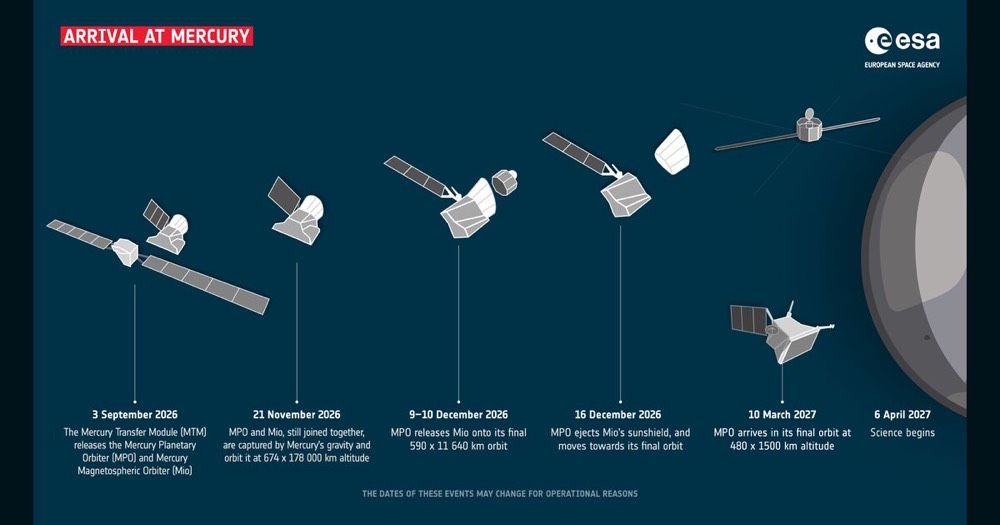
ESA's published arrival timeline lists the 21 November capture as an orbit of 674 by 178,000 kilometres altitude. Using Mercury's mass and mean radius from NASA's fact sheet (0.3301 × 10²⁴ kilograms, 2,439.7 kilometres), that orbit would take about 327 hours, or 13.6 days, not 58 or 75 hours. Its 674-kilometre closest point also differs from the 635 kilometres ESA gives for the burn. ESA's reports do not say which orbit the graphic describes, and its numbers may come from an older plan, so this post uses the 58-hour and 75-hour figures from the 23 November report.
The cause is described in one phrase: a software issue involving attitude guidance and thruster control. ESA has not said why the burn logic stopped the burn, whether the same software runs the later burns, or what change is needed before the next one. The shortfall was also not immediate public knowledge: ESA's first update confirmed capture, and the early cut-off was disclosed later on 22 November, according to a timeline of its statements.
What comes next, and what is waiting to work
Mio separates on 9 December, and on 16 December ESA's orbiter ejects Mio's sunshield and heads for its final 480 by 1,500 kilometre orbit, which it reaches on 10 March 2027. Science begins on 6 April 2027. The nominal mission ends in April 2028, with a possible extension to December 2029. ESA's lead project scientist, Geraint Jones, says the science team numbers almost 600.
The instruments have been tested since the transfer module left. In September the laser altimeter fired more than 700,000 pulses into open space over 21.5 hours, and the thermal spectrometer MERTIS collected about 1 gigabit during a 22-hour test. The UK-built MIXS, the first X-ray instrument on an interplanetary spacecraft, imaged the Crab Nebula over 55 slews in 39 hours on 11 and 12 September. The MIXS team says its micro-pore optics, with millions of pores 20 micrometres wide, make a telescope 1 metre long and 11 kilograms, where a conventional X-ray telescope needs about 10 metres of focal length and hundreds of kilograms.