Synspective StriX 14 on Electron: launch 27 November
Published
Synspective’s 14th StriX radar satellite is set to launch on a Rocket Lab Electron rocket from Launch Complex 1 on New Zealand’s Mahia Peninsula at 00:05 UTC on 27 November 2026. That is 13:05 on 27 November New Zealand time. Synspective’s official launch schedule gives 00:05 UTC. Rocket Lab’s mission page opens the launch window at 00:00 UTC, so the planned time falls five minutes into the window. The mission is called Night Owls Never Sleep.
The launch can still move. Synspective says the launch may be postponed or cancelled because of unforeseen weather or other complications, and it points readers to Rocket Lab’s schedule for the latest information.
Key facts
Mission: Night Owls Never Sleep, the 14th launch of Synspective’s StriX radar satellites. Rocket Lab calls it StriX Launch 14.
Payload: one StriX synthetic aperture radar (SAR) Earth-observation satellite.
Customer: Synspective, a Japan-based company that runs a radar satellite constellation.
Launch vehicle: Rocket Lab’s Electron.
Launch site: Launch Complex 1, Mahia Peninsula, New Zealand.
Scheduled launch: 00:05 UTC on 27 November 2026 (13:05 New Zealand time), from Synspective’s schedule announcement of 20 November.
Launch window: opens at 00:00 UTC on 27 November (1:00 p.m. New Zealand time), per Rocket Lab.
Orbit: 569 km low Earth orbit at 38 degrees inclination, per Rocket Lab.
Rocket Lab count: this would be its 101st launch overall.
Synspective count: the 14th Electron launch for the StriX constellation.
Previous StriX launch: 26 September 2026 at 00:39 UTC, also from Launch Complex 1.
Future flights: Rocket Lab says another 33 Synspective missions are booked on Electron.
Mission and payload
Synspective’s StriX satellites use synthetic aperture radar, which images the ground through cloud and in darkness. Synspective says its data supports urban development planning, construction and infrastructure monitoring, and disaster response. Rocket Lab describes the company’s aim as a constellation able to image any location on Earth within hours, day or night, and through any weather.

The company’s launch page lists 13 StriX missions, from StriX-α in December 2020 to the 13th on 26 September 2026. In its press release on that launch, Synspective said the 13th satellite reached its target orbit and that testing and commissioning would follow over the coming months, before the satellite enters service.
Rocket Lab has been the only launch provider for Synspective’s constellation since 2020. Its mission page says 33 more Synspective missions are booked to fly on Electron, scheduled every year through 2031.
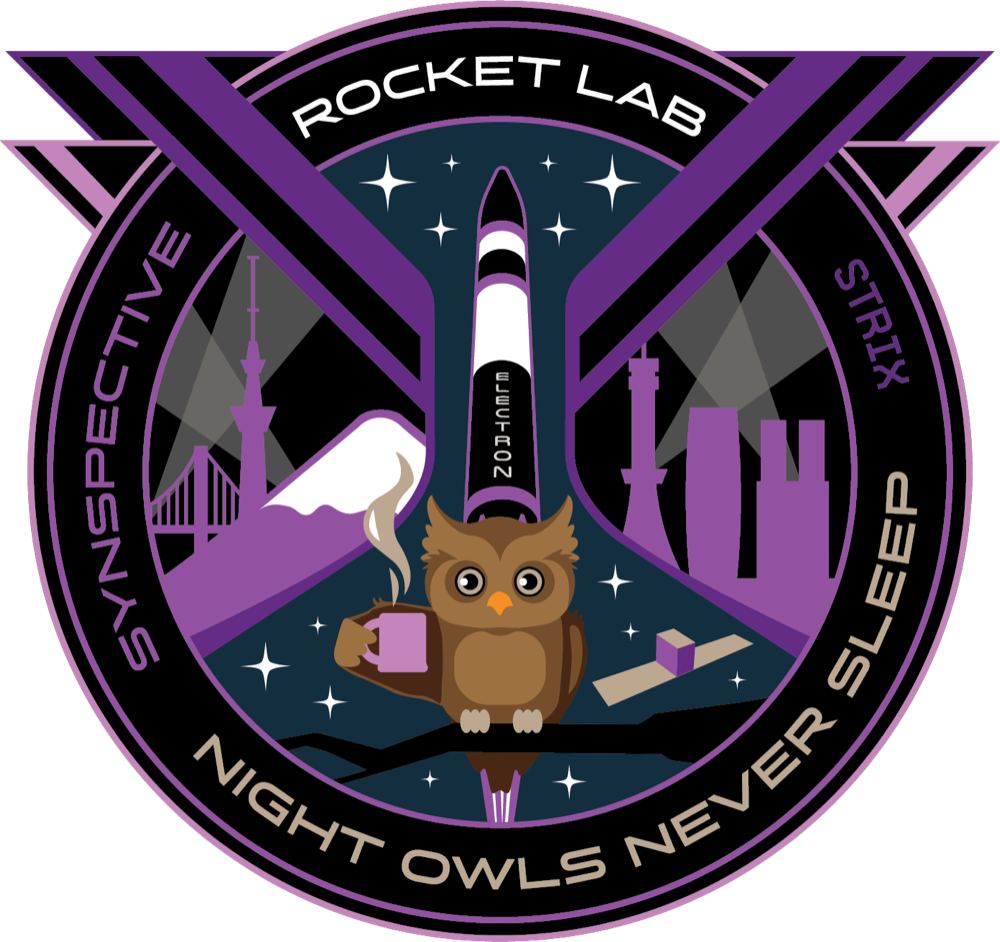
The mission patch, shown as the lead picture, carries the Rocket Lab, Synspective and StriX names around an Electron rocket and an owl holding a mug on a branch.
The StriX constellation so far
Synspective’s launch page gives every StriX mission its own name and patch, and the most recent ones are easy to follow. The 10th StriX was called Ten Owl of Ten and flew on 27 June 2026. The 11th, Owl Around The World, flew on 2 September. The 12th, Owl By The Dozen, flew on 19 September. The 13th, Owlright Owlright Owlright, flew on 26 September. Night Owls Never Sleep is the name for the 14th.
Synspective calls itself a Synthetic Aperture Radar (SAR) satellite data and analytic solutions provider. Radar works at night and through cloud because it sends its own signal toward the ground and records what comes back, so the satellite does not depend on sunlight or clear skies. Rocket Lab describes the company’s aim in those terms.
Rocket Lab’s mission page publishes the patch for Night Owls Never Sleep, and that is the picture shown as the lead.
Flight plan
Times are in UTC. Times that Synspective or Rocket Lab gave are marked as published. Everything else is either not published or an estimate, and the list says which.
About 23:35 UTC on 26 November: Rocket Lab’s live stream starts. Rocket Lab says it starts about 30 minutes before launch, so this time is an estimate from that wording.
00:00 UTC on 27 November: the launch window opens. Published by Rocket Lab.
00:05 UTC on 27 November: scheduled liftoff. Published by Synspective on 20 November.
Time not published: first stage flight, fairing jettison and satellite separation.
Time not published: first signal from the satellite and first image. Synspective says testing and commissioning will follow over the coming months.
Vehicle and its record
Electron is the rocket Rocket Lab uses for this flight. Rocket Lab says this will be its 101st launch overall and the 14th for Synspective. The previous StriX flight on Electron was on 26 September 2026 from the same launch complex, and Synspective says that satellite reached its target orbit.
We did not check the Electron success count for this post. Treat the rocket’s overall record as unverified here.
What could go wrong
The launch is scheduled, not fixed. Synspective says weather and other complications can postpone or cancel it. Rocket Lab’s page gives only the time the window opens, not when it closes, so a slip past 00:05 UTC has no published next time.
Not yet published: the abort plan, the next attempt date if the launch slips, and the satellite’s deployment time.
How to watch
Rocket Lab’s mission page carries a live stream that starts about 30 minutes before launch. Rocket Lab says images and footage will appear on its Flickr account shortly after a successful mission.
Our launch page will carry live notes: Electron Night Owls Never Sleep launch page.