Shenzhou 24: crew, timeline and how to watch
Published · Updated

Shenzhou 24 lifts off from the Jiuquan Satellite Launch Center at 00:18 UTC on 25 November 2026, which is 08:18 Beijing time. It carries three astronauts: commander Tang Hongbo, flight engineer Wu Yi and payload specialist Muhammad Zeeshan Ali of Pakistan, the first foreign astronaut to visit China’s Tiangong space station. The plan is a fast automated rendezvous, with docking to the forward port of the Tianhe core module expected about three and a half hours after liftoff.
Key facts
Mission: Shenzhou 24, the eighth crewed flight of the space station application phase and the 41st crewed mission of China’s program.
Vehicle: Long March 2F, flight Y24, a two-stage rocket that burns hypergolic propellants.
Launch site: Jiuquan Satellite Launch Center.
Planned liftoff: 00:18 UTC, 25 November 2026 (08:18 Beijing time). This is the target set by China’s human spaceflight agency.
Launch window: 00:08 to 00:48 UTC on 25 November, from our schedule data.
Docking: forward port of the Tianhe core module, expected about three and a half hours after liftoff, following the agency's 3.5-hour fast rendezvous plan. No docking clock time has been published.
Crew: Tang Hongbo, Wu Yi and Muhammad Zeeshan Ali.
Returning on Shenzhou 23: Muhammad Zeeshan Ali, Zhang Zhiyuan (return commander) and Lai Ka-ying.
Staying on Tiangong: Tang Hongbo, Wu Yi and Zhu Yangzhu, who will stay for a one-year residency.
Planned experiments: 90 science and technology tests.
Crew or payload
Tang Hongbo is the commander and spacecraft pilot. He flew Shenzhou 12 and Shenzhou 17. If the docking goes to plan, he becomes the first Chinese astronaut to visit Tiangong three times.
Wu Yi is the flight engineer. He belongs to China’s third astronaut group, and this is his first flight.
Muhammad Zeeshan Ali is the payload specialist and the first foreign astronaut to visit Tiangong. He is a military pilot from Pakistan. He trained at the China Astronaut Research and Training Center in Beijing. He was one of two candidates picked from a pool of about 20 finalists. His visit is short. China gave no number of days, but reports put it at about one week. In orbit he will work on China–Pakistan science, including a cyanobacteria photosynthesis experiment. It is one of four joint projects in biotechnology and materials.
Zhu Yangzhu was commander of the Shenzhou 23 crew. He stays on Tiangong for a one-year residency test. If he completes it, he will be the first Chinese astronaut to spend a year in orbit.
Zhang Zhiyuan and Lai Ka-ying flew on Shenzhou 23. Lai Ka-ying is Hong Kong’s first astronaut. Both return on Shenzhou 23 with Muhammad Zeeshan Ali, and Zhang Zhiyuan will command that return.
Flight plan
Times are in UTC. Only the liftoff time and the launch window are published or come from our schedule data. The other times are either not yet published or are estimates, and the list says which.
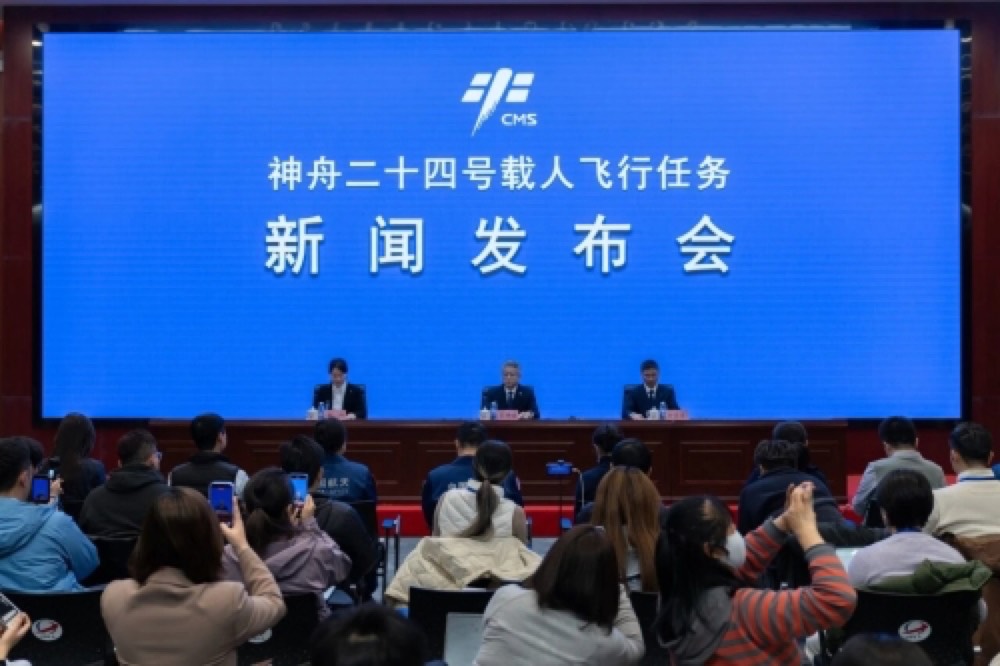
Before launch: the rocket is being fuelled. China’s launch officials said at a press conference on 24 November that fuelling was about to begin. No time was given.
00:08 on 25 November: launch window opens (our schedule data).
00:18 on 25 November: liftoff, 08:18 Beijing time. This is the target set by the agency.
First stage separation, fairing jettison and orbit insertion: times not published.
About 03:55 on 25 November: docking to the forward port of the Tianhe core module (estimate). The agency plans a fast rendezvous of about 3.5 hours. The last crewed flight on this rocket went from liftoff to docking in 3 hours 37 minutes. That flight lifted off at 15:08 UTC on 24 May and docked at 18:45 UTC the same day.
After docking: hatch opening, crew entry and handover with the Shenzhou 23 crew. Times not published.
After the handover: the Shenzhou 23 spacecraft returns to the Dongfeng landing site with the visitor and two crew members. The date is not published.
May 2027: planned end of the one-year residency and landing of the Shenzhou 24 spacecraft. A background reference lists this date, and the agency has not confirmed it.
Vehicle and its record
The Long March 2F is the only in-service Chinese rocket that flies crewed missions. For the last crewed flight, flight Y23, engineers reported 16 technical improvements over Y22. Y24 is the designation in the agency’s notice for this flight. What changed for Y24 is not published.
In November 2025 the rocket flew an emergency launch of the uncrewed Shenzhou 22. That capsule was sent to Tiangong for three astronauts stuck on the station. Shenzhou 23 was brought forward to May 2026 because of that launch.
Our launch data lists 22 launches for this rocket, all successful. None of the sources we checked lists a failure on its crewed flights. The Long March 2F/G variant has longer boosters for extra lift.
What could go wrong
The time can move. The rocket was not yet fuelled at the press conference, and the launch site has winter measures in place for cold weather. A slip of minutes or hours is normal, so treat 00:18 UTC as the target.
Docking is the sharpest part of the flight. The fast rendezvous compresses approach and docking into about 3.5 hours. Engineers on the Shenzhou 23 flight said the docking hardware had to meet very high demands.
The one-year stay is a test of life support for one crew member. Chinese reports call it a full pressure test of the station’s support systems.
The visit is short, and its return depends on the Shenzhou 23 handover, which has no published date.
Not yet published: the abort plan, the payload mass, the exact orbit insertion time and the docking result.
How to watch
The official source for mission notices is the agency’s website, cmse.gov.cn. Its 24 November press conference page gives the target time.
Live video is usually carried by China’s state broadcaster, CCTV. We have not found a start time for the Shenzhou 24 stream in our sources. We will add it here when it is published.
Live notes will appear on our Shenzhou 24 launch page.