Simons Observatory starts its first sky survey
Published
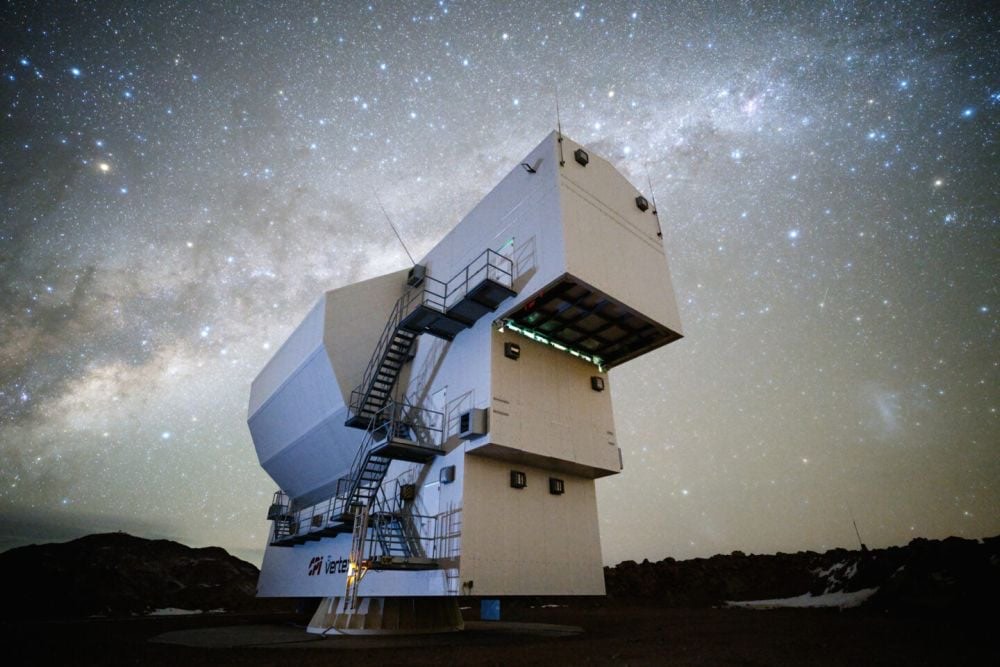
The Simons Observatory in the Atacama Desert has started its survey of the cosmic microwave background, the faint light left over from the early universe, according to Universe Today. The observatory has four telescopes: three small 0.5-metre instruments and one 6-metre Large Aperture Telescope. Together they carry almost 98,000 microwave detectors, which the article says is 16 times more than its predecessor, the Atacama Cosmology Telescope.
The spokesperson, Jo Dunkley of Princeton University, says the first images from a few months of data are already deeper and less noisy than those from Planck, which took years to collect. The team says the sensitivity is meant to be ten times better than Planck's. The large telescope scans about half the available sky every couple of days.
The main goal is to find B-mode polarization, a faint pattern that gravitational waves from the period of inflation would leave. An earlier detection by the South Pole Telescope was questioned, because gravitational lensing can make a similar pattern. The article says the Simons team needs years of observations before it can make a claim. The survey has been extended to 2035, and three more small telescopes are due in 2027.
Why it matters: this is a new, deep view of the early universe, and the data will be shared with researchers in stages. Its first Milky Way magnetic-field maps are already a sign of what it can do.
Do you think the Simons Observatory will find the inflation signal?